
Shede Spirits (600702)

Search documents
酒企推进出清,餐饮链需求承压
Huaxin Securities· 2025-11-03 08:49
Investment Rating - The report maintains a "Recommended" investment rating for the food and beverage industry [7][55]. Core Views - The liquor sector is experiencing a significant performance decline, with most companies entering a rapid clearing phase, except for Guizhou Moutai and Shanxi Fenjiu, which still show slight growth. The impact of alcohol prohibition policies has led to a decrease in high-end and sub-high-end consumption, resulting in downward price adjustments and increased promotional activities, compressing profit margins across the industry. Despite these challenges, leading companies demonstrate strong risk resistance, with a consensus on inventory reduction and a focus on long-term value stocks such as Guizhou Moutai, Wuliangye, and Luzhou Laojiao [5][53][55]. Summary by Sections Industry News - Jiangsu Wine Association aims for revenue exceeding 100 billion yuan by 2030. Sales of liquor on e-commerce platforms have increased by over 50% since the start of the Double 11 shopping festival. Hebei province reported a more than 10% decline in liquor production from January to September [4][16]. Company News - Guizhou Moutai opened its first cultural experience center in Anhui. Wuliangye reported revenue of 60.945 billion yuan for the first nine months. Luzhou Laojiao launched a new zodiac wine for the Year of the Horse and achieved revenue of 23.127 billion yuan [4][17]. Liquor Sector Insights - The liquor industry is undergoing a significant adjustment, with a focus on inventory reduction and maintaining profitability. The report suggests monitoring high-dividend leaders and flexible stocks that have undergone prior adjustments [5][53]. Consumer Goods and New Consumption - The seasoning sector is under pressure due to restaurant demand but benefits from improved raw material costs. The frozen food sector is facing challenges due to weak demand in restaurants and baking, while the snack food sector is experiencing slower store opening speeds. The beverage sector remains strong, with new consumption opportunities emerging [6][54][55]. Key Company and Profit Forecasts - The report provides a detailed forecast for various companies, indicating a buy rating for several key players, including Luzhou Laojiao, Wuliangye, and Guizhou Moutai, with projected earnings per share (EPS) and price-to-earnings (PE) ratios for the coming years [9][56].




舍得酒业(600702) - 舍得酒业关于召开2025年第三季度业绩说明会的公告
2025-11-03 08:00
会议召开时间:2025 年 11 月 12 日(星期三)15:00-16:00 会议召开地点:上海证券交易所上证路演中心(https://roadshow.ssein fo.com/) 会议召开方式:上证路演中心网络文字互动 证券代码:600702 证券简称:舍得酒业 公告编号:2025-051 舍得酒业股份有限公司 关于召开 2025 年第三季度业绩说明会的公告 本公司董事会及全体董事保证本公告内容不存在任何虚假记载、误导性陈述 或者重大遗漏,并对其内容的真实性、准确性和完整性承担法律责任。 重要内容提示: 三、参加人员 投资者可于 2025 年 11 月 5 日(星期三)至 11 月 11 日(星期二)16:00 前登录上证路演中心网站首页点击"提问预征集"栏目或通过公司证券事务部邮 箱(tpzqb@tuopai.biz)进行提问。公司将在说明会上对投资者普遍关注的问题 进行回答。 舍得酒业股份有限公司(以下简称"公司")已于 2025 年 10 月 30 日发布《舍 得酒业 2025 年第三季度报告》,为便于广大投资者更全面深入地了解公司 2025 年 第三季度经营成果、财务状况,公司计划于2025年1 ...
舍得酒业(600702):公司信息更新报告:Q3营收降幅环比扩大,关注后续改善弹性
KAIYUAN SECURITIES· 2025-11-03 07:46
Investment Rating - The investment rating for the company is maintained at "Outperform" [1] Core Insights - The company experienced a significant decline in revenue, with Q3 2025 revenue at 1 billion yuan, down 15.9% year-on-year, and a net profit of 30 million yuan, down 63.2% year-on-year. The revenue decline was greater than expected, attributed mainly to external environmental factors [6] - The company is actively managing channel inventory and has adjusted its resource distribution, linking to new channels and enhancing cost control, indicating potential for recovery as the external environment improves [6] - The forecast for net profit from 2025 to 2027 has been revised downwards, with expected net profits of 500 million yuan, 620 million yuan, and 830 million yuan, representing year-on-year growth rates of 43.3%, 24.1%, and 35.6% respectively [6] Financial Performance Summary - For the first three quarters of 2025, the company reported revenue of 3.7 billion yuan, a year-on-year decrease of 17.0%, and a net profit of 470 million yuan, down 29.4% year-on-year [6] - The Q3 revenue breakdown shows mid-to-high-end liquor revenue at 690 million yuan (down 23% year-on-year) and ordinary liquor revenue at 180 million yuan (up 18% year-on-year) [7] - The company’s gross margin for Q3 2025 was 62.1%, a decrease of 1.6 percentage points year-on-year, with a net profit margin of 2.9%, down 3.7 percentage points year-on-year [9] Cash Flow and Debt Management - As of the end of Q3 2025, the company had a contract liability balance of 110 million yuan, down 40 million yuan from the previous quarter, indicating significant cash flow pressure [8] - Sales cash receipts for Q3 were 920 million yuan, down 19.4% year-on-year, reflecting the challenges faced by distributors in collecting payments [8] Valuation Metrics - The current stock price corresponds to a P/E ratio of 41.7 for 2025, 33.6 for 2026, and 24.8 for 2027 [6] - The projected earnings per share (EPS) for 2025, 2026, and 2027 are 1.49 yuan, 1.85 yuan, and 2.51 yuan respectively [11]
组织提效、毛利提升,舍得酒业前三季度降幅收窄
Bei Jing Shang Bao· 2025-11-03 03:22
Core Viewpoint - Shede Liquor's Q3 2025 report shows a revenue of 3.702 billion yuan, with a net profit of 472 million yuan, indicating a narrowing decline compared to the first half of the year despite significant industry pressure [1] Group 1: Industry Challenges - The overall liquor industry is under significant pressure, with weak demand in key consumption scenarios such as business banquets and holiday sales, leading to high social inventory and downward pricing pressure [1][2] - The industry is undergoing a deep adjustment characterized by "supply clearing," shifting from scale expansion to value enhancement [2] Group 2: Company Strategies - Shede Liquor is implementing a strategy of price control and inventory reduction, maintaining stable pricing for core products despite industry-wide pricing pressures [2][3] - The company is enhancing operational efficiency through organizational restructuring, flat management, and cost control, resulting in an 8.81% decrease in operating costs and a 13.07% reduction in management expenses [3] Group 3: Product and Market Development - The launch of the low-alcohol product "Shede Zizai" has been successful, aligning with new consumption trends and achieving significant market interest [4] - E-commerce sales have grown significantly, with a 40% year-on-year increase, becoming a key driver of revenue growth [5] Group 4: Financial Performance and Market Sentiment - The company reported a 16.46% increase in ordinary liquor sales, contributing to a stable market presence during industry adjustments [5] - Institutional investors have shown increased confidence, with several funds significantly raising their holdings in Shede Liquor, indicating recognition of the company's long-term growth potential [6][7]
舍得酒业20251101
2025-11-03 02:36
Summary of Shede Liquor Industry Conference Call Company Overview - **Company**: Shede Liquor Industry - **Date**: November 1, 2025 Key Points Industry and Company Strategy - Shede Liquor adheres to four core strategies: aged liquor, multi-brand matrix, youth-oriented marketing, and internationalization [2][3][6] - Focus on high-end product structure, national product distribution, and brand internationalization without reducing market investment [2][3] - Implementation of a three-good pricing management system to stabilize prices and optimize channel costs [2][5] Financial Performance - As of Q3 2025, Shede Liquor reported revenue of 3.702 billion yuan and a net profit of 472 million yuan [3] - Significant growth in key products during the double festival season, with double-digit increases in sales and opening bottles [7] Market Dynamics - Positive performance in out-of-province markets, particularly in Shandong, with cities like Dezhou and Liaocheng showing over 50% growth year-on-year [9] - Strict control in the Henan market to maintain price stability, with expectations for gradual recovery in 2026 [10] Consumer Engagement and Marketing - Initiatives to engage younger demographics include establishing live streaming bases and expanding e-commerce efforts [4][5] - Launch of low-alcohol product "Shede Zizai" and innovative marketing strategies to attract new consumers [5][15] Inventory and Sales Management - Effective reduction of channel inventory through strict control of distributor shipments [8][22] - Anticipation of a healthier market state by the end of the year due to improved inventory management [8] Product Performance - Core products, especially premium offerings, saw approximately 50% growth in sales and opening amounts [13] - The T68 series outperformed other products, indicating strong consumer demand across various price segments [13] Future Outlook - The company expects challenges in the upcoming Spring Festival season but notes a gradual recovery in consumer confidence [11] - Emphasis on enhancing product quality without lowering prices to maintain brand value [18] E-commerce Strategy - E-commerce sales are expected to reach double-digit percentages, with a focus on reducing conflicts between online and offline sales [17] - Establishment of specialized teams to enhance e-commerce operations and capitalize on market opportunities [17] Distributor Management - The company has implemented a small and micro customer management project to support new distributors, particularly in weaker regions [20][21] - Stability among larger distributors remains intact, while smaller ones have been phased out due to performance volatility [19] Cost Management - Sales and management expenses have increased due to strategic investments and one-time costs, but overall efficiency is expected to improve [23] Long-term Incentives - Ongoing long-term incentive plans for employees, including stock options and employee shareholding programs [24] Regional Challenges - The decline in the Sichuan market is attributed to high inventory levels, prompting proactive inventory reduction measures [25] This summary encapsulates the key insights and strategic directions of Shede Liquor as discussed in the conference call, highlighting the company's resilience and proactive measures in a challenging market environment.
白酒业交出近十年“最差季报” 至暗时刻或许正是光明到来的前奏
Mei Ri Jing Ji Xin Wen· 2025-11-02 12:58
Core Viewpoint - The Chinese liquor industry is currently experiencing a significant downturn, referred to as its "darkest hour," with many companies reporting substantial declines in profits, including a 92.55% drop in net profit for Kuozi Jiao [1][2] Group 1: Industry Performance - The recent quarterly reports from the liquor industry are described as the "worst in a decade," with most companies showing accelerated profit declines [2] - Even leading companies like Kweichow Moutai reported a revenue of over 130 billion yuan with a 6.25% year-on-year growth in net profit, marking the lowest growth rate in nearly ten years [1][2] - The industry is transitioning from a phase of rapid growth to a more stable and mature development cycle, indicating a shift in investment logic [2][3] Group 2: Market Reactions - The market response to the poor performance reports has been mixed, with some investors remaining optimistic about a potential recovery, while others express concern [2][5] - Despite the negative reports, certain stocks like Gujing Gongjiu saw price increases, suggesting a potential market rebound and a shift towards rational investment considerations [5] Group 3: Long-term Outlook - The current downturn is seen as a necessary phase for the industry, allowing stronger companies to emerge and adapt, ultimately leading to a more resilient market [3] - High-end liquor and collectible old liquor maintain stable demand, providing a solid foundation for the industry despite overall demand slowing [4] - The high gross margins of leading companies, such as Kweichow Moutai at 91.29%, indicate that the long-term value of the liquor industry remains intact despite short-term adjustments [4]


舍得酒业发布三季报,社保基金新进为前十大股东
Xin Lang Cai Jing· 2025-11-02 11:43
Core Viewpoint - Shede Liquor's Q3 2025 report indicates a revenue of 3.702 billion yuan, with a net profit of 472 million yuan, reflecting a narrowing decline compared to the first half of the year despite significant industry pressure [1] Group 1: Industry Challenges - The overall liquor industry is under significant pressure, with weak demand in key consumption scenarios such as business banquets and holiday sales, leading to high social inventory and downward pricing pressure [1][2] - The industry is undergoing a deep adjustment characterized by "supply clearing," shifting growth momentum from scale expansion to value enhancement [2] Group 2: Company Strategies - Shede Liquor is implementing a strategy of price control and inventory reduction, maintaining stable pricing for core products despite industry-wide pricing pressures [2][3] - The company is enhancing operational efficiency through organizational restructuring, flat management, and precise cost control, resulting in an 8.81% decrease in operating costs and a 13.07% reduction in management expenses [3] Group 3: Product and Market Development - The launch of the low-alcohol product "Shede Zizai" has been successful, aligning with new consumption trends and achieving significant market interest, with over 12,000 orders within 36 hours of launch [4] - E-commerce sales have grown significantly, with a 40% year-on-year increase, becoming a key driver of revenue growth [5] Group 4: Financial Performance and Market Sentiment - The company reported a 16.46% increase in revenue from ordinary liquor sales, indicating stability in the market during the industry's adjustment phase [5] - Institutional investors have shown confidence in Shede Liquor, with several increasing their holdings, reflecting recognition of the company's long-term development logic [6][7]
舍得酒业(600702):2025年三季报点评:规模效应缩水,盈利中枢持续下行
Minsheng Securities· 2025-11-01 07:49
Investment Rating - The report maintains a "Recommended" rating for the company [4] Core Views - The company reported a decline in revenue and net profit for the first three quarters of 2025, with total revenue of 3.702 billion yuan, a year-on-year decrease of 17.00%, and a net profit attributable to shareholders of 472 million yuan, down 29.43% [1] - The company is focusing on a long-term strategy of "strong sales, promoting opening bottles, and destocking" to maintain healthy channel development, with expectations for profit margins to enter a slow recovery phase in 2026 [4] Financial Performance Summary - For Q3 2025, the company achieved revenue of 1 billion yuan, a decrease of 15.88% year-on-year, and a net profit of 29 million yuan, down 63.18% [1] - The gross profit margin for the first three quarters of 2025 was 64.73%, down 3.17 percentage points year-on-year, indicating a decline in profitability due to structural shifts and increased costs [3] - The company expects net profits to reach 391 million yuan in 2025, with a growth rate of 13.1%, and further increase to 569 million yuan in 2026 and 838 million yuan in 2027, with growth rates of 45.4% and 47.3% respectively [4][5] Product and Market Analysis - The main revenue from liquor in Q3 2025 was 867 million yuan, a decrease of 17.39% year-on-year, with mid-to-high-end liquor sales declining by 23.43% [2] - The company is launching new products to capture the banquet market, including the "Celebration Edition" of its flagship product, aiming to boost sales [2] - E-commerce sales showed significant growth, increasing by 71.41% year-on-year, while wholesale and agency sales declined by 23.38% [2] Forecast and Valuation - The company is projected to achieve revenues of 4.484 billion yuan in 2025, with a decline of 16.3% year-on-year, followed by a slight recovery in 2026 and 2027 [5] - The current price-to-earnings (PE) ratio is projected to be 53 for 2025, decreasing to 25 by 2027, indicating a potential for valuation improvement as profits recover [5]
从舍得三季报看酒业破局:深蹲蓄力,多维创新打开增量空间
Nan Fang Du Shi Bao· 2025-11-01 07:10
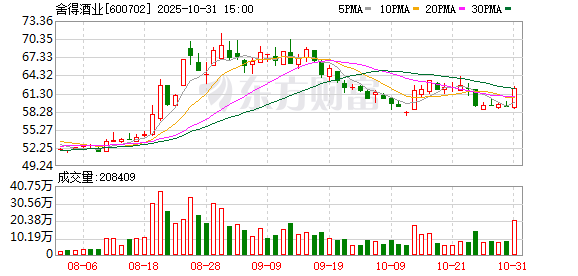
Core Viewpoint - The baijiu industry is undergoing a deep adjustment cycle in 2025, facing challenges such as weakened consumer demand, high channel inventory, and increased sales pressure. However, Shede Liquor has demonstrated resilience in its Q3 report, with revenue of 3.702 billion yuan and a net profit of 472 million yuan, indicating a narrowing revenue decline and a 1.49 percentage point increase in gross margin to 62.09% [2][3]. Group 1: Financial Performance - In the first three quarters, Shede Liquor achieved a revenue of 3.702 billion yuan and a net profit of 472 million yuan, reflecting a strong performance amid industry challenges [2][3]. - The company's gross margin improved to 62.09%, and management expenses decreased by 13.07% year-on-year, while operating costs fell by 8.81%, indicating enhanced operational efficiency [3]. - E-commerce sales reached 450 million yuan, a significant year-on-year increase of 39.62%, driven by the company's focus on traditional e-commerce and emerging channels like live streaming [3]. Group 2: Strategic Initiatives - Shede Liquor has adopted a dual strategy of "high-end pricing and mass market support," alongside explosive growth in e-commerce, to stabilize its market position and cultivate new growth engines [2][3]. - The launch of the low-alcohol product "Shede Zizai" has successfully tapped into new consumer scenarios, achieving over 12,000 orders in just 36 hours on JD.com, expanding the company's product boundaries [4]. - The company is committed to a long-term strategy focused on channel expansion and brand enhancement, aiming to build differentiated competitive advantages through diverse marketing initiatives and deep ESG practices [5]. Group 3: Brand and Market Development - Shede Liquor has enhanced its brand influence through cultural marketing and market activities, including collaborations with popular media and the launch of high-end co-branded products [6]. - The company has engaged in various marketing activities to deepen emotional connections with consumers, enhancing brand exposure and sales conversion [6]. - Shede Liquor has integrated ESG principles into its operations, gaining recognition in the sustainability sector, which strengthens its market position during the industry's recovery phase [6]. Group 4: Market Outlook - As of October 31, Shede Liquor's stock closed at 62.09 yuan per share, with a 5.29% increase, indicating positive market sentiment [7]. - With the upcoming consumption peak in Q4 and ongoing policies to boost domestic demand, the baijiu industry is expected to see a rebound, with Shede Liquor positioned to benefit from its strategic initiatives [7]. - The company's Q3 report highlights its adaptability and growth potential during industry adjustments, suggesting that its proactive strategies may lead to substantial performance returns as the market recovers [7].

食品饮料行业2026年度投资策略:底部修复,柳暗花明
KAIYUAN SECURITIES· 2025-10-31 12:42
Core Insights - The food and beverage sector has underperformed the market, with a decline of 1.6% from January to October 2025, lagging behind the CSI 300 by approximately 37.2 percentage points, ranking last among primary sub-industries [4][11][25] - The snack segment has shown better performance with a growth of 32.5%, while beer, seasoning, and liquor have experienced declines of 9.7%, 6.5%, and 4.8% respectively [4][11][25] - The sector's price-to-earnings (PE) ratio has decreased by 10.4% compared to the end of 2024, with an expected net profit growth of 5.4% for 2025, leading to a 5.6% decline in market capitalization [4][17][20] Market Performance - The food and beverage sector has underperformed the market, with a decline of 1.6% from January to October 2025, ranking last among primary sub-industries [4][11] - The snack segment has shown better performance with a growth of 32.5%, while beer, seasoning, and liquor have experienced declines of 9.7%, 6.5%, and 4.8% respectively [4][11] - The sector's PE ratio has decreased by 10.4% compared to the end of 2024, with an expected net profit growth of 5.4% for 2025, leading to a 5.6% decline in market capitalization [4][17] Fund Holdings - In Q3 2025, the allocation of food and beverage in the overall market funds dropped to a new low of 6.4%, down from 8.0% in Q2 2025, marking the lowest level since 2020 [5][37] - The allocation in active equity funds also decreased from 5.6% in Q2 2025 to 4.1% in Q3 2025, indicating a significant reduction in food and beverage exposure [5][37] - The white liquor segment has seen a reduction in fund allocation, with companies like Luzhou Laojiao and Shede Liquor gaining more market favor due to their performance [5][42] Industry Judgment - The macroeconomic environment shows a weak recovery, with China's GDP growth at 4.8% in Q3 2025, slightly down from Q2 2025 [6][46] - Retail sales of consumer goods grew by 3.5% year-on-year in Q3 2025, reflecting a slower recovery pace, primarily due to the impact of the alcohol ban on dining consumption [6][46] - The food manufacturing sector has faced pressure, with revenue growth of only 1.5% and profit growth of 2.1% from January to September 2025, indicating a downward trend [6][52] Investment Opportunities - The food and beverage industry is expected to see a recovery from its bottom, with a focus on resilient consumer spending and improved economic activity [7][65] - The white liquor sector is nearing a left-side layout zone, suggesting gradual investment opportunities in companies like Kweichow Moutai and Luzhou Laojiao [7][68] - The snack segment is recommended for investment due to its growth potential, with companies like Wei Long and Ximai Foods highlighted for their market opportunities [7][69][62]
