BAIC BluePark(600733)

Search documents
北汽蓝谷:使用募集资金向控股子公司提供借款以实施募投项目
Xin Lang Cai Jing· 2025-12-11 08:40
Core Viewpoint - The company plans to provide a loan of up to 6 billion yuan to its subsidiary, BAIC New Energy, to support the implementation of fundraising projects [1] Group 1: Loan Details - The board meeting is scheduled for December 10, 2025, to approve the loan [1] - The loan will be used for the construction needs of fundraising projects [1] - The loan interest rate will be based on the current bank loan rate for BAIC New Energy [1] Group 2: Project Implementation - The loan duration will last from the actual borrowing date until the completion of the fundraising project [1] - This financial support is aimed at ensuring the smooth progress and implementation of the fundraising projects [1]

北汽蓝谷:拟用6亿元募集资金向子公司借款实施项目
Xin Lang Cai Jing· 2025-12-11 08:30
Core Viewpoint - The company plans to raise funds through a specific stock issuance to provide a loan of up to 600 million yuan to its subsidiary, BAIC New Energy, for investment in new energy vehicles and AI intelligent platforms [1] Group 1: Financial Details - The loan to BAIC New Energy will be used for projects related to new energy vehicles and AI platforms, with a loan term until project completion and interest rates based on current bank loan rates [1] - For the period of January to September 2025, the company reported revenue of 1,389,040.02 million yuan and a net loss of 474,781.74 million yuan [1] Group 2: Corporate Structure - BAIC New Energy is directly held by the company with a 71.69% stake, while a subsidiary holds a 0.01% stake [1] - The proposed loan is subject to approval by the shareholders' meeting [1]
北汽蓝谷:董事会审议多项议案,2026年关联交易预计超525亿
Xin Lang Cai Jing· 2025-12-11 08:30
北汽蓝谷公告称,公司十一届十四次董事会审议通过多项议案。一是确认2025年1 - 10月日常关联交易 情况,同意2026年度与关联方交易金额预计不超5252358.00万元,该议案尚需股东会审议;二是同意使 用募集资金向控股子公司提供借款实施募投项目,该议案尚需股东会审议;三是同意开立募集资金临时 补充流动资金专项账户;四是授权董事长在特定对象发行股票时调整发行价格;五是同意召集召开2025 年第四次临时股东会。 ...
北汽蓝谷间接控股子公司3250万元项目环评获同意
Mei Ri Jing Ji Xin Wen· 2025-12-08 07:44
Group 1 - The core point of the news is that BAIC Blue Valley's subsidiary, BAIC Blue Valley Magna Automotive Co., Ltd., has received approval for an environmental assessment of its new energy vehicle production line upgrade project, with a total investment of 32.5 million yuan [1] - The "A-share Green Report" project aims to enhance transparency in environmental information of listed companies, utilizing authoritative environmental regulatory data from 31 provinces and 337 cities to monitor and analyze the environmental performance of companies [1] - The latest A-share Green Weekly Report indicated that nine listed companies have recently exposed environmental risks [1] Group 2 - BAIC Blue Valley's main business segments are new energy vehicles and other operations, contributing 90.01% and 9.99% to revenue, respectively [3] - The company's projected revenue for 2024 is 14.51 billion yuan, with a forecasted increase to 15.38 billion yuan in the first three quarters of 2025 [4] - The company is expected to report a net profit attributable to shareholders of -6.95 billion yuan in 2024, improving to -3.43 billion yuan in the first three quarters of 2025 [4]

日产N6、别克至境世家、新款蓝电E5上市!小鹏联手华为推出下一代增程发电机!多款新车登录工信部!11月车企销量公布!丨一周大事件
电动车公社· 2025-12-07 16:05
New Car Launches - Dongfeng Nissan N6 launched with a limited-time price of 91,900 to 121,900 yuan, featuring a hybrid system with a 75kW engine and a 155kW motor, offering a pure electric range of 170-180 km [1][3][9] - New Blue Energy E5 Plus launched at a limited-time price of 119,800 yuan, equipped with a 70kW engine and a 160kW motor, providing a pure electric range of 230 km [1][12][17] - Buick Zhijing Shijia launched with a price range of 439,900 to 469,900 yuan, featuring a 132kW engine and a dual-motor system, offering a pure electric range of 224 km [1][20][25] Company Dynamics - Xiaomi Auto has surpassed 500,000 cumulative deliveries, achieving its annual target ahead of schedule [1][28][29] - XPeng Motors collaborates with Huawei to launch a next-generation range extender generator with over 92% efficiency [1][32][35] - Changan Automobile is set to roll out its 30 millionth vehicle, becoming the first Chinese brand to reach this milestone [1][36][40] Sales Performance - BYD sold 474,921 passenger vehicles in November, maintaining a leading position in the new energy sector [1][71][73] - Changan Automobile's November sales reached 283,000 units, with over 125,000 in new energy vehicles [1][76][79] - SAIC-GM-Wuling achieved 118,726 new energy vehicle sales in November, marking three consecutive months of over 100,000 units sold [1][81] - Chery's new energy vehicle sales reached 116,794 units in November, continuing its growth trend [1][82][86] - Hongmeng Zhixing delivered 81,864 units in November, benefiting from increased production capacity [1][87][90] - Leap Motor delivered 70,327 units in November, showing strong market performance [1][91][92] - Great Wall Motors sold 40,113 new energy vehicles in November, reflecting a significant growth in its transition to new energy [1][95][96] - XPeng Motors delivered 36,728 units in November, with a year-to-date growth of 156% [1][98][99] - NIO delivered 36,275 units in November, with a notable increase in sales [1][100][106] - Li Auto delivered 33,181 units in November, maintaining a positive outlook despite market pressures [1][107][109] - Deep Blue Automotive delivered 33,060 units in November, with strong performance from its S05 model [1][111][113] - BAIC New Energy sold 32,328 units in November, with a significant year-on-year increase [1][114][115] - Lantu Automotive delivered 20,005 units in November, marking a strong sales milestone [1][116][118] - FAW Bestune sold 15,793 new energy vehicles in November, with a focus on young consumers [1][119][123] - Avita delivered 14,057 units in November, achieving a historical high [1][124][125] - Zhiji delivered 13,577 units in November, with a focus on expanding its product line [1][126][128] - Jishi Automotive delivered 1,452 units in November, showing steady growth in international markets [1][129][132] Industry News - A new national standard for steer-by-wire technology has been released, removing mandatory mechanical connections [2][133][135] - Global penetration of new energy vehicles is on the rise, projected to reach 25.2% by Q4 2025 [2][138][140] - South Korea's automotive exports have declined for the first time in recent years, with a forecasted drop in total exports [2][143][145]





高增速与巨亏损的背离,北汽蓝谷的战略迷局
Zhong Guo Qi Che Bao Wang· 2025-12-05 08:28
Core Insights - North汽蓝谷 reported a significant increase in vehicle sales, with a total of 67,200 units sold in the first half of 2025, representing a year-on-year growth of 139.73%. However, the company also faced a net profit loss of 2.308 billion yuan, extending its continuous loss period to five and a half years, with cumulative losses exceeding 30 billion yuan [1] - The company's high-end strategy has failed, transitioning from targeting luxury brands to competing on price, leading to a dilution of brand value and profitability challenges [3][4] Sales Performance - The extreme growth in sales was primarily driven by the extreme price reductions of the 极狐 brand, which saw a shift in its pricing strategy from high-end models to more affordable options, with the introduction of models priced below 200,000 yuan [3][4] - The 极狐 T1 model, priced at 62,800 yuan, achieved over 35,000 orders and monthly sales of 15,000 units, but this pricing strategy has solidified the brand's image as a budget option, conflicting with its original high-end positioning [4] Financial Challenges - Despite the increase in sales volume, North汽蓝谷's financial performance deteriorated, with revenue projected at 14.319 billion yuan in 2023 and a further increase to 14.512 billion yuan in 2024, while the average selling price per vehicle dropped by 62.45% [7] - The company's net profit loss is expected to widen to 6.873 billion yuan in 2024, indicating a troubling trend of "selling more but losing more" [7] Brand Strategy Issues - The 享界 brand, developed in collaboration with Huawei, has struggled with unclear positioning and a lack of differentiation, resulting in low sales figures and a failure to penetrate the luxury market effectively [5][9] - The 享界 S9 model, priced between 309,800 and 449,800 yuan, has not resonated with its intended target market, leading to only 3,295 units sold in 2024 [5][9] Internal Conflicts - The dual-brand strategy has led to internal competition rather than synergy, with 极狐 focusing on volume sales while 享界 aims for profitability, resulting in resource allocation issues and strategic misalignment [10][12] - The lack of collaboration between the two brands has hindered North汽蓝谷's ability to leverage its strengths in the competitive electric vehicle market [10][12] Strategic Recommendations - North汽蓝谷 needs to redefine its brand positioning to avoid internal competition and establish a collaborative mechanism between 极狐 and 享界, focusing on volume for one and profitability for the other [13] - The company must balance scale and profit by enhancing product value through technological innovation, moving away from a reliance on low pricing strategies [13]

比亚迪赚走6成利润,6家新势力亏掉107亿,14大车企前三季度业绩锐评
3 6 Ke· 2025-12-05 02:56
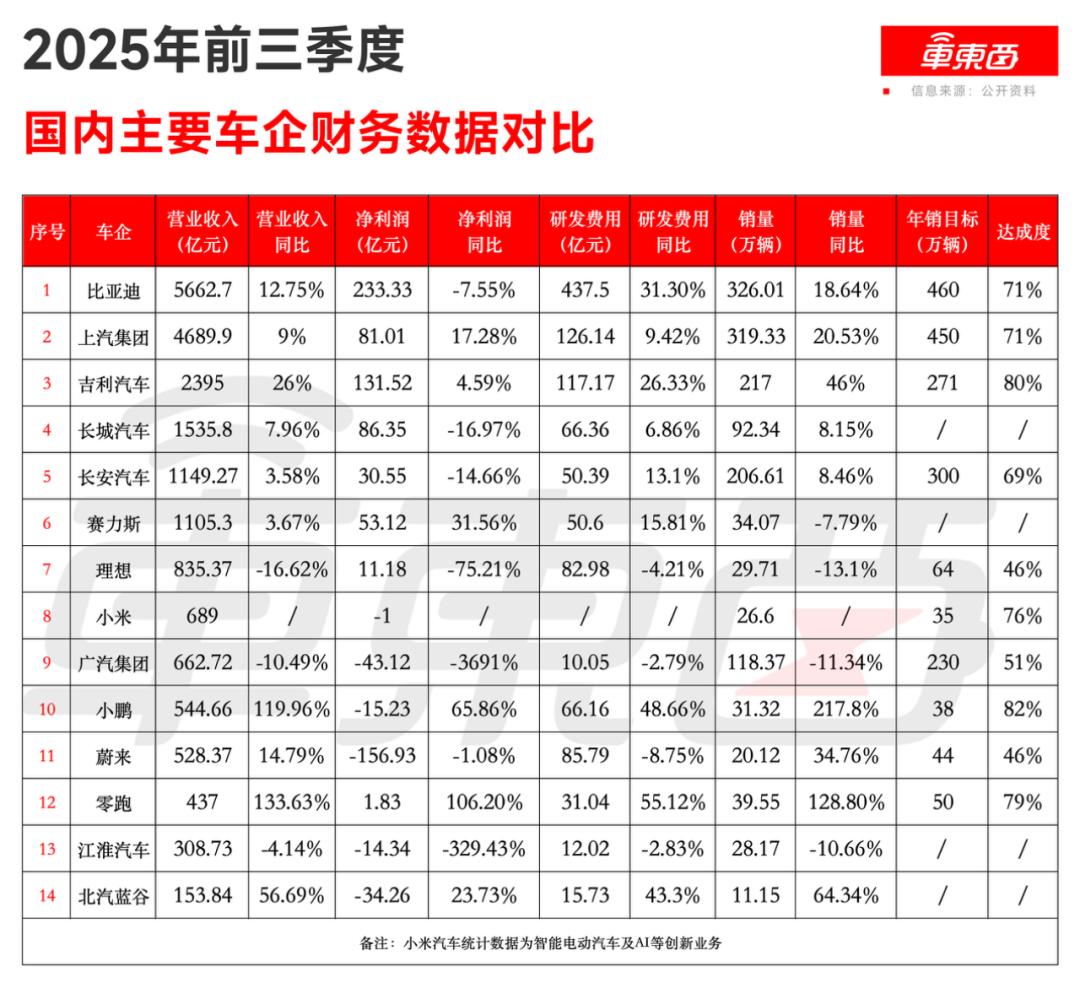
Core Insights - The financial reports of 14 major domestic car manufacturers for the first three quarters of 2025 show a total revenue of 2.07 trillion yuan and a net profit of 364 billion yuan, resulting in a net profit margin of only 1.76% [2][6][22]. Group 1: Financial Performance - Among the traditional car manufacturers, eight companies reported a combined net profit exceeding 471 billion yuan, with BYD leading with a net profit of 233 billion yuan, accounting for 64% of the total net profit of the 14 companies [4][8]. - Geely's revenue reached 239.5 billion yuan, a 26% increase year-on-year, with a net profit of 131.52 billion yuan, benefiting from its accelerated transition to new energy vehicles [8][22]. - The new energy vehicle sector is experiencing significant losses, with six new entrants collectively losing 107 billion yuan, while only Seres, Li Auto, and Leap Motor reported profits [4][6][22]. Group 2: Revenue and Profit Comparison - BYD's revenue was 566.27 billion yuan, a 12.75% increase, while its net profit decreased by 7.55% [5][7]. - SAIC Group reported a revenue of 468.99 billion yuan and a net profit of 81.01 billion yuan, both showing growth [11][22]. - NIO's revenue was 528.37 billion yuan, with a significant net loss of 156.93 billion yuan, highlighting the challenges faced by the company [22][24]. Group 3: R&D Investment - BYD led in R&D investment with 437.5 billion yuan, a 31.3% increase, indicating a commitment to technological expansion despite a slight decline in net profit [25][29]. - Geely's R&D expenditure was 117 billion yuan, up 26%, reflecting its focus on innovation [29][32]. - NIO, despite its losses, invested 85.79 billion yuan in R&D, maintaining a strong commitment to technology development [32][36]. Group 4: Sales Performance - The total sales volume for the 14 companies reached 15 million units, with BYD, SAIC, Geely, and others achieving significant growth [37][41]. - BYD sold 3.26 million vehicles, a year-on-year increase of 18.64%, while SAIC's sales reached 3.19 million units, growing by 20.53% [38][45]. - New entrants like Leap Motor and Xpeng saw substantial sales increases, with Leap Motor's sales up 128.8% and Xpeng's up 217.8% [49][50]. Group 5: Market Dynamics - The competitive landscape in the automotive industry is intensifying, with companies facing pressures from supply chain costs, rapid technological changes, and the need for substantial R&D investments [52]. - The performance of these 14 companies reflects a growing divide in profitability, with only a few achieving a balance between revenue growth and profit margins [22][52].

汽车行业2026年投资策略:政策、出口、智能化协同共振,机器人重塑行业增长逻辑
Shanghai Securities· 2025-12-04 12:42
Core Insights - The report maintains a bullish outlook on the automotive industry, emphasizing the synergy between policies, exports, and smart technology, which is reshaping the market landscape [1][2]. Group 1: Industry Growth Logic - The automotive industry is projected to see a total sales volume of over 34 million units in 2025, with a year-on-year growth rate of approximately 8% [8]. - In the first ten months of 2025, cumulative sales reached 27.65 million units, reflecting a year-on-year increase of 12.29% [8][7]. - The penetration rate of new energy vehicles (NEVs) reached 46.70% in the same period, with cumulative sales of 12.91 million units, up 32.42% year-on-year [21][4]. - The export growth rate for NEVs was significantly higher at 87.57%, compared to domestic demand growth of 25.71% [21][4]. Group 2: Export Dynamics - In the first ten months of 2025, China's automotive exports reached 5.58 million units, marking a year-on-year increase of 15.05%, with exports accounting for 20.19% of total sales [11][10]. - The top ten exporting companies included Chery and BYD, with Chery exporting 1.063 million units, a 12.9% increase, and BYD's exports surging by 140% to 789,000 units [11][10]. Group 3: Domestic Demand - Domestic sales in the first ten months of 2025 totaled 22.06 million units, reflecting an 11.61% year-on-year increase [15][14]. - The "trade-in" policy has been enhanced to stimulate domestic demand, expanding the scope of vehicle scrappage and increasing subsidy standards [15][14]. Group 4: Self-owned Brands - The market share of domestic brands in passenger vehicles rose to 69.48% in the first ten months of 2025, up from 38.43% in 2022, with a growth rate of 21.31% [19][18]. - The overall growth rate for passenger vehicles was 12.80%, indicating a strong performance from domestic brands [19][18]. Group 5: Smart Technology and Parts - The smart driving market in China is expected to approach 450 billion yuan by 2025, with the penetration rate of L2-level assisted driving exceeding 50% [33][31]. - The report highlights the acceleration of domestic parts replacement, driven by supportive national policies and expanding market scales, particularly in the NEV sector [38][34]. - The synergy between smart connected vehicles and humanoid robots is noted, with both industries sharing over 50% of supply chain resources, which could significantly reduce production costs for robots [41][39]. Group 6: Investment Recommendations - Recommended companies in the complete vehicle sector include BAIC Blue Valley, GAC Group, and Great Wall Motors [47]. - In the parts sector, companies such as Bertley, Yinlun, and Longsheng Technology are highlighted as potential investment opportunities [47]. - For small-cap stocks, Baihehua is suggested as a promising investment [47].


对标先进促提升 深化合作谋新篇
Zheng Zhou Ri Bao· 2025-12-02 00:47
近日,市委常委、统战部部长黄卿带领我市汽车产业企业考察团赴京冀考察学习。 全市新能源汽车产业链18名骨干企业负责人参加考察。 黄卿表示,组织民营企业家走出去对标学习,是服务"两个健康"、优化营商环境的具体行动。通过 实地考察,搭建学习交流平台,能够帮助我市企业家看到自身与行业标杆的差距与努力方向,有效提升 战略眼光和创新意识,同时也为推动郑州与京冀地区产业对接、深化区域合作奠定良好基础。希望各位 企业家将学到的新理念、新思路转化为企业创新发展的实际行动,把握发展趋势、拓展合作空间,争做 郑州新能源汽车产业生态的建设者和贡献者,为郑州国家中心城市现代化建设汇聚更多智慧和力量。 考察团先后走进小米汽车、理想汽车、北汽新能源、长城汽车、三河世原等企业,观摩学习智能制 造、技术创新、品牌建设与市场拓展方面的先进理念与实践成果,深入探讨大数据、人工智能如何赋能 研发、营销和用户体验创新,详细了解新材料、新工艺的应用与产业链协同创新模式。 ...


利好突袭!暴增112%!
券商中国· 2025-12-01 15:17
Core Viewpoint - The article highlights significant growth in the sales of electric vehicles (EVs) in November, indicating a strong upward trend in the Chinese EV market and the potential for continued growth in the coming years [1][2][5]. Sales Data Summary - Multiple EV manufacturers reported their November sales figures, with notable performances: - BAIC BluePark's subsidiary, BAIC New Energy, sold over 30,000 units, a year-on-year increase of 112.71% [1][2]. - NIO delivered 36,275 vehicles, up 76.3% year-on-year [1][2]. - Leap Motor achieved 70,327 deliveries, marking a growth of over 75% [1][2]. - Seres sold 55,203 units, a 49.84% increase, setting a new historical high [1][3]. - BYD's sales reached 480,200 units, while Li Auto delivered 33,181 vehicles [1][4]. - Xiaomi's deliveries exceeded 40,000 units [1][4]. Market Share and Growth Projections - The global automotive market is projected to reach 8.64 million units by October 2025, with a year-on-year growth of 4% [1]. - China's share of the global automotive market has improved, reaching 38% in October, an increase of 1 percentage point from the previous year [1]. - The domestic EV market is expected to maintain high growth rates in 2025, driven by increased demand for batteries and materials [1][5]. Policy Support and Industry Outlook - Recent government policies are expected to bolster the EV sector, including a requirement for at least 30% of government vehicle purchases to be EVs by December 2024 [5]. - The inclusion of fuel cell vehicles in government procurement standards is anticipated to provide further support to the industry [5]. - The penetration rate of EVs in China has surpassed 50%, indicating a shift from subsidy-driven growth to market-driven dynamics [6]. Component and Technology Trends - The demand for intelligent components, such as smart cockpits and electric drive systems, is rapidly increasing, benefiting related companies [7]. - The overall automotive and component industry is expected to see significant investment opportunities due to trends in electrification and globalization [7].