BAIC BluePark(600733)

Search documents
新能源与新材料周度报告:新能源汽车全年目标销量1550万辆,增速20%左右-20250914
Dong Zheng Qi Huo· 2025-09-14 13:16
1. Report Industry Investment Rating No relevant content provided. 2. Core Viewpoints of the Report - The "Automobile Industry Steady Growth Work Plan (2025 - 2026)" aims for about 32.3 million vehicle sales in 2025, a 3% YoY increase, with around 15.5 million new energy vehicle sales, a 20% YoY increase, and a 6% YoY growth in automobile manufacturing added - value. In 2026, the industry is expected to maintain a stable and positive development trend [1][105][116]. - From January to August, China's automobile sales reached 21.128 million, a 12.6% YoY increase, and new energy vehicle sales were 9.62 million, a 36.7% YoY increase, achieving 65.4% and 61.9% of the annual targets respectively [1][106][118]. - In the 36th week (September 1 - 7), new energy passenger vehicle retail sales were 220,000, a 0.5% YoY decrease, and the annual cumulative retail sales were 7.645 million, a 23.4% YoY increase. The single - week penetration rate reached 60.6%, and the annual cumulative penetration rate was 51.9%, showing a slow upward trend [2][109][118]. - In July, global new energy vehicle sales reached 1.392 million, an 18.5% YoY increase, and from January to July, sales were 9.233 million, a 25.9% YoY increase. Except for China, Europe and other regions had significant growth, with 29.5% and 53.4% growth respectively from January to July [2][118]. - In August, the US new energy vehicle sales were 177,000, an 18.4% YoY increase, much higher than the overall vehicle growth rate of 2%. From January to August, the cumulative sales were 1.01 million, a 2.4% YoY increase [2][112][119]. 3. Summary by Related Catalogs 3.1 Financial Market Tracking - The weekly price changes of relevant sectors and listed companies are presented. For example, BYD's closing price on September 12 was 105.91 yuan, with a - 1.26% weekly change; CATL's closing price was 325 yuan, with a - 0.03% weekly change [13][15][16]. 3.2产业链数据跟踪 3.2.1 China New Energy Vehicle Market Tracking - **Sales and Exports**: In August, new energy vehicle production and sales were 1.391 million and 1.395 million respectively, with YoY growth of 27.4% and 26.8%. From January to August, production and sales were 9.625 million and 9.62 million respectively, with YoY growth of 37.3% and 36.7%. In August, new energy vehicle exports were 224,000, a 100% YoY increase. From January to August, exports were 1.532 million, an 87.3% YoY increase [106][107][108]. - **Inventory Changes**: Data on monthly new additions to new energy passenger vehicle channel inventory and manufacturer inventory are provided [25][26]. - **Delivery Volumes of Chinese New Energy Vehicle Manufacturers**: Monthly delivery volumes of manufacturers such as Leapmotor, Li Auto, XPeng, NIO, Zeekr, Aion, Voyah, and Deepal are presented [28][29][33]. 3.2.2 Global and Overseas New Energy Vehicle Market Tracking - **Global Market**: In July, global new energy vehicle sales reached 1.392 million, an 18.5% YoY increase, and from January to July, sales were 9.233 million, a 25.9% YoY increase [2][118]. - **European Market**: Relevant data on new energy vehicle sales and penetration rates in Europe, including the UK, Germany, and France, are provided [44][45][49]. - **North American Market**: In August, US new energy vehicle sales were 177,000, an 18.4% YoY increase. From January to August, the cumulative sales were 1.01 million, a 2.4% YoY increase. Data on North American new energy vehicle sales and penetration rates are also presented [2][112][119]. - **Other Regions**: Data on new energy vehicle sales and penetration rates in other regions, such as Japan, South Korea, and Thailand, are provided [60][61][65]. 3.2.3 Power Battery Industry Chain - Data on power battery installation volume (by material), export volume (by material), weekly average price of power battery cells, and material costs are presented. Information on the operating rates and prices of ternary materials, precursors, lithium iron phosphate, negative electrode materials, electrolytes, and other related materials is also provided [76][78][82]. 3.2.4 Other Upstream Raw Materials - Data on the daily prices of rubber, glass, steel, and aluminum are provided [97][98][100]. 3.3 Hot News Summaries 3.3.1 China: Policy Dynamics - The eight - department joint issuance of the "Automobile Industry Steady Growth Work Plan (2025 - 2026)" aims to achieve specific sales and growth targets for 2025 and 2026 [1][105][116]. - The six - department joint launch of a three - month special rectification action for online chaos in the automobile industry aims to improve the handling efficiency of online chaos and regulate marketing and publicity behaviors [105]. - The two - department release of the "Implementation Opinions on Promoting High - Quality Development of 'Artificial Intelligence +' Energy" promotes the application of artificial intelligence in energy - related fields [106]. 3.3.2 China: Industry Dynamics - In August, new energy vehicle production and sales data are as stated above. From January to August, the production and sales of new energy vehicles also showed significant growth [106][107][108]. - From September 1 - 7, new energy retail sales decreased by 3% YoY, and the cumulative retail sales increased by 25% [109]. - In August, China's power battery installation volume was 62.5GWh, a 32.4% YoY increase. From January to August, the cumulative installation volume was 417.9GWh, a 43.1% YoY increase [110][111]. - The China Association of Automobile Manufacturers is preparing to establish a new energy vehicle battery branch [111]. 3.3.3 Overseas: Policy Dynamics - Mexico plans to raise import tariffs on products from Asian countries such as China, South Korea, and India to 50%, which requires congressional approval [112]. - The US has exempted a variety of products, including gold, graphite, and nickel, from tariffs [112]. 3.3.4 Overseas: Industry Dynamics - In August, US new energy vehicle sales were 177,000, an 18.4% YoY increase [112][113][119]. 3.3.5 Overseas: Enterprise Dynamics - Construction of South Korean battery factories in the US has been interrupted due to immigration enforcement. LG Energy Solution has taken corresponding measures [113][114]. - VinFast delivered 72,167 vehicles globally in the first half of 2025, with significant growth in vehicle and motorcycle sales. In the second quarter, revenue increased by 91.6% YoY, and the net loss was approximately 812 million US dollars [115]. - InoBat, a Slovakian electric vehicle battery manufacturer, received 54 million euros in subsidies and 456,000 euros in loans from the Spanish government to support the construction of a battery super - factory [116][117]. 3.4 Industry Views The "Automobile Industry Steady Growth Work Plan (2025 - 2026)" sets clear goals for 2025 and 2026, and current market data shows the development status of the new energy vehicle industry [1][116][118]. 3.5 Investment Suggestions - China's new energy vehicle market penetration rate has reached a relatively high level. In 2025, high - competitiveness new models are continuously launched, and price wars are gradually ending. - Due to severe trade protectionism in Europe and the US, there are risks in exports. Attention should be paid to new growth points such as Belt and Road countries and the Middle East. - In the competitive landscape, domestic brands' market shares continue to expand. Attention should be paid to enterprises with strong product capabilities, smooth overseas expansion, and stable supply [3][120][121].





汽车行业稳增长方案出台!2025年力争实现汽车销量3230万辆左右
Mei Ri Jing Ji Xin Wen· 2025-09-14 13:00
Core Viewpoint - The Ministry of Industry and Information Technology (MIIT) of China has introduced a new "Automobile Industry Stabilization and Growth Work Plan (2025-2026)" aimed at optimizing policies for electric vehicles and promoting the overall growth of the automotive industry [1][4]. Group 1: Sales and Growth Targets - The plan sets a target of approximately 32.3 million vehicle sales in 2025, representing a year-on-year growth of about 3%, with electric vehicle sales expected to reach around 15.5 million, a growth of about 20% [1][2]. - In the first eight months of 2025, China's automotive production and sales both exceeded 20 million units for the first time, achieving 21.1 million and 21.1 million respectively, with year-on-year growth of 12.7% and 12.6% [2]. Group 2: Measures to Boost Consumption - The plan includes multiple initiatives to expand domestic automotive consumption, such as promoting electric vehicles in public sectors, enhancing charging infrastructure in rural areas, and implementing tax incentives [3][5]. - The average monthly sales in the domestic automotive market reached 2.64 million units, indicating a potential increase of about 10 million units in the remaining months of 2025 [2]. Group 3: Industry Challenges and Competition - The automotive industry faces increasing external competition and internal challenges, including insufficient effective demand and irrational competition [4][5]. - The MIIT has initiated a three-month special action to address online chaos in the automotive industry, aiming to create a healthier competitive environment [4][5]. Group 4: Technological Advancements - The plan emphasizes the need for breakthroughs in key technologies such as automotive chips, operating systems, and solid-state batteries to enhance product performance and meet consumer demands [5][6]. - It also proposes the promotion of intelligent connected vehicles and the approval of L3-level vehicle production, alongside improvements in traffic safety and insurance regulations [6].



汽车行业稳增长方案出台!2025年力争实现汽车销量3230万辆左右 工信部:努力实现汽车行业经济发展主要预期目标
Mei Ri Jing Ji Xin Wen· 2025-09-13 10:07
Core Insights - The Ministry of Industry and Information Technology (MIIT) is implementing a new round of the "Automobile Industry Stabilization and Growth Work Plan (2025-2026)" to optimize tax incentives for new energy vehicles and promote electric vehicles in public sectors [1][3] - The plan sets a target of approximately 32.3 million vehicle sales in 2025, with new energy vehicle sales expected to reach around 15.5 million, reflecting a 20% year-on-year growth [1][4] Group 1: Policy and Economic Goals - The "Work Plan" aims to achieve key economic development targets for the automobile industry, which is considered a pillar of the national economy [3][9] - The MIIT has outlined several measures to boost domestic automobile consumption, including promoting electric vehicles in public sectors and enhancing charging infrastructure [6][8] Group 2: Market Performance and Projections - In the first eight months of 2025, China's automobile production and sales both exceeded 20 million units, with year-on-year growth of 12.7% and 12.6% respectively [4] - The average monthly sales in the domestic market reached 2.641 million units, suggesting a potential increase of about 10 million units in the remaining months of 2025 [4] Group 3: Challenges and Industry Dynamics - The automobile industry faces challenges such as intensified overseas competition, insufficient effective demand, and irrational competition within the market [7][8] - The MIIT has initiated a three-month special action to address online irregularities in the automobile industry, aiming to create a healthier competitive environment [7][8] Group 4: Technological Advancements - The plan emphasizes the need for breakthroughs in key technologies such as automotive chips, operating systems, and solid-state batteries to enhance product performance and meet consumer demands [8][9] - It also proposes the advancement of intelligent connected vehicles and the approval of L3-level vehicle production [8]


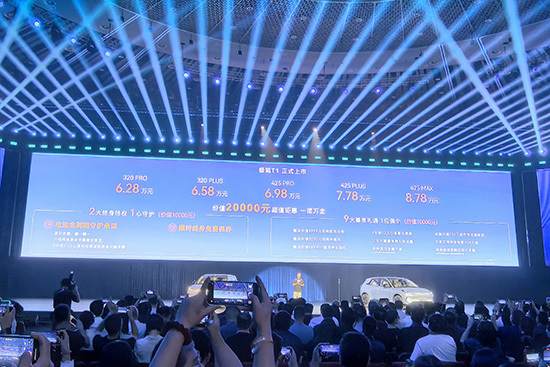
“电池烧一赔一、终身质保、只换不修” 极狐T1力拼6万级放心车
Zhong Guo Jing Ji Wang· 2025-09-12 13:07
Core Viewpoint - The launch of the Arcfox T1 has generated significant consumer interest, with over 43,000 orders placed within hours of its pre-sale, indicating strong market demand for this new electric SUV model [1][5][3]. Group 1: Product Features and Market Position - The Arcfox T1 is positioned as a family-oriented electric SUV with a price range of 62,800 to 87,800 yuan, which is competitive in the A0 segment [1][8]. - The vehicle boasts a spacious design with a 2,770 mm wheelbase, offering a maximum cargo space of 1,352 liters, making it suitable for various family needs [10]. - It features a range of 425 kilometers and can charge from 30% to 80% in just 16.9 minutes, enhancing its practicality for everyday use [10][13]. Group 2: Strategic Goals and Company Vision - Arcfox aims to establish itself as a leading brand in the electric vehicle market, with the T1 model being a key strategic product for the company [5][8]. - The company emphasizes a commitment to quality and customer satisfaction, offering lifetime warranties on key components and free maintenance for the first owner [1][5]. - The leadership expresses a strong ambition for the T1 to achieve 400,000 orders, reflecting the company's aggressive sales targets [5][3]. Group 3: Competitive Landscape - The Arcfox T1 faces competition from established models like the Geely Xingyuan and BYD Sea Gull, which have already captured significant market share [7]. - Despite the competition, the company believes in the T1's unique value proposition, which combines affordability with advanced features and safety [8][13]. Group 4: Marketing and Consumer Engagement - The marketing strategy includes engaging presentations and humorous public appearances by executives, aimed at resonating with younger consumers [3][5]. - The company has successfully leveraged social media and public events to create buzz around the T1, enhancing its visibility in the market [3][5].
【联合发布】一周新车快讯(2025年9月6日-9月12日)
乘联分会· 2025-09-12 08:47
Core Viewpoint - The article provides an overview of new car models set to launch in September 2025, detailing their specifications, market segments, and pricing strategies. Group 1: New Car Models Overview - FAW-Volkswagen's Jetta VS8 is scheduled for release on September 5, 2025, positioned as a B SUV with a price range of 11.99 to 13.49 million yuan [9]. - SAIC Volkswagen's Volkswagen Tiguan L PRO will also launch on September 5, 2025, classified as a B SUV, with a price range of 23.68 to 26.68 million yuan [17]. - GAC Toyota's Toyota Sienna is set to debut on September 5, 2025, in the C MPV segment, with prices ranging from 32.48 to 39.38 million yuan [25]. - Changan Automobile's Changan Yidong will be available on September 7, 2025, as an A NB with a price range of 8.79 to 9.99 million yuan [33]. - Geely's Lynk & Co 10 EM-P will launch on September 8, 2025, as a C NB, priced between 17.38 and 21.18 million yuan [40]. - BYD's Fangchengbao Titanium 7 is set for release on September 9, 2025, classified as a C SUV, with prices from 17.98 to 21.98 million yuan [64]. - Chery's Exeed Lingyun will be available on September 8, 2025, as a B SUV, with a price range of 14.99 to 16.99 million yuan [56]. - FAW-Volkswagen's Sagitar L will launch on September 9, 2025, as an A NB, with prices ranging from 14.79 to 16.49 million yuan [72]. - SAIC-GM's Buick Envision Plus is scheduled for September 10, 2025, as a B SUV, priced between 22.99 and 25.99 million yuan [80]. - Changan Automobile's Qiyuan A07 will be released on September 10, 2025, as a C NB, with a price range of 13.99 to 15.99 million yuan [88]. - Zhiji Automobile's Zhiji LS6 will debut on September 10, 2025, as a C SUV, with prices from 21.79 to 28.49 million yuan [96]. - Chery's Tiggo 8 PLUS will be available on September 10, 2025, as a B SUV, priced between 12.99 and 13.49 million yuan [104]. - Chery's Tiggo 8 PRO will launch on September 10, 2025, as a B SUV, with a price of 13.29 million yuan [111]. - SAIC-GM's Buick GL8 will be released on September 11, 2025, as a C MPV, with a price of 24.99 million yuan [119]. - Geely's Galaxy E8 is set for September 11, 2025, as a C NB, priced between 16.18 and 16.78 million yuan [127]. - BAIC New Energy's ARCFOX T1 will launch on September 11, 2025, as an AO HB, with prices ranging from 6.28 to 8.78 million yuan [135]. Group 2: Engineering Changes and Specifications - The Jetta VS8 features a 1.4T engine and a TIP6 transmission, with a power output of 110 kW and torque of 250 N·m [9]. - The Tiguan L PRO is equipped with a 2.0T engine and DCT7 transmission, delivering 162 kW and 350 N·m of torque [17]. - The Sienna utilizes a 2.5L hybrid engine with E-CVT, producing 139 kW and 236 N·m from the engine, and 134 kW and 270 N·m from the electric motor [25]. - The Yidong offers a 1.5T engine with DCT7 transmission, generating 141 kW and 310 N·m of torque [33]. - The Lynk & Co 10 EM-P features a 1.5T plug-in hybrid engine with a power output of 120 kW and torque of 255 N·m [40]. - The Fangchengbao Titanium 7 is powered by a 1.5T plug-in hybrid engine, with an electric motor output of 200 kW and torque of 315 N·m [64]. - The Exeed Lingyun is equipped with a 1.6T engine, producing 148 kW and 300 N·m of torque [56]. - The Sagitar L features a 1.5T engine with DCT7 transmission, delivering 118 kW and 250 N·m of torque [72]. - The Envision Plus has a 2.0T engine with TIP9 transmission, producing 174 kW and 350 N·m of torque [80]. - The Qiyuan A07 offers a 1.5L range extender engine with EVT, generating 72 kW and 125 N·m from the engine and 200 kW and 290 N·m from the electric motor [88]. - The Zhiji LS6 features a 1.5L range extender engine and pure electric options, with power outputs varying from 114 kW to 245 kW [96]. - The Tiggo 8 PLUS is powered by a 1.6T engine, producing 145 kW and 290 N·m of torque [104]. - The Tiggo 8 PRO features a 1.6T engine, generating 145 kW and 290 N·m of torque [111]. - The Buick GL8 is equipped with a 2.0T engine, producing 174 kW and 350 N·m of torque [119]. - The Galaxy E8 is a pure electric vehicle with a power output of 250 kW and torque of 373 N·m [127]. - The ARCFOX T1 is a pure electric vehicle with power outputs ranging from 70 kW to 95 kW [135].

长城证券-北汽蓝谷-600733-两极向上:享界渐入佳境、极狐破局在即-250911
Xin Lang Cai Jing· 2025-09-11 21:05
Group 1 - The core viewpoint of the article highlights the positive impact of Huawei's ecosystem on the company's high-end smart new energy products, particularly the "Xiangjie" brand, which has shown strong product performance and sales in its respective market segments [1] - The company has successfully launched the "Xiangjie S9" extended-range model, achieving sales of 300 units, indicating a strong market entry [1] - The "Jiku" brand has established a comprehensive product layout including sedans, SUVs, and MPVs, with plans to adjust pricing strategies to penetrate the mainstream consumer market starting in 2025 [1] Group 2 - The company anticipates that the product cycle for the "Jiku" brand will begin to show scale effects, leading to a potential turnaround in profitability, while the "Xiangjie" brand is expected to stabilize its sales growth [1] - Projections for the company's revenue in 2025, 2026, and 2027 indicate a positive trend, supported by the performance of both brands [1]
北汽蓝谷(600733):两极向上:享界渐入佳境、极狐破局在即
Great Wall Securities· 2025-09-11 13:28
Investment Rating - The report upgrades the investment rating to "Buy" for the company [4] Core Views - The company is expected to benefit from the product cycle of its ARCFOX brand, with a potential turnaround in profitability, while the high-margin Xiangjie brand is beginning to stabilize in volume [7] - The company anticipates revenues of 331 billion, 596 billion, and 820 billion for the years 2025, 2026, and 2027 respectively, with corresponding net profits of -44 billion, -17 billion, and 14 billion [7] Financial Summary - Revenue projections for 2023A to 2027E show significant growth, with 2023A at 14,319 million and expected to reach 81,962 million by 2027E, reflecting a growth rate of 50.5% in 2023 and 37.5% in 2027 [1] - The net profit is projected to improve from -5,400 million in 2023A to 1,388 million in 2027E, with a notable increase of 182.8% in 2027 [1] - The report indicates a P/S ratio of 1.4 for 2025, 0.8 for 2026, and 0.6 for 2027, suggesting a favorable valuation trend [7] Brand Development - The Xiangjie brand, in collaboration with Huawei, is gaining traction with the launch of the Xiangjie S9, which has achieved over 3,000 units in sales and aims to lead the market for new energy vehicles priced above 300,000 yuan by June 2025 [2] - The ARCFOX brand is expanding its product lineup with a focus on mainstream consumer markets, including the upcoming A0-class pure electric SUV, ARCFOX T1, priced starting at 68,800 yuan [3] Strategic Partnerships - The collaboration with Huawei has deepened over the years, leading to the successful launch of the Xiangjie S9, which has become a market leader in its segment [46] - The company is leveraging Huawei's advanced technology in smart driving and electric vehicle solutions to enhance its product offerings [21][30]
汽车行业今日净流出资金15.08亿元 赛力斯等8股净流出资金超亿元
Zheng Quan Shi Bao Wang· 2025-09-11 09:55
Market Overview - The Shanghai Composite Index rose by 1.65% on September 11, with 31 out of 41 sectors experiencing gains, led by the communication and electronics sectors, which increased by 7.39% and 5.96% respectively [1] - The automotive sector saw a rise of 1.37% on the same day [1] Capital Flow Analysis - The net inflow of capital in the two markets reached 34.518 billion yuan, with 11 sectors experiencing net inflows. The electronics sector led with a net inflow of 21.723 billion yuan and a daily increase of 5.96%, followed by the computer sector with a net inflow of 8.479 billion yuan and a daily increase of 3.71% [1] - In contrast, 20 sectors experienced net capital outflows, with the pharmaceutical and biological sector leading with a net outflow of 3.975 billion yuan, followed by the media sector with a net outflow of 2.738 billion yuan [1] Automotive Sector Performance - Within the automotive sector, there were 277 stocks, of which 226 rose and 45 fell. One stock hit the daily limit up [2] - The sector experienced a net outflow of 1.508 billion yuan, with 97 stocks seeing net inflows, including 10 stocks with inflows exceeding 50 million yuan. The top inflow was from Xinquan Co., with a net inflow of 213 million yuan [2] - The top three stocks with the highest net outflows were Sairisi and Tuopu Group, each with a net outflow of 237 million yuan, followed by Kuangda Technology with a net outflow of 163 million yuan [2][3] Automotive Sector Capital Inflow and Outflow Rankings - **Top Inflow Stocks**: - Xinquan Co. (603179): +8.64%, 213.05 million yuan - Beiqi Blue Valley (600733): +3.55%, 144.68 million yuan - Zhongding Co. (000887): +4.27%, 125.74 million yuan [2] - **Top Outflow Stocks**: - Sairisi (601127): +0.59%, -237.44 million yuan - Tuopu Group (601689): -1.20%, -236.52 million yuan - Kuangda Technology (002516): +2.95%, -162.55 million yuan [3]


乘用车板块9月11日涨0.7%,北汽蓝谷领涨,主力资金净流出6.56亿元
Zheng Xing Xing Ye Ri Bao· 2025-09-11 08:43
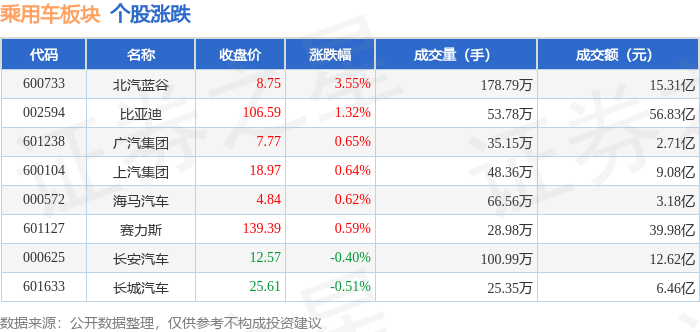
Market Overview - The passenger car sector increased by 0.7% on September 11, with Beiqi Blue Valley leading the gains [1] - The Shanghai Composite Index closed at 3875.31, up 1.65%, while the Shenzhen Component Index closed at 12979.89, up 3.36% [1] Individual Stock Performance - Beiqi Blue Valley (600733) closed at 8.75, up 3.55% with a trading volume of 1.7879 million shares and a transaction value of 1.531 billion [1] - BYD (002594) closed at 106.59, up 1.32% with a trading volume of 537,800 shares and a transaction value of 5.683 billion [1] - GAC Group (601238) closed at 7.77, up 0.65% with a trading volume of 351,500 shares and a transaction value of 271 million [1] - SAIC Motor (600104) closed at 18.97, up 0.64% with a trading volume of 483,600 shares and a transaction value of 908 million [1] - Changan Automobile (000625) closed at 12.57, down 0.40% with a trading volume of 1.0099 million shares and a transaction value of 1.262 billion [1] - Great Wall Motors (601633) closed at 25.61, down 0.51% with a trading volume of 253,500 shares and a transaction value of 646 million [1] Fund Flow Analysis - The passenger car sector experienced a net outflow of 656 million from institutional investors, while retail investors saw a net inflow of 692 million [1] - Beiqi Blue Valley had a net inflow of 138 million from institutional investors, while retail investors had a net outflow of 305,220 [2] - BYD experienced a net outflow of 122 million from institutional investors, but a net inflow of 143 million from retail investors [2] - GAC Group saw a net outflow of 13.15 million from institutional investors, with a net inflow of 22.63 million from retail investors [2]


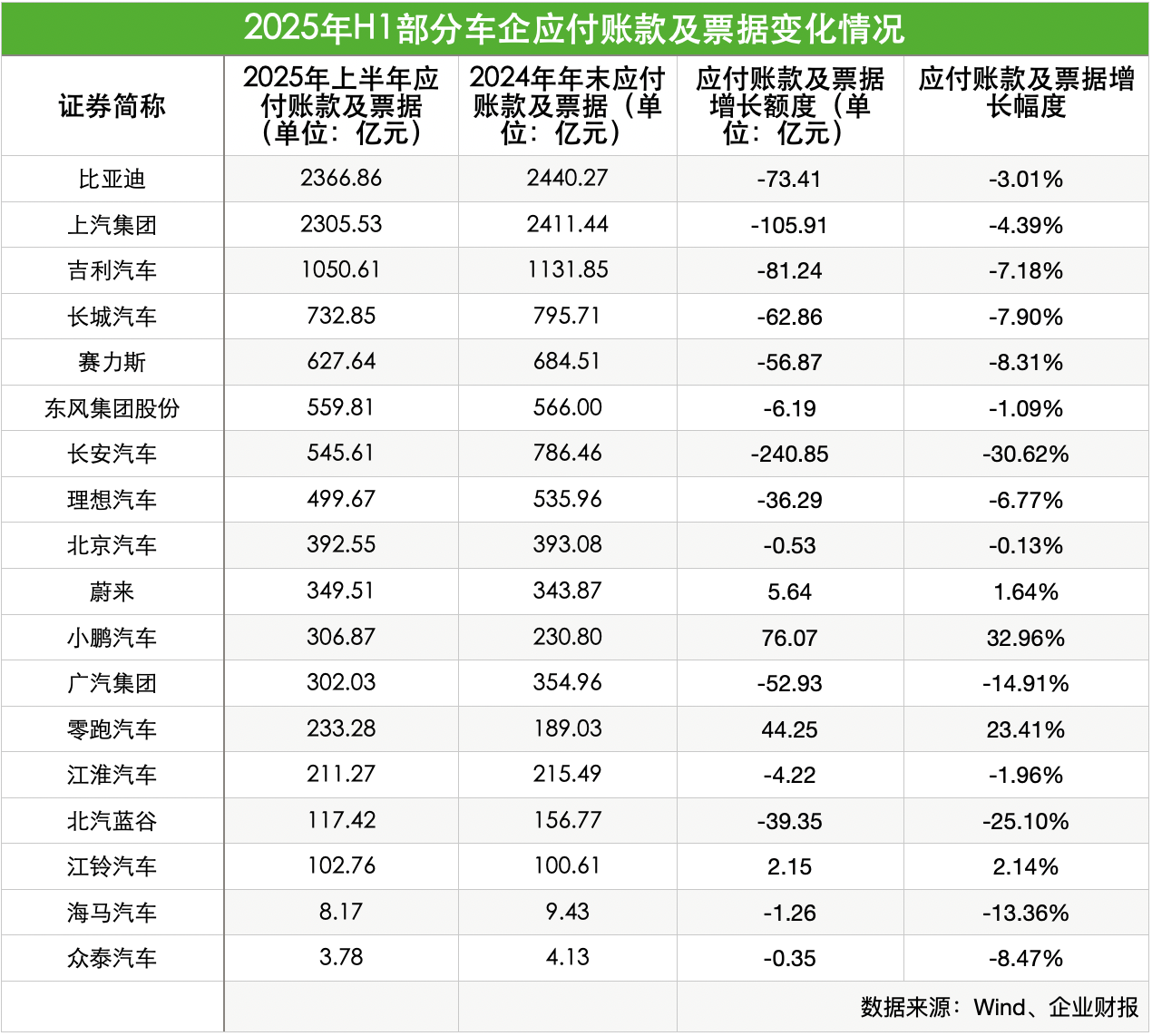
60天账期承诺是否达成?追踪18家上市车企应付账款状况:总额降,账期拉长
Mei Ri Jing Ji Xin Wen· 2025-09-10 10:17
Core Insights - The automotive industry in China is experiencing a trend of "anti-involution," with 17 companies committing to reduce supplier payment terms to within 60 days, aimed at alleviating financial pressure on parts manufacturers [1] - Despite a reduction in total accounts payable and notes to 10,209.03 billion yuan, the average turnover days increased to 192.46 days, indicating a divergence between total amount reduction and extended payment terms [1][2] - BYD, SAIC Motor, and Geely are the top three companies in terms of accounts payable, each exceeding 100 billion yuan [1] Accounts Payable Changes - 14 companies reported a decrease in accounts payable compared to the end of last year, with Changan Automobile, SAIC Motor, and Geely showing the largest reductions of 240.85 billion yuan, 105.91 billion yuan, and 81.24 billion yuan respectively [2] - NIO, Xpeng Motors, and Leap Motor saw increases in accounts payable, with Xpeng Motors rising by 76.07 billion yuan, a 32.96% increase [4] Turnover Days Analysis - Only six companies improved their accounts payable turnover days, with Xpeng Motors achieving the most significant reduction of approximately 63 days, bringing it down to 170 days [5][6] - Companies like SAIC Motor and Changan Automobile also saw improvements, while others like BYD and Ideal Auto experienced increases in turnover days [8] Cash Flow and Payment Terms - Ideal Auto reported a significant increase in cash used in operating activities but a worsening free cash flow, attributed to the adjustment of supplier payment terms to 60 days [9] - The adjustment of payment terms is complex and requires coordination across various departments within companies, posing challenges for timely payments [10][11] Cash Reserves and Coverage - Among 18 companies, only Jiangling Motors and Haima Automobile have cash reserves sufficient to cover their accounts payable [13] - Companies like BYD, Geely, and NIO have cash reserves that fall short of their accounts payable, indicating pressure on short-term liquidity [13]