Haitong Securities(600837)

Search documents
公告速递:海通安泰基金基金暂停申购、转换转入、定期定额投资
Sou Hu Cai Jing· 2025-10-13 01:41
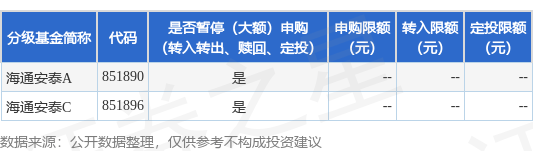
以上内容为证券之星据公开信息整理,由AI算法生成(网信算备310104345710301240019号),不构成 投资建议。 证券之星消息,10月13日上海海通证券资产管理有限公司发布《海通安泰债券型集合资产管理计划基金 暂停申购、转换转入、定期定额投资公告》。公告中提示,为保证集合资产管理计划的平稳运作,保护 集合资产管理计划持有人利益,自2025年10月13日起海通安泰债券型集合资产管理计划基金暂停申购、 转换转入、定期定额投资,下属分级基金调整明细如下: | 分级基金简称 代码 | | 是否暫停(大额)申购 | 申购限额 转入限额 定投限额 | | --- | --- | --- | --- | | | | (转入转出、赎回、定投) | (元) (元) (元) | | 海通安表A | 851890 | 를 | | | 海通安泰C | 851896 | 루 | | ...


公告速递:海通鑫悦基金基金暂停申购、转换转入、定期定额投资
Sou Hu Cai Jing· 2025-10-13 01:41
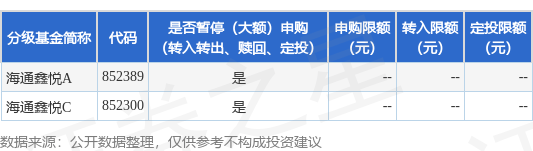
证券之星消息,10月13日上海海通证券资产管理有限公司发布《海通鑫悦债券型集合资产管理计划基金 暂停申购、转换转入、定期定额投资公告》。公告中提示,为保证集合资产管理计划的平稳运作,保护 集合资产管理计划持有人利益,自2025年10月13日起海通鑫悦债券型集合资产管理计划基金暂停申购、 转换转入、定期定额投资,下属分级基金调整明细如下: | 分级基金简称 代码 | | 是否暂停(大额)申购 | 申购限额 转入限额 定投限额 | | --- | --- | --- | --- | | | | (转入转出、赎回、定投) | (元) (元) (元) | | 海通整品A | 852389 | 를 | | | 海通整护C | 852300 | 를 | | 以上内容为证券之星据公开信息整理,由AI算法生成(网信算备310104345710301240019号),不构成 投资建议。 ...
公告速递:海通安悦基金基金暂停申购、转换转入、定期定额投资
Sou Hu Cai Jing· 2025-10-13 01:41
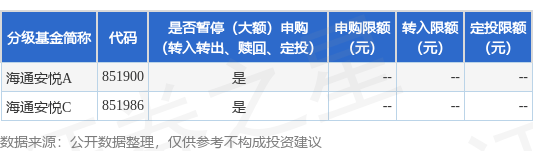
以上内容为证券之星据公开信息整理,由AI算法生成(网信算备310104345710301240019号),不构成 投资建议。 证券之星消息,10月13日上海海通证券资产管理有限公司发布《海通安悦债券型集合资产管理计划基金 暂停申购、转换转入、定期定额投资公告》。公告中提示,为保证集合资产管理计划的平稳运作,保护 集合资产管理计划持有人利益,自2025年10月13日起海通安悦债券型集合资产管理计划基金暂停申购、 转换转入、定期定额投资,下属分级基金调整明细如下: | 分级基金简称 代码 | | 是否暂停(大额)申购 | 申购限额 转入限额 定投限额 | | --- | --- | --- | --- | | | | (转入转出、赎回、定投) | (元) (元) (元) | | 海通安 PA | 851900 | 를 | | | 海通安悦C | 851986 | 루 | | ...
公告速递:海通策略优选基金基金暂停申购、转换转入、定期定额投资
Sou Hu Cai Jing· 2025-10-13 01:41
以上内容为证券之星据公开信息整理,由AI算法生成(网信算备310104345710301240019号),不构成 投资建议。 | 分级基金筒称 | 代码 | 是否暂停(大额)申购 | 申购限额 转入限额 定投限额 | | | --- | --- | --- | --- | --- | | | | (转入转出、赎回、定投) | (元) (元) | (元) | | 海浦要略优先A 852200 | | 를 | | | | 海通赛略优先C 852289 | | 투 | | | 证券之星消息,10月13日上海海通证券资产管理有限公司发布《海通策略优选混合型集合资产管理计划 基金暂停申购、转换转入、定期定额投资公告》。公告中提示,为保证集合资产管理计划的平稳运作, 保护集合资产管理计划持有人利益,自2025年10月13日起海通策略优选混合型集合资产管理计划基金暂 停申购、转换转入、定期定额投资,下属分级基金调整明细如下: ...

国泰海通证券:外部冲击造成的资产下跌 是增持中国市场的良机
Xin Lang Cai Jing· 2025-10-12 11:49
Core Viewpoint - The report from Guotai Junan Securities suggests that the current trade risks are more clearly defined compared to April, and the conditions for domestic financial stability are more apparent, indicating that external shocks will be disturbances rather than trend-ending events. The focus should be on the inherent certainty of China's "transformation bull" market, driven by accelerated transformation, risk-free yield decline, and capital market reforms [1] Group 1: Investment Opportunities - There is a continuous surge in demand from Chinese society and investors for quality assets with solid development logic, making asset price declines due to external conflicts a buying opportunity [1] - The report highlights a new capital expenditure expansion cycle driven by advancements in AI innovation and domestic production, recommending sectors such as internet, electronic semiconductors, defense, media, and robotics [1] - The financial sector, after experiencing adjustments, is now offering improved dividend returns and stable value, with recommendations for brokerage firms, banks, and insurance companies [1] Group 2: Economic Trends - The shift against "involution" reflects a change in economic governance thinking, which may help break or correct previously fully priced deflation expectations, leading to an optimistic outlook for cyclical commodities such as non-ferrous metals (rare earths), chemicals, steel, and new energy [1]
国泰海通宏观:本次关税摩擦对市场的影响预计会相对可控
Ge Long Hui· 2025-10-12 06:52
Core Viewpoint - The article emphasizes that while external factors such as tariff disputes may create short-term uncertainties, the real determinants of China's asset performance are its internal economic and policy developments [1][5]. Group 1: Impact of Tariff Disputes - The recent tariff disputes initiated by the Trump administration have raised market concerns, but the impact is expected to be manageable due to lessons learned from previous tariff experiences [1][4]. - In April, the U.S. imposed tariffs on major economies, leading to a significant drop in global risk assets, but a quick policy softening by the Trump administration resulted in a rapid recovery of asset prices [1][2]. Group 2: U.S. Economic Constraints - The U.S. government faces challenges in maintaining high tariffs due to the inherent economic pressures that arise from such policies, which can lead to domestic issues [2][3]. - Despite a decrease in direct trade reliance on China since 2018, the U.S. still requires indirect trade connections through third-party countries, indicating a complex trade landscape [2][3]. Group 3: Market Experience and Response - The market has gained experience from the April tariff episode, which may lead to a more measured response to current tariff announcements, as investors recall the quick recovery following initial declines [4]. - China's response strategies have become more refined, with stronger policy support and effective measures adopted by export-oriented enterprises to mitigate tariff impacts [4][5]. Group 4: Domestic Economic Factors - The article suggests that the marginal impact of external factors on the domestic economy is limited, and the focus should be on internal economic and policy changes [5]. - Confidence in the domestic economy has strengthened due to supportive policies and the resilience of the supply side, contrasting with earlier concerns during the April tariff episode [4][5].

国泰海通|金工:风格及行业观点月报(2025.10)
国泰海通证券研究· 2025-10-10 09:07
Core Insights - The style rotation model accurately predicted trends in Q3 2025, with signals favoring small-cap and growth stocks for Q4 2025 [1] - The industry rotation model showed positive excess returns in September, with a monthly return of 3.33% and an excess return of 2.43% relative to the benchmark [1] Style Rotation Model - For Q4 2025, the dual-driven rotation strategy indicates a comprehensive score of -1, predicting a preference for small-cap stocks [2] - The growth style is favored in Q4 2025, with a comprehensive score of -3 from the dual-driven rotation strategy [3] Industry Rotation Insights - In September, the composite factor strategy achieved an excess return of 2.43%, while the single-factor multi-strategy had an excess return of -1.02% [3] - For October, the recommended long positions in single-factor multi-strategy include the computer, communication, electronic, non-bank financial, and banking sectors [3] - The composite factor strategy recommends long positions in home appliances, non-ferrous metals, electronics, communication, and computers [3]

前9月32家券商分38.37亿承销保荐费 国泰海通夺第一
Zhong Guo Jing Ji Wang· 2025-10-09 23:29
Summary of Key Points Core Viewpoint - In the first nine months of 2025, a total of 78 companies were listed on the Shanghai Stock Exchange, Shenzhen Stock Exchange, and Beijing Stock Exchange, raising a total of 77.164 billion yuan in funds, with Huadian New Energy leading the fundraising efforts [1][2]. Group 1: Listing and Fundraising - A total of 78 companies were listed from January to September 2025, with 26 on the main board, 29 on the ChiNext, 8 on the Sci-Tech Innovation Board, and 15 on the Beijing Stock Exchange [1]. - The total fundraising amount for these companies reached 771.64 billion yuan, with Huadian New Energy raising 181.71 billion yuan, making it the top fundraiser [1]. Group 2: Underwriting and Sponsorship - 32 securities firms participated in the underwriting and sponsorship of the newly listed companies, earning a total of 3.837 billion yuan in fees [2][4]. - Guotai Junan Securities ranked first in underwriting fees, earning 501.01 million yuan from sponsoring 8 companies [2][5]. - CITIC Securities and CITIC Jianye followed, earning 408.05 million yuan and 399.19 million yuan respectively, with CITIC Securities sponsoring 6 companies [2][3]. Group 3: Detailed Ranking of Securities Firms - The top five securities firms earned a combined total of 1.896 billion yuan, accounting for 49.40% of the total underwriting fees [4]. - Other firms in the top ten included Shenwan Hongyuan, Guolian Minsheng, Dongxing Securities, and Orient Securities, with fees ranging from 134.38 million yuan to 171.31 million yuan [4][6].
国泰海通证券研究与机构业务委员会副总裁路颖: 经济转型与政策发力双轮驱动 投资者信心企稳回升
Sou Hu Cai Jing· 2025-10-09 22:11
Group 1 - The core viewpoint is that China's economic transformation and emerging business models are key drivers for the sustained rise of the stock market, with traditional economic cycles clearing out and stabilizing [1] - The focus of Chinese policy is shifting towards development, with fiscal expansion supporting livelihoods, boosting consumption, and improving corporate cash flow [1] - The "anti-involution" movement reflects a change in economic governance thinking, which is expected to provide conditions for stabilizing long-term return on equity (ROE) [1] Group 2 - In the real estate sector, residential investment as a percentage of GDP is projected to fall to 5.4% by Q2 2025, aligning with levels seen in the US, Japan, and South Korea, indicating a significant reduction in economic drag [1] - The total repayment amounts for domestic debts of real estate companies are forecasted to decrease annually, with figures of 469.4 billion, 319.4 billion, and 313.9 billion yuan for 2025, 2026, and 2027 respectively, suggesting that credit risk is largely cleared [2] - The manufacturing sector is experiencing a self-driven supply clearing, with capital expenditure decreasing by 10.6% year-on-year in Q1 2025, marking the lowest growth rate in nearly a decade [2] Group 3 - The implementation of more reasonable macroeconomic policies is effectively reducing tail risks in the economy and stabilizing investor expectations [2] - New economic opportunities are emerging in sectors such as AI and robotics, with accelerated capital expenditure, indicating a shift towards higher economic quality driven by transformation [2] - The "new three arrows" policy post-September 24, 2024, focuses on debt resolution, demand stimulation, and asset price stabilization, aiming to address the issue of insufficient domestic effective demand [2]
国泰海通俞枫:以全栈创新破局核心技术 做证券行业智能化先行者
Shang Hai Zheng Quan Bao· 2025-10-09 18:40
Core Insights - The article highlights Guotai Junan's commitment to digital transformation and innovation in the securities industry, emphasizing the development of a new generation of core trading systems and the integration of AI technologies [2][3][7]. Digital Transformation Strategy - Guotai Junan has positioned comprehensive digital transformation as a top priority during the 14th Five-Year Plan, aiming to create a "SMART investment bank" and transition from "AI in ALL" to "ALL in AI" [2][3]. - The company has undertaken numerous innovative research projects in cloud computing, big data, AI, and blockchain, contributing to technological advancements in the industry [2][3]. Core Trading System Development - The new core trading system, developed in collaboration with Huawei, utilizes distributed architecture and low-latency technologies, addressing the limitations of traditional systems [3][4]. - The system has achieved significant performance improvements, reducing transaction latency from 20 milliseconds to 200 microseconds and increasing single-node processing capacity from 2,500 to 8,000 orders per second [4][5]. Performance and Reliability - The new trading system has demonstrated exceptional performance and reliability, successfully handling a surge in trading volume during extreme market conditions [4][6]. - The system features automatic switching between primary and backup components, ensuring message integrity and business continuity [4][5]. Collaborative Innovation - Guotai Junan's partnership with Huawei and Huairui has led to the establishment of a joint innovation laboratory, enhancing the capabilities of the core trading system [5][6]. - The company has adopted a collaborative approach to overcome technical challenges, utilizing a gradual strategy for system upgrades [6]. AI Integration - Following the establishment of a robust technical foundation, Guotai Junan is focusing on AI integration, proposing an "ALL in AI" strategy to enhance trading efficiency and risk management [7]. - The company aims to leverage AI for intelligent decision-making, risk control, and efficiency improvements across trading processes [7].