YILI(600887)

Search documents
伊利股份(600887) - 内蒙古伊利实业集团股份有限公司关于2025年度第九、十期超短期融资券兑付完成的公告
2025-09-29 08:01
证券代码:600887 证券简称:伊利股份 公告编号:临 2025-069 内蒙古伊利实业集团股份有限公司关于 2025 年度第九、十期超短期融资券兑付完成的公告 本公司董事会及全体董事保证本公告内容不存在任何虚假记载、误导性陈述或 者重大遗漏,并对其内容的真实性、准确性和完整性承担法律责任。 内蒙古伊利实业集团股份有限公司(简称"公司")于 2025 年 7 月 成功发行了 2025 年度第九、十期超短期融资券,具体情况如下: | 名称 | | 发行总额 | | 发行利率 | 发行期限 | | | 起息日 | | | | 兑付日 | | | | | 公告编号 | | | --- | --- | --- | --- | --- | --- | --- | --- | --- | --- | --- | --- | --- | --- | --- | --- | --- | --- | --- | | 2025 期超短期融资券 | 年度第九 | 100 | 亿元 | 1.44% | 86 | 天 | 2025 | 年 7 | 月 | 2 日 | 2025 | 年 9 | 月 26 | 日 | 临 | 2025- ...

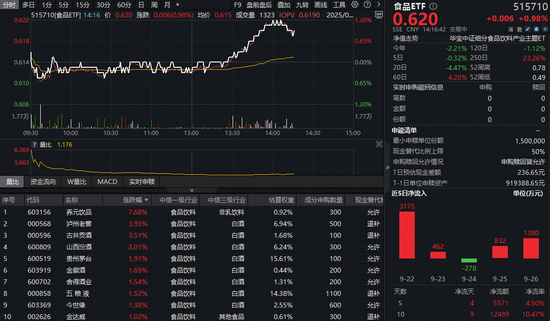
销量爆了!吃喝板块猛攻,“茅五泸汾洋”齐涨!食品ETF(515710)盘中涨超1%
Xin Lang Ji Jin· 2025-09-29 06:33
Group 1 - The food and beverage sector experienced a significant rally on September 29, with the Food ETF (515710) reaching an intraday price increase of up to 1.3% before settling at a 0.98% gain [1][3] - Key stocks in the sector showed strong performance, with Yangyuan Beverage soaring over 7%, and major liquor brands like Luzhou Laojiao and Gujing Gongji rising over 3% [1][3] - The Food ETF (515710) has seen substantial net inflows, with a total of 55.71 million yuan in net subscriptions over the last five trading days, indicating strong investor interest [3] Group 2 - Sales of popular gift items such as liquor and mooncakes surged ahead of the Mid-Autumn and National Day holidays, with liquor sales on Meituan increasing approximately eightfold year-on-year [3][4] - The current valuation of the food and beverage sector is considered low, with the food index's price-to-earnings ratio at 20.21, placing it in the lower 5.88% percentile over the past decade, suggesting a favorable investment opportunity [3][4] - Analysts predict a recovery in the liquor sector due to government policies promoting high-quality development, with expectations for Maotai's prices to rebound as market conditions improve [4][5] Group 3 - The food and beverage industry is witnessing significant policy catalysts, such as the upcoming public consultation on the national standards for prepared food safety, which may benefit leading brands [4][5] - The Food ETF (515710) is strategically positioned, with approximately 60% of its holdings in leading high-end and mid-range liquor stocks, and nearly 40% in other beverage and food segments [5] - Investors can also access core assets in the food and beverage sector through the Food ETF linked funds [5]







伊利:逐步走出下行周期 -液体奶销售额降幅收窄,2025 年下半年常温奶销售持续强劲;估值与收益率具吸引力
2025-09-29 03:06
Summary of Key Points from the Conference Call Company and Industry Overview - **Company**: Inner Mongolia Yili (600887 CH) - **Industry**: Dairy sector in China Core Insights and Arguments - **Market Conditions**: The dairy sector is facing challenges such as lukewarm demand and intense competition, with small brands gaining market share through price cuts due to raw milk oversupply [2][9] - **Sales Forecast**: Yili's sales are expected to grow by 2.3% year-over-year in Q3 2025, with liquid milk sales decline narrowing and strong milk powder sales continuing [2][6] - **Earnings Outlook**: Recurrent earnings are forecasted to decline by 4.7% year-over-year, primarily due to flat raw milk costs impacting gross profit margins [2][9] - **Full-Year Guidance**: Yili aims for a 2.8% year-over-year sales increase in 2025, with a reported net margin of 9% [2][9] - **Valuation**: Trading at 15x 2025 consensus earnings, the valuation reflects known sector headwinds, with a price target of Rmb35 [2][9] Financial Performance and Projections - **Liquid Milk Sales**: Expected decline to narrow from -3.1% in Q1 2025 to -0.5% in Q3 2025, with Yili opting not to engage in nationwide discounting [6][9] - **Milk Powder Sales**: Forecasted to grow by 9% in Q3 2025, driven by a Rmb1.6 billion subsidy program and a growing B-to-B business [6][9] - **Raw Milk Costs**: Current costs at Rmb3.02/kg, the lowest since 2011, with expectations of stability in Q3 2025 and slight decline in Q4 2025 [2][18] Investment Thesis - **Management Alignment**: The top four senior management members hold 8% equity, aligning their interests with public shareholders [9][26] - **Profitability**: Yili is recognized for superior profitability and equity return profile, with expectations of sales and earnings growth in the coming years [9][26] - **Market Recovery**: Anticipated demand recovery and potential raw milk cost increases in mid-2026 could favor Yili's sales growth and margins [9][26] Risks and Catalysts - **Downside Risks**: Include intensifying competition, input cost volatility, management changes, and potential food safety issues [30] - **Upside Catalysts**: Stronger-than-expected liquid milk sales, earlier inflection points in raw milk prices, and successful product innovations could positively impact performance [31] Valuation Metrics - **Price Target**: DCF-based price target of Rmb35 implies an 18x/17x P/E for 2026/27 and a 2.0x PEG for 2026 [10][27] - **WACC**: Estimated at 9.0%, with a risk-free rate of 3.0% and a risk premium of 7.0% [10][27] Additional Important Information - **Market Performance**: Yili's share price has underperformed relative to the SHSZ300 Index, with a year-to-date decline of 10.6% [8][20] - **Financial Estimates**: Revenue is projected to grow from Rmb115.4 billion in 2024 to Rmb128.1 billion in 2027, with adjusted net income expected to rise from Rmb6.0 billion to Rmb13.3 billion over the same period [8][15]
双节前名酒量价回升,食品饮料ETF天弘(159736)连续9日“吸金”, 流通份额超76亿份创新高
2 1 Shi Ji Jing Ji Bao Dao· 2025-09-29 02:58
Core Viewpoint - The food and beverage ETF Tianhong (159736) has shown significant market activity, with a notable inflow of funds and rising stock prices among key components, indicating a positive trend in the sector [2][3]. Group 1: ETF Performance - The Tianhong food and beverage ETF (159736) experienced a slight decline of 0.28% as of the latest report, with a premium rate of 0.04% and frequent premium trading observed [1]. - The ETF has seen a net inflow of nearly 170 million yuan over the past nine trading days, with a total circulation of 7.62 billion shares, reaching a historical high [2]. Group 2: Component Stocks - Key component stocks such as Yangyuan Beverage, Gujing Gongjiu, Luzhou Laojiao, and others have shown price increases, with Yangyuan Beverage rising over 4% [2]. - The ETF closely tracks the CSI Food and Beverage Index, which includes major stocks from the beverage, packaged food, and meat industries, featuring top holdings like Kweichow Moutai, Yili, and Wuliangye [2]. Group 3: Market Trends - Reports indicate a significant increase in the prices of premium liquor, with notable price hikes for products like Feitian Moutai and other well-known brands over a short period [3]. - The liquor market is experiencing a surge in demand, particularly in the mid-range price segment (50-200 yuan), with increased sales reported across various regions [3]. - The upcoming National Day holiday is expected to boost tourism and consumer spending, with a projected 130% increase in travel compared to the previous year, indicating a potential for strong sales in the food and beverage sector [4].


伊利:路演反馈 -聚焦原奶供应周期与核心产品品类策略-Yili Industrial-NDR Feedback - Focus on Raw Milk Supply Cycle and Key Product Category Strategy
2025-09-29 02:06
Summary of Yili Industrial NDR Feedback Company Overview - **Company**: Yili Industrial (600887.SS) - **Industry**: China/Hong Kong Consumer - **Market Cap**: Rmb167,070 million - **Stock Rating**: Overweight - **Price Target**: Rmb35.00, representing a 28% upside from the closing price of Rmb27.26 on September 26, 2025 Key Industry Insights - **Raw Milk Supply/Demand Dynamics**: - Management indicated a sequential drop in cow herds and a rebound in non-contractual raw milk prices, expecting a supply/demand balance by 2026 [2][9] - **Product Category Strategy**: - Focus on liquid milk recovery, with a target of low to mid-single digit growth post-2026 [10] - Anticipation of higher growth in other dairy segments, leading to a gradual decline in liquid milk's contribution to total sales [2][9] - Plans to enhance the product portfolio mix and incubate new segments for long-term growth [9] Financial Projections - **Revenue Growth**: - Projected net revenue for fiscal years ending December 2024 to 2027: Rmb114,121 million, Rmb117,704 million, Rmb122,646 million, and Rmb129,510 million respectively [6] - **Earnings Per Share (EPS)**: - Expected EPS growth from Rmb1.32 in 2024 to Rmb2.24 in 2027 [6] - **Capital Expenditure**: - Estimated at Rmb3-4 billion per annum in the near term [10] Strategic Focus Areas - **Market Share Goals**: - Aim to secure the 1 market share for the Yili brand by 2027 [10] - **Dividend Policy**: - Commitment to maintain a dividend payout of no less than 70% and consider share buybacks [10] Risks and Considerations - **Upside Risks**: - Faster-than-expected demand recovery and better margin expansion due to rational marketing investments [13] - **Downside Risks**: - Potential for slower dairy demand growth and prolonged raw milk oversupply, which could necessitate continued promotional investments [13] Additional Insights - **Stimulus Policies**: - Management anticipates more rounds of subsidies to boost birth rates in 2026, which could positively impact raw milk supply [3] - **Long-term Growth Segments**: - Focus on deep-processing, overseas markets, and adult milk powder as part of the growth strategy [9] This summary encapsulates the key points from the Yili Industrial NDR feedback, highlighting the company's strategic direction, financial outlook, and industry dynamics.
多方建言:如何有效提升食品安全水平?
Bei Ke Cai Jing· 2025-09-29 00:03
Core Viewpoint - The food safety governance faces new challenges due to the emergence of new products, business models, and channels, requiring collaboration among regulatory bodies, industry enterprises, media, and consumers to enhance food safety levels and manage public opinion crises [1] Group 1: Food Safety Governance - The Beijing Municipal Market Supervision Administration emphasizes four key areas for food safety governance: strengthening source control, improving campus meal safety, advancing smart regulatory capabilities, and combating illegal activities [2] - The establishment of a "red light mechanism" for food products aims to quickly block unsafe items, with collaboration among various departments to enhance enforcement and ensure zero tolerance for food safety violations [2] - Consensus among stakeholders is crucial for effective food safety governance, as higher consensus leads to better cooperation with regulatory measures [2][3] Group 2: New Business Models and Standards - There is a need to develop and improve standards for new business models like live streaming and food delivery to protect all parties involved, including regulatory bodies, businesses, and consumers [4] - Platforms are encouraged to take on more responsibility in food safety governance, utilizing technology for daily monitoring and reporting violations [4] - All parties, including businesses, platforms, and regulatory bodies, should enhance legal awareness and promote responsible consumption among consumers [4][5] Group 3: Technology Empowerment - The use of AI and big data is highlighted as essential for enhancing food safety governance, with examples of smart monitoring systems being implemented to detect issues in real-time [5][6] - Companies like Yili Group are leveraging digital platforms to enhance quality control across the entire supply chain, with over 1,000 testing items covered in their safety risk detection system [5] - Meituan has developed a transparent kitchen live-streaming system and upgraded its digital collaboration platform to improve food safety governance, successfully integrating local government data for better compliance verification [5][6] Group 4: Industry Initiatives - The China Dairy Industry Association emphasizes the importance of quality safety initiatives and consumer education to improve public understanding of dairy products [3] - The China Nutrition and Health Food Association is focusing on talent development and communication mechanisms to enhance food safety governance across the industry [3] - Companies like Tastin are innovating with digital solutions to create a closed-loop management system for food safety, continuously optimizing standards based on data analysis and consumer feedback [6]
伊利推动乳业深加工变革 开启“精准营养”新时代
Jing Ji Ri Bao· 2025-09-28 21:49
Core Insights - The article highlights the transformation of China's dairy industry from traditional manufacturing to precision nutrition, emphasizing the importance of deep processing in meeting consumer demands for healthier and more functional dairy products [1][2][3]. Group 1: Industry Trends - The dairy market is shifting from basic nutrition to functional precision, with consumers seeking products that offer natural and targeted nutritional benefits [2][3]. - Despite improvements in raw milk quality and standardized farming practices, the industry faces challenges in deep processing capabilities, with a low proportion of high-value products and a reliance on imports for key functional ingredients [2][3]. Group 2: Technological Advancements - The dairy industry is progressing through three stages: 1.0 focuses on nutrition preservation, 2.0 on nutrition optimization, and 3.0 on precision nutrition, which emphasizes deep processing to extract and retain natural nutrients effectively [3][4]. - Yili has made significant breakthroughs in deep processing technologies, such as the directional protection technology for lactoferrin, increasing its retention rate from 10% to over 90% [4][5]. Group 3: Yili's Innovations - Yili has developed a "拆、切、递" (disassemble, cut, deliver) technology chain to meet personalized nutrition needs, achieving a high retention rate of 91.2% for core natural nutrients [5][6]. - The Yili Health Valley serves as a comprehensive ecosystem for deep processing, integrating smart manufacturing and advanced technologies to enhance production efficiency and product quality [6][7]. Group 4: Future Outlook - Yili aims to lead the transformation of the dairy industry by leveraging technological innovations and a collaborative ecosystem, positioning itself as a key player in providing personalized nutrition solutions [7][8]. - The company emphasizes that deep processing is not only a technical challenge but also a strategic necessity for ensuring control over key dairy ingredients and meeting national health needs [7][8].
年轻人期待与用人单位“共同进化”
Zhong Guo Qing Nian Bao· 2025-09-28 20:27
Group 1: Core Concepts - Companies are increasingly focusing on creating a "growth ecosystem" for new employees, emphasizing the importance of innovation and practical experience in their training programs [2][4][5] - The "Creative Market" initiative at Yili Group exemplifies how companies engage new hires in innovative projects that resonate with consumer needs, fostering a sense of value and belonging among employees [1][8] - Organizations are recognizing that the creativity, adaptability, and commitment of employees are vital assets, leading to a focus on human capital as a source of sustainable competitive advantage [5][6] Group 2: Talent Development Strategies - Companies like ByteDance and Tencent are implementing open and inclusive environments that encourage new hires to contribute ideas and engage in challenging projects from day one [2][3] - The establishment of comprehensive talent management systems, such as Yili Group's "selection, training, retention" framework, aims to support personalized innovation and rapid integration of young employees into the company [2][4] - Educational partnerships and internship programs are being promoted to bridge the gap between academic training and practical workplace skills, allowing companies to identify and nurture potential talent early [9] Group 3: Employee Engagement and Innovation - New employees are seen as a source of fresh perspectives and ideas, which can drive innovation and address business challenges in rapidly changing market environments [8][9] - The emphasis on creating a supportive and engaging workplace culture is crucial for retaining young talent and enhancing their contributions to organizational goals [4][5] - Companies are encouraged to integrate innovation mechanisms into their talent development frameworks, ensuring a continuous cycle of identifying potential, cultivating skills, and providing opportunities for growth [9]

当下消费还有哪些机会—9月消费观点汇报
2025-09-28 14:57
Summary of Key Points from the Conference Call Industry Overview - The current consumer market is expected to recover gradually, with many companies entering a bottoming phase. The liquor industry is projected to see a turning point by Q1 2026, while health foods, dairy products, and small-cap companies present significant investment opportunities [17][19] Core Insights and Arguments - **Food and Consumer Stocks**: Anticipated decline in holdings for food and consumer stocks to historical lows in Q3 2025, with active holdings expected to be very low. This trend may continue for several quarters, eventually forming a bottom [3] - **Investment Opportunities in Food Stocks**: Significant investment opportunities are expected in food stocks next year, with valuations potentially dropping below 15 times earnings and price-to-sales ratios between 1 to 3 times, especially for companies with stable revenues and strong market shares [5][12] - **Liquor and Traditional Consumer Goods**: The liquor industry may have recovery opportunities next year if Q4 reports show positive results. The traditional Chinese medicine sector, despite poor performance this year, has low valuations and strong pricing power, suggesting a faster recovery than other sectors [6][8] - **Health Food Sector**: The health food sector has performed well this year, with companies like Chengfang Bio, Baihe, Xianle, and Jindawei showing promise. The integration of pet-related businesses may further enhance growth opportunities [9][11] Noteworthy Companies and Valuations - **Yili Co., Ltd.**: Valuation is attractive, with expected price-to-sales ratios dropping to 1.5-1.7 times next year. The company has a strong cash reserve of over 50 billion to 60 billion, indicating potential for value creation during bull markets [12] - **Vitasoy International**: Notable for its low price-to-sales ratio of only 2 times and strong cash position, with revenue recovering to 5-6 billion. The company is expected to enhance profitability through management optimization [10] - **Small-Cap Companies**: Companies like Xingye Technology and Tiantie are highlighted for their governance improvements and strong technological capabilities, indicating potential for significant growth [15][16] Challenges and Market Dynamics - **Traditional Consumer Goods**: The traditional consumer sector, including liquor and Chinese medicine, faces challenges due to insufficient product innovation and economic volatility. Many companies are postponing new product launches until 2026 [2][7] - **Market Sentiment**: There is growing concern in the market regarding the performance of traditional consumer goods, particularly with the decline in prices for premium liquor brands like Moutai [2][7] Future Outlook - **Policy Support for Traditional Medicine**: The Chinese medicine sector may improve with policy support and increased capital involvement. Companies with strong cash reserves and high dividend payouts are expected to perform better [8][14] - **Investment Strategy**: The focus will remain on increasing the proportion of small-cap stocks and closely monitoring developments in food, Chinese medicine, non-alcoholic beverages, and liquor sectors [20]

伊利和京东,将搭子进行到底
3 6 Ke· 2025-09-28 13:20
Core Insights - The article discusses how major brands, particularly Yili, are adapting to consumer behavior by embracing the concept of "搭子" (partner) marketing, which emphasizes simplicity and convenience in purchasing decisions [3][5][19] Group 1: Consumer Behavior and Marketing Strategy - Consumers are increasingly rejecting complexity and are more inclined to choose "fail-proof" options, leading brands to rethink their marketing strategies [3][4] - Yili has positioned itself as a complementary product to mooncakes, rather than competing directly for attention, by partnering with JD.com to integrate milk into the purchasing process [5][8] - The collaboration allows consumers to easily add milk to their cart while purchasing mooncakes, enhancing the shopping experience without overwhelming them with choices [5][10] Group 2: Event Marketing and Brand Positioning - The Mid-Autumn Festival is traditionally associated with mooncakes, but Yili's strategy focuses on being a "搭子" that complements the main product, thus creating a unique market position [4][8] - Yili's marketing approach during the festival includes a "maximum tenfold free order" promotion, which not only incentivizes purchases but also reinforces the idea of milk as a staple item during the holiday [10][14] - The partnership with JD.com has evolved through three key events: Spring Festival, the college entrance examination, and Mid-Autumn Festival, showcasing a systematic approach to marketing that builds on previous successes [14][16] Group 3: Long-term Strategy and Brand Evolution - Yili's marketing strategy reflects a long-term vision, focusing on gradual brand integration into consumers' daily lives rather than seeking immediate attention through flashy campaigns [17][19] - The brand's ability to adapt to different cultural moments and consumer sentiments demonstrates its strategic depth and commitment to maintaining relevance in a competitive market [18][19] - This approach signifies a shift in the dairy industry, where brands are moving away from traditional competition for shelf space to embedding themselves into consumers' everyday choices [18][19]