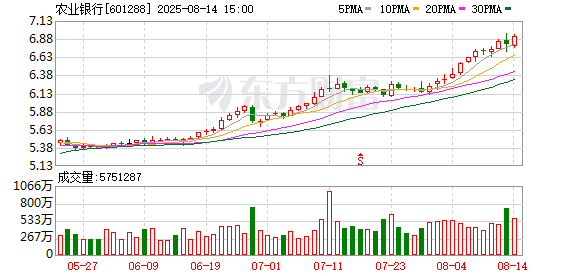
Bank Of Jiangsu(600919)

Search documents
A500指数周涨2.75%!38只基金全红
2 1 Shi Ji Jing Ji Bao Dao· 2025-08-15 11:48
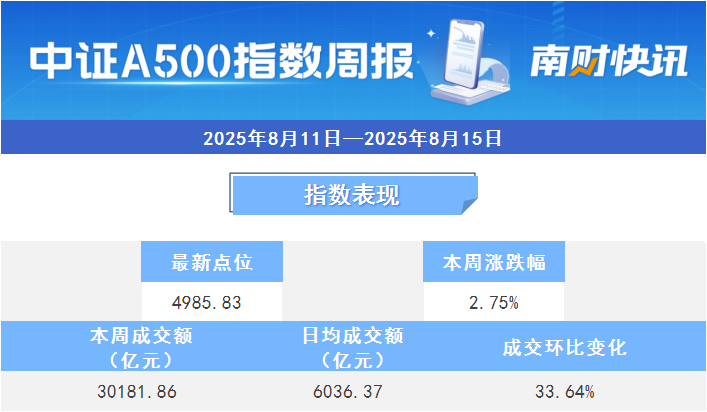
Index Performance - The CSI A500 Index increased by 2.75% this week, closing at 4985.83 points on August 15 [5] - The average daily trading volume for the week was 6036.37 billion yuan, representing a 33.64% increase compared to the previous week [5] Top Performing Stocks - The top ten stocks with the highest gains this week included: - Cambricon Technologies (688256. SH) with a gain of 33.33% - Quzhou Development (600208. SH) with a gain of 33.01% - Philihua (300395. SZ) with a gain of 30.81% [3] Underperforming Stocks - The ten stocks with the largest declines included: - Hongdu Aviation (600316. SH) with a drop of 6.12% - Transsion Holdings (688036. SH) with a drop of 6.08% - Light Media (300251. SZ) with a drop of 5.96% [3] Fund Performance - All 38 CSI A500 funds reported gains exceeding 1% this week, with Huabao Fund leading at 3.32% [6] - The total scale of CSI A500 funds reached 1798.01 billion yuan, showing an increase compared to the previous week [6] Fund Management - The top three funds by scale are: - Huatai-PB Fund with 197.22 billion yuan - E Fund with 180.44 billion yuan - Guotai Fund with 178.60 billion yuan [6] Market Outlook - According to CICC, the current market sentiment is optimistic, suggesting that the ongoing market trend resembles an "enhanced version of 2013" [8] - The report indicates that the market structure this year is similar to 2013, with small-cap and growth styles prevailing, but overall performance is expected to be better than in 2013 [8] - The report also highlights sectors to focus on, including AI/computing, innovative pharmaceuticals, military, and non-ferrous metals [9]




A500指数周涨2.75%!38只基金全红丨A500ETF观察
2 1 Shi Ji Jing Ji Bao Dao· 2025-08-15 11:43
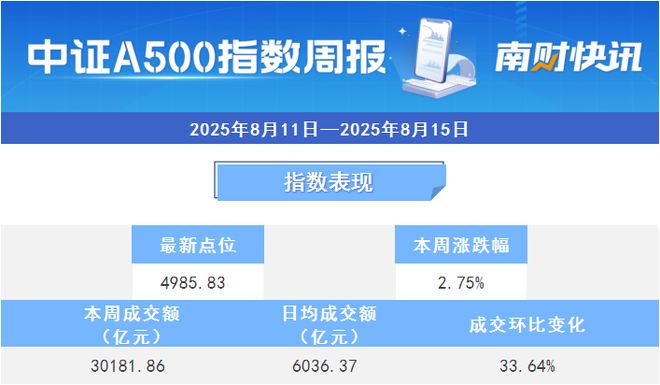
Index Performance - The CSI A500 Index increased by 2.75% this week, closing at 4985.83 points on August 15 [5] - The average daily trading volume for the week was 6036.37 billion yuan, with a week-on-week increase of 33.64% [5] Component Stocks - The top ten gainers this week included: - Cambrian (688256.SH) with a rise of 33.33% - Quzhou Development (600208.SH) up by 33.01% - Filihua (300395.SZ) increased by 30.81% [3] - The top ten losers included: - Hongdu Aviation (600316.SH) down by 6.12% - Transsion Holdings (688036.SH) decreased by 6.08% - Light Media (300251.SZ) fell by 5.96% [3] Fund Performance - All 38 CSI A500 funds rose by over 1% this week, with Huabao Fund leading at 3.32% [5] - The total scale of CSI A500 funds reached 1798.01 billion yuan, showing an increase compared to last week [5] - The top three funds by scale are: - Huatai Baichuan with 197.22 billion yuan - E Fund with 180.44 billion yuan - Guotai Fund with 178.60 billion yuan [5] Market Outlook - CICC's report suggests that the current market sentiment is optimistic, indicating that the ongoing rally may not be over, comparing it to an "enhanced version of 2013" [5] - The report highlights that the market structure this year resembles that of 2013, with small-cap and growth styles prevailing, but overall performance is expected to be better than in 2013 [5] - Recommendations include focusing on sectors with high prosperity and performance verification such as AI/computing power, innovative pharmaceuticals, military, and non-ferrous metals [5] Broader Market Sentiment - Debon Securities believes that the current market breadth and depth exceed previous bull markets, driven by a combination of policy, fundamentals, and liquidity, characterizing it as a "slow bull" market [6] - The report emphasizes the transformation of industrial momentum, with technology growth sectors like semiconductors and robotics leading the way, indicating a rapid development opportunity for emerging industries [6]
江苏银行“绿色工厂贷”解码企业转型新路径
Mei Ri Jing Ji Xin Wen· 2025-08-15 11:39
Core Viewpoint - The issuance of "Green Factory Loans" by Jiangsu Bank represents a significant step in integrating financial services with green development, supporting the green transformation of the real economy [1][2] Group 1: Policy and Market Context - Jiangsu Bank is responding to national green low-carbon development strategies by providing a 200 million yuan "Green Factory Loan" to a Fortune 500 company, showcasing its commitment to green finance [1] - Recent policy documents, such as the "Guiding Opinions on Promoting the High-end, Intelligent, and Green Development of Traditional Industries" and the "Manufacturing Green and Low-carbon Development Action Plan (2025-2027)," have established a solid institutional foundation for the development of green factories [1] Group 2: Financial Innovation - The core innovation of Jiangsu Bank's "Green Factory Loan" lies in linking loan interest rates to the green factory rating and the company's ESG (Environmental, Social, and Governance) evaluation [2] - Companies can benefit from lower interest rates if they improve their green factory standards and optimize their ESG performance during the loan period, effectively translating green performance into tangible financing cost advantages [2] Group 3: Strategic Positioning - As a globally recognized bank and a systemically important bank in China, Jiangsu Bank is committed to green development, positioning green finance as a key driver of its transformation [2] - The bank aims to establish a "domestically leading and internationally influential" green finance brand, having been elected as the only representative from East Asia on the UNEP FI Banking Council in January 2023 [2] - Jiangsu Bank's green financing balance has exceeded 700 billion yuan, serving over 12,000 green enterprises, with its green loan proportion ranking among the top in the 24 banks directly managed by the People's Bank of China [2]
最高达6139亿元!一图了解银行个人消费贷款TOP10
天天基金网· 2025-08-15 11:22
Core Viewpoint - The recent implementation of the personal consumption loan interest subsidy policy by the Ministry of Finance, the People's Bank of China, and the financial regulatory authority aims to stimulate consumer spending through subsidized loans, with a focus on major banks and specific financial institutions [4]. Group 1: Policy Overview - The personal consumption loan subsidy policy will be effective from September 1, 2025, to August 31, 2026, allowing residents to receive a subsidy of 1% per year on loans used for consumption, capped at 50% of the loan contract interest rate [4]. - A total of 23 lending institutions are included in the policy, comprising 6 large state-owned commercial banks, 12 national joint-stock commercial banks, and 5 other personal consumption loan providers [4]. Group 2: Loan Balances - In 2024, 16 banks reported personal consumption loan balances exceeding 100 billion yuan, with the top ten banks surpassing 300 billion yuan, indicating a significant concentration of loan balances among leading banks [4]. - Postal Savings Bank leads with a loan balance of 613.9 billion yuan, followed by China Construction Bank at 544.9 billion yuan and Agricultural Bank of China at 491.4 billion yuan [3][4]. Group 3: Bank Rankings - Among the top ten banks, five are large state-owned commercial banks, while three national joint-stock commercial banks also made the list: Ping An Bank (4th), China Merchants Bank (6th), and CITIC Bank (10th) [5]. - Notable performances include Ping An Bank with a balance of 474.7 billion yuan, surpassing Industrial and Commercial Bank of China at 421.2 billion yuan, and Ningbo Bank at 357.5 billion yuan, slightly ahead of Bank of Communications at 330.3 billion yuan [5].


江苏银行绿色工厂贷解码企业转型新路径
Zhong Jin Zai Xian· 2025-08-15 08:02
Core Insights - The issuance of the "Green Factory Loan" by Jiangsu Bank aligns with national green and low-carbon development strategies, providing strong support for the green transformation of the real economy [1][2] - Jiangsu Bank's innovative approach links loan interest rates to the green factory rating and ESG evaluation, incentivizing companies to improve their green performance for better financing terms [2] Group 1: Policy and Market Context - Recent policy documents such as "Guiding Opinions on Promoting the High-end, Intelligent, and Green Development of Traditional Industries" and "Manufacturing Green and Low-carbon Development Action Plan (2025-2027)" have established a solid institutional framework for the development of green factories [1] - Jiangsu Bank has effectively captured market demand by integrating financial innovation with green development, exemplified by the issuance of the "Green Factory Loan" [1] Group 2: Financial Innovation and Impact - The core innovation of Jiangsu Bank's "Green Factory Loan" is the effective linkage of loan interest rates with the green factory rating and ESG evaluation results, allowing tailored financing solutions [2] - Companies that continuously enhance their green factory standards and optimize ESG performance can benefit from lower interest rates, translating green performance into tangible financing cost advantages [2] Group 3: Jiangsu Bank's Commitment to Green Finance - As a globally recognized bank, Jiangsu Bank is committed to green development, positioning green finance as a key driver for its transformation and development [2] - Jiangsu Bank was elected as the only representative from East Asia on the Board of the United Nations Environment Programme Finance Initiative (UNEP FI) in January 2023, highlighting its influence in the green finance sector [2] - The bank's green financing balance has exceeded 700 billion yuan, serving over 12,000 green enterprises, with a leading proportion of green loans among the 24 banks directly managed by the People's Bank of China [2]
行业点评报告:信贷社融增长背离,存款活化流向非银
KAIYUAN SECURITIES· 2025-08-15 06:52
Investment Rating - Investment rating: Positive (maintained) [1] Core Viewpoints - Credit and social financing growth are diverging, with financial support for the real economy shifting from indirect financing (loans) to direct financing, primarily through government bonds [4] - The increase in social financing in July was mainly driven by government bonds, with a notable increase of 1.24 trillion yuan, the highest for the month in many years [4] - The report highlights a trend of deposits moving from residents to non-bank financial institutions, indicating a shift in risk appetite among investors [5] Summary by Sections Credit Market Analysis - In July, RMB loans decreased by 50 billion yuan, a year-on-year reduction of 310 billion yuan, with a balance growth rate of 6.9%, down 0.2 percentage points from June [3] - The demand for credit remains weak, with both corporate and household loan demands declining, particularly in medium to long-term loans [3][4] - The increase in corporate loans was primarily supported by bills, which saw a year-on-year increase of 312.5 billion yuan [3] Social Financing Insights - Social financing increased by 1.16 trillion yuan in July, a year-on-year increase of 289.3 billion yuan, with a stock growth rate of 9.0%, up 0.1 percentage points from June [4] - The divergence between social financing and credit growth suggests a transition in how financial support is provided to the real economy [4] Deposit Trends - M2 grew by 8.8% year-on-year in July, while M1 saw a significant increase of 5.6%, indicating signs of deposit activation [5] - The report notes that the increase in non-bank deposits by 1.39 trillion yuan contrasts with a decrease in resident deposits by 780 billion yuan, highlighting a clear trend of funds moving towards non-bank sectors [5] Investment Recommendations - The report suggests that dividend strategies remain solid, with a focus on direct financing as the primary means of financial support for the real economy [5] - It recommends specific banks such as CITIC Bank, Construction Bank, Agricultural Bank, and others as beneficiaries of the current market conditions [5]



苏州高新区通安镇村级资金有“钱”途
Xin Hua Ri Bao· 2025-08-14 23:02
Core Viewpoint - The competitive deposit scheme for village collective funds in Tong'an Town, Suzhou High-tech Zone, has significantly increased interest income, achieving nearly 7 million yuan in interest over three years, which is an excess of 6 million yuan compared to previous earnings [1] Group 1: Competitive Deposit Scheme - Tong'an Town initiated a competitive deposit scheme for village collective funds in 2022, accumulating nearly 1 billion yuan in competitive deposits [1] - The scheme attracted bids from seven local banks, achieving a maximum deposit interest rate of 3.55% [1] - The interest income from village collective funds increased tenfold during the three-year period, greatly enhancing the preservation and appreciation of collective assets [1] Group 2: Benefits and Regulation - The competitive deposit scheme has helped avoid issues such as multiple storage of village collective funds and unauthorized bank accounts [1] - The initiative ensures the safety and appreciation of funds while regulating the operation of "micro-powers" within the villages [1] - The additional interest income is equivalent to the annual income from leasing over 8,000 acres of agricultural land, highlighting the financial impact of the scheme [1]

“客源争夺战”升级!多家银行纷纷发力这项业务!
Jin Rong Shi Bao· 2025-08-14 11:50
Core Insights - The article highlights the increasing competition among banks to attract and retain customers in the personal pension account sector, with various promotional activities being launched to incentivize account opening and contributions [1][2][3]. Group 1: Promotional Activities - Industrial and Commercial Bank of China (ICBC) offers up to 388 yuan in WeChat discounts for new personal pension account holders who deposit 10 yuan or more, and an additional 188 yuan for those who deposit 12,000 yuan this year [1]. - Agricultural Bank of China provides a "big gift" for new depositors, allowing customers who deposit 500 yuan to enter a draw for WeChat discounts of 38 or 88 yuan, and those depositing 5,000 yuan can win up to 388 yuan [1]. - Shanghai Pudong Development Bank has introduced a three-tiered reward system for customers who deposit 1,000 yuan or more into their personal pension accounts, offering WeChat discounts, video membership vouchers, and taxi vouchers [2]. Group 2: Innovative Contribution Methods - Minsheng Bank has introduced an "appointment deposit" option, allowing customers to set up automatic monthly deductions or one-time deposits based on their financial situation [3]. - Jiangsu Bank has launched a feature for personalized automatic deposit plans, enabling customers to customize their deposit dates and amounts [3]. Group 3: Market Trends and Challenges - The number of personal pension account holders in China surpassed 70 million by the end of November last year, indicating a rapid growth in account openings [3]. - Despite the surge in account openings, many customers show low willingness to contribute, posing a challenge for banks to enhance deposit engagement [3][4]. - The shift in bank strategies from "customer acquisition" to "customer retention" reflects a focus on account activity and fund retention, aligning with the long-term nature of pension services [4]. Group 4: Future Directions - Experts suggest that banks should integrate pension accounts with services like healthcare and insurance to create a comprehensive "financial + service" solution [4]. - Enhancing the variety of investment products available for personal pension accounts and providing professional advisory services are seen as key to increasing customer loyalty [5].



“创新领航”主题基金重仓银行股,交银施罗德旗下一产品被指风格漂移
Hua Xia Shi Bao· 2025-08-14 09:42
Core Viewpoint - The report highlights significant style drift in the fund "交银创新领航混合" (Jiaoyin Innovation Pioneer Mixed Fund), which has shifted its focus from innovation to traditional banking stocks, leading to poor performance compared to its peers [2][5]. Fund Performance and Style Drift - As of Q2 2025, 10 funds are reported to have style drift, with 3 facing punitive non-rating due to Q1 drift. The Jiaoyin Innovation Pioneer Mixed Fund is particularly noted for its prolonged style drift [2]. - The fund's top ten holdings have been dominated by bank stocks since Q3 2024, with bank stock allocation exceeding 55%, which contradicts its stated focus on innovation [2][3]. - The fund's performance has deteriorated, ranking at the bottom among peers over the past month and three months, significantly underperforming the average of similar funds [2][9]. Investment Strategy and Holdings - The fund's investment strategy, as per its prospectus, mandates that at least 80% of its non-cash assets be invested in securities related to the "innovation pioneer" theme, which includes high-quality listed companies that drive innovation [3]. - Despite this, the actual holdings show a heavy reliance on bank stocks, with 7 out of the top 10 holdings being banks, leading to a total bank stock allocation of approximately 55.24% [3][4]. Management and Oversight - The fund manager, 郭斐 (Guo Fei), has been managing the fund since February 2020, with a background in investment banking and fund management [7]. - Concerns have been raised regarding the fund management's responsibility for the style drift, with regulatory bodies emphasizing the need for stricter compliance and risk management to protect investors [6].




银行行业今日净流入资金1.88亿元,农业银行等6股净流入资金超3000万元
Zheng Quan Shi Bao Wang· 2025-08-14 09:08
主力资金净流出的行业有29个,国防军工行业主力资金净流出规模居首,全天净流出资金93.25亿元, 其次是机械设备行业,净流出资金为82.25亿元,净流出资金较多的还有电子、汽车、电力设备等行 业。 银行行业今日下跌0.02%,全天主力资金净流入1.88亿元,该行业所属的个股共42只,今日上涨的有7 只;下跌的有33只。以资金流向数据进行统计,该行业资金净流入的个股有23只,其中,净流入资金超 3000万元的有6只,净流入资金居首的是农业银行,今日净流入资金3.56亿元,紧随其后的是招商银 行、杭州银行,净流入资金分别为8947.78万元、8532.52万元。银行行业资金净流出个股中,资金净流 出超千万元的有13只,净流出资金居前的有平安银行、兴业银行、江苏银行,净流出资金分别为1.75亿 元、1.52亿元、8540.37万元。(数据宝) 银行行业资金流向排名 沪指8月14日下跌0.46%,申万所属行业中,今日上涨的有1个,涨幅居前的行业为非银金融,涨幅分别 为0.59%。跌幅居前的行业为综合、国防军工,跌幅分别为2.66%、2.15%。银行行业今日下跌0.02%。 资金面上看,两市主力资金全天净流出750.8 ...