HZBank(600926)

Search documents
杭州银行中期分红27.55亿元落地 持续兑现长期价值承诺
Quan Jing Wang· 2025-11-17 12:30
Core Viewpoint - Hangzhou Bank is committed to enhancing shareholder returns through consistent cash dividends, reflecting a strong focus on investor value amidst a growing financial landscape [1][2][3] Dividend Distribution - Hangzhou Bank will distribute a cash dividend of 0.38 yuan per share, totaling approximately 2.75 billion yuan, which represents 24.74% of the net profit attributable to ordinary shareholders for the first half of 2025 [1] - The bank's cash dividend for 2025 increased from 0.37 yuan per share in the previous year, with a total cash dividend amounting to 2.755 billion yuan, marking a year-on-year growth of over 24% [2] Financial Performance - For the first three quarters of 2025, Hangzhou Bank reported a revenue of 28.88 billion yuan, a year-on-year increase of 1.35%, with net interest income rising by 9.96% to 20.09 billion yuan [3] - The net profit attributable to shareholders reached 15.885 billion yuan, reflecting a growth of 14.53% compared to the previous year [3] - The total assets of Hangzhou Bank exceeded 2.29 trillion yuan, growing by 8.67% from the end of 2024, with total loans increasing by 9.39% to 1.025 trillion yuan [3] Risk Management - The non-performing loan ratio remained stable at 0.76%, with a provision coverage ratio of 513.64%, indicating strong risk management capabilities [4] - The bank's proactive measures in risk control have positioned it among the industry leaders in terms of risk resilience [4] Business Strategy - Hangzhou Bank is focusing on high-quality development by enhancing customer service and optimizing its business structure, which has led to significant growth in its wealth management and retail banking sectors [5][6] - The small and micro finance segment has seen substantial growth, with loans to small enterprises increasing by 37.8% year-on-year [6] Market Position - The bank successfully issued 15 billion yuan in financial bonds, contributing to a decrease in overall funding costs and improving its market position in various financial services [6] - Hangzhou Bank's comprehensive financial service capabilities continue to strengthen, positioning it well for sustainable growth and shareholder returns [6]

杭州银行跌2.05%,成交额4.06亿元,主力资金净流出328.64万元
Xin Lang Cai Jing· 2025-11-17 02:20
Core Viewpoint - Hangzhou Bank's stock price has experienced fluctuations, with a recent decline of 2.05% and a year-to-date increase of 10.05%, indicating mixed market sentiment towards the bank's performance [1][2]. Group 1: Stock Performance - As of November 17, Hangzhou Bank's stock price was 15.77 CNY per share, with a market capitalization of 114.317 billion CNY [1]. - The stock has seen a decline of 2.11% over the last five trading days, 3.78% over the last twenty days, and 0.63% over the last sixty days [1]. Group 2: Financial Performance - For the period from January to September 2025, Hangzhou Bank reported a net profit attributable to shareholders of 15.885 billion CNY, reflecting a year-on-year growth of 14.53% [2]. - The bank has cumulatively distributed dividends of 21.854 billion CNY since its A-share listing, with 12.460 billion CNY distributed over the past three years [2]. Group 3: Shareholder Information - As of September 30, 2025, the number of shareholders for Hangzhou Bank increased by 11.02% to 67,600, while the average number of circulating shares per person decreased by 9.93% to 107,281 shares [2]. - Hong Kong Central Clearing Limited is the seventh largest circulating shareholder, holding 240 million shares, a decrease of approximately 6.949 million shares from the previous period [2]. Group 4: Business Segmentation - Hangzhou Bank's main business segments include company business (51.58%), capital business (22.78%), retail business (15.10%), small enterprise business (10.42%), and other business (0.12%) [1].
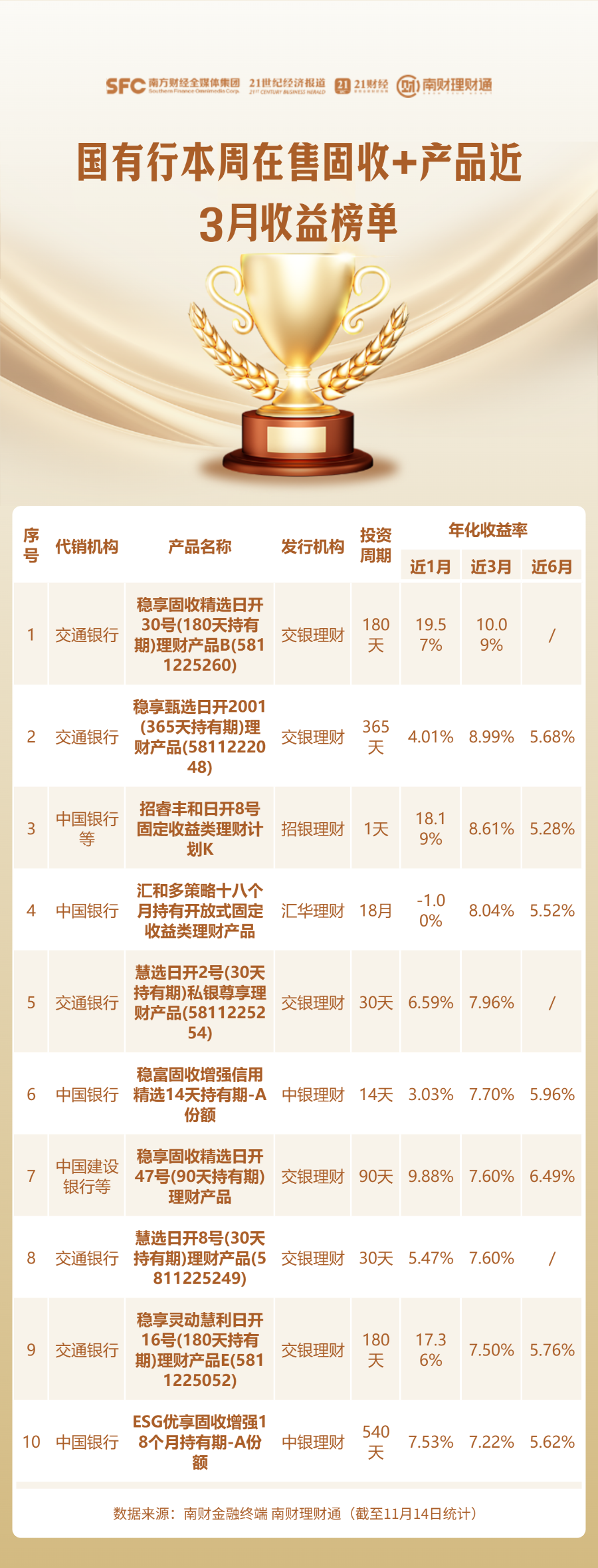
本周各银行在售“固收+”产品哪家强?
2 1 Shi Ji Jing Ji Bao Dao· 2025-11-17 01:20
Core Viewpoint - The article emphasizes the importance of selecting suitable wealth management products, particularly "fixed income+" products, from various banks, highlighting the need for investors to discern among numerous similar offerings [1][5]. Summary by Category Performance Ranking - The article presents a performance ranking of wealth management products based on their annualized returns over the past month, three months, and six months, with a focus on the three-month annualized yield for recent market performance [1][5]. Institutions Involved - A total of 28 banks are involved in the distribution of these wealth management products, including major institutions such as Industrial and Commercial Bank of China, Bank of China, Agricultural Bank of China, and others [1]. Product Selection - The ranking aims to assist investors in identifying high-performing products, with specific attention to the "fixed income+" category, which has gained popularity among investors seeking stable returns [1][5]. Market Dynamics - The article notes that the availability of these products may vary due to factors such as sold-out quotas or differences in product listings across banks, suggesting that investors should verify product availability through the respective bank's app [1].







下周,多家银行派发“现金红包”
Zhong Guo Zheng Quan Bao· 2025-11-16 09:15
南京银行将于11月20日进行2025年中期现金红利发放。该次利润分配以方案实施前的该行总股本123.64 亿股为基数,每股派发现金红利0.3062元(含税),共计派发现金红利37.86亿元。 中信银行将于11月21日进行2025年中期现金红利发放。该次利润分配以截至股权登记日的该行普通股总 股本556.45亿股为基数,向全体股东每股派发现金红利0.188元(含税),共计派发现金红利104.61亿 元。其中A股股本为407.63亿股,派发A股现金红利76.63亿元。 自9月以来,多家银行2025年中期分红已陆续落地。截至11月15日,已有上海银行(601229)、平安银 行(000001)、张家港行(002839)、沪农商行(601825)、长沙银行(601577)、苏农银行 (603323)、民生银行(600016)、常熟银行(601128)8家银行已派发2025年中期现金红利。 下周,四家A股上市银行将实施2025年中期分红。苏州银行(002966)、杭州银行(600926)、南京银 行(601009)、中信银行(601998)将分别于11月17日、18日、20日、21日进行2025年中期分红,分红 金额合 ...



上市银行中期分红热潮持续:国有大行领衔 中小银行加速跟进
Huan Qiu Wang· 2025-11-16 01:37
Core Insights - A total of 8 A-share listed banks have completed their mid-term dividend distributions for 2025, with notable first-time distributions from banks like Changshu Bank, Changsha Bank, and Su Nong Bank [1][3] - Minsheng Bank leads in dividend payout with a total of 5.954 billion yuan, while other banks like Suzhou Bank, Hangzhou Bank, and CITIC Bank are set to distribute dividends next week [1][3] - The trend of mid-term dividends is shifting from an optional practice to a positive factor for smaller banks, as evidenced by Hangzhou Bank's 24.10% year-on-year increase in its dividend payout [3] Summary by Category Dividend Distribution - As of this week, 23 A-share listed banks have disclosed their mid-term dividend plans, accounting for 56.10% of the total, with a cumulative payout of 257.586 billion yuan [3] - The six major state-owned banks collectively account for nearly 80% of the total mid-term dividend payouts, with Industrial and Commercial Bank of China leading at 50.396 billion yuan [3] First-time Dividend Payouts - Seven banks, including Changshu Bank, Ningbo Bank, and Zhangjiagang Bank, have initiated mid-term dividends for the first time, with Changshu Bank distributing 0.15 yuan per share, totaling 0.497 billion yuan [3][4] - Changsha Bank's payout is 0.20 yuan per share, amounting to 0.804 billion yuan, while Su Nong Bank and Zhangjiagang Bank's first-time payouts are 0.182 billion yuan and 0.244 billion yuan, respectively [3] Future Dividend Plans - Jiangyin Bank has announced a proposed dividend of 0.10 yuan per share, pending shareholder approval [4] - Zheshang Bank's vice president indicated that the bank has distributed over 13.2 billion yuan in dividends over the past three years and is considering future dividend arrangements based on policies and industry practices [4]


行业点评报告:社融延续降速,存款“搬家”部分流向理财
KAIYUAN SECURITIES· 2025-11-14 09:43
Investment Rating - The industry investment rating is "Positive" (maintained) [1] Core Viewpoints - The report highlights a continued slowdown in social financing and a shift of deposits towards wealth management products, indicating a need for observation regarding the recovery of resident confidence and corporate operational activity [5][6] - The report notes that the credit growth is slowing down, with new RMB loans added in October amounting to 220 billion yuan, a year-on-year decrease of 280 billion yuan, reflecting seasonal demand factors and constraints on credit expansion [3][4] - Government bonds remain the main contributor to social financing growth, with new government bonds issued in October at 489.3 billion yuan, marking the lowest monthly level for the year [4] Summary by Sections Credit Market Analysis - In October, the new RMB loans were 220 billion yuan, with a year-on-year decrease of 280 billion yuan, and the balance growth rate was 6.5%, down 0.1 percentage points from September [3] - The report indicates that corporate loans increased by 220 billion yuan year-on-year, primarily supported by a 331.2 billion yuan increase in bills, while residential borrowing intentions decreased [3][4] Social Financing Trends - In October, social financing increased by 815 billion yuan, a year-on-year decrease of 597 billion yuan, with a stock growth rate of 8.5%, down 0.2 percentage points from September [4] - The report emphasizes that while social financing growth has been declining since July, the overall downward trend has been limited, with government bonds continuing to play a significant role [4] Deposit and Liquidity Dynamics - The M2 money supply grew by 8.2% year-on-year, while M1 grew by 6.2%, indicating a shift towards demand deposits [5] - There is a notable trend of deposits moving from residents to non-bank financial institutions, with a significant increase of 770 billion yuan in non-bank deposits, suggesting a migration of funds towards wealth management products [5][6] Investment Recommendations - The report suggests that despite the ongoing slowdown in credit growth and social financing, the retail risk for listed banks remains manageable, supported by robust provisioning and stable dividend policies [6] - It recommends increasing allocations to the banking sector, particularly state-owned banks, which are seen as offering value relative to risk-free rates, highlighting specific banks such as CITIC Bank and others as beneficiaries [6]

2025年10月金融数据点评:社融信贷均偏弱,存款搬家继续演绎
Yin He Zheng Quan· 2025-11-14 07:21
Investment Rating - The report maintains a "Recommended" rating for the banking industry [1]. Core Viewpoints - The growth of social financing (社融) has slowed down, with October's new social financing amounting to 814.9 billion yuan, a year-on-year decrease of 597.1 billion yuan. The total social financing stock increased by 8.49% year-on-year, with a slight month-on-month decline of 0.18 percentage points [3]. - Demand for loans remains weak, with a notable decrease in both household and corporate financing needs. In October, the balance of RMB loans grew by 6.5% year-on-year, a decrease of 0.1 percentage points from the previous month [3]. - The phenomenon of "deposit migration" continues, as M1 and M2 growth rates have declined. In October, M1 and M2 increased by 6.2% and 8.2% year-on-year, respectively, with month-on-month declines of 1 percentage point and 0.2 percentage points [3]. Summary by Sections Social Financing - In October, the new social financing was 814.9 billion yuan, down 597.1 billion yuan year-on-year. The government bond issuance has weakened its support for social financing [3]. - RMB loans decreased by 20.1 billion yuan in October, a year-on-year reduction of 316.6 billion yuan. The issuance of new government bonds was 489.3 billion yuan, down 560.2 billion yuan year-on-year [3]. Loan Demand - The demand for loans from the real economy remains weak, with household loans decreasing by 360.4 billion yuan in October, a year-on-year drop of 520.4 billion yuan. Corporate loans increased by 350 billion yuan, primarily driven by a significant rise in bill financing [3]. Deposit Trends - The total RMB deposits in financial institutions increased by 610 billion yuan in October, a year-on-year increase of 100 billion yuan. However, household deposits decreased by 1.34 trillion yuan, indicating ongoing deposit migration [3]. - Non-bank deposits increased by 1.85 trillion yuan year-on-year, reflecting a shift in capital towards more active markets [3]. Investment Recommendations - The report suggests that the weakening support from government bonds for social financing and the ongoing weak loan demand necessitate attention to the effectiveness of new policy financial tools. The banking sector's transformation driven by the 14th Five-Year Plan is expected to provide opportunities for fundamental recovery [3]. - Specific stock recommendations include Industrial and Commercial Bank of China (601398), Agricultural Bank of China (601288), Postal Savings Bank of China (601658), Jiangsu Bank (600919), Hangzhou Bank (600926), and China Merchants Bank (600036) [3].



银行视角看25Q3货币政策执行报告:重提跨周期调节,保持合理利率比价关系维护息差稳定
Orient Securities· 2025-11-14 05:34
Investment Rating - The report maintains a "Positive" investment rating for the banking sector, indicating an expectation of relative outperformance compared to market benchmarks [6]. Core Viewpoints - The report highlights a cautious optimism regarding the banking sector's performance in Q4 2025, driven by stabilizing interest margins and improving fundamentals despite external uncertainties [3][4]. - It emphasizes the importance of maintaining a reasonable interest rate spread to support net interest margins, with a focus on effective monetary policy transmission [9][11]. Summary by Sections Investment Recommendations and Targets - The report identifies two main investment lines: 1. High-quality small and medium-sized banks with stable fundamentals, including targets like Chongqing Rural Commercial Bank (601077, Buy), Ningbo Bank (002142, Buy), and Nanjing Bank (601009, Buy) [4]. 2. Large state-owned banks with solid defensive value, such as Industrial and Commercial Bank of China (601398, Not Rated) and Agricultural Bank of China (601288, Not Rated) [4]. Banking Industry Overview - The report discusses the current state of the banking industry, noting a stabilization in interest margins and a cautious approach to monetary policy, with a focus on cross-cycle adjustments to enhance macroeconomic governance [9][11]. - It also mentions the need for a comprehensive macro-prudential management system to address risks in small financial institutions, suggesting that mergers and restructuring may accelerate [11]. Monetary Policy and Financial Conditions - The report indicates that the monetary policy will continue to be moderately accommodative, with a focus on maintaining reasonable growth in financial aggregates and credit [9][10]. - It highlights that the credit growth rate is expected to decline marginally, with a projected loan growth rate of 6.6% in Q3 2025 [9]. Interest Rate Dynamics - The report stresses the importance of maintaining a reasonable interest rate spread, with specific guidelines for banks to avoid issuing loans at rates lower than government bond yields [9][11]. - It notes that as of Q3 2025, the net interest margin for listed banks has stabilized, benefiting from a significant reduction in funding costs [9][11].



10月金融数据点评:社融增速仍承压,信贷偏弱,票据冲量
Orient Securities· 2025-11-14 04:45
Investment Rating - The report maintains a "Positive" outlook for the banking sector as of Q4 2025 [5][21]. Core Viewpoints - The report highlights that the growth of social financing remains under pressure, with a year-on-year increase of 8.5% in October 2025, which is a decrease of 0.2 percentage points compared to August [8][9]. - Credit growth is weak, with a notable reliance on bill financing to compensate for the decline in traditional loans [13][14]. - The report suggests that the banking sector is expected to show relative strength due to stabilizing interest margins and positive fundamental changes [21][22]. Summary by Sections Social Financing and Credit - In October 2025, social financing increased by 8.5% year-on-year, with a total increment of 815 billion yuan, which is 597 billion yuan less than the previous year [9][10]. - The total amount of RMB loans decreased by 201 million yuan, with a year-on-year decline of 3.166 billion yuan, indicating a seasonal dip in credit [8][9]. - Government bond issuance saw a year-on-year decrease of 560.2 billion yuan, further weakening the support for social financing [10][11]. - Direct corporate financing increased by 189.4 billion yuan, with bond financing up by 148.2 billion yuan and stock financing up by 41.2 billion yuan [10][11]. Loan Structure - Total RMB loans grew by 6.5% year-on-year, with new loans amounting to 220 billion yuan, which is 280 billion yuan less than the previous year [13][14]. - Household loans saw a significant decline, with short-term and medium-to-long-term loans both under pressure, leading to a year-on-year decrease of 5.156 billion yuan [13][14]. - Corporate loans primarily relied on bill discounting, which increased by 331.2 billion yuan year-on-year, while general loans saw a notable decrease [14][15]. Monetary Supply - M1 and M2 growth rates showed marginal declines, with M1 growing by 6.2% and M2 by 8.2% year-on-year [18][19]. - In October 2025, new RMB deposits totaled 610 billion yuan, with a year-on-year increase of 100 billion yuan, despite a significant drop in household deposits [18][20]. - Non-bank deposits increased significantly, indicating a shift away from traditional household savings [18][20]. Investment Recommendations - The report recommends focusing on high-quality small and medium-sized banks, with specific buy ratings for Chongqing Rural Commercial Bank, Ningbo Bank, Nanjing Bank, and Hangzhou Bank [21][22]. - It also suggests considering state-owned banks with stable fundamentals, such as Industrial and Commercial Bank of China, China Construction Bank, and Agricultural Bank of China, which are currently unrated [21][22].
银行研思录25:银行股息率排名与中期分红进度梳理-20251114
CMS· 2025-11-14 03:02
Investment Rating - The report does not explicitly state an investment rating for the banking sector, but it provides detailed insights into dividend yields and distribution processes, which can inform investment decisions. Core Insights - The report outlines the latest dividend yields and mid-term dividend processes for A and H shares of listed banks, emphasizing the importance of accurately calculating dynamic dividend yields to avoid discrepancies across periods [1][2]. - It details the two processes for mid-term dividends following the 2023 revision of the regulatory guidelines, highlighting the conventional and simplified processes for implementing mid-term dividends [2]. - The report provides a comprehensive overview of key dates related to dividend distribution for both A and H shares, including the importance of purchasing shares before the ex-dividend date to qualify for dividends [3][4]. Summary by Sections Dynamic Dividend Yield Calculation - A simplified yet accurate method for calculating dynamic dividend yield is introduced, defined as "rolling 12-month EPS * cash dividend rate / share price," which helps avoid issues related to overlapping or missing annual and mid-term dividends [1]. - The report calculates the cash dividend rate using a standardized approach across different banks, resulting in a clear comparison of dividend yields as of November 13, 2025 [1]. Mid-Term Dividend Processes - The report explains the two processes for mid-term dividends: the conventional process requiring shareholder approval and a simplified process allowing for quicker implementation [2]. - The simplified process is designed to enhance flexibility for companies in distributing mid-term dividends, thereby improving shareholder returns [2]. Dividend Distribution Key Dates - For A shares, investors must purchase shares before the ex-dividend date to receive dividends on the same day, while H shares typically see a delay of about one month for dividend payments [3][4]. - The report outlines the differences in the dividend distribution timeline between A and H shares, emphasizing the need for investors to be aware of these timelines to maximize their returns [3][4]. Mid-Term Dividend Progress - As of November 13, 2025, 31 A-share banks have confirmed mid-term dividends, while 11 H-share banks have also confirmed their dividend distributions [9][11]. - The report categorizes banks based on their dividend status, detailing those that have implemented dividends, those that are pending, and those that have opted not to distribute dividends [9][10][11]. - It highlights that the end of 2025 and early 2026 is expected to be a peak period for mid-term dividend distributions, suggesting potential investment opportunities for dividend-seeking investors [11].