HZBank(600926)

Search documents
中国银行:区域银行间的竞争
2025-08-25 01:38
Summary of Key Points from the Equity Research Report on China Banks Industry Overview - The report focuses on the **China banking sector**, particularly regional banks and city commercial banks, highlighting their performance and potential for growth amid economic conditions in China [3][9]. Core Insights and Arguments - **Sector Performance**: The China banking index increased by **3.9%** over the past 60 trading days, while the CSI 300 index rose by **7.4%** during the same period, driven by ample liquidity and positive economic releases for 1H25 [3]. - **Market Reaction**: The underperformance of the banking sector is attributed to investor concerns regarding the impact of the interest discount policy on banks' net interest margins (NIM). However, the report argues that the market has overreacted, as the policy aims to balance banks' interests with the financing costs of the real economy [3]. - **Focus on High-Quality Banks**: The report emphasizes a focus on high-quality city commercial banks, particularly those with lower exposure to property loans and stable NIM due to lending practices [3][4]. - **Preferred Stocks**: The report identifies **Bank of Hangzhou (BoHZ)**, **Bank of Chengdu (BoCD)**, and **Bank of Jiangsu (BoJS)** as preferred stocks, all rated as Buy, due to their strong asset quality, local economic conditions, and potential for high returns [3][6][9]. Financial Performance Expectations - **Earnings Growth**: The report anticipates marginally better earnings for 2Q25, with expectations of a recovery in non-interest income and stabilization of NIM due to falling liability costs [4]. - **NIM Stabilization**: It is expected that the NIM of top city commercial banks will stabilize in 2H25, supported by a decrease in liability costs and a net increase in mortgage loans in certain regions [4]. - **Credit Demand**: Weaker credit demand is anticipated compared to 1H, but city commercial banks with strong regional presence are expected to outperform their peers in loan growth [4]. Adjustments to Estimates - **Net Interest Income**: Estimates for net interest income have been raised due to expected stabilization of NIM in 2H25 [5]. - **Non-Interest Income**: Estimates for non-interest income have been lowered due to anticipated declines in investment gains amid weaker bond market performance [5]. - **Operating Expenses**: Operating expense estimates have been reduced due to the implementation of AI to enhance efficiency [5]. Regional Economic Strength - **Economic Conditions**: The report highlights the strong economic conditions in **Jiangsu**, **Zhejiang**, and **Sichuan** provinces, which are expected to support the growth of regional banks [23][24][25]. - **Infrastructure Investment**: Jiangsu is noted for its leading position in infrastructure investment and a robust pipeline of large projects, which will benefit local banks [24]. Risks and Valuation - **Key Risks**: The report outlines potential risks including slower-than-expected economic recovery, higher non-performing loan ratios, and adverse impacts from macroeconomic conditions [19][20]. - **Valuation Models**: The report employs the Gordon growth model with trading discounts to derive target prices for the banks covered, indicating significant upside potential for several banks [19][20]. Conclusion - The report concludes with a positive outlook for high-quality city commercial banks in China, emphasizing their potential for excess returns driven by regional economic strength and favorable lending conditions [3][9].



华安国企改革主题灵活配置混合A近一周上涨0.78%
Sou Hu Cai Jing· 2025-08-24 03:29
Group 1 - The core point of the article highlights the performance and holdings of the Huaan State-Owned Enterprise Reform Theme Flexible Allocation Mixed A Fund, which has a latest net value of 2.7230 yuan and a year-to-date return of -0.95% [1] - The fund was established on June 29, 2015, and is managed by Guan Peng, with a total scale of 355 million yuan as of June 30, 2025 [1] - The fund's top ten stock holdings include China Pacific Insurance, Shanghai Bank, Agricultural Bank of China, Hangzhou Bank, Jiangsu Bank, Nanjing Bank, Jiangsu Financial Leasing, Fujian Expressway, Dongwu Securities, and China Gold International, collectively accounting for 40.19% of the total holdings [1]




杭州银行持续优化金融供给 为实体企业高质量发展保驾护航
Zhong Guo Jing Ji Wang· 2025-08-24 01:54
Group 1 - The core viewpoint of the articles emphasizes Hangzhou Bank's commitment to enhancing financial services for the real economy, focusing on key areas such as manufacturing, private enterprises, and inclusive finance [1] - Hangzhou Bank has developed a comprehensive financing solution using pollution rights as collateral, successfully providing 50 million yuan in supply chain financing to a textile company undergoing industrial transformation [2] - The bank has actively promoted online supply chain financing, injecting 2.5 billion yuan into over 200 upstream enterprises since 2020, thereby supporting the real economy [2] Group 2 - Hangzhou Bank's Lishui branch has implemented a "1+3+N" inclusive finance team model to address the financing difficulties faced by small and micro enterprises, resulting in over 300 clients served and a credit amount exceeding 300 million yuan [3] - The bank has conducted extensive outreach activities to identify financing needs among small businesses, successfully disbursing 588 million yuan to various sectors, including logistics and automotive parts [3] - The bank has tailored a "swap financing" solution for export-oriented enterprises to mitigate risks associated with high dollar financing costs and exchange rate fluctuations, enhancing the financial service experience [4] Group 3 - Hangzhou Bank aims to continuously improve production efficiency and customer experience through a long-term strategy focused on digitalization, internationalization, and agile transformation [4]
银行新周期、新格局系列之再看盈利驱动:上市银行有望开启新一轮稳ROE周期
Shenwan Hongyuan Securities· 2025-08-23 15:38
Investment Rating - The report maintains a positive outlook on the banking sector, indicating a potential stabilization of ROE and a favorable investment environment for bank stocks [3][6]. Core Viewpoints - The banking sector is expected to enter a new cycle of stable ROE, with the average ROE projected to stabilize around 10% by the end of 2024, following a decline from over 20% in 2013 [3][7]. - The report emphasizes the importance of maintaining stable bank profits to support the economy and prevent systemic risks, highlighting that bank profits are crucial for fiscal support and capital replenishment [4][5]. - The report argues against the common misconception that declining ROE will continue indefinitely, attributing past declines to regulatory changes rather than a linear trend [3][7]. Summary by Sections Banking Sector Overview - The banking sector is described as the backbone of the economy, with profits primarily reinvested into the real economy through credit and capital replenishment [5][8]. - The report notes a decline in the core Tier 1 capital adequacy ratio for listed banks, indicating pressure on internal capital strength [11]. ROE Analysis - The report discusses the balance between profitability, risk, and capital in determining ROE, emphasizing the need for stable bank performance to support economic stability [5][6]. - It provides a detailed analysis of ROE trends, showing a decline from 20.7% in 2010 to an estimated 10% by 2024, influenced by regulatory changes and market conditions [7][31]. Profitability and Cost Management - The report highlights that banks have been managing profitability through cost control and provisioning strategies, with a shift from relying solely on provisions to maintaining revenue stability [6][14]. - It predicts a stabilization of net interest margins in the near term, with potential recovery in 2026 as deposit costs decrease [6][25]. Investment Opportunities - The report identifies specific banks with strong regional performance and stable profit growth as attractive investment opportunities, recommending banks like Chongqing Bank, Suzhou Bank, and Hangzhou Bank for their potential to recover to 1x PB [6][28]. - It also points out that the banking sector's current PE valuation is significantly undervalued compared to its ROE, suggesting a potential for valuation recovery [6][28]. Long-term Projections - The report estimates that to maintain a stable core Tier 1 capital adequacy ratio, banks need to sustain an ROE of approximately 10% over the next five years, with varying loan growth scenarios [18][22]. - It emphasizes that a slowdown in loan growth does not necessarily equate to lower ROE, as seen in comparisons with international banks [27][28].




红狮集团与子公司解除杭州银行股份转让协议,持股比例维持9.66%不变
Jing Ji Guan Cha Wang· 2025-08-23 04:49
Group 1 - Hangzhou Bank announced the termination of the share transfer agreement with Red Lion Holdings Group, which was originally set to transfer 659 million shares to its subsidiary, Zhejiang Red Lion Cement [1] - The termination is based on a comprehensive consideration of the group's strategic and management situation, aiming to better implement the dual main business development concept of "cement + polysilicon" [1] - After the termination, Red Lion Group's shareholding remains unchanged at 700 million shares, accounting for 9.66% of Hangzhou Bank's total share capital, with no impact on the control or governance of the bank [1]
杭州银行: 杭州银行关于股东解除协议转让公司股份的公告
Zheng Quan Zhi Xing· 2025-08-22 11:14
证券代码:600926 证券简称:杭州银行 公告编号:2025-066 优先股代码:360027 优先股简称:杭银优 1 杭州银行股份有限公司 关于股东解除协议转让公司股份的公告 本公司董事会、全体董事及相关股东保证本公告内容不存在 任何虚假记载、误导性陈述或者重大遗漏,并对其内容的真实性、 准确性和完整性承担法律责任。 重要内容提示: ?协议转让的基本情况:2024 年 2 月 6 日,杭州银行股份有 限公司(以下简称"公司""杭州银行")股东红狮控股集团有 限公司(以下简称"红狮集团")拟将其持有的杭州银行 水泥股份有限公司(以下简称"浙江红狮"),作为对该公司的 出资。 ?解除协议转让的情况:红狮集团基于对自身战略及管理实 际情况的综合考量,为更好地贯彻"水泥+多晶硅"双主业高质 量发展理念,保持集团资产结构的战略平衡,经与浙江红狮协商 一致,双方签署了《增资暨股份转让协议之解除协议》(以下简 称"《解除协议》")。 ?协议转让解除对公司的影响:红狮集团持有的公司股份保 持 700,213,537 股不变,占公司当前普通股股本总额的 9.66%。 近日,公司收到公司股东红狮集团通知,其与其控股子公司 浙 ...
杭州银行(600926) - 杭州银行关于股东解除协议转让公司股份的公告
2025-08-22 10:51
本公司董事会、全体董事及相关股东保证本公告内容不存在 任何虚假记载、误导性陈述或者重大遗漏,并对其内容的真实性、 准确性和完整性承担法律责任。 重要内容提示: 协议转让的基本情况:2024 年 2 月 6 日,杭州银行股份有 限公司(以下简称"公司""杭州银行")股东红狮控股集团有 限公司(以下简称"红狮集团")拟将其持有的杭州银行 659,060,619 股股票以协议转让方式转让给控股子公司浙江红狮 水泥股份有限公司(以下简称"浙江红狮"),作为对该公司的 出资。 解除协议转让的情况:红狮集团基于对自身战略及管理实 际情况的综合考量,为更好地贯彻"水泥+多晶硅"双主业高质 量发展理念,保持集团资产结构的战略平衡,经与浙江红狮协商 一致,双方签署了《增资暨股份转让协议之解除协议》(以下简 称"《解除协议》")。 证券代码:600926 证券简称:杭州银行 公告编号:2025-066 优先股代码:360027 优先股简称:杭银优 1 杭州银行股份有限公司 关于股东解除协议转让公司股份的公告 一、协议转让前期基本情况 2024 年 2 月 6 日,红狮集团与其控股子公司浙江红狮签订 《增资暨股份转让协议》,红狮集 ...
金融行业双周报(2025、8、8-2025、8、21)-20250822
Dongguan Securities· 2025-08-22 07:11
Investment Rating - The report maintains an "Overweight" rating for the insurance sector [2] Core Views - The insurance sector is undergoing a value reassessment during its transformation phase, highlighted by China Ping An's stake acquisition in China Pacific Insurance and China Life Insurance [3][52] - The report emphasizes the potential for high dividend yields in insurance stocks, which are increasingly being viewed similarly to bank stocks in terms of asset allocation [3][52] - The securities sector is experiencing explosive growth in mid-year performance forecasts, with notable profit increases from several listed brokerages [3][51] Summary by Sections Market Review - As of August 21, 2025, the banking, securities, and insurance indices have shown respective changes of -2.00%, +6.94%, and +2.13%, with the CSI 300 index up by +4.21% [15] - Agricultural Bank (+7.75%), Changcheng Securities (+33.37%), and China Pacific Insurance (+7.20%) were the best performers in their respective sectors [15] Valuation Situation - As of August 21, 2025, the banking sector's price-to-book (PB) ratio is 0.76, with state-owned banks at 0.80, joint-stock banks at 0.66, city commercial banks at 0.74, and rural commercial banks at 0.65 [25] - The report indicates that the securities sector has a PB ratio of 1.63, suggesting room for valuation recovery [30] Recent Market Indicators - The one-year Medium-term Lending Facility (MLF) rate is 2.0%, and the Loan Prime Rates (LPR) for one year and five years are 3.0% and 3.5%, respectively [35] - The average daily trading volume in A-shares reached 25,475.45 billion yuan, reflecting a 22.60% increase [37] Industry News - China Ping An's recent acquisitions in H-shares of China Pacific Insurance and China Life Insurance signal a strong belief in the long-term value of the insurance sector [42] - The report highlights a significant increase in insurance funds allocated to equities, with a rise from 7.3% to 8.47% in the proportion of insurance funds invested in stocks [42] Company Announcements - China Pacific Insurance reported a 9% year-on-year increase in original insurance premium income for the first seven months of 2025, totaling 185.96 billion yuan [46] - Jiangyin Bank's half-year report showed a 10.45% increase in operating income, reaching 2.40 billion yuan, with a net profit increase of 16.63% [46] Weekly Views - The report suggests focusing on banks that benefit from high economic growth areas and have strong performance certainty, such as Ningbo Bank, Hangzhou Bank, and Chengdu Bank [49] - In the insurance sector, the report recommends focusing on companies with strong growth in new business value and premium income, such as China Pacific Insurance and China Life Insurance [53]

开源证券:25Q2商业银行经营指标向上修复 红利资产仍具性价比
智通财经网· 2025-08-22 06:22
Core Viewpoint - The report from Kaiyuan Securities indicates that the total amount of high-interest fixed deposits maturing in 2025 for listed banks is approximately 39.7 trillion yuan, with a significant portion maturing in the first quarter [1] Group 1: Maturing Deposits - The estimated total of high-interest fixed deposits (2 years and above) maturing in 2025 is 39.7 trillion yuan, with 19.8 trillion yuan for 2-year, 17.4 trillion yuan for 3-year, and 2.5 trillion yuan for 5-year deposits [1] - The maturity schedule shows that 42% of these deposits will mature in Q1, followed by 16% in Q2, 18% in Q3, and 24% in Q4 [1] - An additional 19.6 trillion yuan of high-interest fixed deposits is expected to mature in the first half of 2026 [1] Group 2: Deposit Repricing and Cost Rate - The average cost rate for deposits is projected to decline to 1.61% in 2025 due to the repricing of fixed deposits, with quarterly rates expected to be 1.68%, 1.64%, 1.58%, and 1.53% for Q1, Q2, Q3, and Q4 respectively [5] - The repricing of fixed deposits is expected to improve the deposit cost rates by 11.7 basis points in Q1, 4.2 basis points in Q2, 5.7 basis points in Q3, and 5.1 basis points in Q4 [5] - For 2026, the average deposit cost rate is expected to further decline to 1.52% in the first half of the year [5] Group 3: Interest Rate Changes - The interest rate reduction for 2025 maturing 3-year deposits is estimated to be between 125 to 150 basis points, while 2-year deposits will see a reduction of 60 to 100 basis points [3] - The interest rate reduction for 2026 maturing deposits is projected to be 60 basis points for 2-year, 135 basis points for 3-year, and 145 basis points for 5-year deposits [4] Group 4: Investment Recommendations - Kaiyuan Securities suggests that the effective decrease in bank liability costs will alleviate the interest rate inversion phenomenon for government bonds, with a potential recovery in bond allocation space by Q4 2025 [6] - The report recommends investment in CITIC Bank and highlights beneficiaries such as Agricultural Bank of China, China Merchants Bank, Beijing Bank, Jiangsu Bank, Hangzhou Bank, and Chongqing Rural Commercial Bank [6]

杭州银行8月21日大宗交易成交223.31万元
Zheng Quan Shi Bao Wang· 2025-08-21 14:25
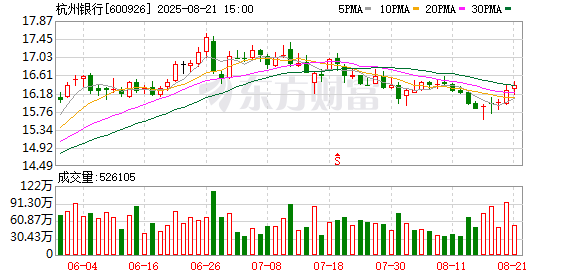
注:本文系新闻报道,不构成投资建议,股市有风险,投资需谨慎。 证券时报·数据宝统计显示,杭州银行今日收盘价为16.36元,上涨0.62%,日换手率为0.73%,成交额为 8.59亿元,全天主力资金净流出8338.02万元,近5日该股累计上涨3.41%,近5日资金合计净流出1.80亿 元。 两融数据显示,该股最新融资余额为23.13亿元,近5日减少7520.67万元,降幅为3.15%。(数据宝) 8月21日杭州银行大宗交易一览 | 成交量 | 成交金额 | 成交价格 | 相对当日收盘折溢 | 买方营业部 | 卖方营业部 | | --- | --- | --- | --- | --- | --- | | (万股) | (万元) | (元) | 价(%) | | | | 13.65 | 223.31 | 16.36 | 0.00 | 中信证券股份有限公司 | 华泰证券股份有限 | | | | | | 上海分公司 | 公司总部 | 杭州银行8月21日大宗交易平台出现一笔成交,成交量13.65万股,成交金额223.31万元,大宗交易成交 价为16.36元。该笔交易的买方营业部为中信证券股份有限公司上海分公司,卖方营业部 ...