CSEC,China Shenhua(601088)

Search documents
金十图示:2025年07月24日(周四)富时中国A50指数成分股午盘收盘行情一览:银行板块回吐昨日涨势,保险、酿酒、半导体等板块集体飘红
news flash· 2025-07-24 03:36
Core Points - The FTSE China A50 Index saw a mixed performance with the banking sector retreating from previous gains while insurance, liquor, and semiconductor sectors showed positive trends [1][6] Banking Sector - The banking sector experienced a decline, with notable stocks like China Everbright Bank showing a decrease of 0.24% [3] - Major banks such as China Pacific Insurance and China Life Insurance reported market capitalizations of 373.69 billion and 360.67 billion respectively, with slight increases in their stock prices [3] Insurance Sector - The insurance sector performed well, with China Pacific Insurance and China Life Insurance seeing stock price increases of 0.92% and 1.43% respectively [3] Liquor Industry - The liquor industry showed strong performance, with Kweichow Moutai, Shanxi Fenjiu, and Wuliangye reporting market capitalizations of 232.44 billion, 1871.65 billion, and 486.02 billion respectively [3] - Kweichow Moutai's stock price increased by 0.98% [3] Semiconductor Sector - The semiconductor sector also performed positively, with stocks like Northern Huachuang and Cambricon Technologies seeing increases of 1.70% and 1.24% respectively [3] - Market capitalizations for key players in this sector include 243.27 billion for Northern Huachuang and 250.71 billion for Cambricon Technologies [3] Oil Industry - The oil sector showed mixed results, with China Petroleum and China Petrochemical reporting market capitalizations of 1616.08 billion and 729.90 billion respectively [3] - China Petroleum's stock price decreased by 1.23% while China Petrochemical remained unchanged [3] Coal Industry - The coal industry saw positive movement, with stocks like Shenhua Group and Shaanxi Coal and Chemical Industry showing increases of 1.93% and 0.46% respectively [3] Automotive Sector - The automotive sector, represented by BYD, reported a market capitalization of 1893.35 billion with a stock price increase of 0.67% [3] Other Sectors - Various other sectors such as shipping, electricity, and securities also showed varied performances, with notable movements in stock prices and market capitalizations across different companies [4][3]







上证中央企业50指数上涨0.07%,前十大权重包含中信证券等
Sou Hu Cai Jing· 2025-07-23 08:02
金融界7月23日消息,A股三大指数收盘涨跌不一,上证中央企业50指数 (上证央企,000042)上涨 0.07%,报1815.1点,成交额992.2亿元。 数据统计显示,上证中央企业50指数近一个月上涨3.50%,近三个月上涨6.40%,年至今上涨1.94%。 从上证中央企业50指数持仓样本的行业来看,金融占比41.36%、工业占比22.84%、公用事业占比 10.80%、能源占比7.63%、通信服务占比6.40%、信息技术占比5.04%、原材料占比3.48%、可选消费占 比1.27%、房地产占比1.17%。 资料显示,指数样本每半年调整一次,样本调整实施时间分别为每年6月和12月的第二个星期五的下一 交易日。除非老样本因上市公司实际控制人变更导致的调整比例超过10%,原则上每次调整比例不超过 10%。定期调整设置缓冲区,排名在40名之前的新样本优先进入;排名在60名之前的老样本优先保留。 权重因子随样本定期调整而调整,调整时间与指数样本定期调整实施时间相同。在下一个定期调整日 前,权重因子一般固定不变。特殊情况下将对指数进行临时调整。当样本退市时,将其从指数样本中剔 除。样本公司发生收购、合并、分拆等情形的 ...


金十图示:2025年07月23日(周三)富时中国A50指数成分股今日收盘行情一览:石油、煤炭板块回吐涨幅,银行、保险板块多数收涨
news flash· 2025-07-23 07:07
富时中国A50指数连续 金十图示:2025年07月23日(周三)富时中国A50指数成分股今日收盘行情一览:石油、煤炭板块回吐涨幅,银行、保险板块多 数收涨 +0.05(+0.89%) +0.03(+0.36%) 0.00(0.00%) 光大银行 2505.23亿市值 7.54亿成交额 4.24 0.00(0.00%) 得經 中国平安 中国太保 中国人保 明 3719.24亿市值 3573.96亿市值 10561.94亿市值 11.79亿成交额 22.33亿成交额 50.21亿成交额 37.15 58.00 8.41 +0.96(+2.65%) +1.30(+2.29%) +0.03(+0.36%) 酿酒行业 贵州茅台 山西汾酒 五粮液 2314.39亿市值 18535.20亿市值 4859.77亿市值 66.76亿成交额 28.88亿成交额 22.23亿成交额 1475.50 125.20 189.71 +10.52(+0.72%) -1.07(-0.56%) -0.33(-0.26%) 半导体 北方华创 寒武纪-U 海光信息 HYGON 2392.12亿市值 2491.53亿市值 3141.81亿市值 39 ...







煤炭“反内卷”先行 隔夜焦煤期货价格大涨(附概念股)
Zhi Tong Cai Jing· 2025-07-23 00:20
Core Viewpoint - The recent policy from the National Energy Administration aims to regulate coal production, with expectations of reduced output in the future, impacting coal prices and production levels in the industry [2][3][6]. Production Regulation - The policy focuses on coal mines in eight provinces, including Shanxi and Inner Mongolia, with a specific emphasis on monitoring production against announced capacities for 2024 and the first half of 2025 [2]. - The notification is a reiteration of previous standards established in 2021, indicating a long-term regulatory approach rather than a new initiative [2]. - Current data shows that there has not been widespread overproduction at the provincial level, although individual companies may still exhibit imbalances [2][4]. - The enforcement of this policy will be closely monitored, particularly as it relates to the responsibilities of safety supervision agencies [5]. Production Impact - Current estimates suggest that overproduction in Shanxi, Shaanxi, Inner Mongolia, and Xinjiang could reach approximately 200 million tons, with a significant portion attributed to Xinjiang [6]. - The coal production growth rate from July 2024 to June 2025 is projected at 4.8%, indicating a high production level even without considering overproduction management [6]. Price Trends - Since June, there has been a recovery in coal prices, with thermal coal and coking coal prices increasing by approximately 6% and 17%, respectively [7]. - Factors contributing to the price increase include seasonal demand, inventory replenishment in the steel sector, a significant drop in imports, and a slowdown in production growth [8]. - The supply-demand balance is expected to shift from a loose state to a tighter one in the second half of the year [9]. Industry Outlook - The coal sector is anticipated to experience a valuation recovery due to changing expectations, with a focus on companies that exhibit high elasticity and low valuations [10]. - The current regulatory approach differs from past supply-side reforms, suggesting a more measured strategy that allows for gradual adjustments in the coal industry [10]. Key Companies - Relevant companies in the coal industry include China Coal Energy (601898), Yancoal Australia (03668), Yanzhou Coal Mining (600188), China Shenhua Energy (601088), and China Qinfa (00866) [11].


我国中东部地区煤炭产量衰减形势展望
Xinda Securities· 2025-07-22 13:31
Core Insights - The report highlights a significant decline in coal production in China's central and eastern regions, with projections indicating a potential exit of approximately 700 million tons of production by 2035, particularly in Shanxi province, which is expected to see the most pronounced decrease [3][4] - The shift in China's coal production focus from the central to the western regions is evident, with the share of production from the central and eastern regions (including Northeast) decreasing by 26% since 2004 [3] - The report emphasizes the limited economically extractable coal reserves in China, with confirmed and credible reserves totaling 2,185.7 billion tons as of the end of 2023, suggesting a potential extraction period of only about 30 years at the current production rate [3][12] Section Summaries 1. Limited Economically Extractable Coal Reserves - China's coal resources are abundant, but the economically extractable reserves are relatively scarce, with a significant portion of reserves located in the western regions [12][13] - The distribution of coal reserves is uneven, with the western regions holding approximately 66% of the total reserves, while the central and eastern regions account for only 28% and 6%, respectively [22][25] - The development of coal reserves in the central and eastern regions faces increasing challenges due to various factors, including deeper mining depths and ecological constraints [33] 2. Declining Coal Production in Central and Eastern Regions - The lifecycle of coal mines typically exhibits a pattern of initial ramp-up, stable production, and a sharp decline in later stages, with the central region's production expected to decrease significantly [2][4] - New coal mines are predominantly being established in the western regions, indicating limited potential for resource development in the central and eastern areas [4][5] - The report notes that the production capacity in key mining areas is rapidly depleting, with challenges in capacity succession becoming more pronounced [4][5] 3. Assessment of Decline Trends and Impacts - The central region, particularly Shanxi, is projected to see an accelerated decline in coal production, with an estimated exit of around 700 million tons by 2035 [4][5] - The report identifies that the consumption rate of coal resources in core mining areas is high, leading to challenges in maintaining production capacity [4][5] - The market for coal mining rights is becoming increasingly competitive, with state-owned enterprises facing structural disadvantages in resource acquisition [4][5] 4. Investment Recommendations - In light of the declining coal production trends in the central and eastern regions, the report suggests focusing on companies with long service life and abundant coal resources in these areas, such as Xinjie Energy and Huaibei Mining [4] - Companies with resources in the Jinshan-Mongolia region or those prioritizing resource acquisition in western Xinjiang are also recommended, including China Shenhua and Shaanxi Coal [4] - The report highlights the potential for asset injections from state-owned enterprises, suggesting that companies like Yanzhou Coal and China Shenhua may benefit from such developments [4]
27.04亿元主力资金今日抢筹煤炭板块
Zheng Quan Shi Bao Wang· 2025-07-22 11:05
Group 1 - The Shanghai Composite Index rose by 0.62% on July 22, with 22 industries experiencing gains, led by coal and building materials, which increased by 6.18% and 4.49% respectively [1] - The coal industry saw a significant increase of 6.18%, with a net inflow of 2.704 billion yuan in main funds, and all 37 stocks in this sector rose, with 6 hitting the daily limit [1] - Among the coal stocks, Shanxi Coking Coal had the highest net inflow of 400 million yuan, followed by China Shenhua and Shanxi Coal International with inflows of 386 million yuan and 301 million yuan respectively [1] Group 2 - The top-performing coal stocks included Shanxi Coking Coal (+10.07%), China Shenhua (+4.53%), and Shanxi Coal International (+10.04%), with significant trading volumes and turnover rates [1] - The coal stocks with the largest net outflows included Electric Power Investment Energy, Panjiang Coal, and Kailuan Energy, with outflows of 18.5492 million yuan, 8.4557 million yuan, and 8.0404 million yuan respectively [1]


煤炭概念涨3.83%,主力资金净流入47股
Zheng Quan Shi Bao Wang· 2025-07-22 09:20
Group 1 - The coal sector saw an increase of 3.83%, ranking fifth among concept sectors, with 70 stocks rising, including Shanxi Coking Coal, Haohua Energy, and Shanmei International hitting the daily limit [1][2] - Notable gainers included Pingmei Shenma, China Coal Energy, and Qingsong Construction, which rose by 9.90%, 9.42%, and 8.43% respectively [1][2] - The sector experienced a net inflow of 2.608 billion yuan, with 47 stocks receiving net inflows, and 11 stocks exceeding 100 million yuan in net inflow [2][3] Group 2 - The top net inflow stocks included Tebian Electric, Shanxi Coking Coal, and China Shenhua, with net inflows of 629 million yuan, 400 million yuan, and 386 million yuan respectively [2][3] - The net inflow ratios for Xining Special Steel, Shanmei International, and Shanxi Coking Coal were 39.52%, 28.45%, and 19.64% respectively [3] - The coal sector's performance was contrasted by declines in stocks like Huayin Power, YN Energy, and Hezhu Intelligent, which fell by 3.63%, 3.19%, and 2.98% respectively [1][4]

A股收评 | 沪指5连阳!成交再度放量 雅下水电概念继续发酵
智通财经网· 2025-07-22 07:18
Market Overview - The market showed an overall upward trend with the Shanghai Composite Index achieving a five-day winning streak and increased trading volume [1] - The coal sector experienced a sudden surge, with stocks like Shanxi Coking Coal and Shanmei International hitting the daily limit, driven by a notice from the National Energy Administration regarding coal mine production inspections [1][4] - Other sectors such as hydropower, civil explosives, engineering machinery, cement, and steel also saw significant gains, with leading companies like China Power Construction and China Energy Construction achieving consecutive gains [1] Stock Performance - A total of 2,540 stocks rose while 2,724 declined, with 114 stocks hitting the daily limit and 11 stocks hitting the lower limit [2] - High-profile stock Weiqi New Materials achieved a record of 10 consecutive daily limits, with a cumulative increase of over 519% [1] Fund Flow - Main capital inflows were observed in coal mining, liquor, battery, photovoltaic equipment, and energy metals sectors [3] - Conversely, there were capital outflows from IT services, automotive parts, software development, general equipment, and diversified finance sectors [3] Policy and Regulatory Updates - The National Energy Administration announced a crackdown on coal mines exceeding production capacity to stabilize coal supply and market order [4] - Shenzhen is expected to see reforms that will allow companies listed in Hong Kong to return to the Shenzhen Stock Exchange [5] Market Outlook - China Galaxy expressed optimism about the market, indicating that the Shanghai Composite Index is likely to maintain above 3,500 points, suggesting a potential upward trend [2][7] - Long-term expectations for the coal sector remain positive, with anticipated strong coal prices and a peak demand season approaching [8] - Huazhong Securities forecasted that the technology sector will continue to perform strongly, supported by macroeconomic policies aimed at stabilizing the economy [9]


煤炭股走强,沪深300自由现金流ETF摩根(563900)跟踪指数上涨1.46%,盘中点位创年内新高
Xin Lang Cai Jing· 2025-07-22 06:37
Group 1 - The core viewpoint is that the A-share market is currently at a historically low valuation level, presenting strong allocation value [2] - The Hu-Shen 300 Free Cash Flow ETF Morgan (563900) has seen a continuous inflow of funds, totaling 289 million yuan over the past 12 days [1] - The Hu-Shen 300 Free Cash Flow Index reflects the performance of 50 listed companies with high free cash flow rates, indicating strong cash flow generation capabilities [2] Group 2 - China Shenhua's dividend rate for 2024 is projected to be 76.5%, continuing a trend of over 70% for four consecutive years, making it a representative of high dividend assets [2] - The coal industry is experiencing a tightening supply-demand relationship, supported by economic recovery and increased electricity demand, which is expected to bolster thermal coal prices [2] - The Hu-Shen 300 Free Cash Flow ETF Morgan has reached a new high in scale at 429 million yuan since its inception [1]
主力资金监控:计算机板块净流出超88亿
news flash· 2025-07-22 06:26
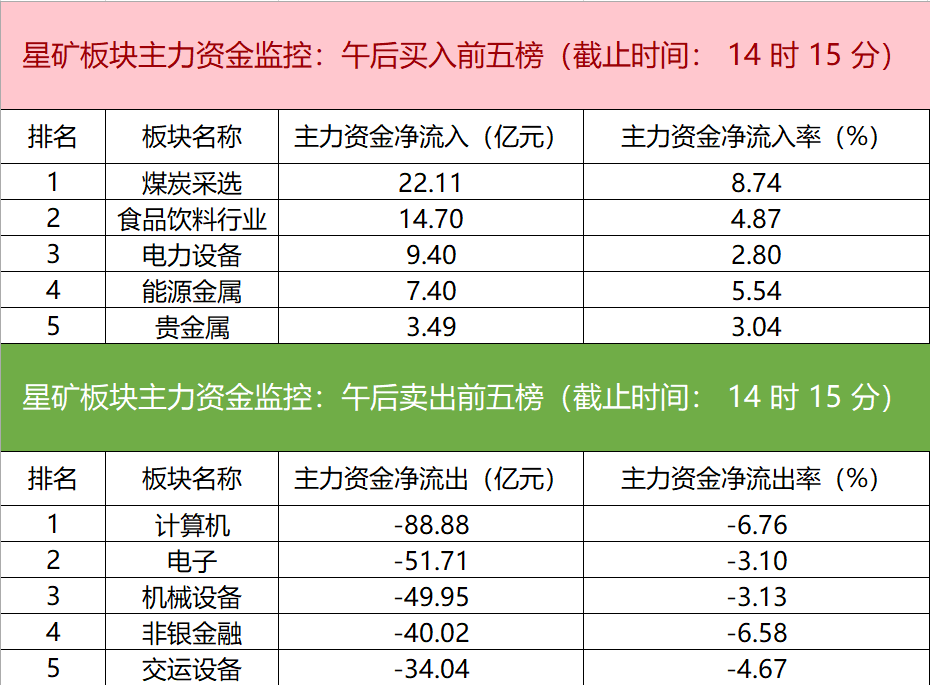
主力资金监控:计算机板块净流出超88亿 | 排名 | 板块名称 | 主力资金净流出 (亿元) | 主力资金净流出率(%) | | --- | --- | --- | --- | | 7 | 计算机 | -88.88 | -6.76 | | 2 | 电子 | -51.71 | -3.10 | | 3 | 机械设备 | -49.95 | -3.13 | | ব | 非银金融 | -40.02 | -6.58 | | 5 | 交运设备 | -34.04 | -4.67 | 星矿主力资金监控: 午后买入前十榜 (截止时间: 14时 15 分) | 排名 | 股票名称 | 主力资金净流入(亿元) | 主力资金净流入率(%) | | --- | --- | --- | --- | | 1 | 长城军工 | 8.52 | 18.40 | | 2 | 特变电工 | 5.14 | 10.48 | | 3 | 贵州茅台 | 4.86 | 10.47 | | র | 歌尔股份 | 4.75 | 11.93 | | 5 | 宁德时代 | 4.02 | 5.02 | | 6 | 五粮液 | 3.61 | 11.86 | | 1 | 中 ...