
SHCI(601225)

Search documents
指数周线4连阳,39只中证A500基金集体上涨
2 1 Shi Ji Jing Ji Bao Dao· 2025-08-29 12:11
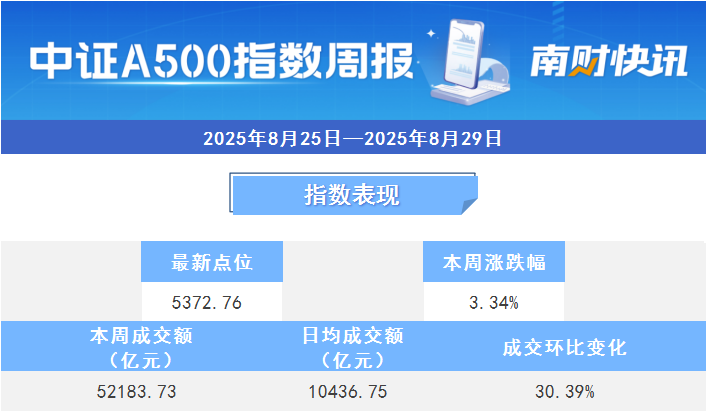
Index Performance - The CSI A500 Index increased by 3.34% this week, marking four consecutive weeks of gains, closing at 5372.76 points on August 29 [4][5] - The average daily trading volume for the week was 10,436.75 billion yuan, with a week-on-week increase of 30.39% [4][5] Component Stock Performance - The top ten gainers this week included Tianfu Communication (61.54%), Yanshan Technology (34.86%), and Shenzhen South Circuit (32.07%) [3] - The top ten losers included Berteli (-11.09%), Giant Star Technology (-9.33%), and Weining Health (-7.78%) [3] Fund Performance - All 39 CSI A500 funds reported positive returns, with the highest increase from Guolian An at 4.72% [5] - The total scale of CSI A500 funds reached 1884.32 billion yuan, showing an increase compared to the previous week [5] - The top three funds by scale were Huatai-PB (210.84 billion yuan), E Fund (198.54 billion yuan), and Guotai Fund (195.83 billion yuan) [5] Market Outlook - Current market conditions support continued stock market growth, with reasonable valuations and emerging positive factors such as a potential interest rate cut cycle by the Federal Reserve [6] - The market is expected to experience a "rotation and rebound" characteristic, with short-term rebound opportunities being more noteworthy [7] - In September, basic factors may have a weaker impact on the market, but liquidity-driven trading is at historical highs, suggesting a potential shift in market dynamics [7]


陕西煤业(601225):降本对冲煤价下滑影响,发售电量下降致收入承压
Tianfeng Securities· 2025-08-29 04:45
Investment Rating - The report maintains a "Buy" rating for the company, with a target price not specified [6]. Core Views - The company's revenue for H1 2025 is reported at 77.983 billion yuan, a year-on-year decrease of 14.19%, while the net profit attributable to the parent company is 7.638 billion yuan, down 31.18% year-on-year [1]. - The coal business revenue is 68.378 billion yuan, reflecting an 11.67% decrease year-on-year, despite a slight increase in coal production and sales [2]. - The electricity business revenue is 6.775 billion yuan, down 11.21% year-on-year, with a notable decline in electricity sales volume [3]. - The report adjusts the net profit forecasts for 2025-2026 to 16.04 billion yuan and 17.29 billion yuan, respectively, and introduces a new forecast of 17.77 billion yuan for 2027 [3]. Financial Performance Summary - H1 2025 operating revenue: 77.983 billion yuan, down 14.19% year-on-year - H1 2025 operating cost: 56.071 billion yuan, down 6.43% year-on-year - H1 2025 net profit attributable to the parent: 7.638 billion yuan, down 31.18% year-on-year - H1 2025 coal production: 87.4 million tons, up 1.15% year-on-year - H1 2025 coal sales: 80.16 million tons, up 2.87% year-on-year - H1 2025 average coal price: 439.67 yuan/ton, down 23.81% year-on-year [1][2][3]. Financial Data and Valuation - Projected operating revenue for 2025: 148.454 billion yuan, with a growth rate of -19.38% - Projected net profit for 2025: 16.040 billion yuan, with a growth rate of -28.26% - Projected EPS for 2025: 1.65 yuan/share - Projected P/E ratio for 2025: 12.93 [4][10].

中炬高新目标价涨幅超83%,五粮液等10股评级被调低丨券商评级观察
2 1 Shi Ji Jing Ji Bao Dao· 2025-08-29 01:47
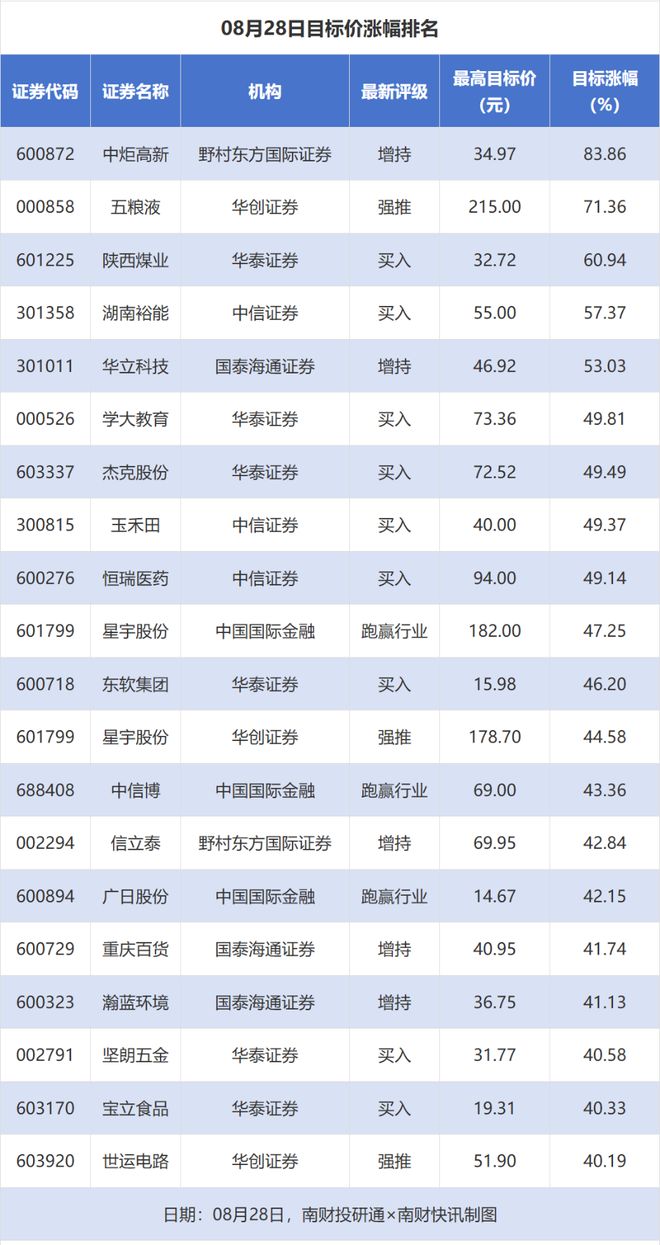
Core Viewpoint - On August 28, 2023, brokerage firms provided target prices for listed companies a total of 225 times, with notable increases in target prices for companies such as Zhongju Gaoxin, Wuliangye, and Shaanxi Coal, showing increases of 83.86%, 71.36%, and 60.94% respectively, across the seasoning, liquor, and coal mining industries [1][2]. Target Price Increases - Zhongju Gaoxin received a target price increase of 83.86%, with a new target price of 34.97 yuan [2] - Wuliangye's target price increased by 71.36%, with a new target price of 215.00 yuan [2] - Shaanxi Coal's target price rose by 60.94%, with a new target price of 32.72 yuan [2] - Other companies with significant target price increases include Hunan YN (57.37%), Huali Technology (53.03%), and Xueda Education (49.81%) [2][3] Brokerage Recommendations - A total of 379 listed companies received brokerage recommendations on August 28, with Wuliangye receiving the highest number of recommendations at 10 [3][4] - China Life received 8 recommendations, while Shaanxi Coal received 7 [3][4] Rating Adjustments - Six companies had their ratings upgraded, including Hualing Steel from "Hold" to "Buy" by Zhongtai Securities, and Wanhe Electric from "Hold" to "Buy" by CITIC Securities [5] - Ten companies had their ratings downgraded, including Tiens Wind Power from "Buy" to "Hold" by Everbright Securities, and China Nuclear Power from "Strong Buy" to "Hold" by CMB Securities [6] First Coverage - On August 28, 11 companies received their first coverage from brokerages, including Xin'an Shares rated "Buy" by Debon Securities and Zhujiang Beer rated "Hold" by Western Securities [7]


煤炭与电子等行业重点公司中报点评
GOLDEN SUN SECURITIES· 2025-08-29 00:46
Overview - The report provides insights into the performance of various companies across different industries, highlighting key financial metrics and growth prospects for the first half of 2025 [1][2]. Key Insights - The coal industry shows signs of recovery with companies like 潞安环能 and 山煤国际 reporting improved performance in Q2 2025, driven by increased production and cost optimization [34][40]. - The electric equipment sector is witnessing stability in pricing due to the phosphoric iron lithium development initiative, which aims to support sustainable growth in the industry [5]. - The construction and decoration industry, represented by companies like 中国建筑 and 矩阵股份, is experiencing accelerated growth in Q2 2025, with improved cash flow and profitability [10][14]. - The agricultural sector, particularly 温氏股份, is seeing a rebound in chicken prices, which is expected to enhance profitability in the latter half of 2025 [12]. - The media and entertainment industry, with companies like 风语筑 and 荣信文化, is leveraging AI and digital transformation to enhance revenue streams and improve financial performance [18][27]. Company Summaries Coal Industry - 潞安环能 reported a Q2 2025 revenue of 71.01 billion yuan, a decrease of 21.05% year-on-year, but with a significant improvement in production and cost management [34]. - 山煤国际's Q2 2025 revenue was 51.58 billion yuan, down 33.03% year-on-year, but the company is optimistic about recovery due to rising coal prices in the second half of the year [40]. Electric Equipment - The phosphoric iron lithium initiative aims to stabilize prices and improve profitability for companies in the sector, with a focus on sustainable development [5]. Construction and Decoration - 中国建筑 achieved a Q2 2025 net profit of 466 billion yuan, reflecting a 1% increase year-on-year, supported by improved cash flow and reduced impairment losses [10]. - 矩阵股份 reported a significant increase in net profit, with a 103% growth in non-recurring profit, driven by enhanced asset quality and cash flow [14]. Agriculture - 温氏股份 sold 1,793.19 million pigs in H1 2025, a 25% increase year-on-year, with a notable drop in costs leading to improved profitability [12]. Media and Entertainment - 风语筑's H1 2025 revenue grew by 33.97% to 7.75 billion yuan, marking a turnaround to profitability, while 荣信文化 is focusing on AI-driven marketing strategies to enhance growth [18][27]. Financial Projections - The report includes projections for various companies, indicating expected growth in net profits for 2025-2027 across multiple sectors, with specific figures provided for companies like 海尔智家 and 龙净环保 [28][30].






国海证券晨会纪要-20250829
Guohai Securities· 2025-08-29 00:02
Group 1 - The report highlights a sustained strengthening of GMV inflection points, indicating optimism for long-term growth in the education sector, particularly for Oriental Selection [4][5] - The report notes a significant increase in the dividend payout ratio to 60% for Excellence Education Group, which may support revenue growth in the second half of 2025 [10][11] - Shanghai Film's performance is under short-term pressure, but the release of "Wang Wang Mountain Little Monster" is expected to provide performance elasticity [13][15] Group 2 - Huabei Mining's revenue for H1 2025 decreased by 45% year-on-year, but cost control measures are expected to enhance future performance as quality projects are gradually put into production [19][21] - The report indicates that the pet ecosystem construction by Reap Bio is becoming increasingly comprehensive, with a notable increase in revenue and net profit in H1 2025 [24][25] - Silver Wheel's revenue and net profit showed significant growth in Q2 2025, driven by dual engines of "server liquid cooling + robotic joints" [27][29] Group 3 - Shaanxi Coal's production and sales volumes remained stable, with a slight increase in coal production in H1 2025, despite a decrease in revenue [31][33] - China Ruyi's net profit turned from loss to profit in H1 2025, driven by game publishing and content investment [36][37] - Light Media's animation production capacity continues to improve, with IP operations expected to become a new growth point [40][42] Group 4 - Cambrian's revenue for H1 2025 saw an extraordinary increase of 4347.82% year-on-year, with net profit also experiencing substantial growth [46]



陕西煤业(601225):煤炭产销量稳中有增 公允价值变动损益扭亏
Xin Lang Cai Jing· 2025-08-28 10:26
Core Viewpoint - In the first half of 2025, the company experienced a decline in revenue and net profit, attributed to lower coal prices and reduced electricity sales, despite stable production and sales volumes in coal [1][2][3]. Financial Performance - The company reported a revenue of 77.983 billion yuan in the first half of 2025, a decrease of 14.19% year-on-year [1]. - The net profit attributable to shareholders was 7.638 billion yuan, down 31.18% year-on-year, with a basic earnings per share of 0.79 yuan, also reflecting a 31% decline [1]. - The weighted average return on equity (ROE) was 8.02%, a decrease of 2.66 percentage points year-on-year [1]. Coal Production and Sales - Coal production reached 87.3964 million tons in the first half of 2025, an increase of 1.15% year-on-year, while coal sales were 125.9892 million tons, up 0.92% year-on-year [2]. - The average selling price of coal was 439.67 yuan per ton, down 23.81% year-on-year, with the cost of raw coal at 280 yuan per ton, a slight decrease of 0.49% [2]. Electricity Business - Total electricity generation was 17.769 billion kilowatt-hours, a decrease of 11.82% year-on-year, while total electricity sales were 16.619 billion kilowatt-hours, down 11.38% year-on-year [3]. - The average electricity selling price increased by 0.19% to 407.64 yuan per megawatt-hour, while the total generation cost rose slightly to 342.59 yuan per megawatt-hour [3]. Dividends and Investments - The company announced a mid-year dividend of 0.039 yuan per share, corresponding to a dividend yield of 0.18% based on the stock price as of August 27 [3]. - The company reported a fair value gain of 447 million yuan in the first half of 2025, recovering from a loss of 641 million yuan in the same period of 2024 [3]. Profit Forecast and Valuation - Revenue projections for 2025-2027 are 157.2 billion yuan, 167.2 billion yuan, and 178 billion yuan, with net profits expected to be 16.8 billion yuan, 18.3 billion yuan, and 20.2 billion yuan respectively [4]. - The estimated earnings per share (EPS) for the same period are 1.74 yuan, 1.89 yuan, and 2.09 yuan, with corresponding price-to-earnings (PE) ratios of 12.32, 11.33, and 10.24 [4].
煤炭开采板块8月28日跌1.12%,陕西煤业领跌,主力资金净流出2.99亿元
Zheng Xing Xing Ye Ri Bao· 2025-08-28 08:42
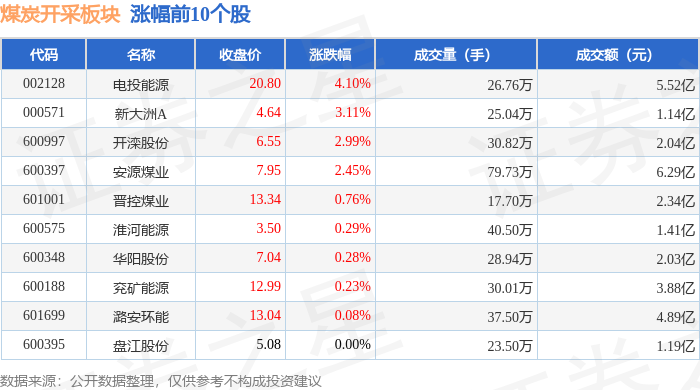
证券之星消息,8月28日煤炭开采板块较上一交易日下跌1.12%,陕西煤业领跌。当日上证指数报收于 3843.6,上涨1.14%。深证成指报收于12571.37,上涨2.25%。煤炭开采板块个股涨跌见下表: | 代码 | 名称 | 收盘价 | 涨跌幅 | 成交量(手) | 成交额(元) | | | --- | --- | --- | --- | --- | --- | --- | | 002128 | 电投能源 | 20.80 | 4.10% | 26.76万 | | 5.52亿 | | 000571 | 新大洲A | 4.64 | 3.11% | 25.04万 | | 1.14亿 | | 600997 | 开滦股份 | 6.55 | 2.99% | 30.82万 | | 2.04亿 | | 600397 | 安源煤业 | 7.95 | 2.45% | 79.73万 | | 6.29亿 | | 601001 | 晋控煤业 | 13.34 | 0.76% | 17.70万 | | 2.34亿 | | 600575 | 淮河能源 | 3.50 | 0.29% | 40.50万 | | 1.41亿 | | 60034 ...


陕西煤业(601225):2025年半年报点评:煤炭产销量稳中有增,公允价值变动损益扭亏
Guohai Securities· 2025-08-28 08:35
Investment Rating - The investment rating for the company is "Buy" (maintained) [1][10] Core Views - The company's coal production and sales have shown steady growth, with a production volume of 87.4 million tons in the first half of 2025, up 1.15% year-on-year, and sales volume of 125.99 million tons, up 0.92% year-on-year [6][9] - The average selling price of coal decreased by 23.81% year-on-year to 439.67 CNY/ton, leading to a narrowing of profit margins [6][9] - The company reported a net profit of 7.64 billion CNY in the first half of 2025, down 31.18% year-on-year, with a basic earnings per share of 0.79 CNY, also down 31% [4][9] Recent Performance - In the second quarter of 2025, the company achieved a revenue of 37.82 billion CNY, a decrease of 20.46% year-on-year, and a net profit of 2.83 billion CNY, down 54.55% year-on-year [5][9] - The company's total power generation decreased by 11.82% year-on-year to 177.69 billion kWh, with total sales of 166.19 billion kWh, also down 11.38% year-on-year [6][9] Financial Forecast - The projected revenues for 2025-2027 are 157.22 billion CNY, 167.17 billion CNY, and 177.97 billion CNY respectively, with net profits expected to be 16.83 billion CNY, 18.31 billion CNY, and 20.25 billion CNY [8][9] - The estimated earnings per share for 2025, 2026, and 2027 are 1.74 CNY, 1.89 CNY, and 2.09 CNY respectively, with corresponding P/E ratios of 12.32, 11.33, and 10.24 [8][9] Dividend Policy - The company has implemented a mid-year dividend for 2025, distributing 0.039 CNY per share, corresponding to a dividend yield of 0.18% [6][9]
陕西煤业(601225):2025年中报点评:煤价拖累业绩下滑,中期分红积极回馈
Western Securities· 2025-08-28 07:50
Investment Rating - The investment rating for the company is "Buy" [4][8]. Core Views - The company's performance has significantly declined due to a 22.74% year-on-year drop in coal prices, leading to a 14.19% decrease in revenue to 779.83 billion yuan and a 31.18% drop in net profit to 76.38 billion yuan in the first half of 2025 [1][4]. - Despite the decline in performance, the company is committed to high dividends, distributing 0.39 yuan per share, totaling 3.82 billion yuan, which is 5% of the net profit attributable to shareholders [2][4]. - The company maintains its profit forecast for 2025-2027, expecting net profits of 195.13 billion yuan, 215.73 billion yuan, and 227.88 billion yuan respectively, with EPS of 2.01 yuan, 2.23 yuan, and 2.35 yuan [2][4]. Financial Summary - In the first half of 2025, the company achieved a coal production of 87.3964 million tons, an increase of 1.15% year-on-year, and coal sales of 125.9892 million tons, an increase of 0.92% year-on-year [1]. - The total power generation was 177.69 billion kWh, down 11.82% year-on-year, and total electricity sales were 166.19 billion kWh, down 11.38% year-on-year [1]. - The company's financial metrics indicate a projected decline in revenue growth rate of -9.5% for 2025, followed by a recovery of 6.7% in 2026 and 3.0% in 2027 [7].
陕西煤业(601225):煤炭产销量稳中有进,下半年业绩回升可期
Xinda Securities· 2025-08-28 07:37
Investment Rating - The investment rating for Shaanxi Coal and Chemical Industry Co., Ltd. is "Buy" [1] Core Views - The report indicates that coal production and sales are steadily increasing, although performance is impacted by declining prices. Cost control remains stable [3] - The power business operates smoothly, with ongoing projects providing growth potential [3] - The second quarter's performance was under pressure due to falling coal prices and one-time tax impacts, but a recovery is expected in the second half of the year [3] - The coal main business is growing steadily, with quality production capacity gradually being released [3] - The coal-electricity integration strategy enhances performance and offers significant future growth potential [3][4] Financial Summary - For the first half of 2025, the company achieved operating revenue of 77.983 billion yuan, a year-on-year decrease of 14.19%, and a net profit attributable to shareholders of 7.638 billion yuan, down 31.18% [1] - In the second quarter, the company reported operating revenue of 37.821 billion yuan, a year-on-year decline of 20.46%, and a net profit of 2.834 billion yuan, down 54.55% [2] - The company’s coal production reached 87.3964 million tons, a year-on-year increase of 1.15%, and coal sales were 125.9892 million tons, up 0.92% [3] - The average coal price was 439.67 yuan/ton, down 23.81% year-on-year, while the cost of raw coal was 280 yuan/ton, a decrease of 0.49% [3] - The company plans to distribute a cash dividend of 0.39 yuan per share, totaling 382 million yuan, which represents 5% of the net profit for the period [6] - Future profit forecasts estimate net profits of 15.7 billion yuan, 16.8 billion yuan, and 17 billion yuan for 2025, 2026, and 2027 respectively, with EPS projected at 1.62, 1.73, and 1.75 yuan per share [6]