SHCI(601225)

Search documents
——煤炭行业2025年年报业绩前瞻:下半年煤价及行业利润边际改善,煤价筑底、盈利回升可期
Shenwan Hongyuan Securities· 2026-01-23 11:54
Investment Rating - The report maintains a positive outlook on the coal industry, suggesting an "Overweight" rating, indicating that the industry is expected to outperform the overall market [22]. Core Insights - The coal industry is anticipated to see a recovery in prices and profits in the second half of 2025, driven by seasonal demand and improved market conditions [1]. - Domestic raw coal production is projected to grow slightly by 1.2% year-on-year in 2025, while coal imports are expected to decline by 9.6% [2][11]. - The fourth quarter of 2025 is expected to witness a significant rebound in both thermal coal and coking coal prices, with thermal coal prices rising approximately 13.9% quarter-on-quarter [2][15]. Summary by Sections Supply and Demand Dynamics - Domestic raw coal production for 2025 is estimated at 4.832 billion tons, reflecting a year-on-year increase of 1.2%. Monthly production figures for October, November, and December are projected at 407 million, 427 million, and 437 million tons, respectively, with slight declines in growth rates [5]. - Coal imports for 2025 are expected to total 490 million tons, a decrease of 9.6% compared to the previous year, with notable monthly fluctuations in the last quarter [11]. Price Trends - In Q4 2025, the average spot price for thermal coal at Qinhuangdao port is projected to be around 767 RMB/ton, down 6.99% year-on-year but up 13.9% from Q3 2025 [14][15]. - Coking coal prices are also expected to rise, with the average price for Shanxi's main coking coal reaching 1,727 RMB/ton, marking a 0.8% increase year-on-year and a 10.44% increase from Q3 2025 [15]. Company Performance Forecasts - Key companies in the coal sector are expected to report varying performance in Q4 2025. China Shenhua is projected to achieve a net profit of 14.129 billion RMB, a year-on-year increase of 12.16% [16]. - Other companies such as TBEA and Erdos are also expected to show significant profit growth, while companies like Shaanxi Coal and Energy may see declines due to price pressures [16]. Valuation Metrics - The report includes a valuation table for key coal companies, indicating their expected earnings per share (EPS) and price-to-earnings (PE) ratios for 2025 and beyond, providing insights into their market positioning [17].



煤炭行业2025年年报业绩前瞻:下半年煤价及行业利润边际改善,煤价筑底、盈利回升可期
Shenwan Hongyuan Securities· 2026-01-23 10:41
Investment Rating - The report maintains a positive outlook on the coal industry, indicating a "Look Forward" investment rating for 2025 [2]. Core Insights - The report highlights a slight increase in domestic raw coal production in 2025, with a year-on-year growth of 1.2%, reaching 4.832 billion tons. However, coal imports are expected to decline by 9.6% to 490 million tons [3][8]. - In Q4 2025, both thermal coal and coking coal prices are projected to rebound significantly, with thermal coal prices increasing by approximately 13.9% from Q3 2025 [3][20]. - Key companies in the coal sector are expected to show varied performance in Q4 2025, with some exceeding expectations, while others may fall short [3][21]. Summary by Sections Supply and Demand Dynamics - Domestic raw coal production growth is slowing, with a total output of 4.832 billion tons in 2025, reflecting a 1.2% increase from 2024. Monthly production figures for October, November, and December show slight declines [3][8]. - Coal imports are projected to decrease to 490 million tons in 2025, a 9.6% drop compared to the previous year, with significant monthly fluctuations noted in Q4 [15][16]. Price Trends - Q4 2025 sees a notable increase in both thermal and coking coal prices, with the average price of Qinhuangdao port's 5500 kcal thermal coal at approximately 767 CNY/ton, a 13.9% increase from Q3 2025 [3][20]. - Coking coal prices are also on the rise, with the average price for Shanxi's main coking coal reaching 1727 CNY/ton, marking a 10.44% increase from Q3 2025 [20]. Company Performance Forecasts - Six companies are expected to exceed profit expectations in Q4 2025, including China Shenhua, TBEA, and others, with projected profits showing significant year-on-year growth [3][21]. - Ten companies are anticipated to meet expectations, while one company, Shaanxi Black Cat, is expected to underperform [3][21]. Investment Recommendations - The report suggests focusing on growth-oriented thermal coal companies such as TBEA and Jinkong Coal, as well as stable dividend-paying companies like China Shenhua and Shaanxi Coal [3][21].



4.83亿元资金今日流出煤炭股
Zheng Quan Shi Bao Wang· 2026-01-23 09:31
Market Overview - The Shanghai Composite Index rose by 0.33% on January 23, with 23 out of the 28 sectors experiencing gains. The top-performing sectors were electric power equipment and non-ferrous metals, with increases of 3.50% and 2.73% respectively. Conversely, the communication and banking sectors saw declines of 1.52% and 0.90% respectively [1] Capital Flow Analysis - The main capital flow showed a net outflow of 8.576 billion yuan across the two markets. However, 12 sectors recorded net inflows, with the electric power equipment sector leading with a net inflow of 12.323 billion yuan, followed by non-ferrous metals with a net inflow of 5.432 billion yuan [1] Coal Industry Performance - The coal industry experienced a decline of 0.76%, with a net outflow of 483 million yuan. Among the 37 stocks in this sector, 16 rose while 16 fell. The top stock for net inflow was Shaanxi Coal and Chemical Industry, with an inflow of 57.68 million yuan, followed by Shanxi Coking Coal and Haohua Energy with inflows of 44.82 million yuan and 4.14 million yuan respectively [2] Individual Stock Movements in Coal Sector - Notable stocks with significant net outflows included Dayou Energy, with an outflow of 189.23 million yuan, followed by Electric Power Investment Energy and China Shenhua with outflows of 75.26 million yuan and 72.08 million yuan respectively. The data indicates that 13 stocks in the coal sector had net outflows exceeding 10 million yuan [2][3]


煤炭开采板块1月23日跌1.26%,中煤能源领跌,主力资金净流出3.49亿元
Zheng Xing Xing Ye Ri Bao· 2026-01-23 09:07
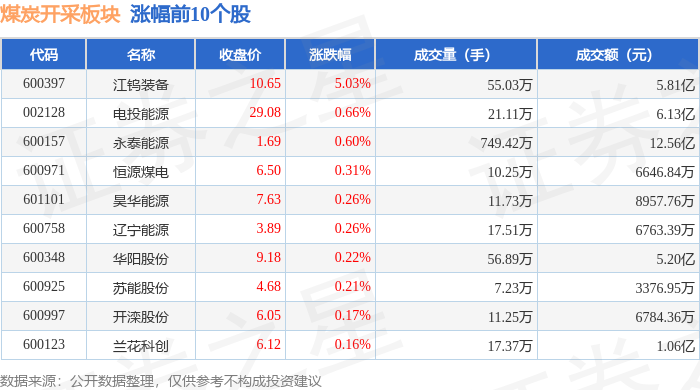
Core Viewpoint - The coal mining sector experienced a decline of 1.26% on January 23, with China Coal Energy leading the drop, while the overall market indices showed slight increases [1]. Group 1: Market Performance - The Shanghai Composite Index closed at 4136.16, up by 0.33% [1]. - The Shenzhen Component Index closed at 14439.66, up by 0.79% [1]. - The coal mining sector saw a net outflow of 349 million yuan from major funds, while retail investors contributed a net inflow of 78.23 million yuan [2][3]. Group 2: Individual Stock Performance - Jiangxi Tungsten Industry (600397) closed at 10.65, with a rise of 5.03% and a trading volume of 550,300 shares, totaling 581 million yuan [1]. - China Shenhua Energy (601088) closed at 40.00, down by 1.60%, with a trading volume of 133,740 shares, totaling 1.356 billion yuan [2]. - Shaanxi Coal and Chemical Industry (601225) closed at 21.41, down by 2.19%, with a trading volume of 454,900 shares, totaling 980 million yuan [2]. Group 3: Fund Flow Analysis - Major funds showed a net inflow of 10.45% for Shaanxi Coal and Chemical Industry, while retail investors had a net outflow of 12.66% [3]. - Shanxi Coking Coal (000983) had a net inflow of 12.99% from major funds, but a net outflow of 8.88% from retail investors [3]. - China Coal Energy (601898) experienced a net inflow of 0.75% from major funds, with a net outflow of 6.42% from retail investors [3].

诺安新动力灵活配置混合A:2025年第四季度利润499.71万元 净值增长率7.26%
Sou Hu Cai Jing· 2026-01-23 08:23
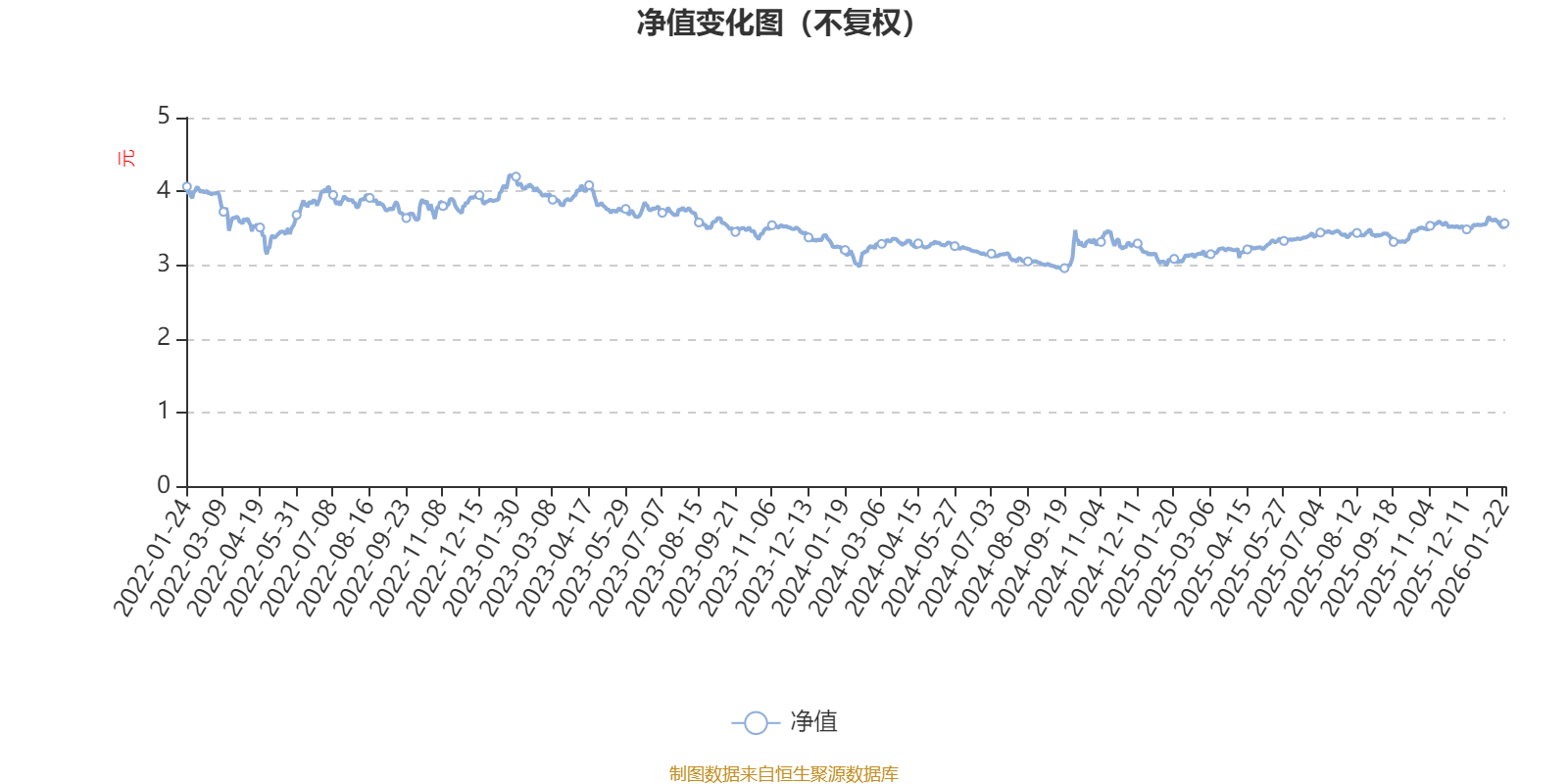
Core Viewpoint - The AI Fund Nuon New Power Flexible Allocation Mixed A (320018) reported a profit of 4.9971 million yuan for Q4 2025, with a weighted average profit per fund share of 0.2548 yuan. The fund's net value growth rate for the reporting period was 7.26%, and the fund size reached 65.8123 million yuan by the end of Q4 2025 [3][14]. Fund Performance - As of January 22, the unit net value of the fund was 3.565 yuan. The fund manager, Li Xiaojie, has managed four funds over the past year, all of which have yielded positive returns. The highest growth rate among these funds was 48.16% for Nuon Low Carbon Economy Stock A, while the lowest was 5.05% for Nuon Huili Mixed A [3]. - The fund's net value growth rates over various periods are as follows: 2.18% over the last three months (ranking 1015/1286), 2.83% over the last six months (ranking 1146/1286), 16.89% over the last year (ranking 980/1286), and -15.38% over the last three years (ranking 1190/1286) [3]. Investment Strategy - The fund's Q4 holdings were primarily in dividend-related assets such as banks, oil and petrochemicals, and non-bank financials. The fund reduced its allocation in the banking sector while increasing its positions in non-bank financials and oil and petrochemicals [3]. Risk Metrics - The fund's Sharpe ratio over the last three years was -0.0472, ranking 1192/1275 among comparable funds [8]. - The maximum drawdown over the last three years was 30.05%, with the largest single-quarter drawdown occurring in Q1 2022 at 17.43% [10]. Portfolio Composition - As of December 31, the fund's average stock position over the last three years was 74.15%, compared to the industry average of 72.57%. The fund reached a peak stock position of 79.28% at the end of 2021 and a low of 51.69% by the end of Q3 2022 [13]. - The top ten holdings of the fund as of Q4 2025 included China Ping An, China Pacific Insurance, China Petroleum, Oppein Home, China Shenhua, New China Life Insurance, Sinopec, Shaanxi Coal and Chemical Industry, Yili Group, and Jiangsu Bank [17].




强势股追踪 主力资金连续5日净流入88股
Zheng Quan Shi Bao Wang· 2026-01-22 09:44
Core Viewpoint - The report highlights the significant inflow of main capital into various stocks, with specific companies showing remarkable performance in terms of net capital inflow and stock price changes [1][2]. Group 1: Main Capital Inflow - A total of 88 stocks have experienced a net inflow of main capital for five consecutive days or more, indicating strong investor interest [1]. - Hangzhou Bank leads with 16 consecutive days of net inflow, followed by Yunnan Baiyao with 14 days [1]. - Midea Group has the highest total net inflow amounting to 1.582 billion yuan over seven days, while Hangzhou Bank follows closely with 1.489 billion yuan over 16 days [1]. Group 2: Performance Metrics - The stock with the highest net inflow ratio relative to trading volume is Fenglong Co., which has surged by 359.76% over the past 16 days [1]. - Other notable stocks include Guotai Junan Securities with a net inflow of 1.109 billion yuan over 11 days and China Ping An with 1.074 billion yuan over six days, although their stock prices have seen declines of 2.46% and 3.28% respectively [1]. - The report includes a detailed table of stocks with their respective net inflow amounts, inflow ratios, and cumulative price changes, providing a comprehensive overview of market trends [1][2].




超200股已跌破“924”!千亿市值权重占一成,这些板块临近行情起点
Xin Lang Cai Jing· 2026-01-21 09:28
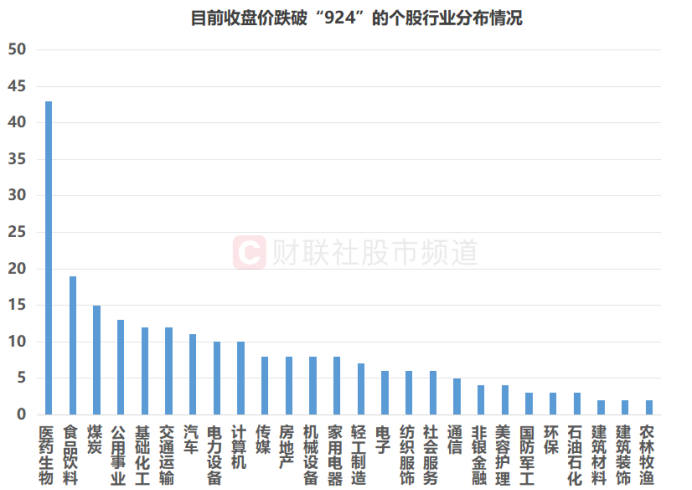
Core Viewpoint - The A-share market has shown overall stability, but nearly 230 stocks have seen their closing prices fall below the level recorded on September 24, 2024, accounting for approximately 4.3% of the total market [1]. Industry Analysis - The pharmaceutical sector has the highest number of stocks below the September 24 closing price, making up 18.7% of the total. Other sectors with significant representation include food and beverage, coal, public utilities, basic chemicals, and transportation, each exceeding 10% [2]. - Among the sub-sectors, stocks in the liquor, traditional Chinese medicine, thermal coal, coking coal, and residential development categories are the most affected, with a notable presence of chemical preparations, in vitro diagnostics, and medical consumables [2]. Market Capitalization Insights - The average total market capitalization of the over 200 stocks currently below the September 24 closing price is approximately 43.6 billion, with a median market capitalization of 10.8 billion. Stocks with a market capitalization below 5 billion account for nearly 30%, while those above 100 billion represent close to 10% [5]. - Notably, China Mobile, the only stock with a market capitalization exceeding 1 trillion, has seen a decline of about 3.7% from its September 24 closing price, currently fluctuating around 96 yuan [5]. Performance of Major Stocks - Key large-cap stocks that have fallen below the September 24 closing price include China Petroleum, Yangtze Power, China Telecom, Wuliangye, and others. Six stocks, including Pizaihuang and Daqin Railway, have experienced declines exceeding 10% [7]. - The performance of the dividend index has lagged behind the broader market, with a cumulative increase of only 5.9% since September 24, while other indices have shown more substantial gains [8]. Index Performance Overview - As of January 21, all 31 first-level industry indices are above their September 24 levels, with an average increase of approximately 58.12% and a median increase of 53.42%. The communication, non-ferrous metals, electronics, and comprehensive sectors have seen increases exceeding 130% [10]. - Conversely, sectors such as coal, food and beverage, public utilities, banking, and transportation have shown relatively lower growth, with the coal sector only increasing by 0.6% [10].





3415.44万元主力资金今日抢筹煤炭板块
Zheng Quan Shi Bao Wang· 2026-01-21 09:23
Market Overview - The Shanghai Composite Index rose by 0.08% on January 21, with 18 out of the 28 sectors experiencing gains. The top-performing sectors were non-ferrous metals and electronics, with increases of 2.79% and 2.62% respectively [1] - The coal industry saw a decline of 1.57%, ranking second in terms of the largest drop [1] Capital Flow - The net inflow of capital in the two markets was 11.98 billion yuan, with 14 sectors experiencing net inflows. The electronics sector led with a net inflow of 16.37 billion yuan, followed by the non-ferrous metals sector with a net inflow of 7.29 billion yuan [1] - In contrast, 17 sectors experienced net outflows, with the power equipment sector leading at a net outflow of 6.69 billion yuan, followed by the defense and military industry with a net outflow of 2.91 billion yuan [1] Coal Industry Analysis - Within the coal industry, there were 37 stocks, of which 4 rose and 30 fell. The net inflow of capital for the coal sector was 34.15 million yuan [2] - The top three stocks with the highest net inflow were Shaanxi Coal and Chemical Industry with 102 million yuan, followed by China Shenhua and Yanzhou Coal with net inflows of 37.21 million yuan and 28.83 million yuan respectively [2] - The stocks with the largest net outflows included Yongtai Energy, Electric Power Investment Energy, and Dayou Energy, with net outflows of 67.19 million yuan, 39.60 million yuan, and 37.50 million yuan respectively [2] Individual Stock Performance - The performance of individual stocks in the coal sector showed significant declines, with Dayou Energy dropping by 8.31% and Yongtai Energy by 1.20% [3] - Other notable declines included Zhengzhou Coal Electricity at -4.05% and Shaanxi Black Cat at -3.54% [3]
煤炭开采板块1月21日跌1.77%,大有能源领跌,主力资金净流入1.36亿元
Zheng Xing Xing Ye Ri Bao· 2026-01-21 09:08
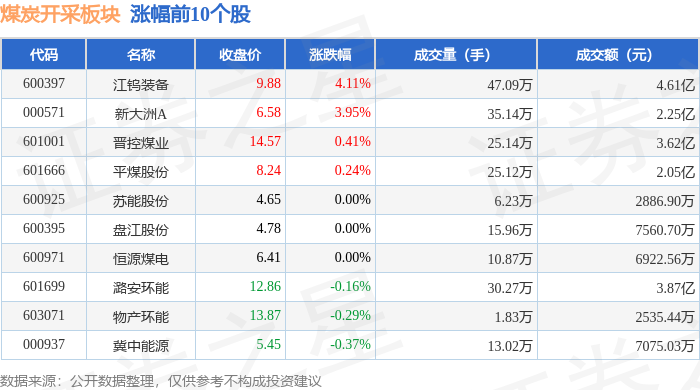
Group 1 - The coal mining sector experienced a decline of 1.77% on January 21, with Dayou Energy leading the drop [1] - The Shanghai Composite Index closed at 4116.94, up 0.08%, while the Shenzhen Component Index closed at 14255.12, up 0.7% [1] - Key stocks in the coal mining sector showed varied performance, with Jiangte Equipment rising by 4.11% and Dayou Energy falling by 8.31% [1][2] Group 2 - The coal mining sector saw a net inflow of 136 million yuan from institutional investors, while retail investors experienced a net outflow of 257 million yuan [2] - Major stocks like Shaanxi Coal and China Shenhua had significant net inflows from institutional investors, indicating potential interest despite overall sector decline [3] - The trading volume for Dayou Energy was 953,600 shares, with a transaction value of 649 million yuan, reflecting its significant market activity despite the price drop [2][3]

142股连续5日或5日以上获主力资金净买入
Zheng Quan Shi Bao Wang· 2026-01-21 03:24
Core Viewpoint - As of January 20, a total of 142 stocks in the Shanghai and Shenzhen markets have experienced net buying from major funds for five consecutive days or more, indicating strong investor interest in these stocks [1] Group 1: Stocks with Significant Net Buying - The stock with the longest consecutive net buying days is Fenglong Co., which has seen net buying for 15 consecutive trading days [1] - Other notable stocks with significant net buying days include Anhui Heli, *ST Guohua, Kangchen Pharmaceutical, Jiuding Investment, Shaanxi Coal and Electricity, Yili Co., Microelectrophysiology, and Gansu Expressway [1]