GAC GROUP(601238)

Search documents
京东、广汽、宁德时代联合掀起“低价换电”风暴
Mei Ri Shang Bao· 2025-11-12 22:27
Core Insights - The launch of the Aion UTsuper by JD.com, GAC Group, and CATL marks a significant entry into the low-priced electric vehicle market, with a starting price of 49,900 yuan, making it the only model in its price range that supports battery swapping [1][4] - The vehicle features a range of 500 km, rapid battery swapping in 99 seconds, and advanced technology from Huawei, positioning it as a strong competitor against traditional micro electric vehicles [1][2] Pricing Strategy - The Aion UTsuper offers a dual purchase model: a full purchase price of 89,900 yuan or a battery rental option starting at 49,900 yuan, potentially dropping to 45,400 yuan after subsidies [1][2] - This pricing strategy undercuts competitors like Wuling Hongguang MINIEV and Chery QQ Ice Cream, enhancing its market appeal [1][4] Market Reaction - The vehicle generated significant interest, with over 100,000 test drive appointments on its launch day, indicating strong consumer demand [1] - Consumer feedback highlights the attractiveness of the low price and the cost savings compared to traditional fuel vehicles, with a monthly battery rental fee of 399 yuan seen as acceptable [2] Industry Challenges - Despite the positive market response, there are concerns regarding the sustainability of the low-cost model, particularly the limited number of battery swapping stations (approximately 1,000 by mid-2025) and their concentration in first- and second-tier cities [3] - The long-term viability of the light asset model is questioned, as the automotive service chain requires extensive experience and resources for effective after-sales support [3][5] Competitive Landscape - The introduction of the Aion UTsuper could accelerate the shift towards a "low-cost battery swapping" model in the industry, challenging existing players like BYD and Wuling [4] - The current market for electric vehicles under 100,000 yuan accounts for 45% of total new energy vehicle sales, with most models offering a range of 300 km or less [4] Strategic Implications - JD.com's approach represents a new attempt at supply chain integration, focusing on user needs and channel consolidation rather than heavy asset manufacturing [5] - The competition in the electric vehicle sector is evolving from price and configuration to a comprehensive battle over service ecosystems and user experience [5]



宁德时代与广汽集团签署长期战略合作
Zheng Quan Ri Bao· 2025-11-12 16:40
Core Insights - GAC Group and CATL signed a comprehensive strategic cooperation agreement for a 10-year partnership, focusing on technology development, ecosystem building, and business expansion in the automotive industry [2][3] Group 1: Strategic Cooperation - The agreement aims to leverage the strengths of both companies in manufacturing, technology, resources, and market access, particularly in advanced areas like smart chassis and battery swapping [2] - The partnership will enhance the driving experience and safety standards of GAC's vehicles through the integration of CATL's advanced battery technologies [2][3] Group 2: Business Expansion - Beyond traditional battery supply, the collaboration will explore innovative business models such as battery leasing and joint station construction, promoting a "swap and go" energy service network [2][3] - This strategic move is expected to provide diverse mobility solutions for users, aligning with the growing demand for electric vehicles [2] Group 3: Industry Impact - The partnership is seen as a model for long-term cooperation in the industry, addressing challenges like technology innovation bottlenecks and supply chain stability [3][4] - The collaboration reflects the shift in the new energy sector from rapid expansion to a critical phase of transformation, emphasizing the need for upstream and downstream collaboration for higher quality development [4]


发力换电!宁德时代与广汽签十年合作
起点锂电· 2025-11-12 10:22
Core Viewpoint - The collaboration between CATL and GAC marks a significant step forward in the electric vehicle industry, focusing on supply chain synergy, technology development, and the establishment of a new energy ecosystem, particularly in smart chassis and battery swapping systems [4][5]. Summary by Sections Collaboration Details - CATL and GAC have signed a 10-year cooperation agreement in Panyu, aiming to enhance vehicle performance through the integration of CATL's expertise in power and energy storage with GAC's vehicle models, particularly the GAC Trumpchi series [4]. - The partnership will also focus on battery leasing and the construction of battery swapping stations, expanding the reach of the "Chocolate Battery Swapping" network [4]. Historical Context and Market Position - CATL's battery swapping business has only been active for about four to five years, with the establishment of Times Electric in 2021 marking its entry into this sector. The company is expected to experience rapid expansion from 2024 to 2025, collaborating with various partners like Sinopec and NIO [5][6]. - The swift response to government policies regarding battery swapping reflects CATL's strong grasp of the trends in the new energy industry [5]. Industry Challenges and Opportunities - The current challenges in the electric vehicle charging infrastructure, such as insufficient charging stations leading to long wait times, highlight the growing importance of battery swapping as a solution [6]. - The integration of battery swapping with vehicle and charging station systems is emphasized in the "New Energy Vehicle Industry Development Plan (2021-2035)," which aims to accelerate the development of this sector [6]. Future Outlook - The investment required for battery swapping is substantial, necessitating the involvement of major players in the industry to ensure standardized and efficient operations [6][7]. - CATL's strategy includes creating a standardized battery swapping solution, which will allow for compatibility across different vehicle brands, thereby enhancing the overall user experience [7]. - Industry experts predict that by 2030, battery swapping, home charging, and charging stations will coexist, leading to a more vibrant new energy market [7].

杀疯了!广汽亮出终极底牌,43.99万预售价让整个重卡江湖彻夜无眠!| 头条
第一商用车网· 2025-11-12 09:00
Core Viewpoint - The GAC Lingcheng T9 electric heavy truck has officially started pre-sales, priced at 459,900 yuan, aiming to redefine value standards in the logistics industry with its long range, high safety, and excellent performance [1][12]. Group 1: Product Features - The GAC Lingcheng T9 features a "diamond-cut" design that enhances aerodynamics while showcasing a robust appearance [6]. - The truck's weight is optimized to 8.9 tons for the 400 kWh version, allowing for an additional 1 ton of cargo per trip, potentially increasing annual revenue by over 30,000 yuan for users [8]. - The vehicle is equipped with a self-developed "three-electric" system that significantly reduces energy consumption, achieving a low energy consumption rate of 1.1 kWh/km [8]. Group 2: Interior and Usability - The interior design includes a low ground clearance of 1.39 meters and a three-step design for easier access, along with a 14.6-inch touchscreen that supports smart connectivity [10]. Group 3: Pre-sale Policy - The pre-sale policy offers a "1,000 yuan deposit to offset 3,000 yuan" promotion, effectively lowering the purchase price to 439,900 yuan during the pre-sale period from November 6 to November 20 [12]. - This promotional strategy aims to reduce early decision costs for users and incentivize them to secure ownership of the flagship model [12]. Group 4: Market Impact - The launch of the GAC Lingcheng T9 represents a significant transformation in the logistics industry, providing a commercially viable solution for the increasing demands for environmental sustainability and rising operational costs [12].

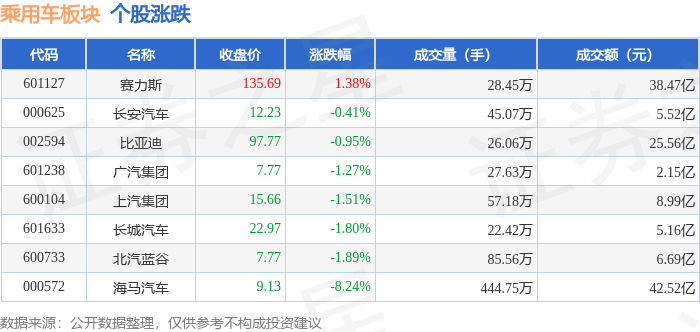
乘用车板块11月12日跌0.83%,海马汽车领跌,主力资金净流出9.87亿元
Zheng Xing Xing Ye Ri Bao· 2025-11-12 08:42
Core Insights - The passenger car sector experienced a decline of 0.83% on November 12, with Haima Automobile leading the drop [1] - The Shanghai Composite Index closed at 4000.14, down 0.07%, while the Shenzhen Component Index closed at 13240.62, down 0.36% [1] Passenger Car Sector Performance - The closing prices and percentage changes for key companies in the passenger car sector are as follows: - Seres: 135.69, +1.38% - Changan Automobile: 12.23, -0.41% - BYD: 97.77, -0.95% - GAC Group: 7.77, -1.27% - SAIC Motor: 15.66, -1.51% - Great Wall Motors: 22.97, -1.80% - BAIC Blue Valley: 7.77, -1.89% - Haima Automobile: 9.13, -8.24% [1] Capital Flow Analysis - The passenger car sector saw a net outflow of 9.87 billion yuan from main funds, while retail funds had a net inflow of 8.42 billion yuan [1] - The detailed capital flow for selected companies is as follows: - Seres: Main funds net inflow of 60.73 million yuan, retail net outflow of 95.10 million yuan - Great Wall Motors: Main funds net inflow of 53.74 million yuan, retail net outflow of 37.67 million yuan - GAC Group: Main funds net outflow of 23.12 million yuan, retail net inflow of 21.17 million yuan - Changan Automobile: Main funds net outflow of 66.99 million yuan, retail net inflow of 63.71 million yuan - BAIC Blue Valley: Main funds net outflow of 1.27 billion yuan, retail net inflow of 78.36 million yuan - SAIC Motor: Main funds net outflow of 210 million yuan, retail net inflow of 147 million yuan - Haima Automobile: Main funds net outflow of 275 million yuan, retail net inflow of 412 million yuan - BYD: Main funds net outflow of 400 million yuan, retail net inflow of 253 million yuan [2]





广汽本田收购增资 锁定发动机核心资产
Zhong Guo Jing Ying Bao· 2025-11-12 02:33
Core Viewpoint - GAC Group is enhancing its core component supply and cost control capabilities through a significant capital operation involving its joint venture GAC Honda, which includes a share acquisition and capital increase to fully integrate its engine business segment [1][2]. Group 1: Transaction Details - GAC Honda will acquire a 50% stake in Dongfeng Honda Engine Co., Ltd. from Dongfeng Motor Group for 1.172 billion RMB and will simultaneously implement a capital increase plan of 326 million USD (approximately 2.544 billion HKD) [1]. - Following the completion of the transaction, GAC Honda will achieve 100% control over Dongfeng Honda Engine, meaning GAC Group will indirectly hold a 50% interest in the engine company [1][2]. - The capital increase will raise GAC Honda's registered capital from 541 million USD to 867 million USD, with the total capital increase amounting to 326 million USD (approximately 2.544 billion HKD) [1]. Group 2: Shareholding Structure - GAC Group will contribute 50% of the capital increase, amounting to 16.31 million USD (approximately 1.172 billion RMB), while Honda and Honda China will contribute through their existing stakes in Dongfeng Honda Engine, valued at 13.05 million USD and 3.26 million USD (approximately 93.8 million RMB and 23.4 million RMB) respectively [2]. - Post-transaction, the shareholding ratios of GAC Group, Honda, and Honda China in GAC Honda will remain unchanged at 50%, 40%, and 10%, respectively, while GAC Group's equity in the core powertrain asset will increase to 50% [2].
汽车早餐 | 软银出售英伟达所有股份套现58亿美元;长安汽车回应购车纠纷;北京市汽车报废更新补贴暂停
Zhong Guo Qi Che Bao Wang· 2025-11-12 01:17
Group 1: Trade and Economic Policies - Mexico has postponed its plan to impose high tariffs on Chinese imports until at least December due to opposition from the private sector and members of the ruling party [2] - China advocates for inclusive economic globalization and opposes unilateralism and protectionism [2] Group 2: Automotive Industry Developments - The Ministry of Industry and Information Technology has set the new energy vehicle credit ratio requirements for 2026 and 2027 at 48% and 58% respectively, with a 50% reduction in the average score for standard models compared to the previous phase [3] - Beijing has announced the suspension of the vehicle scrapping and renewal subsidy policy effective from November 11 [4] - Changan Automobile has responded to consumer complaints regarding vehicle purchase disputes, clarifying that the involved intermediary has no cooperation with them [13] Group 3: Corporate Actions and Changes - SoftBank has sold all its shares in NVIDIA, cashing out $5.8 billion to invest in artificial intelligence [5] - Key personnel from Tesla's Cybertruck and Model Y projects have announced their departures after over eight years with the company [6] - Elliott Management has acquired shares in Toyota Industries and criticized the proposed privatization offer as undervalued at ¥16,300 per share [7] - Former Intel CTO Sachin Katti has joined OpenAI to work on infrastructure for general artificial intelligence [8] Group 4: Product and Service Updates - Huawei has launched a limited-time discount on its high-end driving assistance package, reducing the price from 499 yuan to 299 yuan, a nearly 40% decrease [11] - Xiaomi's upcoming model SU7 is rumored to have a price increase of 0.99 million yuan and 12 configuration upgrades, although the company has not confirmed any official announcements [10]




汽车早报|宁德时代与广汽集团签署10年战略合作 小米汽车“挖孔”机盖外观专利获授权
Xin Lang Cai Jing· 2025-11-12 00:39
Group 1: New Energy Vehicle Sales - In the first ten months of 2023, sales of traditional fuel passenger cars were mainly concentrated in the price range of 100,000 to 150,000 yuan, with a total sales volume of 3.698 million units, a year-on-year decline of 8.6% [1] - In contrast, sales of new energy passenger cars in the price range of 100,000 to 200,000 yuan reached 5.446 million units, showing a year-on-year growth of 29.4% [1] Group 2: Market Trends and Policies - The "old-for-new" policy has had a significant positive effect, leading to a reduction in aggressive price competition and an improvement in market order [1] - The automotive industry's profit margin rebounded to 4.5% in the first nine months of 2023, indicating a stabilization in price promotions and an increase in industry scale [1] Group 3: Strategic Partnerships - CATL and GAC Group signed a 10-year strategic cooperation agreement focusing on joint research and development in smart chassis and battery swapping ecosystems [2] - The partnership aims to enhance the competitiveness of new energy vehicles and improve vehicle quality through the application of key technologies [2] Group 4: New Product Launches - SAIC-GM Wuling announced the launch of the Wuling Hongguang MINIEV four-door version with a range of 301 kilometers, priced at 55,800 yuan [3] Group 5: Corporate Leadership Changes - General Motors announced that John Roth will succeed Steve Hill as the President of GM China, effective December 1 [5] Group 6: Impact of Tariffs on Japanese Automakers - Japanese automakers reported significant declines in performance due to the U.S. tariffs on imported vehicles, with an estimated total loss of 1.5 trillion yen for the seven major manufacturers [7] - The tariffs, which began in April 2023, have led to increased costs and reduced profits for companies heavily reliant on the U.S. market [8]
广汽本田销量降26%获25亿港元增资 拟11.7亿收购东风本田发动机50%股权
Chang Jiang Shang Bao· 2025-11-11 23:33
Core Viewpoint - GAC Group is undertaking significant capital operations that may positively impact the declining sales of GAC Honda, including a share acquisition and capital increase to enhance its engine supply chain [1][2]. Group 1: Capital Operations - GAC Honda will acquire 50% of Dongfeng Honda Engine for approximately RMB 11.72 billion [2][3]. - GAC Honda will receive a capital increase of USD 3.26 billion (approximately HKD 25.44 billion) to strengthen its core component supply capabilities [1][2]. - The capital increase will raise GAC Honda's registered capital from USD 5.41 billion to USD 8.67 billion, with GAC Group contributing 50% of the increase [2][3]. Group 2: Sales Performance - GAC Honda's sales have been declining, with 259,600 units sold in the first ten months of 2025, a year-on-year decrease of 26.16% [1][4][6]. - The projected total sales for the year 2025 are around 340,000 units [4][6]. - Sales trends indicate a significant drop, with 640,500 units sold in 2023 and 470,600 units expected in 2024, marking a decline of 13.66% and 26.52% respectively [6][7]. Group 3: Strategic Initiatives - The acquisition aims to integrate engine operations for GAC Honda, enhancing supply chain stability and reducing transaction costs [3][7]. - The transaction is expected to support GAC Group's transition towards smart and electric vehicle production, improving competitiveness in the evolving automotive market [3][7]. - GAC Honda's new electric model, the P7, launched in April 2025, has seen limited sales, with only 1,400 units sold by September 2025 [8][9].
中汽协:10月我国新能源汽车销量首次超过总销量50%;广汽集团与宁德时代签十年战略合作
Mei Ri Jing Ji Xin Wen· 2025-11-11 22:33
Group 1: New Energy Vehicle Sales and Market Trends - In October, new energy vehicle sales in China exceeded 50% of total vehicle sales for the first time, reaching 51.6%, indicating strong market demand and accelerating consumer transition towards electric vehicles [1] - From January to October, China's total vehicle production and sales reached 27.69 million units, with new energy vehicle production and sales at 13.01 million and 12.94 million units, respectively, reflecting year-on-year growth of 33.1% and 32.7% [1] - The rapid growth of new energy vehicles is reshaping the competitive landscape of the automotive industry and is expected to drive traditional automakers to accelerate their electrification transformation [1] Group 2: Regulatory Changes in New Energy Vehicle Credits - The Ministry of Industry and Information Technology announced new credit ratio requirements for new energy vehicles, set at 48% for 2026 and 58% for 2027, with a 50% reduction in the average score for standard models compared to the previous phase [2] - The adjustments aim to strengthen incentives and constraints on traditional automakers while providing clear market expectations for new energy vehicle companies [2] - Major automotive manufacturers are expected to increase investments in electric vehicle models and technology development, promoting industry growth [2] Group 3: Strategic Partnerships in the Electric Vehicle Sector - GAC Group and CATL signed a ten-year strategic cooperation agreement to leverage their strengths in manufacturing, technology, resources, and market to create a systematic ecosystem and collaborative development [3] - The partnership will focus on R&D collaboration in smart chassis and battery swapping, enhancing GAC's competitiveness in the new energy vehicle market [3] - This collaboration may prompt other industry players to accelerate their strategies, potentially altering the competitive landscape [3] Group 4: Financial Performance of Hesai Technology - Hesai Technology reported third-quarter revenue of 800 million RMB, a year-on-year increase of 47.5%, achieving profitability ahead of schedule [4] - The company delivered a total of 440,000 laser radar units, with ADAS product deliveries reaching 380,000 units, reflecting a year-on-year growth of 193.1% [4] - Hesai's strong performance supports its dual-driven strategy of "ADAS + Robotics," although the company faces challenges from increasing industry price competition and the need for further commercialization of its robotics business [4]