
GAC GROUP(601238)

Search documents
与京东合作,昔日“网约车之王”埃安的艰难变革
3 6 Ke· 2025-11-13 10:33
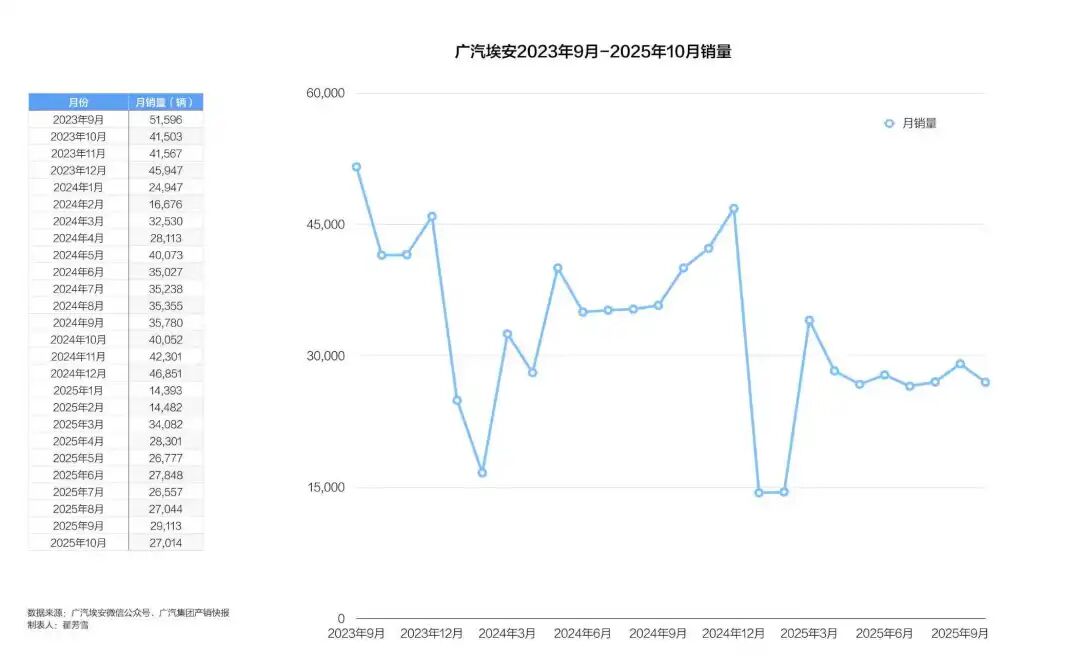
Core Viewpoint - The automotive industry is experiencing a surge in sales due to increased promotional efforts and the impending expiration of tax exemption policies, with many companies achieving record sales in October. However, GAC Aion's performance stands out negatively, showing significant declines in both sales and financial results [1][2]. Sales Performance - SAIC Passenger Cars saw a substantial increase in domestic market sales by 234.4%, while BYD's sales grew approximately 11.47%, reaching a new high for the year. Geely's monthly sales exceeded 300,000 units for the first time, and Chery's new energy vehicle sales rose by 54.7% year-on-year, surpassing 110,000 units in a single month [1]. - GAC Aion's October sales were 27,014 units, reflecting a 7.2% decrease month-on-month and a 32.6% year-on-year decline, contrasting sharply with the overall industry growth [1][2]. Financial Results - GAC Group reported third-quarter revenue of 24.106 billion yuan, a year-on-year decline of 14.62%, with a net loss attributable to shareholders of 1.774 billion yuan, worsening from the previous year. For the first three quarters, revenue decreased by 10.49%, and net profit turned from a profit of 120 million yuan to a loss of 4.312 billion yuan, a staggering drop of 3693.3% [1][2]. Market Dynamics - GAC Aion's struggles are attributed to intense competition in the domestic automotive market and rapid changes in demand structure. The brand, once dominant in the ride-hailing market, is now facing unique challenges as the market evolves [2][6]. - The ride-hailing market saw a significant slowdown, with GAC Aion's share of new ride-hailing vehicles dropping as the overall market contracted. In 2023, GAC Aion accounted for 220,000 of the 850,000 new ride-hailing vehicles, representing 45% of its total sales for the year [6]. Product Strategy and Challenges - GAC Aion's sales have halved over two years, with average monthly sales dropping from over 40,000 units in 2023 to 20,000 units in 2025. The brand's reliance on pure electric vehicles limits its competitiveness, especially in northern markets where hybrid models are preferred [3][7]. - Despite launching new models aimed at private consumers, such as Aion Bawanglong, Aion RT, and Aion UT, these vehicles have not met sales expectations, with monthly sales remaining between 3,000 and 6,000 units [8][12]. Organizational Changes and Future Outlook - GAC Group is undergoing internal reforms to enhance efficiency, including the integration of marketing resources across brands. However, the pace of these reforms has been slow, leading to challenges in decision-making and execution [11][12]. - The introduction of a new brand focused on B-end markets (ride-hailing and taxis) is planned, but has yet to materialize. Meanwhile, GAC Aion has partnered with JD.com and CATL to launch the Aion UT Super, which has generated significant market interest despite potential infrastructure limitations [13][15].


乘用车板块11月13日涨1.36%,海马汽车领涨,主力资金净流入13.55亿元
Zheng Xing Xing Ye Ri Bao· 2025-11-13 08:44
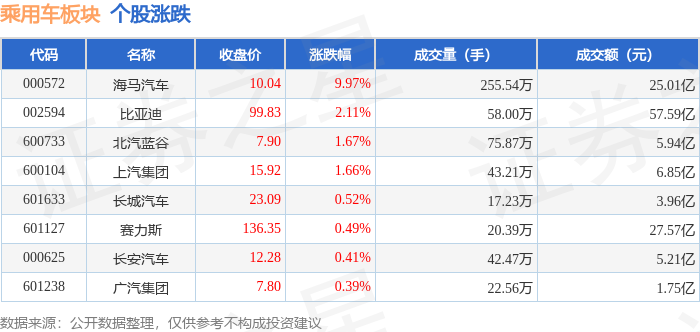
Core Viewpoint - The passenger car sector experienced a rise of 1.36% on November 13, with Haima Automobile leading the gains, while the Shanghai Composite Index closed at 4029.5, up 0.73% [1]. Group 1: Market Performance - The Shenzhen Component Index closed at 13476.52, increasing by 1.78% [1]. - The passenger car sector saw a net inflow of 1.355 billion yuan from main funds, while retail investors experienced a net outflow of 530 million yuan [1]. Group 2: Individual Stock Performance - Haima Automobile (000572) closed at 10.04 yuan, with a significant increase of 9.97% and a trading volume of 2.5554 million shares, amounting to a transaction value of 2.501 billion yuan [1]. - BYD (002594) closed at 99.83 yuan, rising by 2.11% with a trading volume of 580,000 shares, totaling 5.759 billion yuan [1]. - Great Wall Motors (601633) closed at 23.09 yuan, with a modest increase of 0.52% and a transaction value of 396 million yuan [1]. - SAIC Motor (600104) closed at 15.92 yuan, up by 1.66%, with a trading volume of 432,100 shares, resulting in a transaction value of 685 million yuan [1]. Group 3: Fund Flow Analysis - Main funds showed a net inflow of 817 million yuan for Haima Automobile, while retail funds had a net outflow of 434 million yuan [2]. - BYD experienced a net inflow of 607 million yuan from main funds, but retail funds saw a net outflow of 208 million yuan [2]. - Great Wall Motors had a net inflow of 35.9479 million yuan from main funds, while retail funds experienced a net outflow of 65.7917 million yuan [2].





京东“定制车”想要大卖,维修售后和换电网络是难点
Xin Lang Cai Jing· 2025-11-13 08:19
Core Viewpoint - The collaboration between JD.com, GAC Group, and CATL has led to the launch of the Aion UT Super, a competitive electric vehicle targeting the sub-100,000 yuan market, featuring a price point that disrupts existing market dynamics [1][3]. Group 1: Product Overview - The Aion UT Super is a pure electric hatchback with a standard range of 500 kilometers, equipped with CATL's lithium iron phosphate battery, and designed primarily for urban commuting and short-distance travel [1]. - The vehicle is priced at 49,900 yuan for the battery rental version, with a minimum price of 45,400 yuan after subsidies, significantly impacting the pricing balance in its segment [1][3]. - JD.com has implemented an internet marketing strategy, offering a refundable deposit of 500 yuan and additional benefits to lower the purchase threshold for consumers [1]. Group 2: Service Network and Maintenance - JD.com's car maintenance service currently focuses on traditional fuel vehicles, with plans to upgrade to accommodate the Aion UT Super as the vehicle gains traction [2]. - The maintenance facilities in Beijing require a minimum area of 200 to 300 square meters and must adhere to JD.com's digital management systems, ensuring quality control of electric vehicle parts and consumables [2]. - Customers primarily using JD.com's services are accustomed to lower maintenance costs compared to traditional dealerships, which could influence their decision-making regarding the Aion UT Super [3]. Group 3: Market Strategy and Competition - The Aion UT Super targets price-sensitive consumers, with promotional comparisons highlighting its lower starting price compared to competitors like BYD Seagull and Leap Motor T03 [3]. - Despite its low price, experts suggest that the Aion UT Super may not be the cheapest option in the sub-100,000 yuan segment, as other models have higher sales volumes [4]. - The vehicle's battery rental model, while initially appealing, may not result in long-term cost savings for users, raising concerns about its overall value proposition [4]. Group 4: Future Considerations - The success of the Aion UT Super will depend on the enhancement of the battery swapping network, as demonstrated by competitors like NIO, which have leveraged their infrastructure for consumer convenience [5]. - Market dynamics may shift due to changes in purchase tax policies and subsidy reductions, making the performance of the Aion UT Super a critical indicator for the entry-level electric vehicle market [5].


明年起购置税将减半征收,17家汽车品牌承诺兜底
Di Yi Cai Jing· 2025-11-13 08:07
Core Viewpoint - The end of the full exemption policy for new energy vehicle (NEV) purchase tax in 2025 has triggered a competitive order-seizing battle among car manufacturers, with many offering tax subsidy schemes to lock in consumers before the policy change [2][3]. Group 1: Policy Changes and Impacts - From January 1, 2026, the NEV purchase tax will be halved, with a maximum tax reduction of 15,000 yuan per vehicle [2]. - The current exemption policy allows for a maximum tax exemption of 30,000 yuan for NEVs purchased between January 1, 2024, and December 31, 2025 [2]. - The urgency among consumers to purchase vehicles has increased due to the impending policy changes, influencing their choice of models based on delivery timelines [3]. Group 2: Manufacturer Responses - 17 mainstream automotive brands have introduced purchase tax subsidy schemes to cover the tax difference for consumers whose vehicles are delivered after the policy change [2][3]. - The subsidy schemes include various forms such as tax difference vouchers, cash reductions on final payments, and direct cash subsidies, with a maximum subsidy of 15,000 yuan [3]. - The competition among manufacturers is expected to intensify as they aim to capture market share amid the changing tax policies [4]. Group 3: Market Trends and Performance - In October, NEV production and sales reached 1.772 million and 1.715 million units, respectively, both showing over 20% year-on-year growth, with a market penetration rate surpassing 50% [3]. - The cumulative production and sales of NEVs in the first ten months of the year exceeded 13 million units, marking a year-on-year increase of approximately 33% [3]. - The automotive market continues to show strong growth, with new models being launched and production rates maintained to meet demand [4]. Group 4: Future Outlook - The technical threshold for NEV purchase tax exemptions will increase starting in 2026, as plug-in hybrid vehicles with an electric range of less than 100 kilometers will no longer qualify for tax reductions [4]. - This change is expected to lead to a clearer market differentiation, with companies possessing core technological competitiveness likely to gain a larger market share [4].




明年起购置税将减半征收,17家汽车品牌承诺兜底
第一财经· 2025-11-13 07:49
Core Viewpoint - The article discusses the impending end of the full exemption from purchase tax for new energy vehicles (NEVs) in China, leading to a competitive order-seizing battle among car manufacturers as they introduce tax subsidy plans to attract consumers before the policy changes take effect [3][4]. Group 1: Policy Changes and Impacts - Starting January 1, 2026, the purchase tax for NEVs will be halved, with a maximum tax reduction of 15,000 yuan per vehicle [3]. - From January 1, 2024, to December 31, 2025, NEVs will continue to be exempt from purchase tax, with a maximum exemption of 30,000 yuan per vehicle [3][4]. - The adjustment in tax policy has intensified consumer urgency to purchase vehicles, influencing their choice of models based on delivery timelines [4]. Group 2: Manufacturer Responses - 17 major automotive brands, including Li Auto, NIO, and BYD, have introduced purchase tax subsidy plans to cover the tax difference for consumers whose vehicles are delivered after the policy change [3][4]. - The subsidy methods include tax difference vouchers, cash reductions on final payments, and direct cash subsidies, with a maximum subsidy of 15,000 yuan [4]. - The competition among manufacturers is expected to increase as they strive to maintain market share amid changing tax incentives [5]. Group 3: Market Trends and Performance - In October, NEV production and sales reached 1.772 million and 1.715 million units, respectively, with year-on-year growth exceeding 20% and a market penetration rate surpassing 50% [4][5]. - Cumulative NEV production and sales for the first ten months of the year exceeded 13 million units, reflecting a year-on-year growth of approximately 33% [4]. - The market is witnessing a shift as consumers, influenced by the availability of popular models, are increasingly opting for less popular models, contributing to sustained sales growth [4].


新能源车企“银十”成绩单普涨,广汽埃安却掉队了
Feng Huang Wang Cai Jing· 2025-11-13 06:47
Group 1: Industry Performance - Leap Motor achieved a significant milestone by delivering over 70,000 vehicles in October, marking a year-on-year growth of over 84% [1] - Hongmeng Zhixing, which includes brands like AITO and Zhijie, also set a record with 68,216 vehicles delivered in October, surpassing a cumulative delivery of 1 million vehicles [1] - NIO, Xiaomi, and Xpeng all entered the "40,000 club" in October, with Xpeng delivering 42,013 vehicles, a historical high, and a year-to-date total of 355,209 vehicles, reflecting a 190% increase year-on-year [1] Group 2: Company-Specific Insights - NIO delivered 40,397 vehicles in October, a year-on-year increase of 92.6%, with a total of 913,182 vehicles delivered to date [1] - Ideal Auto reported a decline in deliveries, with 31,767 vehicles delivered in October, a drop of 38% year-on-year and 6.43% month-on-month, but sees the new Ideal i6 as a key growth driver [2][3] - GAC Aion experienced a notable decline, with October sales at 27,014 vehicles, down 32.55% year-on-year and 7.2% month-on-month, marking six consecutive months of year-on-year decline [3][4] Group 3: Strategic Responses - GAC Aion is attempting to rebrand and expand its market appeal by launching new models priced between 70,000 to 150,000 yuan, but market response has been lukewarm [4] - The company has introduced significant price adjustments for models like AION UT, reducing the starting price by 16,000 yuan, yet this strategy has not effectively stimulated sales [4]
新能源车企“银十”成绩单普涨,广汽埃安却掉队了
凤凰网财经· 2025-11-13 06:36
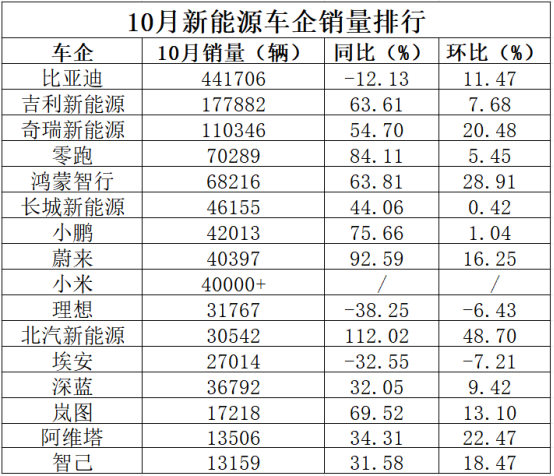
Core Insights - The article highlights the sales performance of various electric vehicle manufacturers in October, showcasing significant growth for many domestic brands and new energy vehicle startups [2][4]. Sales Performance Summary - BYD sold 441,706 units in October, experiencing a year-on-year decline of 12.13% but a month-on-month increase of 11.47% [1]. - Geely New Energy reported sales of 177,882 units, marking a year-on-year increase of 63.61% and a month-on-month increase of 7.68% [1]. - Chery New Energy achieved sales of 110,346 units, with a year-on-year growth of 54.70% and a month-on-month increase of 20.48% [1]. - Leap Motor surpassed 70,000 units for the first time, delivering 70,289 vehicles, a year-on-year increase of over 84% [4]. - Hongmeng Zhixing delivered 68,216 units, also achieving a record high for monthly deliveries [4]. - Great Wall New Energy sold 46,155 units, with a year-on-year increase of 44.06% [1]. - NIO delivered 40,397 units, reflecting a year-on-year growth of 92.59% [4]. - Xiaomi's sales exceeded 40,000 units, continuing a strong performance from September [5]. - Li Auto's sales fell to 31,767 units, down 38.25% year-on-year and 6.43% month-on-month [6]. - Aion's sales were 27,014 units, down 32.55% year-on-year and 7.21% month-on-month [6]. Market Trends and Challenges - 75% of the 16 automotive companies reported both year-on-year and month-on-month growth in October, indicating a robust market recovery [6]. - Li Auto's decline is attributed to recent controversies, but the company is optimistic about the upcoming launch of the Li i6 model, which has already received over 70,000 orders [6][4]. - Aion's continuous decline over six months is linked to its brand positioning and market strategy, which has not resonated well with personal consumers despite initial success in the ride-hailing segment [7][8].
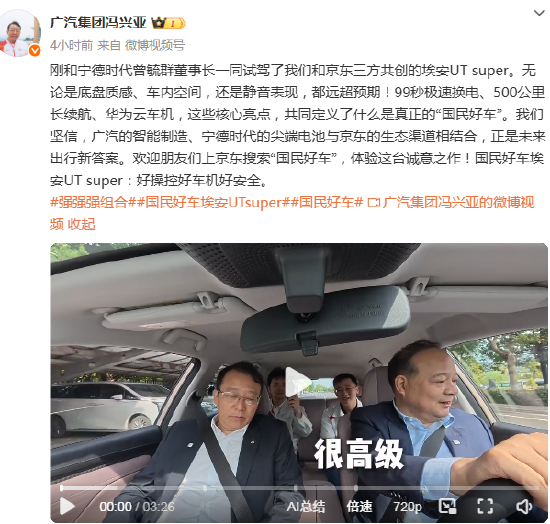
广汽冯兴亚与宁德时代曾毓群试驾埃安UT super,称其表现远超预期
Xin Lang Ke Ji· 2025-11-13 06:25
Core Viewpoint - GAC Group's chairman, Feng Xingya, expressed positive feedback after test-driving the Aion UT super, co-created with CATL and JD.com, highlighting its superior performance and features [1]. Group 1: Product Highlights - The Aion UT super features a rapid battery swap capability of 99 seconds, a long range of 500 kilometers, and Huawei's cloud vehicle system, which are all considered core highlights [1]. - The vehicle's chassis quality, interior space, and noise reduction performance exceeded expectations during the test drive [1]. Group 2: Strategic Collaboration - The collaboration between GAC's smart manufacturing, CATL's advanced battery technology, and JD.com's ecological channels is seen as a promising solution for future mobility [1].
京东、广汽、宁德时代联合掀起“低价换电”风暴
Mei Ri Shang Bao· 2025-11-12 22:27
Core Insights - The launch of the Aion UTsuper by JD.com, GAC Group, and CATL marks a significant entry into the low-priced electric vehicle market, with a starting price of 49,900 yuan, making it the only model in its price range that supports battery swapping [1][4] - The vehicle features a range of 500 km, rapid battery swapping in 99 seconds, and advanced technology from Huawei, positioning it as a strong competitor against traditional micro electric vehicles [1][2] Pricing Strategy - The Aion UTsuper offers a dual purchase model: a full purchase price of 89,900 yuan or a battery rental option starting at 49,900 yuan, potentially dropping to 45,400 yuan after subsidies [1][2] - This pricing strategy undercuts competitors like Wuling Hongguang MINIEV and Chery QQ Ice Cream, enhancing its market appeal [1][4] Market Reaction - The vehicle generated significant interest, with over 100,000 test drive appointments on its launch day, indicating strong consumer demand [1] - Consumer feedback highlights the attractiveness of the low price and the cost savings compared to traditional fuel vehicles, with a monthly battery rental fee of 399 yuan seen as acceptable [2] Industry Challenges - Despite the positive market response, there are concerns regarding the sustainability of the low-cost model, particularly the limited number of battery swapping stations (approximately 1,000 by mid-2025) and their concentration in first- and second-tier cities [3] - The long-term viability of the light asset model is questioned, as the automotive service chain requires extensive experience and resources for effective after-sales support [3][5] Competitive Landscape - The introduction of the Aion UTsuper could accelerate the shift towards a "low-cost battery swapping" model in the industry, challenging existing players like BYD and Wuling [4] - The current market for electric vehicles under 100,000 yuan accounts for 45% of total new energy vehicle sales, with most models offering a range of 300 km or less [4] Strategic Implications - JD.com's approach represents a new attempt at supply chain integration, focusing on user needs and channel consolidation rather than heavy asset manufacturing [5] - The competition in the electric vehicle sector is evolving from price and configuration to a comprehensive battle over service ecosystems and user experience [5]
宁德时代与广汽集团签署长期战略合作
Zheng Quan Ri Bao· 2025-11-12 16:40
Core Insights - GAC Group and CATL signed a comprehensive strategic cooperation agreement for a 10-year partnership, focusing on technology development, ecosystem building, and business expansion in the automotive industry [2][3] Group 1: Strategic Cooperation - The agreement aims to leverage the strengths of both companies in manufacturing, technology, resources, and market access, particularly in advanced areas like smart chassis and battery swapping [2] - The partnership will enhance the driving experience and safety standards of GAC's vehicles through the integration of CATL's advanced battery technologies [2][3] Group 2: Business Expansion - Beyond traditional battery supply, the collaboration will explore innovative business models such as battery leasing and joint station construction, promoting a "swap and go" energy service network [2][3] - This strategic move is expected to provide diverse mobility solutions for users, aligning with the growing demand for electric vehicles [2] Group 3: Industry Impact - The partnership is seen as a model for long-term cooperation in the industry, addressing challenges like technology innovation bottlenecks and supply chain stability [3][4] - The collaboration reflects the shift in the new energy sector from rapid expansion to a critical phase of transformation, emphasizing the need for upstream and downstream collaboration for higher quality development [4]
