
Industrial Securities(601377)

Search documents
把握“成长+价值”双主线,兴业证券最新研判
Zhong Guo Ji Jin Bao· 2025-12-16 15:32
Group 1 - The core investment strategy for 2026 focuses on "growth momentum and value reconstruction dividends," emphasizing the importance of patience and stability in the Hong Kong stock market [2] - The AI wave is compared to the internet boom of 1996-1998, with expectations that macroeconomic conditions and Federal Reserve policies will differ significantly from the early 2000s [2] - The nominal GDP growth rate is expected to improve in 2026, with a moderate inflation recovery, indicating structural opportunities in the Chinese economy [2] Group 2 - Four key areas of opportunity are identified: 1) Growth momentum driven by AI, internet, and new consumption sectors; 2) High-yield assets like insurance and banking in a low-interest environment; 3) Value discovery in traditional industries benefiting from global supply chain restructuring; 4) Strategic assets such as gold and rare earths amid global order changes [3] - The A-share market is expected to benefit from limited negative external impacts, a global AI industry trend, and supportive liquidity conditions [4] - The recovery of corporate earnings is anticipated to be a major highlight, with a shift from a "淘汰赛" (elimination race) to a "竞速赛" (speed race) in industry performance as more sectors enter a recovery phase [4][5] Group 3 - Key sectors for investment in 2026 include AI, new energy, military industry, and innovative pharmaceuticals, with a focus on companies that can leverage global competitive advantages [5] - The trend of domestic wealth reallocating towards the stock market, along with the influx of long-term capital from various sources, is expected to create positive feedback in the market [4] - The selection of individual stocks may shift from stable dividend payers to those with strong free cash flow as overall corporate profitability improves [5]

把握“成长+价值”双主线,兴业证券最新研判
中国基金报· 2025-12-16 15:29
Core Viewpoint - The investment strategy for 2026 emphasizes "growth momentum and value reconstruction dividends" in both the Hong Kong and A-share markets, with a focus on structural opportunities and long-term development while downplaying short-term economic fluctuations [2][3]. Group 1: Hong Kong Market Insights - The chief strategist believes that patience and a steady approach are essential for Hong Kong investments in 2026, with excess returns expected from the AI wave and a favorable macroeconomic environment due to anticipated interest rate cuts by the Federal Reserve [3]. - The macroeconomic outlook for 2026 includes an expected improvement in nominal GDP growth and moderate inflation recovery, indicating that the Chinese economy will present structural opportunities for the stock market [3][4]. - Key investment opportunities identified include sectors benefiting from the AI wave, military technology, energy technology, and new consumption driven by the "14th Five-Year Plan" [4]. Group 2: A-share Market Insights - The A-share market is expected to benefit from limited negative external shocks, a global AI industry trend, and a favorable liquidity environment, which will support market performance in 2026 [5]. - Internal factors such as the recovery of nominal GDP growth and price increases are anticipated to improve corporate earnings, which are seen as a major highlight for the market [5]. - The shift in industry performance from a "淘汰赛" (elimination race) to a "竞速赛" (speed race) is expected as more sectors enter a recovery phase, with a focus on high-growth industries [5][6]. Group 3: Investment Themes and Strategies - Key investment themes for 2026 include focusing on industries aligned with trends in AI, new energy, military, and innovative pharmaceuticals, as well as sectors benefiting from price recovery and global competitiveness [6]. - The low interest rate environment is expected to enhance the strategic value of high-yield assets such as insurance, banking, and energy [4]. - The selection of individual stocks may shift from stable dividend payers to those with strong free cash flow as overall corporate earnings become more elastic [6].


积极拥抱买方投顾业务转型,券商密集发布财富管理新品牌
2 1 Shi Ji Jing Ji Bao Dao· 2025-12-16 14:57
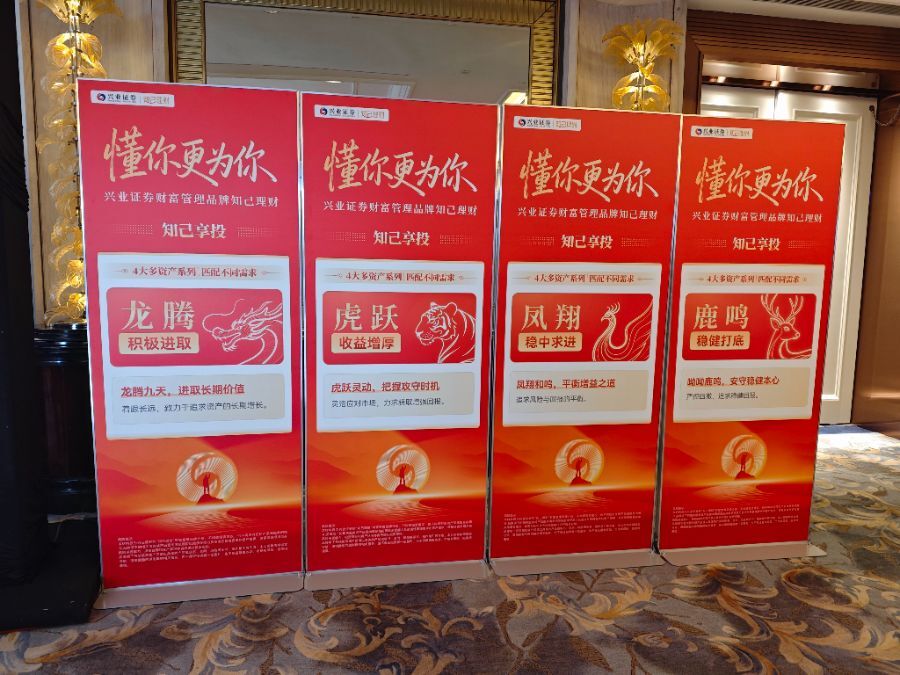
Core Viewpoint - The launch of the "Zhiji Wealth Management" brand by Industrial Securities marks a significant transformation towards a buyer-oriented advisory model in the wealth management industry, emphasizing customer interests and personalized services [4][5][6]. Group 1: Brand Launch and Services - Industrial Securities introduced the "Zhiji Wealth Management" brand on December 16, 2023, featuring three service solutions: "Zhiji Enjoy Investment," "Zhiji Preferred Investment," and "Zhiji Intelligent Investment," which cater to asset allocation and professional investment needs [2][3]. - The brand's core philosophy is "Understanding you, working for you," focusing on transaction and allocation scenarios to create a comprehensive wealth management ecosystem [3][4]. Group 2: Industry Trends and Transformation - The wealth management industry is shifting from product sales to value-driven services, driven by increasing resident wealth and demand for professional investment support [5][6]. - The buyer-oriented advisory model has become essential for high-quality development in the financial sector, with many securities firms, including Industrial Securities, actively transitioning to this model [6][8]. Group 3: Competitive Landscape - Since 2025, several securities firms have launched or upgraded their wealth management brands, including CITIC Securities and Guosen Securities, indicating a trend towards personalized and diversified wealth management solutions [6][7]. - The introduction of new brands reflects a response to investor demands for tailored wealth management services and aligns with regulatory guidance towards value competition, moving away from homogeneous product sales [8].



兴业证券策略首席张启尧:积极看好2026年A股市场投资机会
Xin Lang Cai Jing· 2025-12-16 12:11
Core Viewpoint - The chief strategy analyst of Industrial Securities, Zhang Qiyao, is optimistic about investment opportunities in the A-share market for 2026, citing limited negative external impacts and positive internal economic indicators [1] External Factors - Global trends in the AI industry, along with loose liquidity and a weak dollar, are expected to boost the A-share market [1] - The negative impact from overseas markets on the domestic market is anticipated to be limited [1] Internal Factors - The direction of the GDP deflator and nominal growth recovery is relatively clear, indicating a potential improvement in the economic fundamentals [1] - Nominal economic recovery and price increases are expected to support further enhancements in the fundamentals [1] - The recovery of domestic corporate profits is projected to be a significant highlight [1] Capital Flow - There is a trend of domestic residents reallocating wealth into the stock market, which is expected to deepen in 2026 [1] - Active equity funds are anticipated to achieve excess returns, while long-term capital from insurance funds and state-owned enterprises is expected to enter the market firmly [1] - The return of foreign capital to Chinese assets is also seen as a positive trend for 2026 [1]
3家券商将发10亿“现金红包”
Di Yi Cai Jing· 2025-12-16 11:51
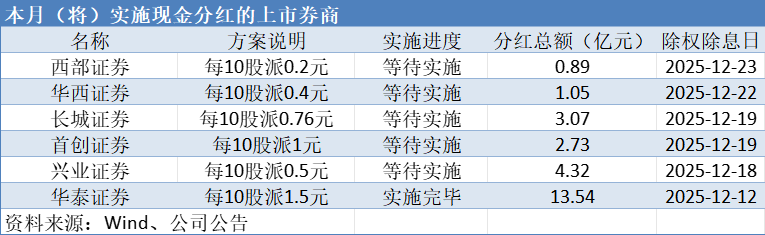
Core Viewpoint - The recent trend of cash dividends among listed securities firms indicates a robust financial performance and a shift towards stable return mechanisms, driven by regulatory changes and improved profitability in the industry [3][12][14]. Group 1: Recent Dividend Announcements - Three securities firms, namely Industrial Securities, Great Wall Securities, and Shouhua Securities, have announced cash dividends totaling over 1 billion yuan, with specific amounts of 432 million, 307 million, and 273 million yuan respectively [2][4]. - Additional firms, Huaxi Securities and Western Securities, are set to follow suit with their own dividend distributions, bringing the total cash dividends from five firms in the past two weeks to over 1 billion yuan [2][4]. Group 2: Financial Performance and Dividend Support - The recent surge in dividends is supported by significant profit growth among the firms, with all six firms reporting net profit increases in the first three quarters of the year [7][8]. - Huaxi Securities reported a remarkable net profit growth of over 300%, with revenues increasing by 56.52% year-on-year [8]. Group 3: Changes in Dividend Frequency - The frequency of cash dividends has notably increased among these firms, with Western Securities implementing five dividend plans this year alone, totaling over 500 million yuan [10]. - Shouhua Securities has also consistently issued dividends, with a significant increase in their third-quarter dividend compared to previous years [10]. Group 4: Regulatory and Market Implications - The recent dividend activity reflects a combination of regulatory guidance and market mechanisms, indicating a new norm in the industry where both leading and smaller firms are engaging in higher dividend payouts [13][14]. - Analysts suggest that while dividends can boost market sentiment in the short term, long-term stock performance will depend on the underlying fundamentals of the firms [15].


3家券商本周将发10亿“现金红包”,证券业新一波分红潮来了
Di Yi Cai Jing· 2025-12-16 10:49
Core Viewpoint - The recent surge in cash dividends among listed securities firms is driven by improved profitability and regulatory encouragement for stable returns, with a total of over 25 billion yuan expected to be distributed by the end of December 2023 [1][3][8]. Group 1: Recent Dividend Announcements - Three securities firms, including Industrial Securities, Great Wall Securities, and Shouchao Securities, have announced cash dividends totaling over 10 billion yuan [1][2]. - The upcoming dividends include Huaxi Securities and Western Securities, further increasing the total cash distribution to over 25 billion yuan by December 23 [2][3]. - Notably, the cash dividend ratios for some firms exceed 30%, with Shouchao Securities distributing 2.73 billion yuan, which is 34.01% of its net profit for the first nine months [3]. Group 2: Financial Performance Supporting Dividends - All six securities firms that are distributing dividends have reported net profit growth in the first three quarters of 2023, with Huaxi Securities showing a remarkable increase of over 300% in net profit [3]. - Other firms, such as Industrial Securities and Great Wall Securities, also reported net profit increases exceeding 70%, indicating strong financial health [3]. Group 3: Trends in Dividend Frequency - The frequency of cash dividends among securities firms has significantly increased, with Western Securities implementing five dividend plans this year alone, totaling over 5 billion yuan [5]. - Shouchao Securities has consistently issued dividends for its third-quarter reports in recent years, reflecting a shift towards more frequent distributions [5][6]. - Huatai Securities has also maintained a trend of high-value dividends, with total distributions exceeding 60 billion yuan over the past two years [5]. Group 4: Market and Regulatory Context - The current wave of dividends is seen as a result of policy guidance and market mechanisms, reflecting a return to core financial principles [8][9]. - The concentration of dividends among leading firms, while smaller firms adopt higher payout ratios to attract investment, illustrates a dual strategy in the market [8]. - The expectation of increased dividend frequency has become a new norm in the industry, driven by regulatory support [9].

证券行业2026年年度策略报告:提质增效,格局优化-20251216
Ping An Securities· 2025-12-16 10:30
Core Viewpoints - The report emphasizes the importance of improving efficiency and optimizing the industry structure in the securities sector, projecting a strong performance relative to the market for 2026 [1] Market Review - The securities sector has demonstrated a prominent Beta attribute, with significant attention on the shift in funding styles. Historical analysis indicates that periods of excess returns for brokerages typically require a confluence of policy, liquidity, and market conditions [4][9] - From January to November 2025, the securities index underperformed the CSI 300 index by 12.9 percentage points, attributed to factors such as technology style preferences and the diversion of funds towards low-valuation H-shares [4][43] - Despite this, the brokerage sector achieved a notable excess return from April to August 2025, particularly H-share brokerages, which saw a cumulative increase of 43.9% for the year, outperforming the CSI 300 index by 25.4 percentage points [4][43] Fundamental Outlook - The equity market is experiencing high prosperity, with a strong certainty of profit growth. In the first three quarters of 2025, listed brokerages reported a year-on-year net profit growth of 63.4% and a revenue increase of 13.0% [4][20] - The revenue structure for the first three quarters of 2025 shows significant growth in brokerage, investment banking, and proprietary trading, with net income growth rates of 68%, 16%, and 42% respectively [4][20] - The wealth management sector is positioned to capitalize on internationalization trends, with Hong Kong emerging as a preferred fundraising destination for Chinese enterprises, leading to a 146% increase in IPO fundraising compared to the entire year of 2024 [4][20] Investment Recommendations - The report suggests that as capital market reforms deepen, the securities industry is expected to maintain steady growth in 2026, benefiting particularly head brokerages through mergers and acquisitions [4][20] - Recommended stocks include CITIC Securities and CICC, which are expected to benefit from their strong comprehensive service capabilities and balanced business structures [4][20] - Other notable mentions include Guosen Securities, Industrial Securities, and Dongfang Securities, which are anticipated to perform well due to their advantages in financial products and services [4][20] Valuation Insights - The current price-to-book (P/B) ratio for the securities industry stands at 1.35x, which is below the historical average of 1.71x, indicating potential for valuation recovery [4][50] - The report highlights that the industry P/B valuation is at the 27.7% historical percentile, suggesting that there is room for improvement in valuations relative to historical performance [4][50]


兴业证券:化工周期拐点即将到来 新兴需求助力升级
Zhi Tong Cai Jing· 2025-12-16 06:39
Group 1: Chemical Industry - The chemical industry is expected to experience a cyclical recovery and industrial upgrade by 2026, following three years of bottom-range operation for chemical products [1] - The growth rate of ongoing projects in the industry continues to decline, and the new capacity release is nearing its end [1] - Domestic policies aimed at stable growth and the Federal Reserve entering a rate-cutting cycle are anticipated to support a mild recovery in traditional chemical product demand [1] - The "anti-involution" trend is expected to accelerate the cyclical turning point, benefiting core chemical assets with global competitive advantages, leading to profit and valuation recovery [1] - Sub-industries such as organic silicon, PTA, polyester filament, caprolactam, spandex, soda ash, PVC, glyphosate, and urea are expected to see profit recovery due to industry self-discipline and price control measures [1] Group 2: Pesticide Industry - The pesticide industry is entering a phase where inventory reduction is nearing completion, with signs of recovery in market conditions [2] - The global pesticide channel inventory is expected to approach reasonable levels by 2025, with some products already seeing price increases [2] - The industry is anticipated to shift towards capacity reduction in the next two years, favoring companies with cost advantages and strong market channels [2] - The concentration of the industry and the pricing power of leading enterprises are expected to increase [2] - Domestic companies are making significant progress in the research, production, and marketing of innovative pesticides, with leading firms likely to achieve high value-added upgrades [2] Group 3: Tire Industry - The tire industry is facing an upgrade in international trade barriers, which may present opportunities for companies with global layouts [3] - The EU's anti-dumping investigation against Chinese tires is expected to conclude by early 2026, potentially leading to higher tariffs [3] - If high anti-dumping duties are imposed, domestic semi-steel tire exports may be hindered, creating a demand gap in the EU market that could be filled by other regions [3] - This supply-demand mismatch may lead to price increases, benefiting leading tire companies with overseas production bases and expansion plans [3] Group 4: Emerging Industries - The path to carbon reduction is challenging, but the AI industry continues to thrive alongside the development of sustainable aviation fuel (SAF), bio-based materials, carbon capture, utilization, and storage (CCUS), electronic resins, liquid cooling materials, and lithium battery materials [4] - Europe is set to initiate its SAF era in 2025, with mandatory standards for bio-based plastics expected by 2027 [4] - CCUS is a core component of the European Green Deal, and similar policies are anticipated in China under its dual carbon strategy [4] - The demand for AI computing power remains strong, with electronic resins and liquid cooling materials identified as key upgrade directions [4] - AIDC storage is expected to become a significant growth area for lithium battery materials [4]
现金流ETF(159399)近20日净流入超7亿元,震荡市关注自由现金流配置价值
Mei Ri Jing Ji Xin Wen· 2025-12-16 06:33
Group 1 - The core viewpoint is that in a low-interest-rate environment, dividend stocks will remain quality core assets, but the selection of individual stocks may shift from stable dividends to free cash flow due to overall corporate profitability showing elasticity [1] - Free cash flow direction has the potential for both increased dividends and expanded capital expenditures, offering stronger elasticity compared to ordinary dividend stocks [1] - Investors are encouraged to pay attention to the cash flow ETF (159399), which has outperformed the CSI Dividend Index and the CSI 300 Index for nine consecutive years from 2016 to 2024 [1] Group 2 - The cash flow ETF (159399) focuses on large and mid-cap stocks, with a higher proportion of central state-owned enterprises compared to similar cash flow indices [1] - According to the fund announcement, the cash flow ETF can assess dividends monthly and has distributed dividends for ten consecutive months since its listing [1]
兴业王涵:大国复兴叙事推动A股价值重估新机遇
2 1 Shi Ji Jing Ji Bao Dao· 2025-12-16 05:17
Core Viewpoint - The narrative of national rejuvenation, the rise of capital market status, and the enhancement of policy discourse power are collectively driving the A-share market towards a value reassessment opportunity [1]. Group 1: Economic Outlook - In 2026, China's economy is expected to show a "low first, high later" trend, with weaker performance in the first half due to the inertia of demand from the conclusion of the 14th Five-Year Plan, followed by a recovery in investment in the second half [1]. - Consumer momentum in 2026 is anticipated to be stronger than in 2025, benefiting from policy support and the wealth effect from the financial market [1]. - External demand remains uncertain, largely dependent on the sustainability of the U.S. AI narrative [1]. Group 2: A-share Value Reassessment - The three solid pillars supporting the logic of A-share value reassessment are: 1. National rejuvenation narrative: The perception of Chinese enterprises' competitiveness has significantly improved compared to 2018 [2][3]. 2. Rise in capital market status: The importance of the capital market in macroeconomic regulation has been further elevated, leading to a systematic increase in overall valuation positioning [3]. 3. Enhanced policy discourse power: The ability to actively defend national interests has improved market risk appetite [3]. Group 3: Market Comparisons and Predictions - Key data indicates that the U.S. GDP accounts for 25% of the global total, with its stock market capitalization representing nearly 50%, while China's GDP accounts for 16% and the combined market capitalization of A-shares and Hong Kong stocks is only 14%, highlighting clear reassessment potential for A-shares [3]. - Regarding the AI bubble in the U.S. stock market, it is characterized as a monopoly pricing bubble, with current valuations of AI giants based on a "shovel monopoly" logic, which is being challenged by the emergence of open-source models [3]. - A potential trigger for a U.S. stock market crash could be the realization that the Federal Reserve's ability to rescue the market is limited, especially if inflation rebounds and forces the Fed to pause interest rate cuts [3]. Group 4: Long-term Investment Confidence - 2026 is identified as a critical year for the A-share value reassessment, with the three pillars remaining solid, indicating that the reassessment process will not be altered by short-term fluctuations [4]. - Investors are encouraged to maintain confidence and seize long-term value opportunities [4].