
ICBC(601398)

Search documents
金价疯涨,银行积存金“戴着镣铐跳舞”
3 6 Ke· 2026-01-16 00:22
Core Viewpoint - The recent surge in gold prices, reaching a historical high of $4643 per ounce, has led to increased investor interest in gold accumulation products offered by banks, which are seen as accessible and flexible investment options [1] Group 1: Market Trends - From January 2 to January 14, 2026, the London spot gold price increased by 7.35% [1] - Banks are responding to the rising demand for gold accumulation products by lowering fees while simultaneously raising minimum investment thresholds and enhancing risk warnings [1][5] Group 2: Business Strategies - Banks are marketing gold accumulation products as "pain-free gold saving," promoting low entry barriers to attract individual investors [3] - Some banks, like Jiangsu Bank, have launched promotional campaigns encouraging customers to convert small expenditures into gold investments [3] - Various banks are offering temporary fee discounts to lower the cost of entry for investors, such as Industrial and Commercial Bank of China (ICBC) waiving fees for purchases made between January 1 and March 31, 2026 [3] Group 3: Risk Management - Banks are tightening risk management measures in response to the volatility in gold prices, transitioning gold accumulation products from general savings alternatives to medium-risk investment products [5] - ICBC has raised the minimum investment amount for its gold accumulation products from 1000 yuan to 1100 yuan as of January 8, 2026 [5][6] - Risk assessment requirements for investors have been increased, with banks like ICBC requiring a minimum risk rating of C3 (balanced) for new accounts and investments [6][7] Group 4: Investor Suitability - The increase in risk assessment levels aims to ensure that only investors with appropriate risk awareness and capacity can participate, thereby protecting them from potential losses during price fluctuations [7] - The dual strategy of raising entry barriers while offering fee discounts is designed to attract qualified investors and enhance market share, reflecting a balanced approach to risk management and business growth [7]

抢滩“开门红”揽储 中小行限时上调利率,大行分层经营稳成本
2 1 Shi Ji Jing Ji Bao Dao· 2026-01-15 23:22
Core Viewpoint - The banking sector is experiencing a "New Year" deposit rush, with small and medium-sized banks facing pressure to attract deposits despite a decrease in the overall enthusiasm compared to previous years [2][5]. Group 1: Deposit Rate Adjustments - Several small and medium-sized banks have recently raised their fixed deposit rates, albeit by limited margins compared to previous years, reflecting a balance between managing funding costs and maintaining market competitiveness [2][4]. - For instance, the DeShang Village Bank in Henan increased its one-year and three-year fixed deposit rates from 1.50% and 1.70% to 1.55% and 1.73%, respectively [3]. - Other banks, such as the Jiangsu Bank and Shenyang Bank, have also introduced higher interest rate products, with some three-year fixed deposits offering rates as high as 1.90% [3][4]. Group 2: Marketing Strategies and Competitive Pressures - To attract deposits, some banks are employing promotional strategies, such as offering shopping vouchers for depositors, indicating a competitive environment among small banks [4]. - Analysts suggest that the recent rate increases by small banks are primarily short-term marketing tactics to meet year-end deposit targets, rather than indicative of a long-term trend [5]. Group 3: Large Banks' Strategies - Major state-owned banks have not followed suit in raising deposit rates but have adjusted the minimum deposit thresholds for their products, indicating a strategic shift towards customer relationship management [6][7]. - For example, the Industrial and Commercial Bank of China has set a minimum deposit of 1 million for certain high-yield products, while the Agricultural Bank of China has varied its minimum deposit requirements significantly across different products [6]. Group 4: Future Outlook - Industry experts predict that banks may continue to lower funding costs, with potential downward adjustments in deposit rates as net interest margins remain under pressure [8]. - The average cost of deposits may decrease by approximately 35 basis points in 2026, potentially improving net interest margins by 10 to 15 basis points, which could provide more room for future interest rate cuts by the central bank [8].

中国工商银行股份有限公司深圳市分行与中国信达资产管理股份有限公司深圳市分公司债权转让通知暨债务催收联合公告
Jing Ji Ri Bao· 2026-01-15 21:51
Core Viewpoint - The Industrial and Commercial Bank of China (ICBC) Shenzhen Branch has signed an asset transfer agreement with China Cinda Asset Management Co., Ltd. Shenzhen Branch, transferring its creditor's rights and related rights under guarantee contracts to Cinda, effective December 23, 2025 [1]. Group 1: Agreement Details - The asset transfer agreement is identified as "Shenzhen 2025 SZ001" and involves the transfer of principal debts and guarantee rights from ICBC to Cinda [1]. - Borrowers and guarantors are required to fulfill their repayment obligations to Cinda as per the original loan and guarantee contracts [1]. - The announcement includes a list of borrowers and guarantors, detailing their respective principal and interest amounts as of the transfer benchmark date of May 20, 2025 [1][4]. Group 2: Financial Obligations - Borrowers and guarantors must pay interest, penalties, and other dues as stipulated in the loan and guarantee contracts until actual repayment [1]. - Legal fees incurred during litigation, which have been advanced by ICBC, are to be borne by the borrowers and guarantors as per the relevant legal documents [1]. Group 3: Contact Information - Contact details for both ICBC and Cinda are provided for any inquiries related to the announcement [2][3].
中国工商银行股份有限公司关于董事任职资格获核准的公告
Xin Lang Cai Jing· 2026-01-15 19:28
李金鸿先生的简历请参见本行刊载于上海证券交易所网站(www.sse.com.cn)的《中国工商银行股份有 限公司2025年第一次临时股东大会会议资料》。 ■ 中国工商银行股份有限公司 关于董事任职资格获核准的公告 中国工商银行股份有限公司董事会及全体董事保证本公告内容不存在任何虚假记载、误导性陈述或者重 大遗漏,并对其内容的真实性、准确性和完整性承担法律责任。 中国工商银行股份有限公司(简称本行)收到《国家金融监督管理总局关于李金鸿工商银行独立董事任 职资格的批复》。根据有关规定,国家金融监督管理总局已核准李金鸿先生担任本行独立董事的任职资 格。李金鸿先生担任本行独立董事的任职已生效。本行欢迎李金鸿先生加入本行董事会。 特此公告。 中国工商银行股份有限公司董事会 二〇二六年一月十五日 ...
多家银行开年推出资产提升活动
Zheng Quan Ri Bao Zhi Sheng· 2026-01-15 16:41
Core Insights - Banks are shifting focus from deposit acquisition to asset management growth, aiming to enhance wealth management services and diversify client asset allocation [1][3] - The launch of asset enhancement activities is driven by the need to stabilize liabilities and expand retail client asset scales amid narrowing net interest margins [1][3] - Retail AUM (Assets Under Management) has become a key indicator of retail business competitiveness and profitability [1][3] Group 1 - Agricultural Bank of China launched an "Asset Enhancement Reward" program, offering rewards based on monthly average financial asset increases, with a minimum threshold of 100,000 yuan and potential rewards up to 2.4 million small beans for increases over 6 million yuan [1] - Industrial and Commercial Bank of China introduced the "Golden Upgrade" program, providing dual rewards for asset enhancement and maintenance, with a maximum reward of 4 million IC beans for qualifying clients [2] - Smaller banks like Shanghai Bank and Nanjing Bank are also implementing similar asset enhancement initiatives, capitalizing on the seasonal increase in retail client income due to year-end bonuses [3] Group 2 - The asset enhancement activities are a response to three main factors: the seasonal increase in retail client income, the pressure on net interest margins, and the need to optimize liability structures by shifting funds from deposits to diversified financial products [3] - The banking sector is experiencing three major trends: a shift in assessment criteria from deposit metrics to total client asset evaluations, a move towards differentiated services based on client asset tiers, and deeper integration of digital operations [3] - Experts suggest that banks should move beyond simple "reward subsidy" models and focus on differentiated services and professional capabilities to avoid potential pitfalls in client retention [4]
并购贷款新规施行半月 商业银行“首单”业务纷纷落地
Zheng Quan Ri Bao Zhi Sheng· 2026-01-15 16:36
Core Viewpoint - The new regulations for commercial bank merger loans will take effect on December 31, 2025, leading to the first batch of merger loan businesses being implemented by state-owned banks and some joint-stock banks in early 2026, expanding the scope of applicable merger loans [1] Group 1: Implementation of New Regulations - Major state-owned banks such as Industrial and Commercial Bank of China, Agricultural Bank of China, and China Construction Bank have actively responded to the new regulations, launching merger loan businesses including controlling and equity participation loans [2] - The Industrial and Commercial Bank of China issued a controlling merger loan of 299 million yuan to support a company's acquisition of core assets in an industrial park, marking the first controlling merger loan in the banking industry [2] - Agricultural Bank of China and China Construction Bank also successfully launched their first merger loans under the new regulations shortly after the implementation [2] Group 2: Participation from Other Banks - Other banks, including Shanghai Pudong Development Bank and Beijing Bank, have also engaged in expanding their merger financing services, with notable transactions supporting equity participation in technology enterprises [3] - The new regulations set asset scale thresholds for banks to engage in merger loan businesses, primarily involving state-owned banks, listed joint-stock banks, and city commercial banks [3] Group 3: Upgraded Merger Loan Services - The new regulations optimize merger loan services by broadening the applicable scope, improving loan conditions, and emphasizing the assessment of the acquirer's repayment ability [4] - The new rules allow for a higher proportion of merger loans relative to the total acquisition price and extend the maximum loan term, facilitating financing for technology enterprises and strategic emerging industries [4] - Despite the current low proportion of merger loans in total loans, the growth rate is significant, with Shanghai Pudong Development Bank reporting a 14.53% increase in merger loan balance from the end of 2024 [4] Group 4: Future Market Dynamics - The merger market is expected to see increased activity and expansion potential, with competition shifting from mere capital supply to comprehensive service capabilities [5] - Banks with strong professional and risk control capabilities are likely to stand out in the competitive landscape [5] - Some banks are proactively enhancing their merger-related financial services, with Beijing Bank aiming to establish a new high ground in merger finance [6]

【监管处罚】江苏金融监管局公布行政处罚信息!工商银行宝应支行和苏州吴中支行分别被罚30万元
Xin Lang Cai Jing· 2026-01-15 14:14
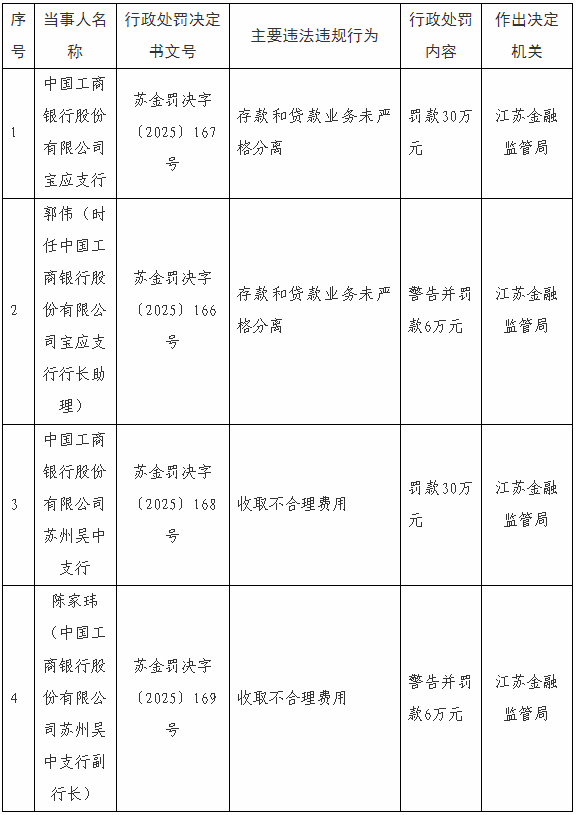
Core Viewpoint - The Jiangsu Regulatory Bureau of the National Financial Supervision Administration has imposed fines on two branches of the Industrial and Commercial Bank of China (ICBC) for violations related to banking practices [1][3]. Summary by Category Administrative Penalties - ICBC's Baoying Branch was fined 300,000 yuan for failing to strictly separate deposit and loan businesses [1][3]. - Guo Wei, the assistant branch manager of ICBC's Baoying Branch, received a warning and was fined 60,000 yuan for the same violation [1][3]. - ICBC's Suzhou Wuzhong Branch was also fined 300,000 yuan for charging unreasonable fees [1][3]. - Chen Jiawei, the deputy branch manager of ICBC's Suzhou Wuzhong Branch, was warned and fined 60,000 yuan for this violation [1][3].

银行大额存单利率新低,部分跌破1%
新华网财经· 2026-01-15 14:03
Core Viewpoint - The deposit market is undergoing significant changes in 2026, with large-denomination certificates of deposit (CDs) experiencing a downward trend in interest rates, leading to some small and medium-sized banks offering 3-month products with rates falling below 1%, officially entering the "0" range [2][3]. Group 1: Changes in Deposit Products - The decline in interest rates for short-term large-denomination CDs is a notable market phenomenon, marking the first occurrence in recent years [3]. - This shift is altering depositors' perceptions of "high-interest deposits" and is driving a restructuring wave in the asset allocation of the entire wealth management market [4]. - Over 40 banks have announced the issuance of large-denomination CDs in early 2026, with significant changes in both "term" and "interest rate" compared to previous years. Most banks are focusing on products with a term of one year or less, while the issuance of three-year products has sharply decreased, and five-year products are nearly extinct [5]. Group 2: Interest Rate Trends - The interest rates for three-year products are generally below 2%, with one-year rates often falling below 1.5%, and rates for products with a term of one year or less have dropped below 1% [5]. - Major banks have collectively removed five-year large-denomination CDs from sale, with available products typically having a term of three years or less. For instance, the Industrial and Commercial Bank of China and China Construction Bank offer three-year CDs at a rate of 1.55%, while one-month and three-month CDs from several major banks have rates of 0.9% [5]. Group 3: Market Dynamics and Future Outlook - The interest rate gap between newly issued large-denomination CDs and regular fixed-term deposits is narrowing, indicating a deepening trend of declining deposit rates as 2026 begins [7]. - The decline in large-denomination CD rates is attributed to multiple factors, including the pressure on banks' net interest margins, leading them to lower long-term high-cost liabilities and adjust rates downward [8]. - Regulatory efforts to curb irrational deposit competition among banks have also played a role in suppressing high-interest deposit strategies [8]. - There is a growing trend of private negotiations for high-interest CDs on social platforms, indicating a shift in market behavior [8][9]. - Experts predict that large-denomination CD rates will continue to decline, especially for short-term products, suggesting that the likelihood of earning passive income through these instruments is significantly decreasing [10]. - Investors are advised to diversify their asset allocations, with stable investors focusing on fixed-term deposits and savings bonds, while those with higher risk tolerance may consider "fixed income plus" products and equity investments [10].


工商银行:李金鸿担任独立董事的任职资格获核准
Zhi Tong Cai Jing· 2026-01-15 12:29
工商银行(601398)(01398)发布公告,中国工商银行股份有限公司(该行)收到《国家金融监督管理总局 关于李金鸿工商银行独立董事任职资格的批复》。根据有关规定,国家金融监督管理总局已核准李金鸿 先生担任该行独立董事的任职资格。李金鸿先生担任该行独立董事的任职已生效。该行欢迎李金鸿先生 加入该行董事会。 ...
工行玉林分行:深化普惠金融创新助力实体经济高质量发展
Zhong Guo Jin Rong Xin Xi Wang· 2026-01-15 10:38
Core Insights - The Industrial and Commercial Bank of China (ICBC) Yulin Branch is focusing on enhancing inclusive finance by driving product innovation and strengthening government-business cooperation to support the real economy [1][2][3] Group 1: Product Innovation - The bank has launched efficient financing products such as "Industrial e-loan," "Transaction e-loan," and "Merchant e-loan," which cater to various sectors including industrial manufacturing, commercial circulation, and modern agriculture [1] - As of the end of 2025, the balance of the bank's "Regional e-loan" series exceeded 2.1 billion, becoming a core driver of inclusive loan growth [1] Group 2: Support for Agriculture - The bank has developed the "Xingnong e-loan" product system to support rural revitalization, addressing the financial needs of agricultural sectors like rice, pomelo, and pig farming [2] - By the end of 2025, the balance of the "Xingnong e-loan" products reached 361 million, marking a new growth point for inclusive finance [2] - The bank has promoted the "Warehouse Receipt Pledge Loan" model to help agricultural enterprises and merchants unlock their inventory assets, issuing over 70 million in such loans throughout the year [2] Group 3: Policy Collaboration - The bank has strengthened collaboration with local governments and financial regulatory bodies to facilitate policy implementation and promote financial services [3] - In April 2025, the bank renewed a strategic cooperation agreement with the Yulin Municipal United Front Work Department to promote new inclusive products and policies, attracting significant business interest [3] - By the end of 2025, the bank had issued 3.2 million in entrepreneurial guarantee loans, supporting the development of small and micro enterprises [3]