
ICBC(601398)

Search documents
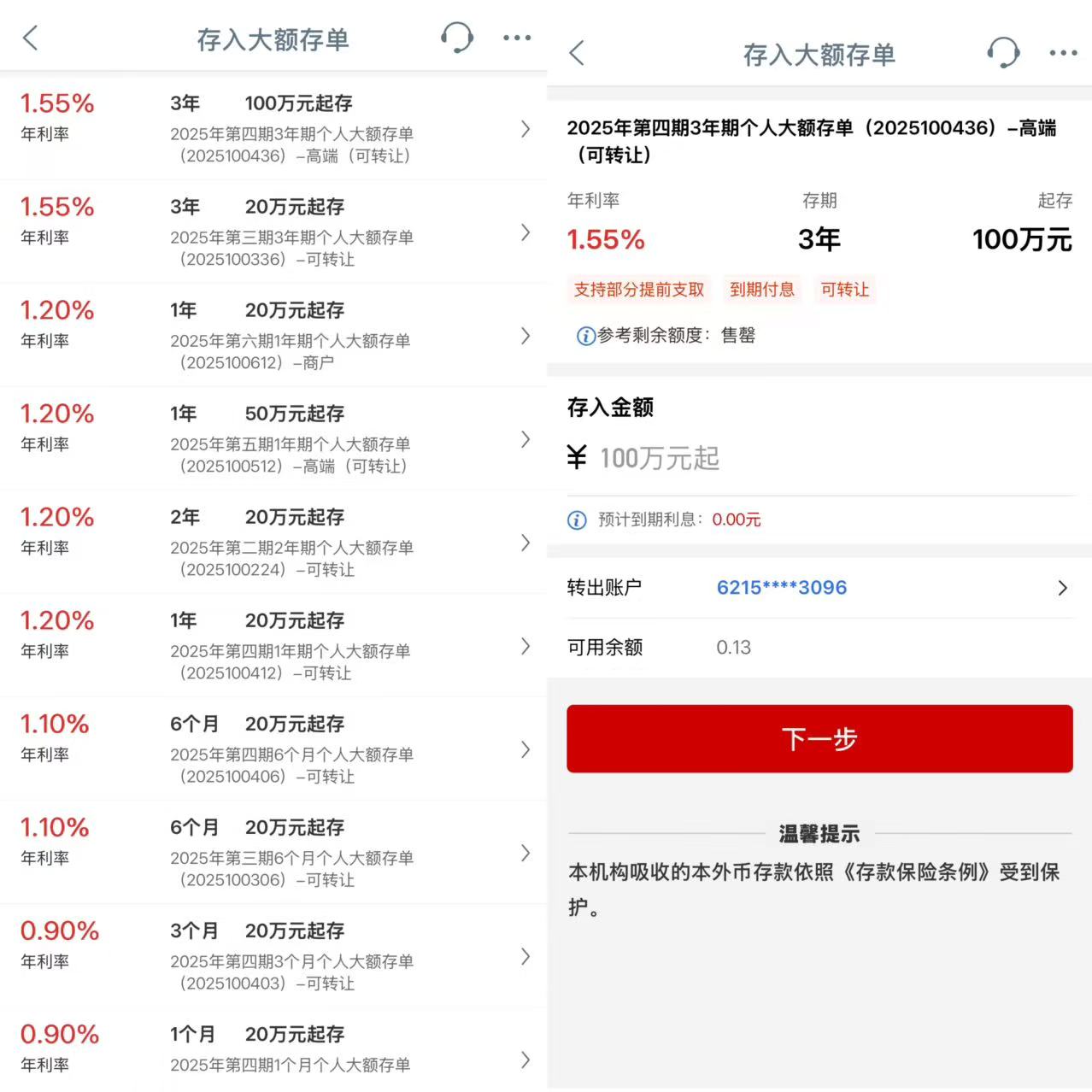
“劝退”普通储户?大行3年期大额存单现500万“天价”起购
Xin Jing Bao· 2025-12-04 14:58
Core Viewpoint - The Industrial and Commercial Bank of China (ICBC) has raised the minimum deposit requirement for its three-year large-denomination certificates of deposit (CDs) to 1 million yuan, while still offering a lower threshold of 200,000 yuan for another product, both with an interest rate of 1.55% [1][2][4]. Summary by Sections Product Offerings - ICBC offers two types of three-year large-denomination CDs: one with a minimum deposit of 1 million yuan, which is currently sold out, and another with a minimum of 200,000 yuan, which still has a remaining balance of over 10 million yuan [1][2]. - Other banks, such as Agricultural Bank of China, also offer three-year CDs with varying minimum deposit requirements, including a product with a 500,000 yuan minimum [4][5]. Market Dynamics - The adjustment in deposit thresholds by major banks reflects a strategic move to manage liabilities more effectively in a low net interest margin environment, aiming to reduce high-cost long-term liabilities [1][9]. - The trend of raising minimum deposit requirements is seen as a way to filter out ordinary depositors and attract high-net-worth clients, thereby optimizing the customer structure [1][6]. Interest Rate Environment - The interest rates for three-year large-denomination CDs are currently set at 1.55%, which is consistent across several banks, indicating a stable yet competitive market for these products [2][4]. - The overall banking sector is experiencing a structural adjustment, with large state-owned banks reducing high-cost deposit products while some smaller banks are increasing interest rates to attract deposits [7][8]. Future Outlook - Analysts predict that the interest rates for large-denomination CDs may continue to decline due to ongoing pressure on banks' net interest margins and potential further reductions in policy rates by the central bank [10][11]. - The demand for large-denomination CDs is expected to remain strong in the short term due to their perceived safety and stability, particularly among risk-averse investors [10][12].



银行行业2026年度投资策略:基本面筑底回升,聚焦息差改善和风险演绎
Orient Securities· 2025-12-04 14:44
Core Viewpoints - The banking sector is expected to return to a fundamental narrative in 2026, supported by policy financial tools and resilient asset expansion, with net interest margins likely stabilizing and improving due to the ongoing deposit repricing cycle [3][9] - The report highlights two main investment lines: high-quality small and medium-sized banks with solid fundamentals and state-owned large banks with good defensive value [3][9] Group 1: Fiscal Policy and Social Financing - In 2026, fiscal policy will remain key to stabilizing demand, with a stable growth rate of social financing expected between 8.3% and 9.0% [9][41] - The fiscal deficit rate is projected to remain at least at the 2025 level, with a focus on stimulating total demand and influencing the growth rate of bank asset expansion [26][41] - The government has introduced a new policy financial tool of 500 billion yuan, which is expected to leverage a total investment scale of approximately 7 trillion yuan, with a significant portion of related loans anticipated to materialize in 2026 [26][41] Group 2: Net Interest Margin Outlook - The net interest margin for banks is expected to stabilize and improve in 2026, primarily driven by a significant reduction in liability costs, with a projected improvement of approximately 30 basis points [9][49] - The scale of deposits entering the repricing cycle in 2026 is estimated at around 112 trillion yuan, contributing approximately 17.5 basis points to the improvement in the cost of interest-bearing liabilities [47][49] - The report anticipates that the overall improvement in the cost of interest-bearing liabilities will be around 30 basis points, with a corresponding effect on net interest margins of approximately 27 basis points [49] Group 3: Non-Interest Income and Asset Quality - Growth in non-interest income is expected to return to normal levels, with a marginal decline in contributions from other non-interest income sources [9][45] - The overall asset quality is projected to remain stable, with a focus on the risks associated with individual loans and real estate loans, which are expected to be manageable [9][45] - The report indicates that corporate asset quality continues to improve, while risks in the real estate sector are expected to be controllable [9][45] Group 4: Capital and Refinancing Outlook - The capital adequacy ratios of commercial banks are expected to remain stable, with a slight decline due to fluctuations in bond market interest rates [9][45] - The successful capital injection into four major state-owned banks is anticipated to enhance their ability to manage risks and support credit issuance [9][45] - The report notes that the path for capital replenishment through external channels remains relatively blocked, particularly for small and medium-sized banks [9][45]






最高500万元!银行大额存单门槛为何高低并行?
Guo Ji Jin Rong Bao· 2025-12-04 14:28
Core Viewpoint - The recent adjustment by Industrial and Commercial Bank of China (ICBC) to raise the minimum investment for its 3-year large-denomination certificates of deposit (CDs) to 1 million yuan reflects a broader industry trend where commercial banks are transforming traditional large deposit products into tools for customer relationship management [1][5]. Group 1: Changes in Deposit Products - ICBC has increased the minimum investment for its "high-end" 3-year large-denomination CD to 1 million yuan, while still offering regular products starting at 200,000 yuan [2][3]. - Agricultural Bank of China (ABC) has a similar product with a minimum investment of 5 million yuan, while also maintaining lower threshold products [4]. - Many banks have removed 5-year large-denomination CDs from their offerings, indicating a tightening of availability for medium to long-term large-denomination CDs [4]. Group 2: Interest Rates and Market Dynamics - The interest rates for the high-threshold large-denomination CDs have aligned with those of regular 3-year fixed deposits, both at 1.55% [4]. - The limited availability of large-denomination CDs has led to a situation where banks are using these products to attract high-end clients rather than relying on interest rates as the main draw [5]. Group 3: Strategic Implications for Banks - The adjustments in deposit structures are seen as a strategy to manage high-cost liabilities and stabilize net interest margins, which have been under pressure [5]. - By increasing the minimum investment threshold, banks aim to reduce the number of lower-value depositors, thereby lowering operational and management costs [5]. - The trend of adjusting deposit structures and lowering interest rates is becoming a normalized practice in the banking industry as they seek to maintain profitability in a low-interest environment [5][6].
“迎击变局,智赢未来”系列文章:助力商业银行董事应对挑战洞察先机
Xin Lang Cai Jing· 2025-12-04 11:27
Group 1: Core Insights - The external environment for commercial banks is increasingly complex, with geopolitical tensions, technological revolutions, and deepening regulations posing new challenges to strategic resilience and governance capabilities [2][35] - The board of directors is crucial in leading banks to proactively transform and adapt to changes, shifting from passive defense to active positioning and from compliance to value creation [2][35] Group 2: Organizational Structure - Digital technologies such as AI, big data, and blockchain are reshaping the financial landscape, pushing banks towards intelligent, inclusive, and globalized operations [3][36] - The article discusses the need for banks to reassess their organizational structures to adapt to the competitive environment of the digital age, focusing on how to break down departmental silos and enhance strategic collaboration [3][37] Group 3: Business Development - The banking industry is experiencing a significant shift from a "scale-oriented" approach to "value reconstruction," driven by narrowing net interest margins and intense competition [8][42] - The article outlines how banks can leverage dual forces of financial digital ecosystems and industry terminal scenarios to drive transformation, providing actionable business layout and innovation directions [8][42] Group 4: Risk Management - Commercial banks are facing a new normal where external risks outweigh internal risks, necessitating a shift from traditional passive risk management to a more proactive and systematic risk governance model [15][49] - The article emphasizes the importance of integrating strategic execution with risk appetite to ensure banks maintain the correct direction in dynamic environments [15][49] Group 5: Compliance Management - Compliance management has evolved from merely meeting regulatory requirements to becoming a core competitive advantage that supports long-term value growth [21][55] - The article provides a framework for compliance transformation, emphasizing the need for boards to lead the redefinition of compliance functions to adapt to changing environments [21][56] Group 6: Internal Audit - Traditional internal audit models are challenged by rapid technological advancements and regulatory changes, necessitating a shift towards agile auditing that provides real-time insights and strategic support [28][62] - The article outlines how agile auditing can transform internal audit functions from compliance overseers to strategic partners that enhance risk management and value creation [28][62]


存款争夺熄火:有银行下架1年期及以上产品
3 6 Ke· 2025-12-04 10:37
Core Viewpoint - The banking industry is facing pressure on net interest margins, leading to a control on liabilities and a reduced likelihood of a deposit competition by the end of 2025 [1][6]. Group 1: Deposit Products and Interest Rates - Some banks have temporarily suspended the issuance of term deposits of 1 year and above, with current rates for shorter-term deposits ranging from 1.25% to 1.45% [1][3]. - Six major state-owned banks have collectively removed 5-year large certificates of deposit (CDs) from their offerings, while still providing various term deposit products with maximum rates of 1.3% [1][4]. - The interest rates for 1-year, 2-year, 3-year, and 5-year term deposits from state-owned banks are approximately between 0.95% and 1.3% [4][5]. Group 2: Net Interest Margin and Loan Quality - As of the end of Q3 2025, the net interest margin for commercial banks was 1.42%, remaining stable compared to Q2 but down by 11 basis points year-on-year [6][7]. - The non-performing loan ratio for commercial banks was 1.52%, an increase of 0.03 percentage points from the previous quarter [1]. - The net interest margin for joint-stock banks and rural commercial banks was relatively higher at 1.56% and 1.58%, respectively, while state-owned banks and city commercial banks had lower margins of 1.31% and 1.37% [7]. Group 3: Strategic Adjustments in Banking - Banks are optimizing their liabilities as a core strategy, with many large and medium-sized banks ceasing the issuance of long-term large CDs since Q2 2024 [4][6]. - The banking sector is focusing on aligning loan pricing with business risks to maintain reasonable net interest margins, amidst concerns of a potential "inversion" between non-performing rates and net interest margins [6][7]. - The trend of deposit rates being lowered has been ongoing, with the latest adjustments occurring on May 20, 2025, marking the seventh reduction since September 2022 [5].


工行菏泽分行借助融安e信平台筑牢数字经济金融安全防线
Qi Lu Wan Bao· 2025-12-04 10:12
李可 融安e信平台依托大数据分析,有效整合社会公信体系等多方权威信息。一方面,能实时识别诈骗电话、短 信和链接,对涉嫌欺诈的犯罪行为及时发出风险提示和自动预警,从源头上降低诈骗成功率;另一方面,可 查询企业信息、法人涉诉信息、失信信息等风险情况,全面了解企业状况,及时发现失信、涉诈等潜在风 险,有效提升融资业务风险管理水平,为防范外部欺诈筑牢屏障。 广泛宣传,助力快速止损 工行菏泽分行对融安e信的宣传推广工作制定了明确任务,并逐步推进落实。首先做好员工内部培训,让员 工了解产品特点、功能、使用方法及服务管理要求,以便结合目标客户的产品需求,为客户分析产品特点 及优势,实现精准营销。各网点通过电子显示屏不间断播放产品宣传标语,将产品资料摆放在柜台醒目位 置,对意向客户进行面对面讲解。此外,还通过走访企业用户,推广融安e信的反欺诈手段,提升企业用户信 任度,帮助其规避融资风险。 精准掌握,有效防范金融风险 该分行将继续履行国有大行的社会责任,凭借优质的金融产品和高效的服务质量,在助力社会高效治理、 防范化解金融风险等方面积极作为,为维护社会安全稳定和保障群众资金安全贡献金融力量。 通讯员 刘宏明 菏泽报道 融安e ...
工行德州分行探索“以链带群”服务模式
Qi Lu Wan Bao· 2025-12-04 10:12
Group 1 - The core focus of the Industrial and Commercial Bank of China (ICBC) Dezhou Branch is to support the new industrialization of Dezhou City by integrating into the new development pattern, particularly emphasizing manufacturing and strategic emerging industries [1] - As of the end of September, the total loan balance reached nearly 68 billion yuan, an increase of approximately 5.6 billion yuan since the beginning of the year, marking a historic breakthrough [1] - The bank has implemented a dynamic project list update mechanism, ensuring timely financing solutions through a "one project, one plan, one team" approach, which has effectively supported the stability and growth of industrial clusters [1] Group 2 - ICBC Dezhou Branch has introduced specialized products like Park e-loans and Industry e-loans to alleviate the financial pressure faced by small and medium-sized enterprises (SMEs) within the industrial chain [2] - Specific examples include a 500,000 yuan Industry e-loan that enabled a company in the HVAC industry park to launch a new energy-saving fan, and a 4.9 million yuan loan that supported a textile company in introducing waterless dyeing equipment, increasing product value by nearly 30% [2] - By the end of September, the Park e-loan and Industry e-loan programs had covered 2 national-level parks and 11 provincial-level parks, providing nearly 200 million yuan in loans to around 100 enterprises [2] Group 3 - ICBC Dezhou Branch has visited over 11,000 enterprises this year, completing credit approvals of approximately 12 billion yuan and disbursing loans of 9.2 billion yuan to over 9,400 enterprises, including about 150 million yuan in supply chain loans [3] - The implementation of industrial chain finance has empowered the entire industrial chain, alleviating financing difficulties for SMEs and accelerating the development of industrial clusters, thereby providing robust support for local industrial transformation [3]
多部门统筹推进科技金融,银行信贷如何才能加大“含科量”?路径依赖等多重障碍待破除
Xin Lang Cai Jing· 2025-12-04 09:07
Core Viewpoint - The central theme of the news is the emphasis on accelerating the construction of a technology finance system in China, with a focus on increasing credit support for technology enterprises by banks [1]. Group 1: Credit Support for Technology Enterprises - Various banks have reported significant growth in technology loans this year, with Agricultural Bank of China (ABC) indicating a technology loan balance exceeding 4.7 trillion yuan, an annual increase of over 800 billion yuan [1]. - Industrial and Commercial Bank of China (ICBC) has also surpassed 6 trillion yuan in technology loans, with loans to technology enterprises exceeding 2.5 trillion yuan [1]. - Other banks, including CITIC Bank and Nanjing Bank, are actively increasing their technology loan portfolios, with CITIC Bank reporting a technology loan balance exceeding 1 trillion yuan [1]. Group 2: Sector Focus and Loan Distribution - The manufacturing sector, particularly advanced manufacturing and traditional enterprise upgrades, remains a primary focus for bank lending, with a significant portion of loans directed towards these areas [3]. - As of the end of Q3, loans to manufacturing enterprises from ABC's Hubei branch reached 576.2 billion yuan, accounting for 54% of technology loans, with advanced manufacturing receiving 360.3 billion yuan [3]. - Emerging sectors such as robotics and deep-sea economy are also gaining attention, with banks expanding credit support in these areas [4]. Group 3: Challenges in Technology Finance - Despite the growth in technology loans, banks face challenges in advancing technology finance, including reliance on traditional credit channels and a need for enhanced industry analysis and research [5]. - There is a dependency on external trade and small micro-enterprises for credit, which may hinder the motivation for technology loan issuance [5]. - The unique characteristics of technology enterprises, such as reliance on intellectual property and human capital rather than physical collateral, necessitate innovative financing solutions [5][6].

易方达中证工程机械主题交易型开放式指数证券投资基金 基金份额发售公告
Zhong Guo Zheng Quan Bao - Zhong Zheng Wang· 2025-12-04 08:29
登录新浪财经APP 搜索【信披】查看更多考评等级 基金管理人:易方达基金管理有限公司 基金托管人:中国工商银行股份有限公司 2.本基金为交易型开放式、股票型证券投资基金、指数基金。 3.本基金的管理人为易方达基金管理有限公司(以下简称"本公司"),托管人为中国工商银行股份有限 公司,本基金登记结算机构为中国证券登记结算有限责任公司。 4.本基金将自2025年12月11日至2025年12月19日进行发售。本基金的投资人可选择网上现金认购和网下 现金认购2种方式(本基金暂不开通网下股票认购),其中网下现金认购的日期为2025年12月11日至 2025年12月19日,网上现金认购的日期为2025年12月11日至2025年12月19日。如深圳证券交易所对网上 现金认购时间作出调整,本公司将作出相应调整并及时公告。基金管理人根据认购的情况可适当调整募 集时间,并及时公告,但最长不超过法定募集期限。 5.网上现金认购是指投资人通过具有基金销售业务资格的深圳证券交易所会员用深圳证券交易所网上系 统以现金进行的认购;网下现金认购是指投资人通过基金管理人及其指定的发售代理机构以现金进行的 认购。 6.投资者认购本基金时需具有深 ...
行业深度报告:存款偏离与指标问题对当前司库策略的影响
KAIYUAN SECURITIES· 2025-12-04 07:49
Group 1 - The core viewpoint of the report emphasizes the importance of balancing positions, indicators, and costs in treasury liability strategies, focusing on liquidity management and cost optimization [2][14][16] - Current treasury strategies are characterized by a focus on long-term funding, short-term deposits, cost control, and improving liquidity indicators, with banks experiencing reduced cost pressures and increased expected liquidity gaps [3][4][6] - The report identifies that the expected liquidity gap is exacerbated by factors such as the non-bankization of deposits and the concentration of high-interest deposits maturing, estimating that 17 trillion yuan of high-interest deposits will mature in the second half of 2025, and 26 trillion yuan in the first half of 2026 [3][4][19] Group 2 - The liquidity risk indicators are under pressure, with some joint-stock banks experiencing a rapid decline in their Net Stable Funding Ratio (NSFR), indicating a reliance on the liability side for liquidity adjustments [4][5][22] - The report suggests that the pricing of negotiable certificates of deposit (NCDs) may increasingly reflect internal management demands, with banks focusing on managing liquidity gaps and improving liquidity indicators through NCD issuance [5][6][20] - Investment recommendations include positioning in large state-owned banks, core holdings in leading comprehensive banks, and flexible allocations in regional banks, with specific banks identified as beneficiaries [6][14][19]


