
CPIC(601601)

Search documents
ETF资金榜 | 航天ETF(159267):净流出4917.20万元,居全市场第一梯队-20260122
Xin Lang Cai Jing· 2026-01-23 10:41
资金流出也带来了份额的减少,该基金最新份额较前一日减少3800.00万份,达12.62亿份。与此同时, 该基金最新规模达16.32亿元。 2026年1月22日,航天ETF(159267.SZ)收涨3.92%,成交2.30亿元。净流出4917.20万元(净赎回份额*单 位净值),居全市场第一梯队。 拉长时间看,该基金连续2天资金净流出,累计流出5292.14万元,居可比基金前二。 航天ETF(159267.SZ),场外联接(A:025732;C:025733)。 ...
ETF资金榜 | 科创债ETF嘉实(159600):净流出7.90亿元,居可比基金首位-20260122
Xin Lang Cai Jing· 2026-01-23 10:41
Group 1 - The core point of the article highlights that the Jiashi Science and Technology Bond ETF (159600.SZ) experienced a significant net outflow of 7.90 billion yuan, making it the top fund in terms of net redemption among comparable funds [1] - Over a longer period, the fund has seen a continuous net outflow for five days, totaling 12.92 billion yuan, ranking it among the top three in comparable funds [1] - The outflow of funds has resulted in a reduction of the fund's shares, with the latest share count decreasing by 7.90 million to reach 301 million shares [1] Group 2 - The latest scale of the Jiashi Science and Technology Bond ETF stands at 30.126 billion yuan [1]
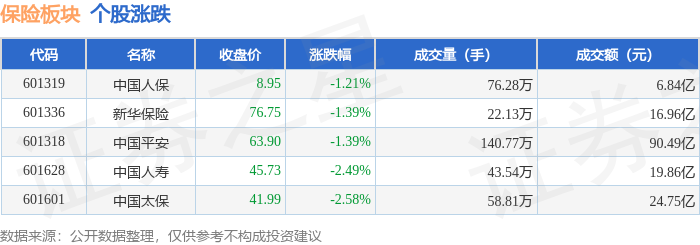
保险板块1月23日跌1.95%,中国太保领跌,主力资金净流出2.49亿元
Zheng Xing Xing Ye Ri Bao· 2026-01-23 09:04
Core Viewpoint - The insurance sector experienced a decline of 1.95% on January 23, with China Pacific Insurance leading the drop, while the overall market indices showed slight gains [1]. Group 1: Market Performance - The Shanghai Composite Index closed at 4136.16, up 0.33% [1]. - The Shenzhen Component Index closed at 14439.66, up 0.79% [1]. Group 2: Individual Stock Performance - China Life Insurance (601628) closed at 45.73, down 2.49% with a trading volume of 435,400 shares [1]. - China Pacific Insurance (601601) closed at 41.99, down 2.58% with a trading volume of 588,100 shares [1]. - China Ping An (601318) closed at 63.90, down 1.39% with a trading volume of 1,407,700 shares [1]. - New China Life Insurance (601336) closed at 76.75, down 1.39% with a trading volume of 221,300 shares [1]. - China Reinsurance (601319) closed at 8.95, down 1.21% with a trading volume of 762,800 shares [1]. Group 3: Capital Flow Analysis - The insurance sector saw a net outflow of 249 million yuan from institutional investors and 278 million yuan from retail investors, while retail investors had a net inflow of 527 million yuan [1]. - China Life Insurance had a net inflow of 126 million yuan from institutional investors, but a net outflow of 124 million yuan from retail investors [2]. - China Pacific Insurance had a net inflow of 112 million yuan from institutional investors, with a net outflow of 1.42 million yuan from retail investors [2]. - China Ping An experienced a significant net outflow of 546 million yuan from institutional investors [2].






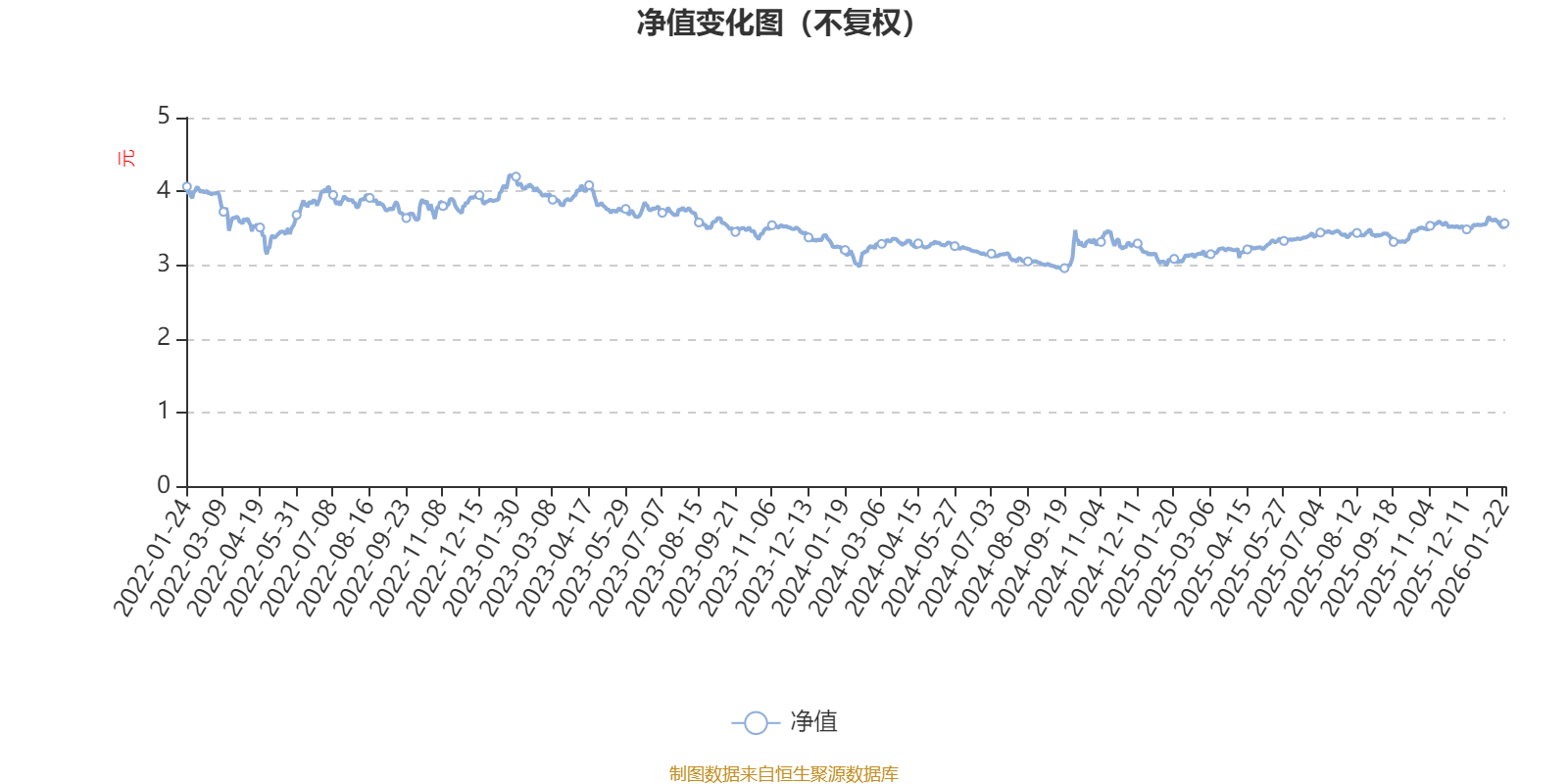
诺安新动力灵活配置混合A:2025年第四季度利润499.71万元 净值增长率7.26%
Sou Hu Cai Jing· 2026-01-23 08:23
Core Viewpoint - The AI Fund Nuon New Power Flexible Allocation Mixed A (320018) reported a profit of 4.9971 million yuan for Q4 2025, with a weighted average profit per fund share of 0.2548 yuan. The fund's net value growth rate for the reporting period was 7.26%, and the fund size reached 65.8123 million yuan by the end of Q4 2025 [3][14]. Fund Performance - As of January 22, the unit net value of the fund was 3.565 yuan. The fund manager, Li Xiaojie, has managed four funds over the past year, all of which have yielded positive returns. The highest growth rate among these funds was 48.16% for Nuon Low Carbon Economy Stock A, while the lowest was 5.05% for Nuon Huili Mixed A [3]. - The fund's net value growth rates over various periods are as follows: 2.18% over the last three months (ranking 1015/1286), 2.83% over the last six months (ranking 1146/1286), 16.89% over the last year (ranking 980/1286), and -15.38% over the last three years (ranking 1190/1286) [3]. Investment Strategy - The fund's Q4 holdings were primarily in dividend-related assets such as banks, oil and petrochemicals, and non-bank financials. The fund reduced its allocation in the banking sector while increasing its positions in non-bank financials and oil and petrochemicals [3]. Risk Metrics - The fund's Sharpe ratio over the last three years was -0.0472, ranking 1192/1275 among comparable funds [8]. - The maximum drawdown over the last three years was 30.05%, with the largest single-quarter drawdown occurring in Q1 2022 at 17.43% [10]. Portfolio Composition - As of December 31, the fund's average stock position over the last three years was 74.15%, compared to the industry average of 72.57%. The fund reached a peak stock position of 79.28% at the end of 2021 and a low of 51.69% by the end of Q3 2022 [13]. - The top ten holdings of the fund as of Q4 2025 included China Ping An, China Pacific Insurance, China Petroleum, Oppein Home, China Shenhua, New China Life Insurance, Sinopec, Shaanxi Coal and Chemical Industry, Yili Group, and Jiangsu Bank [17].


ETF融资榜 | 半导体设备ETF 广发(560780)融资净买入1036.58万元,居可比基金前2-20260122
Xin Lang Cai Jing· 2026-01-23 01:59
Group 1 - The semiconductor equipment ETF, Guangfa (560780.SH), experienced a decline of 2.47% on January 22, 2026, with a trading volume of 276 million yuan [1] - The fund saw a net financing purchase of 10.37 million yuan, ranking it among the top two comparable funds [1] - Over the past five trading days, the fund recorded net financing inflows on three occasions, totaling 11.28 million yuan, making it the top fund in its category [1] Group 2 - The fund has both onshore and offshore connection classes, specifically Class A (020639) and Class C (020640) [1]
开创“保险+精准医疗+健康管理”新范式
Jin Rong Shi Bao· 2026-01-23 01:30
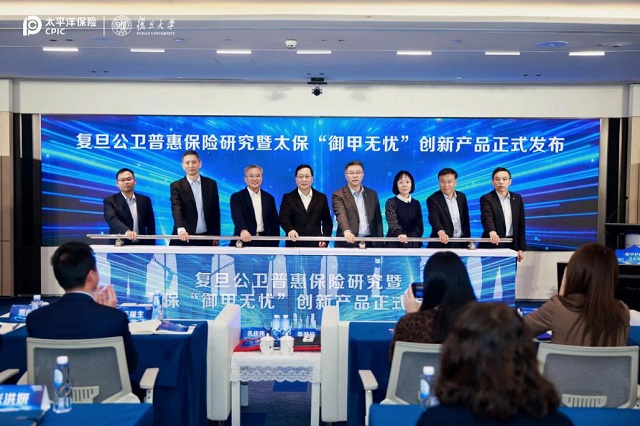
复旦大学公共卫生学院院长何纳分享专项研究报告 中国太保寿险总经理李劲松阐述"御甲无忧"精准破解甲癌患者三大痛点 复旦大学公共卫生学院院长何纳带来《中国人群甲状腺癌术后复发与生存研究报告》。他指出,甲状腺 癌近年来发病率呈上升趋势。尽管患者术后总体生存率较高,但术后复发仍是需要关注的重要风险。研 究团队基于大量临床数据分析,明确了影响复发风险的关键因素,这些研究成果为"御甲无忧"产品的精 准风险定价与保障设计提供了关键的医学依据。 1月9日,中国太保旗下中国太保寿险与复旦大学保险应用创新研究院、复旦大学公共卫生学院联合研发 的创新产品"太保御甲无忧疾病保险"(以下简称"御甲无忧")正式发布。作为面向甲状腺癌术后患者的专 属解决方案,"御甲无忧"精准回应患者对于健康风险保障及持续健康管理的迫切需求,是破解带病体人 群保障难题的一次创新实践。 发布会上,复旦大学保险应用创新研究院执行理事长孔庆伟表示,这款由复旦大学与中国太保寿险联合 研发的带病体保险产品的推出,标志着精准医学与保险精算的深度融合,是金融创新服务民生的重要实 践。他回望复旦大学保险应用创新研究院创立的初心"复旦平台、上海力量、行业先声",表示"御甲无 ...
资金动态20260123
Qi Huo Ri Bao Wang· 2026-01-23 01:08
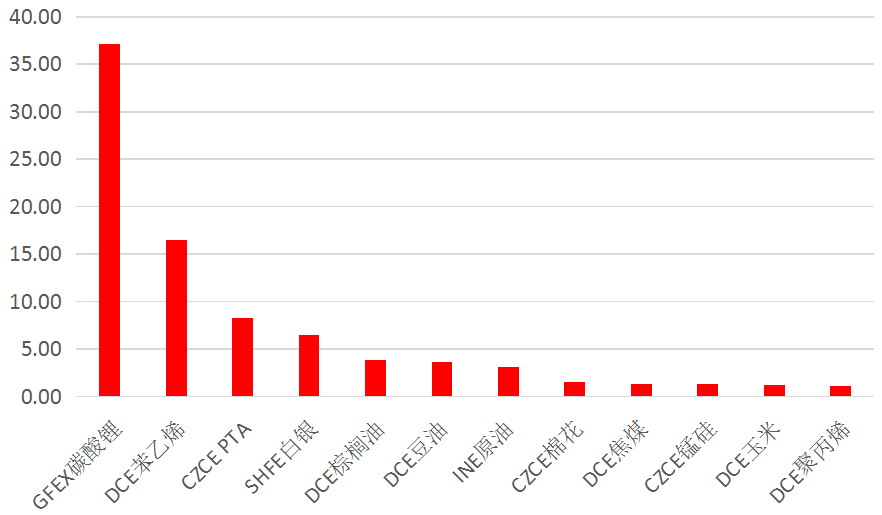
Group 1 - The core viewpoint of the article indicates a significant inflow of funds into commodity futures, particularly in sectors such as chemicals, non-ferrous metals, and agricultural products, while the financial sector experienced outflows [1] - The top inflow commodities included lithium carbonate (37.12 billion), styrene (16.50 billion), PTA (8.21 billion), silver (6.51 billion), and palm oil (3.82 billion) [1] - The main outflow commodities were gold (16.25 billion), platinum (3.88 billion), iron ore (1.58 billion), nickel (1.57 billion), and soybean meal (0.93 billion) [1] Group 2 - The chemical, non-ferrous metals, and agricultural sectors showed substantial inflows, with a focus on lithium carbonate, styrene, PTA, silver, palm oil, crude oil, and cotton [1] - The black sector had a slight inflow, particularly in coking coal and ferrosilicon, while iron ore faced outflows [1] - In the financial sector, attention is drawn to the CSI 1000 index futures and 30-year treasury futures [1]
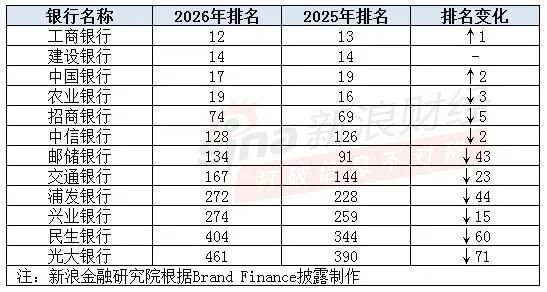
谁能跻身全球品牌价值500强?光大银行下滑71名,民生银行降60名
Xin Lang Cai Jing· 2026-01-23 01:08
Group 1: Core Insights - The Brand Finance 2026 Global Brand Value 500 report was released, highlighting the performance of various banks and insurance companies [1][7] - Chinese brands have shown a double-digit growth in total value, indicating strong resilience and potential for future growth [7] Group 2: Banking Sector Summary - Major Chinese banks included in the ranking are Industrial and Commercial Bank of China (ICBC) at 12th, China Construction Bank at 14th, and Bank of China at 17th, with ICBC holding a brand value of $90.88 billion and a brand strength index of 91.5 [2][3] - China Bank surpassed Agricultural Bank, which dropped to 19th place, while China Merchants Bank ranked 74th as the highest among joint-stock banks [3][4] - Notable declines were observed for China Everbright Bank, which fell 71 places to 461st, and Minsheng Bank, which dropped 60 places to 404th [1][4] Group 3: Insurance Sector Summary - Among the insurance companies, Ping An Insurance ranked 32nd globally, being the only Chinese insurer in the top 100, with a brand strength rating of AAA- [5][6] - Other insurers like China Life and China Pacific Insurance also maintained positions within the top 200, while Prudential Insurance saw a significant drop of 117 places to 350th [5][6] - Notably, Cathay Life Insurance improved its ranking by 180 places to 407th [6] Group 4: Overall Brand Performance - The report indicates that 12 Chinese brands made it to the top 50 globally, with Douyin's brand value increasing by 45.1% to $153.54 billion, ranking 6th [7] - State Grid Corporation achieved a brand value of $102.44 billion, ranking first in the global utility sector, with a 19.6% increase in brand value [8]




大盘简评20260122
Mei Ri Jing Ji Xin Wen· 2026-01-23 00:56
Group 1 - The market experienced a rebound on January 22, with all three major indices turning positive. The Shanghai and Shenzhen stock exchanges recorded a trading volume of 2.69 trillion yuan, an increase of 91 billion yuan compared to the previous trading day. The Shanghai Composite Index rose by 0.14%, the Shenzhen Component Index by 0.5%, and the ChiNext Index by 1.01% [1] - Market liquidity remains abundant despite a recent decrease in trading volume, which is still at a relatively high level. The overall upward pressure on the market is significant, with accelerated sector rotation indicating a potential short-term thematic market [1] - The military industry sector has seen a rebound, particularly in the large aircraft segment, which is experiencing active trading. The delivery progress of domestic large aircraft has been slow, but capacity construction is expected to accelerate. Recent reports indicate that the European Union Aviation Safety Agency (EASA) has begun flight evaluation of the C919 in Shanghai, with a positive overall assessment, suggesting that the development of domestic large aircraft may enter a rapid growth phase [1] Group 2 - The artificial intelligence (AI) wave continues to rise, with a recommendation for integrated hardware and software layouts. Reports indicate that Jensen Huang plans to visit China in January, focusing on key core suppliers. The AI hardware sector has seen unprecedented growth opportunities, while the software side still needs to improve its commercialization loop. As foundational model performance improves, AI software is expected to enter a growth phase [2] - Investors are encouraged to pay attention to the communication ETF (515880) and software ETF (515230) for simultaneous investment in overseas computing hardware and software [2]
寻找中国保险的Alpha系列之四从保单到数据新能源车险的价值跃迁
Guoxin Securities· 2026-01-23 00:30
Investment Rating - The report maintains an "Outperform" rating for the insurance sector, particularly focusing on companies involved in new energy vehicle insurance [5][6]. Core Insights - The new energy vehicle insurance market in China is entering a "golden development period" characterized by simultaneous growth in volume and price, driven by national policies and increasing market penetration of new energy vehicles [1][4]. - The insurance industry faces high costs and claims pressures due to the inherent differences in risk structures between new energy vehicles and traditional fuel vehicles, necessitating a re-evaluation of underwriting models [2][3]. - The industry's profitability model needs restructuring, focusing on risk reduction, ecosystem integration, and international expansion to build competitive barriers [3][4]. Summary by Sections Industry Investment Rating - The report rates the insurance sector as "Outperform," highlighting the potential for growth in new energy vehicle insurance [5]. Market Dynamics - The penetration rate of new energy vehicles is projected to reach 40.9% of total new car sales by 2024, with retail penetration nearing 50%, indicating a robust growth trajectory for insurance premiums [1][22]. - The average annual growth rate of new energy vehicle sales from 2020 to 2024 is approximately 62.9%, significantly outpacing traditional fuel vehicles [22][25]. Risk Management and Innovation - The introduction of Advanced Driver Assistance Systems (ADAS) and Usage-Based Insurance (UBI) is reshaping risk management and pricing strategies in the insurance sector, providing tools to address high costs and claims [32][34]. - The penetration rate of L2 and above ADAS in new vehicles is expected to exceed 50% in 2024, enhancing the ability of insurers to manage risks proactively [33][35]. Strategic Recommendations - The report suggests focusing on insurance companies that are leading in data technology investments, have deep partnerships with major new energy vehicle manufacturers, and possess clear international expansion strategies [4][6]. - Companies like China Pacific Insurance, China Ping An, and China Property & Casualty Insurance are identified as having the potential to convert current scale advantages into long-term risk pricing and cost control capabilities [4][5].