CPIC(601601)

Search documents
ETF资金榜 | 半导体设备ETF 广发(560780):净流入2.60亿元,居全市场第一梯队-20260119
Xin Lang Cai Jing· 2026-01-20 01:40
2026年1月19日,半导体设备ETF 广发(560780.SH)收跌0.51%,成交3.11亿元。净流入2.60亿元(净申购 份额*单位净值),居全市场第一梯队。 拉长时间看,该基金连续9天资金净流入,合计吸金16.38亿元,居全市场第一梯队。 资金流入也助力了份额的提升,该基金最新份额较前一日增加1.21亿份,突破16.00亿份,创历史新高。 与此同时,该基金最新规模突破35.00亿元,创历史新高。 半导体设备ETF 广发(560780.SH),场外联接(A:020639;C:020640)。 ...
资金动态20260120
Qi Huo Ri Bao Wang· 2026-01-20 01:22
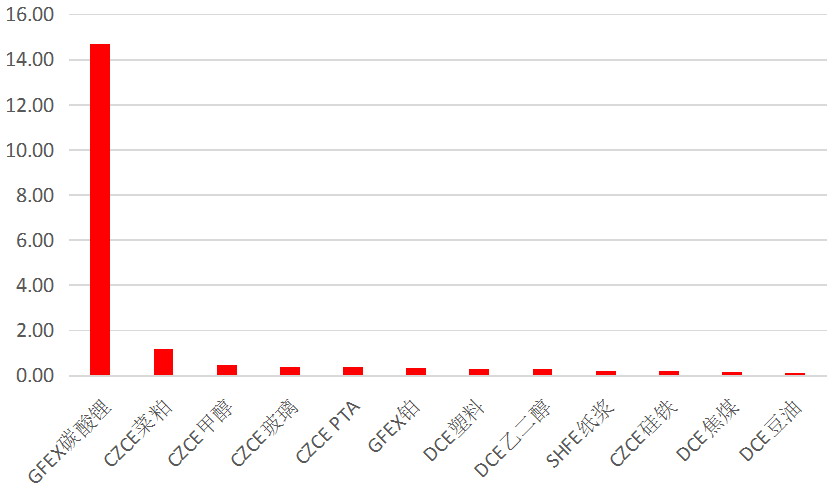
Group 1 - The main inflows in commodity futures (main contracts) yesterday were in lithium carbonate, rapeseed meal, methanol, glass, and PTA, with inflows of 1.471 billion, 117 million, 45 million, 39 million, and 36 million respectively [1] - The main outflows were in copper, gold, iron ore, tin, and silver, with outflows of 509 million, 463 million, 410 million, 358 million, and 262 million respectively [1] - Overall, commodity futures experienced a moderate outflow, particularly in non-ferrous metals and black metals, with significant attention on the outflows of copper, gold, iron ore, tin, silver, and nickel, while lithium carbonate and coking coal saw inflows [1] Group 2 - The chemical and agricultural products sectors experienced slight outflows, with notable inflows in rapeseed meal, methanol, glass, and PTA, while cotton, live pigs, apples, and rubber saw larger outflows [1] - In the financial sector, key focus is on the CSI 500 index futures and 10-year government bond futures [1]

2025年度保险理赔报告密集出炉:“直付”服务打通壁垒,重疾出险年轻化、仍存较大保障缺口
Xin Lang Cai Jing· 2026-01-20 00:13
Core Insights - The insurance industry is witnessing a significant shift in claims and service models, with a focus on digitalization and direct payment services, enhancing the efficiency of claims processing [1][8] - Total claims paid by life insurance companies reached 1.18 trillion yuan, while property insurance companies paid 1.03 trillion yuan in 2025, both showing an increase compared to the previous year [1] - Medical insurance remains the dominant category in terms of claim numbers, while critical illness insurance accounts for a significant portion of claim amounts, highlighting a growing awareness of health risks among residents [5][6] Group 1: Claims Data Overview - Major insurance companies reported substantial increases in claims for 2025, with China Life processing over 62.24 million claims, a 7% increase year-on-year, and total claims amounting to over 100.4 billion yuan, a 10% increase [2] - China Pacific Life reported 4.24 million claims with a total payout of 20.1 billion yuan, while Ping An Life processed 4.96 million claims totaling 41.51 billion yuan [3] - China Property & Casualty Insurance processed over 200 million claims, with a total payout exceeding 380 billion yuan, marking a growth of over 10% [2] Group 2: Critical Illness and Medical Insurance Trends - Medical insurance claims accounted for over 90% of total claims in many companies, while critical illness insurance represented over 50% of the total payout amounts [5][6] - The trend of younger individuals being diagnosed with critical illnesses is rising, with significant claims from the 40-60 age group, and the 18-40 age group showing a high incidence rate [6][7] - Despite the increase in awareness and claims, the average payout for critical illness insurance remains insufficient to cover the high costs of treatment, with many claims below 100,000 yuan [7] Group 3: Digitalization and Service Improvements - The introduction of direct payment services has streamlined the claims process, allowing patients to avoid upfront costs, with China Life reporting 8.17 million direct payment claims totaling over 4.3 billion yuan [8][9] - The digital transformation in the insurance sector has led to over 90% of claims being processed online for several companies, significantly improving efficiency [8][9] - Companies are leveraging technology, including IoT and automated claims processing, to enhance service delivery and customer experience [9]





2025三季度车险榜&非车险榜:平安增速快,泰康、众安等车险增速超30%,泰康、京东等非车增速连续2年超10%
13个精算师· 2026-01-19 16:01
Core Insights - The insurance industry is experiencing a shift towards non-auto insurance, with premium growth slowing down in both auto and non-auto segments. The overall premium growth for the insurance industry in 2025 is expected to be below 4% [10][24]. Auto Insurance Premium Rankings - The top three companies in auto insurance premium rankings are stable, with Ping An showing the fastest growth. Zhong An, Tai Kang, and BYD have all exceeded 30% growth [12][24]. - The premium rankings for auto insurance in 2025 show that PICC has a premium of 2,201.19 billion, followed by Ping An with 1,760.95 billion, and Taibao with 852.32 billion [2][14]. - The overall growth rate of auto insurance premiums has slowed compared to the previous year, with the market facing challenges due to a single-digit growth rate in vehicle ownership [9][19]. Non-Auto Insurance Premium Rankings - Ping An's non-auto insurance premium growth is at 14%, while Tai Kang, Zijin, and JD Allianz have consistently exceeded 10% growth for two consecutive years [25][26]. - The premium rankings for non-auto insurance in 2025 indicate that PICC leads with 2,228.76 billion, followed by Ping An at 936.28 billion, and Taibao at 787.56 billion [26][27]. - The non-auto insurance segment is experiencing a shift, with some companies focusing on maintaining strong growth in this area while others face declining growth rates [10][25].


【微聚焦】中国太保寿险青岛分公司岁末年初筑牢非法金融“防火墙”
Xin Lang Cai Jing· 2026-01-19 13:16
Core Viewpoint - China Pacific Life Insurance Qingdao Branch is actively promoting education to prevent illegal financial activities, aligning with the directives from the Central Financial Work Conference and relevant State Council documents, to safeguard public financial security [1][3]. Group 1: Promotional Activities - The branch has established a special task force to plan, deploy, and supervise the promotional education work, leveraging the peak travel season at the year's end to engage the public [1][3]. - The promotional efforts will integrate education into business promotion and customer service, ensuring thorough implementation [1][3]. Group 2: Focus Areas of Education - The campaign will focus on the characteristics of illegal financial activities in the insurance sector, educating the public on basic insurance knowledge and detailing the typical features, manifestations, and common tactics of illegal financial activities [1][3]. - Specific warnings will be issued regarding illegal fundraising risks disguised as retirement services, cultural tourism, cloud farming, RWA, and blockchain, as well as new modes of illegal financial activities using social media, short video platforms, and apps [1][3]. Group 3: Target Audience and Methods - The initiative aims to enhance the awareness and capability of key groups, particularly the elderly and youth, in recognizing and reporting illegal financial activities [1][3]. - Various methods will be employed at service points, including hanging banners, posting posters, playing promotional videos, and distributing materials to educate customers [1][3]. - For the elderly, SMS alerts will be sent to warn them about illegal fundraising risks under the guise of "retirement services" and "health management" [1][3]. Group 4: Community Engagement - Institutions at all levels will conduct "Seven In" campaigns, reaching out to communities, markets, schools, and stations, with county-level institutions focusing on rural and urban areas [2][4]. - The campaign will include legal policy interpretations, case analyses, and investment risk education to guide the public in recognizing, participating in, and reporting illegal financial activities, ensuring comprehensive outreach [2][4].
特朗普扰动地缘政治局势,建议超配黄金|战术性大类资产配置周度点评(20260118)
Xin Lang Cai Jing· 2026-01-19 13:10
Group 1 - The core viewpoint is that the Trump administration's hegemonic policies are worsening international geopolitical tensions, which is favorable for gold performance. Tactical recommendations include overweighting A/H shares, US stocks, and gold, while underweighting US Treasuries and oil [1][21]. Group 2 - Multiple factors support the performance of Chinese equities, suggesting an overweight in A/H shares. The upcoming economic work conference and the start of the 14th Five-Year Plan in 2026 are expected to lead to further expansion of the broad deficit and more proactive economic policies. The Federal Reserve's expected rate cut in December and the stable appreciation of the RMB provide favorable conditions for monetary easing in early 2026. Reforms are expected to boost market risk appetite in China [2][22][9]. - The uncertainty surrounding the new Federal Reserve chairperson is increasing, leading to heightened market speculation regarding US monetary policy, suggesting an underweight in US Treasuries. The cooling labor market, declining energy prices, and slow wage growth are conducive to a decrease in endogenous inflation stickiness, providing more room for the Fed to adjust monetary policy. The resilience of the US economy suggests a cautious direction for Fed policy guidance, with US Treasury yields expected to decline moderately [2][22][9]. - In the context of geopolitical upheaval, gold exhibits strong resilience and safe-haven attributes, suggesting an overweight in gold. The rising uncertainty in global geopolitical situations and continued gold purchases by central banks support a stable long-term gold price. Despite speculative trading inflows temporarily increasing gold volatility, the price remains resilient amid the Trump administration's hegemonic policies and the further erosion of US international credibility [2][22][9]. Group 3 - Short-term speculation in oil may intensify, suggesting an underweight in oil. Investor expectations regarding oil supply and demand are relatively consistent, and OPEC+'s production adjustments are moderate. Geopolitical events in South America may increase the US's influence on global oil prices, while the Trump administration's policy direction favors low oil prices, indicating that oil prices may remain under pressure and face intense short-term speculation [3][23][11].
中国太保:太平洋人寿保险2025年原保险保费收入为2581.15亿元,同比增长8.1%
Zhi Tong Cai Jing· 2026-01-19 11:52
Group 1 - The core viewpoint of the article is that China Pacific Insurance (601601) reported its insurance premium income for the year 2025, showing growth in both life and property insurance segments [1] Group 2 - China Pacific Life Insurance Co., Ltd. achieved a cumulative original insurance premium income of RMB 258.115 billion, representing a year-on-year increase of 8.1% [1] - China Pacific Property Insurance Co., Ltd. reported a cumulative original insurance premium income of RMB 203.561 billion, with a slight year-on-year growth of 0.2% [1]

中国太保(02601.HK):2025年太保寿险累计原保险保费收入2581.15亿元 同比增长8.1%
Ge Long Hui· 2026-01-19 11:44
Group 1 - The core point of the article is that China Pacific Insurance (Group) Co., Ltd. reported its insurance premium income for the year 2025, showing growth in both life and property insurance segments [1] Group 2 - China Pacific Life Insurance Co., Ltd. achieved a cumulative original insurance premium income of RMB 258.115 billion, representing a year-on-year increase of 8.1% [1] - China Pacific Property Insurance Co., Ltd. reported a cumulative original insurance premium income of RMB 203.561 billion, with a slight year-on-year growth of 0.2% [1]
中国太保(02601) - 保费收入公告
2026-01-19 11:38
香港交易及結算所有限公司及香港聯合交易所有限公司對本公告的內 容 概 不 負 責,對 其 準 確 性 或 完 整 性 亦 不 發 表 任 何 聲 明,並 明 確 表 示,概 不對因本公告全部或任何部分內容而產生或因倚賴該等內容而引致的 任 何 損 失 承 擔 任 何 責 任。 中國太平洋保險(集團)股份有限公司 CHINA PACIFIC INSURANCE (GROUP) CO., LTD. (於中華人民共和國註冊成立的股份有限公司) (股份代號:02601) 保費收入公告 於2025年1月1日 至2025年12月31日 期 間,中 國 太 平 洋 保 險(集 團)股 份 有 限 公 司(「本公司」)子 公 司 中 國 太 平 洋 人 壽 保 險 股 份 有 限 公 司 累 計 原 保 險保費收入為人民幣2,581.15億 元,同 比 增 長8.1%,本 公 司 子 公 司 中 國 太 平洋財產保險股份有限公司累計原保險保費收入為人民幣2,035.61億 元, 同比增長0.2%,分 類 明 細 如 下: 單 位:人 民 幣 百 萬 元 | 太保壽險 | 2025年1-12月 | 同比變動 | | --- | ...
保险公司为什么疯狂买股票?
Xin Lang Cai Jing· 2026-01-19 10:27
Core Viewpoint - In a declining interest rate environment, fixed-income assets like bonds are unable to match the long-duration liabilities of insurance companies, leading them to prefer high-dividend stocks as investment targets [1][10]. Group 1: Insurance Companies' Investment Activities - As of January 18, 2024, 81 insurance institutions conducted over 300 investigations into A-share listed companies, involving 80 companies [1]. - On January 9, 2024, Pacific Life announced a significant increase in its stake in Shanghai Airport, acquiring 72.424 million shares, bringing its total ownership to 4.9994% [1]. - The revival of insurance capital's stake acquisitions began in 2024, with approximately 40 acquisitions expected in 2025, marking a ten-year high [11][12]. Group 2: Premium Income Growth - In the first eleven months of 2025, insurance companies reported premium income of 5.76 trillion, a 7.56% increase compared to the same period in 2024 [3][14]. - Life insurance premiums reached 4.42 trillion, up 9.2% year-on-year, while property insurance premiums totaled 1.34 trillion, a 2.48% increase [3][14]. - China Life's premium income surpassed 700 billion in the first eleven months of 2025, with New China Life reporting a full-year premium income of 195.9 billion in the previous year, reflecting a 15% growth [3][14]. Group 3: Asset and Liability Management - The rapid growth of liabilities in insurance companies necessitates matching quality assets in the market [4][15]. - Unlike insurance companies, banks have shorter liability durations, with most deposits maturing within 1 to 3 years, allowing for quicker adjustments in a declining interest rate environment [4][15]. - By mid-2025, the average net investment return for listed insurance companies is projected to approach the cost of guaranteed liabilities, indicating a concerning downward trend [4][16]. Group 4: Stock Investment Trends - Low-valuation, high-dividend, and high-reliability companies are becoming preferred investment targets for insurance companies, as their dividend yields surpass bond returns [6][18]. - By mid-2025, the total stock investment of the five major listed insurance companies reached 1.85 trillion, accounting for 10.35% of total investment assets [6][18]. - China Life led with a stock investment of 620.1 billion, representing 11.83% of its total assets, followed by New China Life with 199.2 billion, or 11.63% [19]. Group 5: Future Projections - By the end of 2024, insurance companies are expected to have invested 2.43 trillion in stocks, with a projected increase to 5.2 trillion by the end of 2026 if stock investment ratios rise to 11.5% [20]. - If the stock investment ratio only increases to 10%, the total investment could still reach 4.5 trillion, reflecting an increase of 880 billion from the previous year [20]. - High-dividend stocks are anticipated to remain a primary investment direction for insurance capital in 2026, serving as a safety net for equity investments [10][20].