
Zhuzhou Kibing (601636)

Search documents
玻璃玻纤板块12月17日涨2.59%,中材科技领涨,主力资金净流入4.28亿元
Zheng Xing Xing Ye Ri Bao· 2025-12-17 09:07
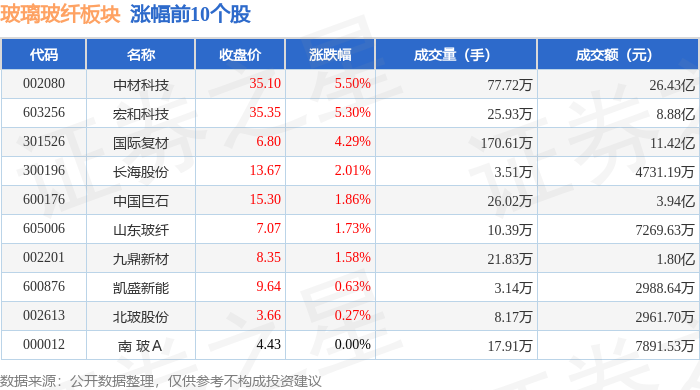
Market Overview - The glass fiber sector increased by 2.59% on December 17, with Zhongcai Technology leading the gains [1] - The Shanghai Composite Index closed at 3870.28, up 1.19%, while the Shenzhen Component Index closed at 13224.51, up 2.4% [1] Stock Performance - Zhongcai Technology (002080) closed at 35.10, up 5.50%, with a trading volume of 777,200 shares and a turnover of 2.643 billion [1] - Honghe Technology (603256) closed at 35.35, up 5.30%, with a trading volume of 259,300 shares and a turnover of 888 million [1] - International Composite (301526) closed at 6.80, up 4.29%, with a trading volume of 1,706,100 shares and a turnover of 1.142 billion [1] - Other notable stocks include China Jushi (600176) at 15.30, up 1.86%, and Shandong Glass Fiber (605006) at 7.07, up 1.73% [1] Capital Flow - The glass fiber sector saw a net inflow of 428 million from institutional investors, while retail investors experienced a net outflow of 379 million [2] - The main stocks with significant net inflows include Zhongcai Technology with 313 million and International Composite with 151 million [3] - Retail investors showed a notable outflow from stocks like Honghe Technology, with a net outflow of 98.43 million [3]


一上市湘企承诺未来3年分红比例超50%
Chang Sha Wan Bao· 2025-12-15 07:13
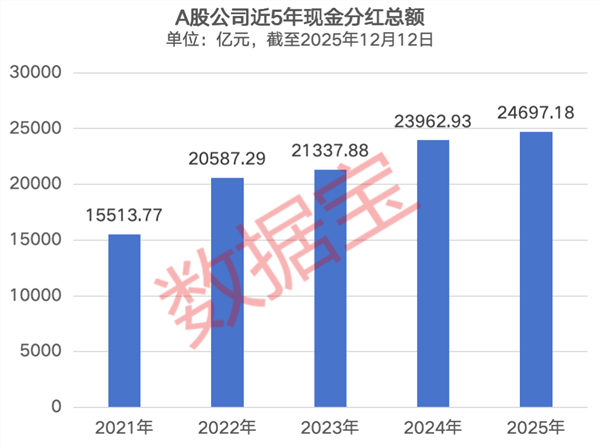
旗滨集团表示,未来三年公司在足额预留盈余公积金以后,每年以现金方式分配的利润(含年度、中期 分配)高于当年实现的可供分配利润的50%。记者发现,公司最近3年以现金方式累计分配的利润不少 于当年可分配利润的50%。 记者发现,除了旗滨集团,上市湘企邵阳液压、华锐精密也于近期发布分红公告。其中邵阳液压于12月 10日发布公告,表示单一年度以现金方式分配的利润不少于当年度实现的可分配利润的10%。同日,公 司发布公告拟6亿元并购新承航锐,深化公司在高端制造产业的布局。华锐精密于12月2日发布公告表 示,今年前三季度,公司实现归属于上市公司股东的净利润137445757.34 元,截至2025年9月30日,公 司合并报表期末可供分配利润为659000092.36 元(以上财务数据未经审计)。经董事会决议,公司拟向 全体股东每10股派发现金红利6元(含税),合计拟派发现金红利56140920.60 元(含税)。 长沙晚报掌上长沙12月15日讯(全媒体记者 刘军)今年以来,上市公司以现金分红等方式积极回馈投 资者。截至12月12日,A股上市公司现金分红总额达到2.47万亿元,已超过2024年全年的现金分红总 额。并且,不 ...



未来三年分红规划,这些公司已提前布局(名单)
Zheng Quan Shi Bao Wang· 2025-12-15 01:39
Core Viewpoint - The article highlights the increasing trend of cash dividends among listed companies in China, with a focus on their commitment to return profits to shareholders through substantial cash distributions over the next three years. Group 1: Cash Dividend Trends - Listed companies in China have shown a significant increase in cash dividend intentions, with the total cash dividends exceeding 2.47 trillion yuan this year, surpassing the total for the entire previous year [2][4] - Major companies like BYD, Hikvision, and Zijin Mining have reported cash dividends exceeding 10 billion yuan for the first time this year, with many traditional "dividend giants" increasing their payouts [4][5] Group 2: Future Dividend Plans - Nearly 40 companies have established shareholder return plans for the next three years (2026-2028), with most committing to distribute at least 10% of their annual distributable profits in cash [7] - Specific companies have set higher targets, such as Qibin Group, which plans to distribute over 50% of its annual distributable profits in cash, and China Merchants Shekou, which aims for a minimum of 40% [7][9] Group 3: Market Performance and Institutional Interest - Companies that announced shareholder return plans have seen an average stock price increase of over 4.5%, outperforming the average increase of the CSI 300 index [10] - Notably, companies like Wangzi New Materials and Aibison have experienced stock price increases exceeding 50% since their announcements [10][12] Group 4: Institutional Research Activity - Among the 37 companies with announced return plans, 17 have received significant institutional interest, with some receiving over 350 institutional research inquiries [11][12] - Companies like Baiwei Storage and Shiji Information have also reported substantial stock price increases alongside their active engagement with institutional investors [12][13]





建筑材料行业:中央经济工作会议举行,着力稳定房地产市场、继续反内卷
GF SECURITIES· 2025-12-14 13:29
Core Insights - The central economic work conference emphasizes stabilizing the real estate market and combating "involution" in competition, aiming to promote the construction of "good houses" and accelerate the establishment of a new model for real estate development [6][15] - The report suggests that the cement, glass, and certain consumer building materials industries may see continued optimization in supply-side dynamics, leading to increased concentration and improved profitability [6][15] Consumer Building Materials - The consumer building materials sector is experiencing a recovery in retail due to high demand for second-hand housing and supportive subsidy policies, with leading companies showing strong operational resilience [6][31] - Long-term demand stability and increasing industry concentration provide significant growth potential for quality leading companies in the consumer building materials sector [6][31] - Key companies to watch include Sanke Tree, Rabbit Baby, Hanhai Group, Dongfang Yuhong, China Liansu, Beixin Building Materials, Weixing New Materials, and others [6][31] Cement - National cement market prices increased by 0.05% week-on-week, with the average price at 355 RMB/ton as of December 12, 2025, reflecting a year-on-year decrease of 69.17% [6][31] - The report anticipates that cement prices will maintain a slight fluctuation in the future, with industry valuations at historical lows, highlighting companies like Huaxin Cement, Conch Cement, and others for potential investment [6][31] Glass - Float glass prices are showing mixed trends, while photovoltaic glass inventories continue to rise, with the average price of float glass at 1156 RMB/ton, down 1.0% month-on-month and 18.0% year-on-year [6][31] - The report indicates that leading glass companies have low valuations and suggests focusing on Qibin Group, Xinyi Solar, and others for investment opportunities [6][31] Fiberglass/Carbon-based Composites - The market for fiberglass is stable, with direct yarn prices holding steady, while electronic yarn prices have stabilized after previous increases [6][31] - The report identifies leading companies in the fiberglass sector, including China Jushi and others, as having a significant competitive edge [6][31] Market Data and Trends - The report notes that the consumer building materials sector has seen a year-on-year revenue decline of 4.2% in the first three quarters of 2025, with a notable improvement in revenue growth rates for leading companies [33][34] - The profitability of the consumer building materials sector is stabilizing, with net profit margins hovering at the bottom, indicating potential for recovery as market conditions improve [34][41]




建材行业2026年投资策略:告别内卷、挖掘存量、寻找增量
GF SECURITIES· 2025-12-14 12:09
Core Insights - The report emphasizes the importance of identifying investment opportunities in the building materials sector as it transitions from a period of intense competition to one focused on value extraction and growth [1]. Group 1: Investment Opportunities in the Building Materials Sector - Four key investment themes are highlighted: traditional building material leaders emerging from the bottom of the cycle, overseas capacity expansion, high-demand new materials, and policy support for industry consolidation [5]. - Traditional building material leaders are expected to recover first, with a focus on alpha opportunities as the sector stabilizes [14]. - The overseas expansion of building material capacity is driven by high demand in foreign markets, particularly in Africa, where Chinese companies are increasingly investing [20][22]. Group 2: Consumer Building Materials - The consumer building materials sector is stabilizing, with a narrowing decline in real estate indicators expected in 2026, leading to a potential rebound in demand [15]. - Strong alpha leaders in the sector are anticipated to achieve positive revenue growth first, with companies like Sanke Tree and Dongfang Yuhong highlighted as key players [15][16]. - Profit margins are expected to improve in 2026 due to price stabilization, structural optimization, and enhanced operational efficiency [15]. Group 3: Glass Fiber Industry - The glass fiber market is projected to maintain a tight supply-demand balance, with demand expected to grow by 5.8% in 2025 and 4.6% in 2026 [5][25]. - The report notes that the profitability of traditional glass fiber products is on an upward trajectory, with leading companies benefiting from differentiated product advantages [5][28]. Group 4: Cement Industry - The domestic cement market is facing a decline in demand, with expectations of a 7% drop in 2025 and a 6% drop in 2026, while overseas markets remain robust [5][31]. - The report suggests that supply-side policies will play a crucial role in stabilizing the market, with potential profitability improvements anticipated in 2026 [5][36]. Group 5: Glass Industry - The glass industry is expected to see supply optimization as a key theme in 2026, with a slight decline in demand for float glass anticipated [5][40]. - The photovoltaic glass segment is projected to experience a balanced supply-demand situation, with potential profitability improvements if production resumes [5][45].


2025年1-10月中国夹层玻璃产量为13423万平方米 累计增长4.6%
Chan Ye Xin Xi Wang· 2025-12-14 02:22
Core Viewpoint - The article discusses the current state and future trends of the laminated glass industry in China, highlighting production statistics and growth rates from 2020 to 2025 [1]. Industry Overview - According to the National Bureau of Statistics, the production of laminated glass in China for October 2025 was 13.44 million square meters, representing a year-on-year decrease of 9.1% [1]. - Cumulatively, from January to October 2025, the total production of laminated glass reached 134.23 million square meters, showing a cumulative growth of 4.6% [1]. Market Research - The article references a report by Zhiyan Consulting titled "2026-2032 China Laminated Glass Industry Market Status Survey and Development Trend Analysis Report," indicating ongoing research and analysis in the industry [1]. - Zhiyan Consulting is noted as a leading industry consulting firm in China, providing comprehensive industry research reports and tailored consulting services [1].




【建筑建材】五个维度看玻璃:从供需研究到企业竞争优势分析 ——浮法玻璃&光伏玻璃行业研究框架(孙伟风/陈奇凡)
光大证券研究· 2025-12-13 00:06
Core Insights - The glass industry is characterized by its heavy asset nature, with leading companies in float and photovoltaic glass having fixed assets and construction projects accounting for approximately 60% and 40% of their revenue respectively [4] - The supply side of the glass industry is subject to strict regulations, with the new 2024 policy prohibiting the addition of new flat glass capacity nationwide, emphasizing a zero-increment approach in key areas [4] - Demand for float glass is primarily driven by the real estate sector, with a forecasted contraction in demand over the next two to three years, although the rate of decline is expected to narrow [5] - The cost structure of the glass industry is heavily influenced by raw materials and energy, which together account for over 80% of total costs, leading to significant profit sensitivity to fluctuations in prices of soda ash and fuel [6] - Leading companies maintain competitive advantages through scale and vertical integration, with significant revenue gaps widening between top-tier firms and others in the industry [7][8] Supply Side Analysis - The glass production process is dominated by the float method, which accounts for 80%-90% of total production, while the upstream consists of inorganic raw materials like silica sand and soda ash [3] - The design lifespan of glass production lines is typically 8-10 years, necessitating continuous production once operational, which contributes to supply rigidity [4] - The cyclical nature of the glass supply side indicates that during upturns, supply is an independent variable, while in downturns, it becomes a dependent variable [4] Demand Side Analysis - The primary demand for float glass comes from housing construction and the automotive sector, with housing being the dominant factor [5] - The photovoltaic glass market is driven by the growth in solar installations and the penetration rate of dual-glass technology, with expectations of continued growth in global and Chinese solar installation capacity through 2030 [5] Cost Structure & Profitability - The profitability of float glass companies has seen a widening gap in gross margins, with leading firms experiencing a 14 percentage point increase to a 20 percentage point difference from 2015 to 2024 [6] - The photovoltaic glass sector shows a smaller margin difference, indicating a more stable competitive landscape compared to float glass [6] Competitive Advantage Analysis - Scale advantages and integrated supply chains are crucial for leading companies to maintain low-cost positions, with top firms like Xinyi Glass and Qibin Group showing significant revenue leadership [7][8] - Leading companies are increasing their self-supply ratios for raw materials, such as silica sand, to mitigate cost pressures and enhance profitability [8]


2026年建材行业年度策略:玻纤粗纱和电子布景气有望共振
Soochow Securities· 2025-12-12 13:05
Core Views - The building materials sector slightly underperformed the overall A-share market in 2025, with a return of 19.62% compared to a -4.85% excess return relative to the Wind All A Index [2][10] - The macro outlook suggests that total policies are expected to strengthen, with physical demand support likely to increase, as emphasized in the December Politburo meeting [2][15][20] - The glass fiber industry is anticipated to see a resonance between traditional and emerging fields, with demand growth expected to remain stable despite a potential slowdown [2][23][45] 2025 Market Review - The building materials sector's performance can be segmented into several phases, with notable periods of underperformance and outperformance against the A-share market [10][12] - The glass fiber sub-sector showed significant excess returns driven by high demand in wind power and thermoplastics [10][12] - The cement sub-sector experienced a boost due to improved domestic demand expectations and effective supply-side discipline [10][12] Macro Outlook - Fixed asset investment in China saw a year-on-year decline of 1.7% from January to October 2025, with infrastructure and real estate investments dropping by 0.1% and 14.7%, respectively [15][19] - The Politburo's focus on expanding domestic demand and optimizing supply is expected to lead to a moderate increase in total policies [15][20] - The anticipated fiscal spending for 2026 is projected to reach 41.62 trillion yuan, a 2.1% increase year-on-year, with a focus on effective investment [20][21] Glass Fiber Industry - The supply shock in the glass fiber industry is gradually being digested, with new capacity expected to be limited in the medium term [23][39] - The effective production capacity for glass fiber is projected to reach 759.2 million tons for roving and 107.7 million tons for electronic fabrics in 2026, representing year-on-year increases of 6.9% and 7.3%, respectively [23][40] - Demand for glass fiber is expected to remain stable, supported by wind power and thermoplastics, despite potential declines in growth rates [45][46] Cement Industry - The cement industry is expected to maintain self-discipline in supply, with a focus on eliminating outdated capacity, which will support profitability [3][20] - The exit of 10,952 million tons of outdated capacity is projected, which will enhance the utilization rate of clinker capacity [3][20] - The profitability of the cement sector is expected to improve in 2026, particularly in regions with significant infrastructure projects [3][20] Glass Industry - The glass industry is experiencing accelerated supply clearance, which is expected to provide price elasticity in 2026 [2][3] - The current state of losses in the industry is likely to drive the closure of high-cost production lines, leading to a potential rebound in prices in the first half of 2026 [2][3] - Long-term policies aimed at curbing disorderly competition are expected to stabilize industry profitability and enhance the competitive advantage of leading companies [2][3]


——浮法玻璃&光伏玻璃行业研究框架:五个维度看玻璃:从供需研究到企业竞争优势分析
EBSCN· 2025-12-12 11:36
Investment Rating - The report maintains a "Buy" rating for the non-metallic building materials sector [6]. Core Insights - The glass industry is characterized by heavy asset attributes and continuous production, leading to rigid supply dynamics. The report highlights the structural differentiation between float glass and photovoltaic glass, indicating that the float glass sector is experiencing a downward cycle while photovoltaic glass is entering a growth phase [8][10]. Supply and Production Characteristics - The float glass production process is the mainstream method, accounting for 80%-90% of total production. The industry is heavily reliant on raw materials such as silica sand and soda ash, with fixed assets and construction in progress representing approximately 60% and 40% of total revenue for float and photovoltaic glass leaders, respectively [1][2]. - The glass production lines have a design lifespan of 8-10 years, necessitating continuous operation once ignited, which creates supply rigidity. The report notes that the supply side is influenced by policies that restrict new capacity and require capacity replacement [2][42]. Demand Analysis - Demand for float glass is primarily driven by the real estate sector and automotive industry, with real estate construction area being the leading factor. The report predicts a contraction in float glass demand over the next two to three years, although the decline will narrow [2][3]. - Photovoltaic glass demand is driven by the growth in photovoltaic installations and the penetration rate of double-glass modules, with expectations for continued growth in global and Chinese photovoltaic installations until 2030 [2][3]. Cost Structure and Profitability - The cost structure of the glass industry is dominated by raw materials and energy, accounting for over 80% of total costs. Float glass is sensitive to raw material prices, while photovoltaic glass is more sensitive to energy prices [3]. - The report indicates that the gross margin gap between leading and lagging companies in the float glass sector has widened from 14 percentage points to 20 percentage points from 2015 to 2024, reflecting increased profitability for leading firms [3]. Competitive Advantage Analysis - Scale advantages and vertical integration are key factors for leading companies to maintain low-cost advantages. The report highlights that leading firms like Xinyi Glass and Qibin Group have significantly outperformed their peers in revenue scale, further widening the gap [4]. - Leading companies are increasing their self-supply ratio of raw materials to reduce production costs, with Qibin Group's self-supply ratio of silica sand increasing from 48% in 2019 to 70% in 2024 [4]. Investment Recommendations - For the float glass sector, the report suggests focusing on leading companies such as Xinyi Glass and Qibin Group, as the trend of increasing concentration among leading firms is expected to continue [4][10]. - In the photovoltaic glass sector, the report anticipates a wave of small and medium-sized enterprises exiting the market, leading to increased concentration among leading firms like Xinyi Solar and Flat Glass [4][10].
建筑材料行业12月12日资金流向日报
Zheng Quan Shi Bao Wang· 2025-12-12 09:29
Market Overview - The Shanghai Composite Index rose by 0.41% on December 12, with 21 out of the 28 sectors experiencing gains, led by the non-ferrous metals and electronics sectors, which increased by 1.50% and 1.46% respectively [1] - The retail and comprehensive sectors saw the largest declines, with drops of 1.28% and 1.18% respectively [1] Capital Flow Analysis - The main capital outflow from the two markets totaled 4.872 billion yuan, with 14 sectors seeing net inflows [1] - The power equipment sector had the highest net inflow, amounting to 2.805 billion yuan, and it rose by 1.42% [1] - The machinery equipment sector followed with a net inflow of 1.771 billion yuan and a daily increase of 1.21% [1] - The electronics sector experienced the largest net outflow, totaling 3.703 billion yuan, followed by the computer sector with a net outflow of 2.501 billion yuan [1] Construction Materials Sector - The construction materials sector declined by 0.47%, with a net capital outflow of 383 million yuan [2] - Out of 71 stocks in this sector, 18 rose, including one that hit the daily limit, while 49 fell [2] - The top net inflow stock was Qibin Group, with an inflow of 127 million yuan, followed by Zaiseng Technology and China National Materials, with inflows of 59.7249 million yuan and 38.7227 million yuan respectively [2] - The stocks with the highest net outflows included Sichuan Jinding, with an outflow of 284 million yuan, International Composite Materials with 176 million yuan, and Leizhi Group with 37.3974 million yuan [2] Individual Stock Performance - The following stocks had significant capital flow and performance metrics: - Sichuan Jinding: -4.01% change, -284.13 million yuan outflow [2] - International Composite Materials: -4.06% change, -175.88 million yuan outflow [2] - Leizhi Group: -5.91% change, -37.3974 million yuan outflow [2] - Qibin Group: +1.33% change, +12.675 billion yuan inflow [4] - Zaiseng Technology: +10.05% change, +59.7249 million yuan inflow [4]


