
CHINA COAL ENERGY(601898)

Search documents
煤炭开采行业专题研究:印尼煤炭供给侧行动,重申全球煤价上行机遇
GOLDEN SUN SECURITIES· 2026-02-06 01:45
Investment Rating - The report recommends a "Buy" rating for several companies directly benefiting from Indonesian coal resources, including China Qinfa, Power Development, Yanzhou Coal Mining, and others [11]. Core Insights - Indonesia's coal production is expected to decline by approximately 5.5% in 2025, with production estimated at 790 million tons, down from 836 million tons in 2024 [1][14]. - As the world's largest coal exporter, Indonesia's coal exports are projected to decrease by about 5.0% in 2025, with total exports expected to reach 505 million tons [2][20]. - The report highlights significant declines in coal export revenue and tax contributions, leading to increased fiscal pressure on the Indonesian government [3][28]. - Domestic coal demand is expected to grow robustly, driven by population growth and increasing electricity needs [31]. - The Indonesian government plans to implement a series of policies to tighten coal production quotas, increase export taxes, and enhance domestic market obligations (DMO) to support coal prices and increase tax revenue [4][36]. Summary by Sections Coal Production and Export Trends - In 2025, Indonesia's coal production is projected to be 790 million tons, a decrease of 5.5% from 2024 [1][14]. - The coal export volume for 2025 is expected to be 505 million tons, reflecting a 5.0% decline compared to the previous year [2][20]. - The export revenue for coal (excluding lignite) in the first eleven months of 2025 is reported at $22.17 billion, a year-on-year decrease of 20.27% [28]. Domestic Demand and Policy Changes - The IEA forecasts that Indonesia's coal consumption will reach approximately 266 million tons in 2025, primarily due to population growth and economic expansion [31]. - The Indonesian government is set to implement a "combination policy" to manage coal supply actively, which includes tightening production quotas and increasing export taxes [4][36]. Regulatory and Taxation Framework - New regulations will impose a progressive export tax ranging from 1% to 11%, depending on coal type and price, effective from 2026 [9][44]. - The introduction of stricter mining rights taxes linked to coal quality and production methods is expected to raise operational costs for coal producers [45]. Investment Recommendations - The report emphasizes investment in companies that are well-positioned to benefit from the changes in the Indonesian coal market, particularly those with strong domestic market presence and resilience to price fluctuations [11].




【即将截止】中国中煤能源集团有限公司旗下多家公司公布招聘公告
Xin Lang Cai Jing· 2026-02-05 12:18
Group 1 - China Coal Energy Group Co., Ltd. (referred to as China Coal) is a state-owned enterprise supervised by the State-owned Assets Supervision and Administration Commission, with a history dating back to 1982 when it was established as the China Coal Import and Export Corporation [1][30] - The company has coal resource reserves exceeding 700 billion tons, with a total coal production capacity of 310 million tons per year and an annual coal trade volume of nearly 400 million tons [1][30] - China Coal operates 69 coal mines and has 11 coal chemical projects with a total capacity of over 20 million tons, producing products such as polyolefins, methanol, urea, ammonium nitrate, and coke [1][30] - The company has 35 thermal power projects in operation and under construction, with a total installed capacity of 47.55 million kilowatts, and a renewable energy installed capacity of 7 million kilowatts [1][30] - China Coal has been recognized as one of the Fortune Global 500 companies for six consecutive years and has achieved an A-level performance assessment from the State-owned Assets Supervision and Administration Commission for six years [1][30] Group 2 - China Coal Xinji Energy Co., Ltd. is a secondary enterprise of China Coal located in Anhui Province, focusing on coal, electricity, and new energy [2][45] - The company has a production capacity of 23.5 million tons per year and a total installed capacity of 796,000 kilowatts for coal-fired power plants [2][45] - China Coal holds a 31.92% stake in Xinji Energy, with other shareholders including Guohua Energy and Anhui Xinji Coal Power [2][45] - The company is advancing the "two joint ventures" project to promote the coordinated development of coal, coal power, and new energy, aiming to exceed 10 million kilowatts in installed capacity by 2026 [2][45] Group 3 - China Coal Power Co., Ltd. is a wholly-owned subsidiary of China Coal, established in January 2020, focusing on power production and sales, as well as new power system project development [15][57] - The company is constructing two 660,000-kilowatt ultra-supercritical coal-fired power units in Xinjiang, with a total investment of approximately 5.79168 billion yuan [15][57] - The project is expected to be completed and put into operation by 2026, featuring advanced technologies for emissions reduction [15][57] Group 4 - The Southwest Branch of China Coal was established in February 2023 in Chongqing, managing several companies and focusing on energy supply in the southwest region [31][62] - The branch aims to develop clean and efficient coal power, accelerate new energy development, and explore green chemical layouts [31][62] - The company is involved in various projects, including the construction of a coal-fired power project in Sichuan with a planned capacity of 2×1000MW [32][63]



国泰海通:印尼削减煤炭产量配额 看好煤价后续上升周期
Zhi Tong Cai Jing· 2026-02-05 06:49
Group 1 - Indonesia's export policy adjustment significantly reduces production quotas, reflecting a shift in the government's strategy for resource exports, including nickel and coal, aimed at controlling supply and increasing prices [1][2] - In February 2026, Indonesian mining officials announced a substantial reduction in coal production quotas by 40% to 70% compared to 2025 levels, as part of a plan to boost coal prices [2] - Indonesia's coal production for 2025 is projected at 790 million tons, a 5% year-on-year decrease, with potential further reductions to 600 million tons in 2026, representing a 24% decline from 2025 [2] Group 2 - Global coal supply-demand balance may begin to shift in 2026, with supply contraction and rising demand, indicating a potential upward price cycle for coal [3] - Indonesia is expected to export 524 million tons of coal in 2025, a 6.1% decrease, and if production is limited to 600 million tons in 2026, exports could drop to 450 million tons, impacting global shipping trade [3] - Other countries, including Australia and Russia, are also facing production declines, contributing to a tightening global coal market [3] Group 3 - China's coal imports from Indonesia are projected to decline further in 2026, with an expected total of around 45 million tons, a decrease of approximately 4 million tons [4] - In 2025, Indonesia is expected to export 21 million tons of coal to China, a 10.6% year-on-year decrease, accounting for 42.9% of China's total coal imports [4] - Domestic coal prices in China are anticipated to recover in 2026, ending a four-year decline, supported by stable domestic supply and slightly reduced overseas imports [4] Group 4 - Companies with a clear outlook for volume and price elasticity over the next five years are recommended for investment, including Yanzhou Coal Mining (600188), Shaanxi Coal and Chemical Industry (601225), China Coal Energy (601898), Jincheng Anthracite Mining (601001), and China Shenhua Energy (601088) [5] - Yancoal Australia (03668) is also recommended for investment in the Hong Kong market [5]


热点跟踪-行情火热-煤炭后续怎么看
2026-02-05 02:21
Summary of Conference Call on Coal Industry Outlook Industry Overview - The conference call focuses on the coal industry, particularly the impact of Indonesia's coal export policy adjustments on global and Chinese coal markets [1][3][12]. Key Points and Arguments - **Indonesia's Export Policy Changes**: Indonesia has significantly reduced its coal production quota for 2026, leading to an expected decrease in export volume by 90 million tons, primarily affecting the spot market while long-term contracts remain largely unaffected [1][4]. - **Impact on Small vs. Large Miners**: Smaller miners will face greater production pressure due to the new quotas, while large coal companies are less affected due to their long-term contracts [1][5]. - **Price Projections**: The anticipated supply contraction in the global thermal coal market, combined with improving demand, is expected to drive prices up. If Indonesia strictly enforces its export limits, coal prices could rise to 800 RMB/ton [1][9]. - **Profitability of Major Companies**: Companies like Yanzhou Coal Mining Company (兖矿) are projected to achieve significant profits, with estimates of 12 billion RMB in main business profits at a price of 750 RMB/ton, potentially reaching 16 billion RMB if prices rise to 800 RMB/ton [1][10]. - **China's Market Reaction**: A reduction of 40 million tons in Indonesian exports could lead to a price increase of approximately 100 RMB/ton in China, indicating a 15% upside potential from current prices [2][12]. - **Investment Recommendations**: Investors are advised to focus on companies with high market share and growth potential, such as Yanzhou, China Coal Energy, and Shenhua, while also considering companies that are sensitive to price changes [2][13]. Additional Important Insights - **Long-term Market Dynamics**: The overall trend indicates a tightening supply situation, which is expected to support higher prices in the coal market [8][9]. - **Government Revenue Considerations**: Indonesia's government aims to increase fiscal revenue through these export restrictions, and future policy adjustments will depend on the acceptance of price increases by downstream demand [7][8]. - **Potential for Future Adjustments**: The likelihood of policy changes post-Ramadan remains uncertain, with expectations that coal prices may strengthen in the first quarter [6][8]. - **Valuation Considerations**: Current valuations for companies like Yanzhou suggest significant investment potential, with projected earnings growth and a commitment to maintaining a dividend payout ratio of at least 60% [10][11]. This summary encapsulates the critical insights from the conference call regarding the coal industry's future, particularly in light of Indonesia's export policies and their implications for market dynamics and investment strategies.

沪指重返4100点 煤炭能源板块趋于活跃
Mei Ri Shang Bao· 2026-02-04 22:16
Group 1 - The A-share market showed recovery with the Shanghai Composite Index returning to 4100 points, closing up 0.85% while the Shenzhen Component Index rose 0.21% and the ChiNext Index fell 0.4% [1] - The coal energy sector performed exceptionally well, with multiple stocks hitting the daily limit up, including Yanzhou Coal Mining Company, Meijin Energy, and Shanxi Coking Coal [1][2] - The coal mining and processing sector saw an overall increase of 7.92%, with several stocks achieving limit up, indicating strong market interest and performance [2] Group 2 - Recent cold weather has increased energy demand for heating, prompting local governments to enhance energy supply measures, which supports coal production and supply stability [3] - Analysts are optimistic about coal prices stabilizing and rebounding, with expectations of increased demand post-Chinese New Year, suggesting a tight supply-demand balance [3] - The coal ETF has risen over 10% year-to-date, reflecting strong investor interest and net inflows over the past four days [4] Group 3 - International thermal coal prices have significantly increased, with Australian Newcastle coal futures reaching a one-year high, indicating a bullish trend in the market [5] - Forecasts for the coal industry suggest a notable improvement in profitability by 2026, driven by a slowdown in supply growth and recovery in demand [5]


煤炭产业:基本面持续改善,价格中枢上移
Shang Hai Zheng Quan Bao· 2026-02-04 18:12
Group 1 - The coal market is experiencing a surge, with the Wande Central Enterprise Coal Concept Index and the Wande Coal Mining Selected Index rising by 7.61% and 7.58% respectively, leading to several stocks hitting the daily limit [2] - Short-term coal prices may be influenced by the suspension of spot coal exports by Indonesian miners, while the medium to long-term outlook suggests an improvement in the coal supply-demand fundamentals, with annual price levels expected to rise [2][3] - The coal market is entering a pre-holiday state, with some private coal mines halting production for the Spring Festival, while state-owned mines maintain stable output to ensure supply, resulting in a marginal reduction in overall production [3] Group 2 - The National Bureau of Statistics indicates that by 2025, the national output of industrial raw coal is projected to reach 4.83 billion tons, a year-on-year increase of 1.2%, marking a historical high [4] - In 2025, Shanxi Province's raw coal output is expected to be 1.305 billion tons, reflecting a growth of 2.1%, while the government report suggests that coal production will stabilize around 1.3 billion tons by 2026 [5] - The Xinjiang region's coal production is rapidly increasing, with a projected output of 553 million tons in 2025, a year-on-year growth of 1.9%, although this growth rate is significantly slowing compared to previous years [5] - Analysts predict that with Indonesia's coal production targets significantly reduced for 2026, the supply contraction will strengthen, potentially leading to a return to a balanced supply-demand state and a price recovery to the range of 750 to 1000 yuan per ton [6]

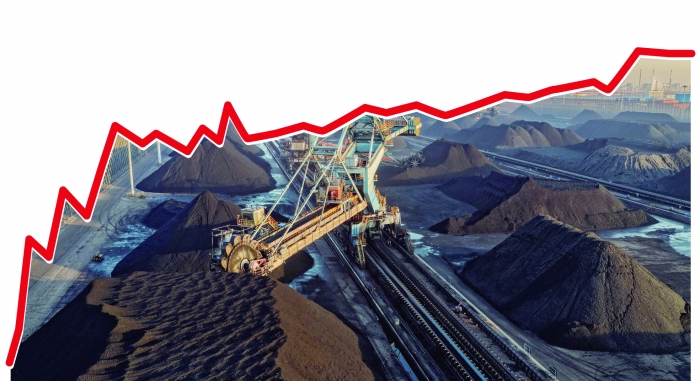
沪指重返4100点 煤炭、光伏板块领涨
Shang Hai Zheng Quan Bao· 2026-02-04 18:12
Group 1: A-Share Market Performance - The A-share market showed mixed performance with the Shanghai Composite Index rising to 4102.20 points, up 0.85% [1] - The Shenzhen Component Index increased by 0.21% to 14156.27 points, while the ChiNext Index fell by 0.40% to 3311.51 points [1] - The total trading volume in the Shanghai and Shenzhen markets reached 250.33 billion yuan [1] Group 2: Solar Industry Strength - The solar industry chain, particularly the space solar sector, continued to show strength with companies like JinkoSolar and Zhonglai Co. hitting the 20% daily limit [2] - Jingsheng Mechanical & Electrical announced that the "space solar" application is still in the exploratory phase, indicating uncertainty in the industrialization process [2] - JinkoSolar highlighted that space solar energy density is 7 to 10 times higher than ground-based systems, with generation hours increasing by 4 to 7 times [2][4] Group 3: Coal Sector Activity - The coal sector was notably active, with the Shenwan Coal Industry Index rising over 7%, leading all sectors [5] - Companies such as Yanzhou Coal and China Coal Energy saw their stocks hit the daily limit [5] - Recent trends show a stabilization and increase in coal prices, supported by seasonal demand and supply-side policies [5] Group 4: Market Outlook - The A-share market is expected to continue its rebound, with analysts suggesting that the risk of disappointing earnings has diminished [6] - The market is anticipated to experience fluctuations, with a focus on growth styles in the near term [6] - Analysts recommend a balanced strategy in sector allocation, emphasizing technology, materials, and defensive high-dividend assets like coal [6]





印尼削减产量配额,搅动全球煤炭贸易
GUOTAI HAITONG SECURITIES· 2026-02-04 14:36
股票研究 /[Table_Date] 2026.02.04 印尼削减产量配额,搅动全球煤炭贸易 [Table_Industry] 煤炭 行 | [姓名table_Authors] | 电话 | 邮箱 | 登记编号 | | --- | --- | --- | --- | | 黄涛(分析师) | 021-38674879 | huangtao@gtht.com | S0880515090001 | | 邓铖琦(分析师) | 010-83939825 | dengchengqi@gtht.com | S0880523050003 | 本报告导读: 印尼出口政策调整,大幅削减产量配额;全球煤炭 2026 年起供给收缩需求抬升,看 好上升周期;2026 年中国进口煤量或将进一步下降,国内煤价有望恢复增长。 投资要点: [Table_Report] 相关报告 煤炭《持仓略有提升,焦炭第一轮提价》 2026.02.02 煤炭《国泰海通煤炭行业基本面数据库大全 20260202》2026.02.02 煤炭《Q4 基金持仓持续回升,板块拐点确认》 2026.01.30 煤炭《地产政策多部门联动稳预期,非电需求有 望修复》202 ...
全球供给格局突变!印尼暂停现货煤炭出口,国内煤价获强支撑,开采服务企业订单扩容、盈利弹性释放
Xin Lang Cai Jing· 2026-02-04 12:20
Group 1 - Yanzhou Coal Mining Company is a leading coal enterprise in Shandong, with core businesses including coal mining, washing, processing, coal chemical, and power generation, benefiting from the recent rise in coal prices due to increased energy supply demand and price stabilization expectations [1] - Lu'an Environmental Energy is a key coal enterprise in Shanxi, focusing on the mining and sales of high-quality coking coal, benefiting from the recovery in downstream steel industry demand, and actively promoting intelligent mining to enhance production efficiency [2] - China Coal Energy is a central state-owned enterprise with a comprehensive coal production and processing capability, experiencing valuation recovery due to rising coal prices and benefiting from resource integration and policy support [3] Group 2 - Meijin Energy focuses on coal mining, coking, and hydrogen fuel cells, with its hydrogen business benefiting from policy support and industry development, showing significant performance elasticity [4] - Shaanxi Black Cat is a coal coking enterprise with a complete coking industry chain, experiencing profit increases due to rising coke prices and industry consolidation, while focusing on intelligent upgrades and carbon reduction technology [5] - Jincheng Anthracite Mining Group is a major coal supplier in Shanxi, benefiting from valuation recovery and resource integration under state-owned enterprise reforms, while focusing on coal-electricity integration and accelerating new energy project implementation [6] Group 3 - Baotailong is a coal enterprise in Heilongjiang, with a diversified industry layout including graphene new materials, benefiting from rising coal and coking profits and growing demand for graphene [7] - Shanxi Coking Coal is a leading coking coal supplier, benefiting from rising coking coal prices due to recovery in the steel industry, while focusing on intelligent mining and exploring hydrogen energy integration [8] - Yunnan Coal Energy is a significant coal enterprise in Southwest China, benefiting from rising coal and coking profits and stable market demand due to regional energy supply needs [9] Group 4 - Shanxi Coal International is a coal enterprise with a complete coal trading network, benefiting from valuation recovery and resource integration under state-owned enterprise reforms, while focusing on coal-electricity integration and new energy projects [10] - Shanxi Coking Coal Group is a major coking coal supplier, benefiting from rising prices and focusing on intelligent mining and hydrogen energy integration [11] - Shaanxi Coal and Chemical Industry is a leading coal supplier in Shaanxi, benefiting from valuation recovery and resource integration, while focusing on coal-electricity integration and new energy projects [12] Group 5 - Dayou Energy is a key coal supplier in Henan, benefiting from valuation recovery and stable market demand due to regional energy supply needs [13] - Xinjie Energy is an important coal supplier in East China, benefiting from valuation recovery and stable market demand due to regional energy supply needs [14] - Pingmei Shenma Group is a significant coal supplier in Central China, benefiting from rising coking coal prices and focusing on intelligent mining and hydrogen energy integration [15] Group 6 - Haohua Energy is a key coal supplier in North China, benefiting from valuation recovery and resource integration under state-owned enterprise reforms [16] - China Shenhua Energy is a leading coal enterprise with a comprehensive industry layout, benefiting from valuation recovery and resource integration, while focusing on coal-electricity integration and new energy projects [17] - Hengyuan Coal Power is a significant coal supplier in East China, benefiting from valuation recovery and stable market demand due to regional energy supply needs [18] Group 7 - Kailuan Company is a major coal enterprise in Hebei, benefiting from rising coke prices and focusing on low-carbon technology upgrades and hydrogen energy integration [19] - Shanghai Energy is a key coal supplier in East China, benefiting from valuation recovery and stable market demand due to regional energy supply needs [20] - Antai Group is an independent coking enterprise, benefiting from rising coke prices and focusing on low-carbon technology upgrades and hydrogen energy integration [21] Group 8 - Zhengzhou Coal Power is a significant coal supplier in Central China, benefiting from valuation recovery and stable market demand due to regional energy supply needs [22] - Huaibei Mining is an important coking enterprise in East China, benefiting from rising coke prices and focusing on low-carbon technology upgrades and hydrogen energy integration [23] - Panjiang Coal and Electricity is a key coal supplier in Southwest China, benefiting from valuation recovery and stable market demand due to regional energy supply needs [24] Group 9 - Lanhua Science and Technology is a significant coking enterprise in North China, benefiting from rising coke prices and focusing on low-carbon technology upgrades and hydrogen energy integration [25] - Huayang Co. is a coal enterprise with a layout in sodium-ion batteries, benefiting from rising coal profits and policy support for new energy [26] - Jizhong Energy is a key coal supplier in North China, benefiting from valuation recovery and stable market demand due to regional energy supply needs [27] Group 10 - Gansu Energy and Chemical is a significant coal supplier in Northwest China, benefiting from valuation recovery and stable market demand due to regional energy supply needs [28] - Liaoning Energy is a key coal supplier in Northeast China, benefiting from valuation recovery and stable market demand due to regional energy supply needs [29] - Electric Power Investment Energy is a coal enterprise with a layout in wind and solar energy, benefiting from rising coal profits and policy support for new energy [30]


强势反弹+板块共振!中煤能源(601898)封板涨停,多重利好共振修复
Jin Rong Jie· 2026-02-04 11:33
Core Viewpoint - The strong performance of China Coal Energy (601898) on February 4, with a 10% increase in stock price, is attributed to multiple factors including business fundamentals, sector sentiment, and a rebound from previous declines [2]. Group 1: Stock Performance - On February 4, China Coal Energy's stock surged to the daily limit, closing at 14.08 yuan, with a total trading volume of 9.55 billion yuan, approximately 2.3 times higher than the previous trading day [1]. - The stock experienced a net inflow of 159.13 million yuan from main funds, indicating strong market interest [1]. Group 2: Business Fundamentals - China Coal Energy's core business includes coal production and trade, coal chemical products, mining equipment manufacturing, pithead power generation, and financial services, with key products being thermal coal, coking coal, polyolefins, urea, and methanol [2]. - The company has a competitive advantage in coal mining, with production costs lower than most coal enterprises in China [2]. - The domestic fertilizer market is experiencing structural price increases, significantly enhancing short-term profitability for the company [2]. Group 3: Future Prospects - The company anticipates an additional production capacity of 6.4 million tons per year for coal and 900,000 tons per year for coal chemicals by the end of 2026 or 2027, which is expected to improve long-term profitability [2]. - Following a 7.38% drop in stock price on February 2, the market pressure was released, allowing for a potential rebound, further amplified by the collective rise in the coal mining sector [2].