CCB(601939)

Search documents
2025年第三季度中国手机银行APP流量监测报告
艾瑞咨询· 2025-11-11 00:05
Core Viewpoint - The mobile banking app has become a crucial platform for commercial banks to expand service boundaries, optimize user experience, and enhance market competitiveness. The industry is shifting from user expansion to refined operations and value extraction from existing users as user engagement declines and traffic stabilizes [1][2][3]. Industry Development - The banking industry is facing profound changes in the operating environment, with narrowing interest margins and intensified competition. The integration of AI technology and data value is becoming essential for banks to build core competitiveness [2][3]. - Since the launch of the first banking app in 2009, the industry has transitioned to online operations, now entering a phase that requires refined management. As of 2023, the overall traffic of mobile banking apps in China fluctuates between 650 million and 720 million, with daily effective usage time dropping from 4.93 minutes to 2.95 minutes [2][3]. Operational Strategies - Banks need to adopt refined operational models to tap into existing user value. A three-layer strategy is proposed: 1. **Foundation Layer**: Build a comprehensive user segmentation and profiling system using big data and AI technologies for optimal resource allocation [3]. 2. **Key Layer**: Deepen the integration of high-frequency life scenarios with financial functions to create a "finance + scenario" ecosystem [3]. 3. **Goal Layer**: Establish emotional connections with users through immersive interactions, enhancing user retention and value accumulation [3]. Mobile Banking App Rankings - In Q3 2025, the top 50 mobile banking apps in China were ranked based on average monthly active users (MAU). The Agricultural Bank of China leads with over 250 million MAU, followed by the Industrial and Commercial Bank of China and the China Construction Bank [5][7]. - State-owned banks showed positive growth, with increases ranging from 1.6% to 6.1%. Among the 10 listed joint-stock banks, 8 experienced growth, with Everbright Bank seeing an increase of over 10% [5][7]. Performance of State-owned Banks - The six major state-owned banks maintained strong performance in Q3 2025, with the Agricultural Bank of China leading the MAU rankings. The Industrial and Commercial Bank of China and the China Construction Bank also performed well, with significant growth rates [7][9]. Performance of Joint-stock Banks - Joint-stock banks performed well in Q3 2025, with China Merchants Bank leading with over 70 million MAU. The overall MAU for joint-stock banks increased, with Everbright Bank showing an 11% growth [13][14][16]. Performance of City Commercial Banks - City commercial banks had a notable performance, with 17 banks entering the top 50 list. Ningbo Bank led with 364.4 million MAU, achieving a 43.9% growth rate [19][21]. Performance of Rural Commercial Banks - In Q3 2025, 17 rural commercial banks and rural credit cooperatives made it to the top 50 list, with Fujian Rural Credit leading at 781.6 million MAU. Most banks showed positive growth, with Sichuan Rural Credit and Fengshou Interconnection exceeding 10% growth [24][25]. Future Outlook - The future development of banking apps will heavily rely on data and AI technologies, with AI digital financial advisors expected to become core service providers. The transition from standardized to personalized services will enhance user experience and accessibility [27][28].








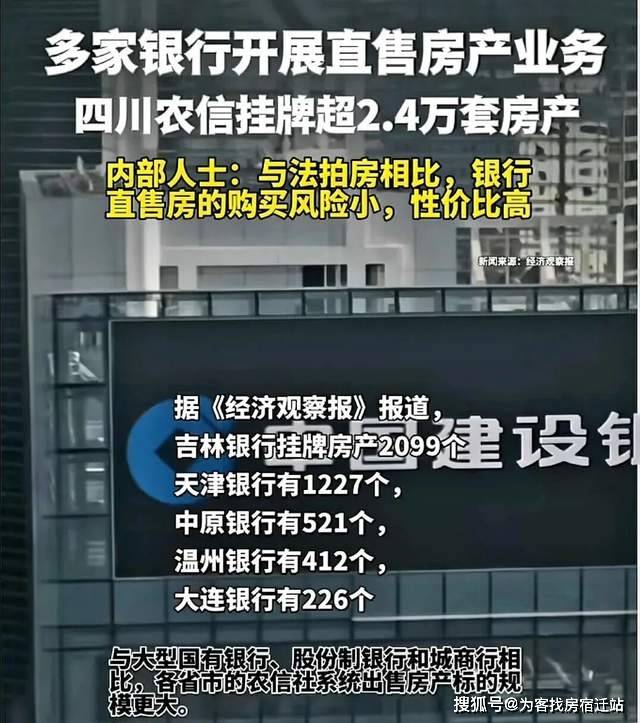
史无前例!银行开始下场卖房了。
Sou Hu Cai Jing· 2025-11-10 23:13
Core Viewpoint - The banking sector is transitioning from being merely a provider of credit to becoming a significant player in the real estate market, actively selling properties to manage non-performing assets and improve recovery rates [1][3]. Group 1: Reasons for Banks Selling Properties - The properties sold by banks are primarily assets recovered from borrowers who defaulted on loans, which have become liabilities due to rising mortgage default rates in certain regions [3]. - Traditional methods of asset disposal, such as judicial auctions, have proven ineffective, with high rates of unsold properties and lengthy processing times, prompting banks to adopt direct sales through online platforms [3][4]. Group 2: Market Dynamics of Direct Sales - Smaller banks, particularly those in the agricultural credit system and local city commercial banks, are leading in the number of properties listed for sale, with significant listings from institutions like Sichuan Agricultural Credit and Guangdong Agricultural Credit [5]. - There is a stark contrast in sales performance based on property location, with some areas experiencing low demand while others, particularly in prime locations, see high interest due to competitive pricing [5]. Group 3: Banking Strategy and Market Implications - The direct sale of properties represents a shift in banking strategy from passive asset management to active asset optimization, aiming to mitigate risks, enhance efficiency, and improve capital allocation [6]. - The focus on core location properties reflects a broader market strategy where banks seek to identify opportunities in a differentiated market, while developers are encouraged to enhance value through improved product and service offerings [6]. - The current phase of risk resolution in the real estate sector is viewed as a necessary step towards a more sustainable economic model, moving away from reliance on land finance [6].
年内商业银行金融债发行规模达2.95万亿元
Zheng Quan Ri Bao· 2025-11-10 16:11
Core Insights - The issuance of bonds by commercial banks in China has surged, reaching a total of 2.95 trillion yuan in 2023, marking a year-on-year increase of 14.79% [1] - The primary types of bonds issued are subordinated debt and perpetual bonds, which together account for approximately 1.38 trillion yuan [1][2] - Major banks like Industrial and Commercial Bank of China and China Construction Bank have announced their bond issuance plans for 2026, with ICBC planning to issue up to 488 billion yuan and CCB setting a cap of 700 billion yuan for various capital instruments [1] Group 1 - The increase in bond issuance is driven by three main factors: optimizing capital structure through instruments like perpetual bonds, raising long-term funds to improve liability structure, and favorable market conditions for expanding issuance [2] - The trend of increasing bond issuance is expected to continue into 2026, positively impacting bank operations, financial markets, and the real economy [2][3] - The issuance of bonds enhances banks' capital adequacy ratios and risk resilience, while also providing quality investment options for institutional investors [2] Group 2 - The favorable monetary and macroeconomic policies are expected to support the continued growth of bond issuance by banks [3] - The demand for bonds is also driven by banks' operational needs and their mission to serve the real economy [3]

信贷支持、线上引流、小程序连接……银行这样深度促消费
Jing Ji Guan Cha Wang· 2025-11-10 15:03
Core Insights - The article highlights the role of banks, particularly China Construction Bank (CCB), in promoting consumption through innovative financial products and services, addressing various industry pain points and enhancing consumer experiences [2][10]. Group 1: Financial Support for Small Businesses - CCB introduced the "民宿贷" (Homestay Loan) as part of its "农商场景" (Agricultural Business Scene) loan products, specifically targeting homestay businesses, which has helped entrepreneurs like Xing Hailong recover from financial difficulties [3][4]. - As of September 2025, CCB has provided 4.5 million yuan in funding support to one-third of the merchants in Xiaowan Village, facilitating over 17,000 transactions worth more than 11 million yuan through its platform [4]. Group 2: Agricultural Sector Innovations - The article discusses the challenges faced by the blueberry industry in Chengjiang, Yunnan, including insufficient scale and brand recognition, which hinder its growth potential [5][6]. - CCB's "裕农快贷" (Quick Agricultural Loan) has enabled farmers to cover significant costs without collateral, with loans processed online and disbursed within three days, thus supporting agricultural development [6]. Group 3: Enhancing Consumer Experience - CCB has implemented a smart charging system for cold chain logistics in Kunming's Jinma Zhengchang Fruit Market, addressing previous inefficiencies and reducing management costs by 30% [7]. - The bank's "一部手机逛商圈" (One Mobile Phone to Explore Business Circles) platform has facilitated the distribution of government consumption vouchers, enhancing consumer access to various services and products [6][10]. Group 4: Consumer Financing and Promotions - CCB has actively participated in government consumption subsidy programs, distributing over 19.7 billion yuan in subsidies across 306 cities, which has stimulated consumption transactions exceeding 136.8 billion yuan [10][11]. - The bank's collaboration with retailers like JD.com has created a seamless experience for consumers, combining various promotional offers to alleviate the financial burden of purchasing large appliances [11][12].
建行长沙新世纪支行成功拦截养老诈骗
Chang Sha Wan Bao· 2025-11-10 14:38
Core Points - A potential fraud targeting an elderly customer was successfully intercepted by China Construction Bank's Changsha New Century Branch, safeguarding the customer's 40,000 yuan retirement funds [1][2] - The incident involved an 82-year-old man who attempted to withdraw funds for a supposed real estate purchase for his grandson, raising suspicions due to inconsistent statements from an accompanying individual claiming to be the grandson [1] - The bank staff's quick response and collaboration with the police led to the identification of the elderly man's family, confirming he had no such purchase plans and was suffering from mild Alzheimer's disease [1][2] Summary by Sections - **Fraud Prevention**: The bank's proactive measures in fraud prevention were highlighted, showcasing the importance of employee training and awareness, particularly for protecting elderly clients [2] - **Emergency Response**: The effective communication between bank staff and law enforcement was crucial in resolving the situation, demonstrating the importance of quick action in potential fraud cases [2] - **Community Protection**: The bank's commitment to financial safety for the community aligns with its "finance for the people" philosophy, reinforcing the protective measures for the public's financial security [2]
人民日报:携手全球伙伴 共享中国机遇──中国建设银行强化创新引领,为进博会提供金融服务
Ren Min Ri Bao· 2025-11-10 11:20
Core Insights - The 8th China International Import Expo was held in Shanghai from November 5 to 10, showcasing China Construction Bank's commitment to providing innovative financial services to domestic and international guests [1] Group 1: Digital Innovation in Financial Services - China Construction Bank introduced a humanoid robot named "Jian Xiao Ai" at the expo, which assists customers with various banking tasks and provides intelligent responses to financial inquiries, enhancing customer experience [2] - The bank emphasizes the integration of digital technology in financial innovation, aiming to improve service quality and expand application scenarios through the use of intelligent robots [2] Group 2: Focus on Technology Enterprises - A new "Technology Flow" evaluation system was launched, allowing companies to receive a comprehensive assessment based on their innovation value and development potential, which is particularly beneficial for growth-oriented tech firms [3] - This evaluation system enhances the bank's ability to understand and serve technology enterprises, thereby improving the efficiency of financial services for the tech industry [3] Group 3: Supporting Global Expansion - A cross-border trade and investment service event titled "Encountering Jian at the Expo: Navigating Global" was held, where the bank introduced a comprehensive financial service plan for enterprises looking to expand internationally [4] - The bank's Shanghai branch aims to facilitate Chinese companies' global outreach by providing a structured service system that includes financing, intelligence, and business support [4] Group 4: Establishing a Global Financial Service Center - The Construction Bank plans to establish the "Construction Bank Shanghai Global Financial Service Center" by September 11, 2024, to enhance cross-border financial services and coordinate global financial service networks [5] - The center will integrate domestic and international resources to support Chinese enterprises in their overseas ventures and provide streamlined access for foreign companies entering Shanghai [5]
金融科技助力进博会:从智能体验到交易撮合,金融力量贯穿“买与卖”
Di Yi Cai Jing· 2025-11-10 11:10
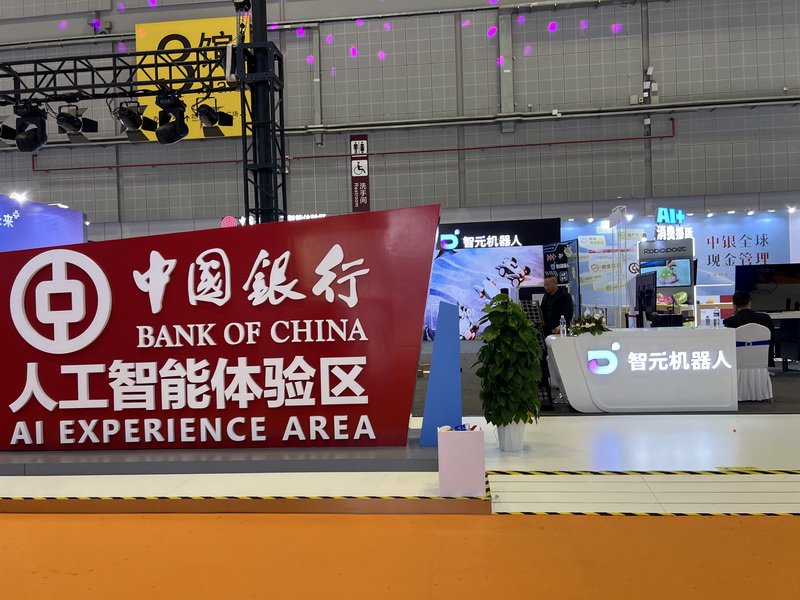
Core Insights - The eighth China International Import Expo (CIIE) concluded with an intended transaction amount of $83.49 billion, marking a record in both the number of participating companies and exhibition area, with 461 new global product launches [1] Group 1: Financial Institutions' Role - Financial institutions played a crucial role in enhancing the exhibition experience through technology and services, creating a seamless "transaction network" for buyers and sellers [1] - The integration of artificial intelligence (AI) and financial technology was highlighted, with various banks showcasing AI-driven experiences, such as China Bank's AI experience zone featuring robots and interactive displays [2][4] - The introduction of digital currency and upgraded payment systems facilitated smoother transactions, with the Industrial and Commercial Bank of China (ICBC) offering a commemorative digital currency wallet for the expo [6][9] Group 2: AI and Interactive Experiences - AI technology was prominently featured, with banks like China Construction Bank presenting humanoid robots capable of natural language interaction and full-service capabilities [5] - Interactive experiences, such as virtual racing and personalized AI portraits, attracted significant visitor engagement, demonstrating the blend of financial services with entertainment [5][6] - The use of AI in financial services was emphasized, with robots not only providing assistance but also marketing financial products effectively [4][5] Group 3: Payment Innovations - The payment system saw significant upgrades, with digital currency becoming a standard for transactions at the expo, allowing for quick and efficient cross-border payments [9][10] - The introduction of "instant buy and refund" services streamlined the tax refund process for international visitors, significantly reducing the time required for refunds [10] - The collaboration between China UnionPay and China Bank to offer integrated payment and tax refund services showcased the evolution of payment solutions at the expo [10] Group 4: Trade Facilitation and Collaboration - Financial institutions positioned themselves as resource hubs, facilitating connections between exhibitors and domestic buyers through various matchmaking activities [11] - The launch of upgraded banking apps by financial institutions aimed to enhance service integration, providing a comprehensive "finance + lifestyle" experience for exhibitors and consumers [13] - The role of financial institutions has evolved from merely providing loans to becoming key players in promoting global supply chain cooperation, as evidenced by the significant growth in cross-border settlement volumes [13]

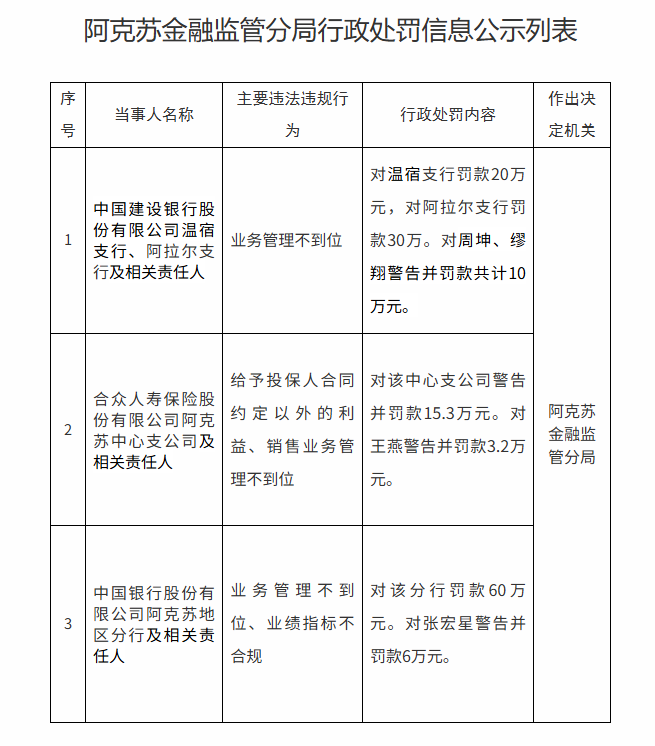
因业务管理不到位等问题,建设银行、合众人寿、中国银行被罚!
Zhong Guo Neng Yuan Wang· 2025-11-10 10:40
Core Points - Recent administrative penalties were imposed on several financial institutions in the Aksu region due to inadequate business management and non-compliance with performance indicators [1][2] Group 1: Penalties on Financial Institutions - China Construction Bank's Wensu and Alar branches were fined 200,000 yuan and 300,000 yuan respectively for poor business management, with responsible individuals receiving warnings and a total fine of 100,000 yuan [1][2] - Huazhong Life Insurance's Aksu Central Branch was fined 153,000 yuan for providing benefits outside of contractual agreements and inadequate sales management, with the responsible individual fined 32,000 yuan [1][2] - Bank of China Aksu Branch was fined 600,000 yuan for inadequate business management and non-compliance with performance indicators, with the responsible individual fined 60,000 yuan [1][2]
“银行App迎来关停潮”冲上热搜!中国银行等多家银行公告:这些App将关停
Mei Ri Jing Ji Xin Wen· 2025-11-10 08:57
Core Viewpoint - The banking industry is experiencing a wave of app closures, with many banks, including state-owned and city commercial banks, shutting down their independent apps, particularly in the credit card and direct banking sectors [2][3]. Group 1: App Closures and Mergers - Over 10 small and medium-sized banks have completed the shutdown of their credit card apps in 2024, with at least 6 more expected to follow by October 2025, integrating their functions into main mobile banking apps [3]. - China Bank has become the first state-owned bank to close its independent credit card app, "Bountiful Life," migrating all functions to the "Bank of China" app [2][3]. - The trend of closing direct banking apps began earlier, with at least 21 banks ceasing operations of their direct banking apps in 2023, reducing the number of such apps to less than one-tenth of their peak [3][8]. Group 2: Reasons for App Consolidation - The closure of multiple apps is driven by the need to reduce operational costs and improve user experience, as many independent apps have low user engagement and high maintenance costs [7][8]. - Regulatory pressures have accelerated the consolidation process, with financial authorities mandating banks to optimize or terminate apps that have low user activity and high compliance risks [8]. - The credit card industry is entering a contraction phase, with a decline in the number of credit cards issued and overall transaction activity, prompting banks to shut down underperforming apps [8]. Group 3: User Behavior and Market Trends - Users prefer a single app that offers comprehensive financial and lifestyle services, leading banks to recognize the importance of a unified digital experience [7][9]. - The banking sector is transitioning from a phase of aggressive app proliferation to a more rational approach, focusing on enhancing user engagement and operational efficiency [7][9]. - The decline in user engagement is evident, with only a few credit card service apps achieving over 10 million monthly active users, while many others struggle to maintain relevance [6][7].

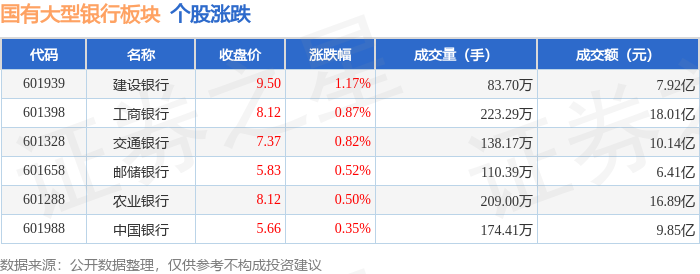
国有大型银行板块11月10日涨0.61%,建设银行领涨,主力资金净流入3.85亿元
Zheng Xing Xing Ye Ri Bao· 2025-11-10 08:48
Core Insights - The state-owned large bank sector saw an increase of 0.61% on November 10, with China Construction Bank leading the gains [1] - The Shanghai Composite Index closed at 4018.6, up 0.53%, while the Shenzhen Component Index closed at 13427.61, up 0.18% [1] Bank Performance Summary - China Construction Bank (CCB) closed at 9.50, up 1.17% with a trading volume of 837,000 shares and a transaction value of 79.267 million [1] - Industrial and Commercial Bank of China (ICBC) closed at 8.12, up 0.87% with a trading volume of 2.2329 million shares and a transaction value of 1.801 billion [1] - Bank of Communications closed at 7.37, up 0.82% with a trading volume of 1.3817 million shares and a transaction value of 1.014 billion [1] - Postal Savings Bank closed at 5.83, up 0.52% with a trading volume of 1.1039 million shares and a transaction value of 641 million [1] - Agricultural Bank of China closed at 8.12, up 0.50% with a trading volume of 2.09 million shares and a transaction value of 1.689 billion [1] - Bank of China closed at 5.66, up 0.35% with a trading volume of 1.7441 million shares and a transaction value of 985 million [1] Fund Flow Analysis - The state-owned large bank sector experienced a net inflow of 385 million from institutional investors, while retail investors saw a net outflow of 107 million [1] - The detailed fund flow for individual banks shows that ICBC had a net inflow of 172 million from institutional investors, while it faced a net outflow of 67.16 million from retail investors [2] - Bank of Communications had a net inflow of 133 million from institutional investors, with a net outflow of 34.23 million from retail investors [2] - CCB had a net inflow of 57.239 million from institutional investors, but also faced a net outflow of 53.9629 million from retail investors [2] - Agricultural Bank of China had a net inflow of 10.959 million from institutional investors, while retail investors contributed a net inflow of 60.3273 million [2] - Bank of China experienced a net outflow of 20.5749 million from institutional investors, but had a net inflow of 12.2374 million from retail investors [2]