CCB(601939)

Search documents
金信智能中国2025跑输大盘20%:“智能主题”基金却重仓银行,三季度踏空行情
Feng Huang Wang Cai Jing· 2025-10-22 12:58
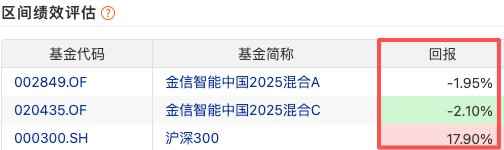
Core Viewpoint - The phenomenon of investment style drift is evident in the third-quarter report of the Jinxin Fund's Intelligent China 2025 Flexible Allocation Mixed Fund, which, despite its stated investment goal of focusing on intelligent enterprises, has heavily invested in traditional financial stocks, leading to poor performance and significant underperformance compared to peers [1][10]. Fund Performance - Jinxin Intelligent China 2025 Mixed Fund reported returns of -1.95% for Class A and -2.10% for Class C in the third quarter, while the benchmark return was 12.19%, and the CSI 300 index rose by 17.90%, indicating a nearly 20% underperformance against the index [2][3]. - Year-to-date performance as of October 21 shows Class A with a return of 14.90%, ranking 1417 out of 2303 similar products, and a six-month return of 11.87%, lagging the CSI 300 by nearly 10 percentage points [4][5]. Investment Strategy and Holdings - The fund's investment objective is to focus on enterprises providing intelligent production, design, and services, including sectors like smart machinery and smart healthcare [6]. - However, the top ten holdings for the third quarter were entirely traditional financial stocks, including major banks such as Industrial and Commercial Bank of China and China Construction Bank, indicating a significant deviation from its stated investment strategy [8][10]. Investor Sentiment - Investors have expressed concerns regarding the fund's strategy, questioning the rationale behind its heavy allocation to traditional financial stocks instead of intelligent enterprises, leading to skepticism about the fund's alignment with its stated goals [11][13]. Regulatory and Market Implications - The drift in investment style raises compliance concerns, as frequent style changes can mislead investors regarding the product's risk profile, potentially leading to greater scrutiny and pressure on the fund's future performance [14].







金信智能中国2025跑输大盘20%:“智能主题”基金却重仓银行,三季度踏空行情
凤凰网财经· 2025-10-22 12:48
Core Viewpoint - The article highlights the phenomenon of style drift in public funds, specifically focusing on the Jin Xin Fund's "Intelligent China 2025" mixed fund, which has deviated from its stated investment goal of focusing on intelligent enterprises by heavily investing in traditional financial stocks, resulting in poor performance compared to the market [3][4][11]. Group 1: Fund Performance - Jin Xin Intelligent China 2025 mixed fund reported a negative return of -1.95% and -2.10% for its A and C shares respectively in Q3, significantly underperforming the benchmark return of 12.19% and the CSI 300 index which rose by 17.90%, leading to a performance gap of nearly 20% [4][5]. - Year-to-date performance as of October 21 shows the fund's A shares with a return of 14.90%, ranking 1417 out of 2303 similar products, indicating a mid-to-low tier performance [6][7]. - The fund's total management scale decreased by 25.7% from 7.59 billion to 5.64 billion yuan in Q3 [6]. Group 2: Investment Strategy and Holdings - The fund's stated investment objective is to focus on enterprises providing intelligent production, design, and services, including sectors like smart machines and smart healthcare [8]. - However, the top ten holdings in Q3 were entirely traditional financial stocks, including major banks like ICBC and Ping An Bank, indicating a significant deviation from its stated investment strategy [9][10]. - The fund's historical trend shows a consistent increase in bank stock holdings since 2017, with at least 8 out of the top 10 holdings being bank stocks since 2018, demonstrating a long-standing style drift [11]. Group 3: Investor Sentiment and Concerns - Investors have expressed concerns regarding the fund's management and investment strategy, questioning the rationale behind the heavy allocation to traditional financial stocks despite the fund's focus on intelligent enterprises [12][15]. - The fund managers acknowledged the market volatility in Q3 but maintained that their strategy focused on the financial services sector's intelligence, which contrasts sharply with their actual stock selections [14][15]. - The article notes that frequent style shifts can lead to confusion among investors regarding the fund's positioning, potentially misleading them about the risk profile of the product [15].

10月22日180低贝(000136)指数跌1.2%,成份股山东黄金(600547)领跌
Sou Hu Cai Jing· 2025-10-22 09:16
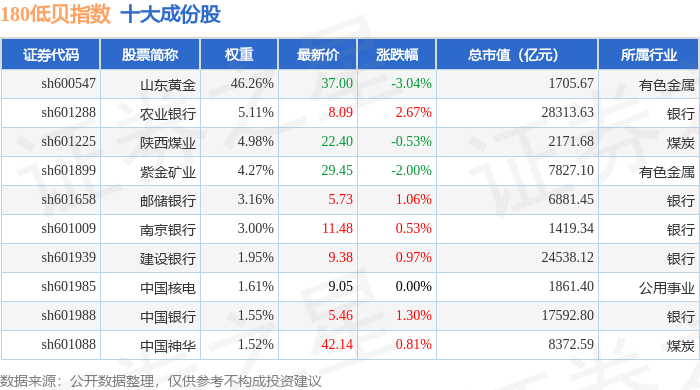
Market Overview - The 180 Low Bei Index closed at 13229.35 points, down 1.2%, with a trading volume of 621.03 billion and a turnover rate of 0.35% [1] - Among the index constituents, 35 stocks rose while 20 stocks fell, with Agricultural Bank leading the gainers at 2.67% and Shandong Gold leading the decliners at 3.04% [1] Key Constituents - The top ten constituents of the 180 Low Bei Index include: - Shandong Gold: 46.26% weight, latest price 37.00, down 3.04%, market cap 1705.67 billion [1] - Agricultural Bank: 5.11% weight, latest price 8.09, up 2.67%, market cap 28313.63 billion [1] - Other notable stocks include Zijin Mining, Postal Savings Bank, and China Nuclear Power, with varying performance [1] Capital Flow - The index constituents experienced a net outflow of 17.22 billion from main funds, while retail investors saw a net inflow of 12.7 billion [1] - Detailed capital flow for key stocks shows significant net inflows for Agricultural Bank and China Nuclear Power, while major banks like Industrial and Commercial Bank and Bank of China faced net outflows [2] ETF Performance - The Gold Stock ETF (product code: 159562) tracks the CSI Hong Kong and Shanghai Gold Industry Index, with a recent five-day decline of 3.62% and a P/E ratio of 24.77 [4] - The ETF's latest share count is 1.34 billion, down by 56 million, with a net inflow of 19.88 million from main funds [4]





国有大型银行板块10月22日涨1.92%,农业银行领涨,主力资金净流入4.43亿元
Zheng Xing Xing Ye Ri Bao· 2025-10-22 08:19
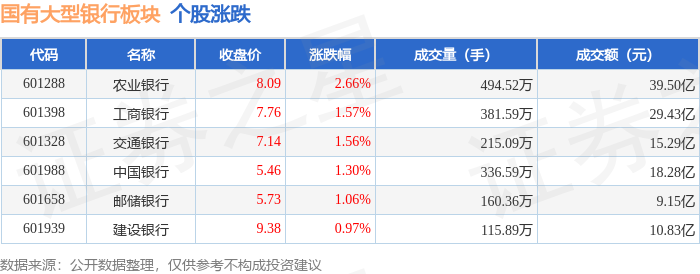
Core Insights - The state-owned large bank sector saw an increase of 1.92% on October 22, with Agricultural Bank leading the gains [1] - The Shanghai Composite Index closed at 3913.76, down 0.07%, while the Shenzhen Component Index closed at 12996.61, down 0.62% [1] Bank Performance - Agricultural Bank (601288) closed at 60.8, up 2.66% with a trading volume of 4.9452 million shares [1] - Industrial and Commercial Bank (601398) closed at 7.76, up 1.57% with a trading volume of 3.8159 million shares [1] - Bank of Communications (601328) closed at 7.14, up 1.56% with a trading volume of 2.1509 million shares [1] - Bank of China (601988) closed at 5.46, up 1.30% with a trading volume of 3.3659 million shares [1] - Postal Savings Bank (601658) closed at 5.73, up 1.06% with a trading volume of 1.6036 million shares [1] - China Construction Bank (601939) closed at 9.38, up 0.97% with a trading volume of 1.1589 million shares [1] Capital Flow - The state-owned large bank sector experienced a net inflow of 443 million yuan from institutional investors, while retail investors saw a net outflow of 315 million yuan [1] - Institutional capital flow details show that Industrial and Commercial Bank had a net inflow of 220 million yuan, while Bank of China had a net inflow of 134 million yuan [2] - Agricultural Bank had a net inflow of 87.35 million yuan from institutional investors, while it faced a net outflow of 38.26 million yuan from retail investors [2]

建行德州分行 9月末绿色贷款余额超百亿元
Jin Rong Shi Bao· 2025-10-22 04:31
Core Insights - The Construction Bank's Dezhou branch is actively supporting the development of the real economy, achieving a corporate loan balance of 23.308 billion yuan by the end of September 2025, with a year-to-date increase of 4.642 billion yuan, representing a growth rate of 39.21%, leading among the four major state-owned commercial banks in Dezhou City and the entire provincial system of the Construction Bank [1] Group 1 - The bank is focusing on financing clean and low-carbon energy infrastructure projects, directing credit resources towards key areas such as environmental protection, clean energy, low-carbon energy conservation, green buildings, and green transportation [1] - By the end of September, the balance of green loans reached 10.678 billion yuan, with a year-to-date increase of 1.909 billion yuan [1] - The bank has included personal housing loans in its "retail credit project" and the "No. 1 project" of the Dezhou branch's party committee, with a cumulative issuance of personal housing loans amounting to 1.64 billion yuan, capturing a market share of 36.75%, ranking among the top in the provincial system of the Construction Bank [1]
大摩:相信建设银行(00939)未来60天内股价将呈现绝对上涨 目标价9.5港元
智通财经网· 2025-10-22 03:49
Core Viewpoint - Morgan Stanley believes that the stock price of China Construction Bank (00939) will experience absolute growth in the next 60 days, with a probability of occurrence estimated at 70% to 80% [1] Summary by Categories Stock Rating and Target Price - Morgan Stanley rates China Construction Bank as "Overweight" with a target price of HKD 9.5 [1] Market Conditions and Expectations - The bank's stock price is expected to be supported by seasonal capital inflows, with more upward potential anticipated by the end of the year [1] - Moderate but stable credit demand is expected to stabilize financial asset yields and the bank's net interest margin, supporting revenue and profit growth in the coming quarters [1] Financial Performance Outlook - The third quarter is likely to be another quarter of positive profit growth for China Construction Bank, driven by a rebound in fee income and a reduced narrowing of net interest margin [1] - The bank presents an attractive return opportunity with a dividend yield of 5.8% [1]

“存三年不如存一年” 中小银行存款降息步伐加快
Zhong Guo Zheng Quan Bao· 2025-10-21 23:21
Core Viewpoint - Recent adjustments in deposit interest rates by several small and medium-sized banks indicate a trend towards lowering rates, particularly for long-term deposits, to optimize liability structures and manage funding costs amid a declining interest rate environment [1][5][6] Group 1: Deposit Rate Adjustments - Suzhou Bank plans to lower its three-year deposit rate by 10 basis points to 2.1% starting October 22, with new customers still eligible for a 2.2% rate [1][2] - Other regional banks, such as Pingyang Pudong Development Village Bank and Fujian Huato Bank, have also announced significant reductions in deposit rates, with some long-term rates dropping by as much as 80 basis points [2][3] - The frequency of rate adjustments has increased, with some banks like Huixian Zhujiang Village Bank making multiple changes within a short period [3] Group 2: Interest Rate Inversion - A notable phenomenon of interest rate inversion is emerging, where short-term deposit rates exceed long-term rates across various banking institutions [4] - For instance, China Construction Bank offers a three-year deposit rate of 1.55%, while the five-year rate is lower at 1.3% [4] - This inversion is prevalent among state-owned banks, joint-stock banks, and rural commercial banks, indicating a broader trend in the banking sector [4] Group 3: Factors Influencing Rate Changes - Industry experts attribute the inversion of deposit rates to expectations of further interest rate declines and the need for banks to adjust their liability structures [5][6] - The pressure on the liability side is prompting banks to lower long-term deposit rates to reduce funding costs and improve their financial stability [5] - Analysts predict that the central bank may implement further interest rate cuts, which could compel banks to continue lowering deposit rates to manage their interest margins [6]

金融优化服务促消费提振
Jing Ji Ri Bao· 2025-10-21 22:01
Group 1: Economic Growth and Consumer Spending - Consumption is identified as the main engine driving economic growth, with a focus on enhancing consumer spending through various initiatives [1] - Jiangsu Province achieved a total retail sales of consumer goods amounting to 30,984.7 billion yuan from January to August this year, ranking first nationwide and supporting high-quality national consumption development [1] Group 2: Financial Institutions and Consumer Policies - Financial institutions are actively implementing policies to boost consumption, with China Construction Bank (CCB) leading the way by launching a consumption finance initiative that integrates credit, scenarios, payments, and derivative services [2] - As of October, CCB's personal consumer loan balance reached 629.5 billion yuan, with over 100 billion yuan added this year [2] - CCB has distributed nearly 6.9 billion yuan in government consumption subsidies across 185 cities, stimulating over 56.4 billion yuan in payment transactions [2] Group 3: Aging Population and New Consumer Products - The aging population is expected to create significant market opportunities for elderly care products and services, as highlighted by the founder of a health industry company that has completed over 300,000 home modifications for elderly individuals [3] - Intelligent robotic dogs are emerging as a new consumer favorite, with one company reporting over 20,000 units sold in just over a year [4] - Financial support from CCB has been crucial for companies developing innovative products, enabling them to transition from research to market [4]
中小银行存款降息步伐加快
Zhong Guo Zheng Quan Bao· 2025-10-21 20:18
Core Viewpoint - The recent trend of lowering deposit rates among small and medium-sized banks is driven by the need to optimize liability structures and control funding costs, amidst a backdrop of anticipated interest rate declines and the phenomenon of inverted deposit rates for different maturities [1][2][3][4] Group 1: Deposit Rate Adjustments - Several small and medium-sized banks, including Suzhou Commercial Bank and Pingyang Pudong Development Village Bank, have announced reductions in deposit rates, with some three-year and five-year rates decreasing by as much as 80 basis points [1][2] - Suzhou Commercial Bank will lower its three-year deposit rate from 2.2% to 2.1% starting October 22, with a minimum deposit requirement of 100,000 yuan [1] - The trend of rate reductions is not isolated, as multiple banks have made similar announcements, indicating a broader industry shift [2] Group 2: Inverted Deposit Rates - The phenomenon of inverted deposit rates, where shorter-term deposit rates exceed those of longer-term deposits, is becoming increasingly common across various types of banks, including state-owned and joint-stock banks [2][3] - For instance, China Construction Bank offers a three-year deposit rate of 1.55%, which is higher than its five-year rate of 1.3% [3] - This inversion is attributed to market expectations of further interest rate declines, leading banks to adjust their deposit offerings accordingly [3] Group 3: Liability Structure Adjustments - Industry experts suggest that the inverted deposit rates are linked to banks' efforts to adjust their liability structures in response to increasing pressure on the funding side [3][4] - Banks are actively lowering long-term deposit rates to optimize their funding costs and mitigate the impact of narrowing net interest margins [3] - The anticipated future decline in interest rates is prompting banks to reassess their deposit strategies to maintain operational efficiency [4]
瑞银坚定唱多中国科技股,列为全球股票中最具信心投资标的
Zhi Tong Cai Jing· 2025-10-21 14:08
Core Viewpoint - UBS has upgraded the rating of Chinese stocks to "attractive" and technology stocks to "most attractive," citing them as the most confident investment targets globally [1][2]. Group 1: Technology Sector Insights - Chinese technology stocks are seen as the most confident investment targets globally, supported by two main factors: clear AI commercialization trends and strong growth prospects from leading tech companies, along with significant progress in domestic chip production [2][3]. - Major Chinese tech companies are expected to increase capital expenditures by 55% by 2025 to meet the surging demand for AI, with AI user penetration in China showing significant growth, reaching 645 million users as of August, a year-on-year increase of over 60% [3][4]. Group 2: Market Dynamics - The technology sector is entering a multi-year growth cycle driven by technological breakthroughs, strong policy support, and domestic production, with projected earnings growth of 37% by 2026, making it the fastest-growing stock sector globally [4][5]. - Historical analysis indicates that Chinese bull markets are typically driven by liquidity and valuation expansion, with the current market trend following a similar pattern, suggesting a more sustainable and robust upward movement [5][6]. Group 3: Liquidity and Investment Trends - Domestic investors have net bought $50 billion in Hong Kong stocks through the Stock Connect this year, the highest level since the mechanism's launch, indicating strong liquidity in the market [6][7]. - Local institutional investors are likely to shift funds from bonds to stocks due to declining yields on 10-year government bonds, which could support continued market growth [6][7]. Group 4: Policy Support - The macroeconomic environment remains stable, with expectations for targeted policy support rather than large-scale fiscal stimulus, focusing on technology and advanced manufacturing sectors [8][9]. - Upcoming policies are expected to prioritize innovation and high-quality growth, with specific measures aimed at supporting AI commercialization and chip production, reflecting the government's commitment to these sectors [8][9].