NJTC(601975)

Search documents
国泰海通交运周观察:元旦航空量价两旺,油运淡季运价回落
GUOTAI HAITONG SECURITIES· 2026-01-04 08:06
Investment Rating - The report maintains an "Overweight" rating for the aviation and oil transportation sectors, indicating a positive outlook for both industries [35]. Core Insights - The aviation sector is expected to see robust demand growth, driven by increased travel during the New Year holiday, with significant year-on-year increases in both passenger volume and ticket prices. The report suggests a strategic investment during the off-peak season, anticipating a long-term super cycle [3][4]. - In the oil transportation sector, while seasonal price declines are noted, the report emphasizes the potential for future price increases due to ongoing global oil production growth and limited capacity expansion. It recommends a contrarian investment approach during the off-peak period [3][4]. Summary by Sections Aviation Sector - The report highlights a strong increase in travel demand during the New Year holiday, with a 19% year-on-year increase in overall passenger movement from December 31, 2025, to January 2, 2026. Specifically, civil aviation saw a 13% increase [3][4]. - Domestic ticket prices are estimated to rise by over 10% year-on-year during the holiday period, despite a projected short-term dip in passenger flow post-holiday [3][4]. - The aviation industry is experiencing high load factors while ticket prices remain at historical lows, suggesting a favorable environment for profitability growth driven by demand recovery and market pricing dynamics [3][4]. Oil Transportation Sector - The report notes that the average daily earnings for Very Large Crude Carriers (VLCC) reached $51,000 in 2025, significantly higher than the $36,000 in 2023-2024, driven by improved capacity utilization and increased oil production from the Middle East and South America [3][4]. - Despite a recent decline in freight rates during the traditional off-peak season, the report maintains a positive outlook for future price increases, supported by ongoing global oil production growth and limited fleet expansion [3][4]. - The report suggests monitoring geopolitical developments, particularly in Venezuela, and recommends increasing positions in companies like COSCO Shipping Energy, China Merchants Energy Shipping, and China Shipbuilding Leasing [3][4].

交通运输行业2026年投资策略:周期拐点渐显
Dongguan Securities· 2025-12-30 09:08
Investment Strategy Overview - The transportation industry is closely linked to the macroeconomic environment, with a weak overall performance in 2025, underperforming the CSI 300 index. Key segments like railways and highways have weakened due to style shifts, while logistics, aviation, and shipping have seen some support in the second half of the year from anti-involution and external demand factors, but still lag behind the market index. Looking ahead to 2026, domestic demand is expected to improve driven by anti-involution and major infrastructure projects, with recommendations to focus on (1) improved domestic express delivery competition and benefiting bulk supply chains from upstream price recovery, (2) growth in business and leisure demand potentially returning aviation airports to profitability, and (3) the high prosperity cycle of oil transportation [5][72]. 2025 Review - The transportation industry index showed a stable performance, with a cumulative increase of 1.55% as of December 29, 2025, but underperformed the CSI 300 index. The performance of sub-sectors varied, with aviation airports, shipping ports, railways, and logistics showing cumulative changes of 9.74%, 6.56%, -12.86%, and 6.34% respectively, all underperforming the CSI 300 index [13][14]. Aviation Sector - The aviation supply-demand landscape continues to improve, with aircraft utilization recovering to high levels. Domestic civil aviation demand has been steadily increasing, with passenger volume reaching new highs in the second half of 2025. The average daily utilization of aircraft in China was 8.7 hours as of November 2025, nearing pre-pandemic levels [18][21]. - The average ticket price has stabilized, with a peak passenger load factor of 87.5% in August 2025. The market supply-demand situation is tight, and further tightening could boost ticket prices [23][24]. - The supply side faces challenges with aircraft manufacturers struggling to restore production capacity, with Boeing and Airbus delivering significantly fewer aircraft than pre-pandemic levels. As of 2024, Boeing delivered 348 commercial aircraft, while Airbus delivered 766, both below their respective 2019 levels [25][26]. - The demand side is supported by policy initiatives that have revitalized business activities, with business line passenger volume increasing year-on-year in the first eight months of 2025 [34][36]. - Cost pressures are alleviated by declining oil prices, with WTI futures at $56.74 per barrel as of December 26, 2025, down 54.13% from peak levels. The strengthening of the RMB also reduces dollar-denominated debt burdens for airlines [40][43]. Oil Transportation Sector - The oil transportation industry is currently in a high prosperity cycle, with oil prices influenced by demand fluctuations and unexpected events. The BDTI index has seen an uptick, indicating potential for improved industry conditions [46][47]. - Short-term demand is driven by significant U.S. strategic petroleum reserve replenishment needs, while long-term demand is expected to stabilize globally. The IEA forecasts a growth of 2.5 million barrels per day in global oil demand from 2024 to 2030 [49][51]. - The supply side is characterized by tight compliance capacity, with sanctions on shadow fleets leading to a reduction in compliant shipping capacity. This is expected to gradually elevate oil transportation rates [56][57]. Bulk Supply Chain Sector - The bulk supply chain sector is transitioning from traditional trading and logistics models to integrated service provider models, enhancing resource control and operational efficiency. Leading companies are learning from international experiences to improve their market positions [60][63]. - The sector is currently fragmented, with a low market share for leading firms (CR5 at around 5%). As domestic companies consolidate, there is potential for increased market share and profitability [63][64]. - The anti-involution trend is expected to stabilize the PPI, benefiting bulk supply chains as they recover from price declines. The sector is poised to benefit from price rebounds and improved demand conditions [65][66]. Investment Recommendations - Maintain a market-weight rating for the transportation industry, with a focus on improving domestic demand and sector recovery in 2026. Recommended stocks include China National Aviation (601111), Southern Airlines (600029), and Xiamen Xiangyu (600057) [72][74].




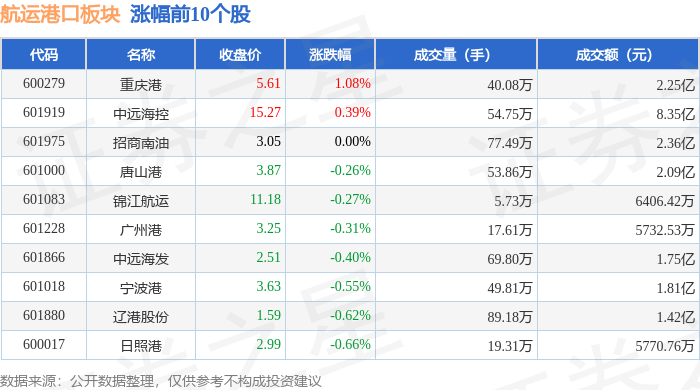
航运港口板块12月30日跌1.18%,安通控股领跌,主力资金净流出4.03亿元
Zheng Xing Xing Ye Ri Bao· 2025-12-30 09:00
Core Viewpoint - The shipping and port sector experienced a decline of 1.18% on December 30, with Antong Holdings leading the drop. The Shanghai Composite Index closed at 3965.12, down 0.0%, while the Shenzhen Component Index rose by 0.49% to 13604.07 [1]. Group 1: Market Performance - The shipping and port sector saw a decline of 1.18% on the trading day [1]. - Antong Holdings was the biggest loser in the sector, with a closing price of 5.49, down 6.95% [2]. - The sector's main stocks showed mixed performance, with Chongqing Port rising by 1.08% to 5.61, while other stocks like Xiamen Port and Haixia Co. fell by 5.20% and 5.51%, respectively [1][2]. Group 2: Trading Volume and Capital Flow - The total trading volume for the shipping and port sector was significant, with Chongqing Port recording a volume of 400,800 shares and a transaction value of 225 million yuan [1]. - The sector experienced a net outflow of 403 million yuan from main funds, while retail investors saw a net inflow of 308 million yuan [2]. - The capital flow data indicates that major stocks like Zhongyuan Shipping and Shanghai Port had varying levels of net inflow and outflow, reflecting investor sentiment [3].





招商南油(601975.SH):完成回购1.22亿股公司股份
Ge Long Hui A P P· 2025-12-29 11:12
格隆汇12月29日丨招商南油(601975.SH)公布,2025年12月26日,公司完成回购,已实际回购公司股份 1.22亿股,占公司总股本的2.53%,回购最高价格3.38元/股,回购最低价格3.04元/股,回购均价3.29元/ 股,使用资金总额399,999,477.93元(不含交易费用)。 ...
招商南油(601975) - 招商南油关于股份回购实施结果暨股份变动的公告
2025-12-29 10:48
招商局南京油运股份有限公司 证券代码:601975 证券简称:招商南油 公告编号:2025-044 关于股份回购实施结果暨股份变动的公告 本公司董事会及全体董事保证本公告内容不存在任何虚假记载、误导性陈述 或者重大遗漏,并对其内容的真实性、准确性和完整性承担法律责任。 重要内容提示: | 回购方案首次披露日 | 2025/8/25 | | | | | --- | --- | --- | --- | --- | | 回购方案实施期限 | 2025 9 9 日~2026 年 月 8 日 | 年 | 月 | 9 | | 预计回购金额 | 25,000万元~40,000万元 | | | | | 回购价格上限 | 4.32元/股 | | | | | 回购用途 | √减少注册资本 □用于员工持股计划或股权激励 | | | | | | □为维护公司价值及股东权益 | | | | | 实际回购股数 | 121,511,470股 | | | | | 实际回购股数占总股本比例 | 2.53% | | | | | 实际回购金额 | 399,999,477.93元 | | | | | 实际回购价格区间 | 3.04元/股~3.38元 ...
招商南油:累计回购约1.22亿股
Mei Ri Jing Ji Xin Wen· 2025-12-29 10:43
每经头条(nbdtoutiao)——绕开光刻机"卡脖子",中国新型芯片问世!专访北大孙仲:支撑AI训练和 具身智能,可在28纳米及以上成熟工艺量产 (记者 曾健辉) 每经AI快讯,招商南油(SH 601975,收盘价:3.05元)12月29日晚间发布公告称,2025年12月26日, 公司完成回购,已实际回购公司股份约1.22亿股,占公司总股本的2.53%,回购最高价格3.38元/股,回 购最低价格3.04元/股,回购均价约3.29元/股,使用资金总额约4亿元。 2024年1至12月份,招商南油的营业收入构成为:运输业占比97.01%,船员租赁占比2.28%,其他业务 占比0.67%,船舶管理费占比0.04%。 截至发稿,招商南油市值为146亿元。 ...
油气ETF汇添富(159309)开盘涨0.09%,重仓股杰瑞股份跌2.00%,中国海油跌0.39%
Xin Lang Cai Jing· 2025-12-29 01:37
Group 1 - The core point of the article highlights the performance of the oil and gas ETF Huatai Fuhua (159309), which opened with a slight increase of 0.09% at 1.139 yuan [1] - The major holdings of the oil and gas ETF include companies such as Jereh, CNOOC, PetroChina, Sinopec, and others, with varying performance on the opening day [1] - The ETF's performance benchmark is the CSI Oil and Gas Resource Index return rate, managed by Huatai Fuhua Fund Management Co., Ltd., with a return of 13.88% since its establishment on May 31, 2024, and a return of 5.61% over the past month [1] Group 2 - Jereh shares opened down by 2.00%, while CNOOC and PetroChina saw declines of 0.39% and 0.10% respectively [1] - Sinopec remained unchanged, while other companies like China Merchants Energy and Intercontinental Oil & Gas showed slight increases [1] - The overall performance of the ETF reflects the mixed performance of its underlying assets in the oil and gas sector [1]




国资央企市值管理步入价值创造新阶段
Zhong Guo Zheng Quan Bao· 2025-12-26 21:06
Core Viewpoint - The recent meeting of central enterprise leaders emphasized the need to enhance the quality and market value management of listed companies by 2026, coinciding with the one-year anniversary of the State-owned Assets Supervision and Administration Commission's (SASAC) guidelines on improving market value management for central enterprises [1] Group 1: Central Enterprises' Market Value Management - Central enterprises are increasingly adopting systematic actions for market value management, transitioning from regulatory requirements to concrete market commitments [1] - Measures such as share buybacks and increases in shareholding are being implemented to stabilize market expectations and enhance investor confidence [1] - China Metallurgical Group plans to repurchase A-shares and H-shares with a buyback amount between 1 billion and 2 billion yuan, while China National Coal's shareholding has increased from 30.31% to 31.72% [1] Group 2: Systematic Approach to Market Value Management - More central enterprises are integrating market value management into systematic projects, with companies like Sinopec launching initiatives to enhance investment value and shareholder returns [2] - Data from SASAC indicates that the market value of central enterprise-controlled listed companies has exceeded 22 trillion yuan, reflecting a nearly 50% increase since the end of the 13th Five-Year Plan [2] - Future market value management for central enterprises is expected to become more institutionalized, market-oriented, and normalized, focusing on quality improvement and investor communication [2] Group 3: Local State-Owned Assets and Market Value Management - Local governments are also promoting market value management for state-owned listed companies as a key strategy for deepening reforms and supporting high-quality development [3] - Shandong Province's State-owned Assets Supervision and Administration Commission has outlined a training program for enhancing the market value of provincial enterprises [3] - The emphasis is on establishing a correct market value management philosophy that prioritizes value creation over short-term stock price fluctuations [3] Group 4: Integration of Market Value Management - The strategic importance of market value management is increasingly recognized, becoming integral to corporate strategy, governance, and investor relations [4] - During the 14th Five-Year Plan period, market value management is expected to be deeply integrated into all aspects of enterprise operations, serving as a comprehensive measure of operational quality and governance [4]



航运行业2026年策略报告:关注2026年油轮、散货景气上行-20251226
CMS· 2025-12-26 09:04
Group 1: Core Insights - The report highlights a positive outlook for the tanker and bulk shipping sectors in 2026, with a relatively favorable supply-demand balance for medium and large vessels, indicating potential for significant seasonal elasticity [1] - The shipping sector has shown relative outperformance against the transportation index, although it remains weaker than the CSI 300 index, with the shipping index rising by 8.8% year-to-date compared to a 16.1% increase in the CSI 300 [5][11] - The report emphasizes the impact of geopolitical factors and tariff policies on shipping performance, noting significant fluctuations in freight rates due to trade tensions, particularly between the US and China [11] Group 2: Container Shipping - In 2025, container shipping faced notable impacts from tariff policies, leading to a significant drop in cargo volumes on US-China routes, with a temporary surge in freight rates due to a "rush to ship" phenomenon [21] - The demand for container shipping remains resilient, with a year-on-year export growth of 5.4% in China for the first eleven months of 2025, despite challenges from tariff adjustments [25][30] - Supply forecasts indicate a steady increase in container fleet capacity, with expected growth rates of 4.7% and 6.4% for 2026 and 2027, respectively, while the demand growth is projected at 2.4% and 3.0% for the same years [49][55] Group 3: Oil Shipping - The oil shipping sector is expected to maintain a favorable supply-demand balance in 2026, driven by multiple positive factors, including increased production from the Middle East and rising demand for oil imports from Asia [60] - The report notes a significant increase in global oil exports starting from September 2025, with major oil-producing countries ramping up their output, contributing to a supply-demand imbalance that supports rising freight rates [63] - VLCC (Very Large Crude Carrier) rates have shown a substantial increase, with rates reaching $110,000 per day by December 2025, reflecting the strong demand and supply constraints in the oil shipping market [60][61] Group 4: Dry Bulk Shipping - The dry bulk shipping market is experiencing a recovery in the second half of 2025, with increased demand for iron ore and grain transportation, leading to a positive outlook for 2026 [60] - The report forecasts a growth rate of 0.9% and 0.7% for dry bulk shipping volumes in 2026 and 2027, respectively, driven by the demand for iron ore and grain [60] - Supply constraints are anticipated, particularly for Capesize vessels, with limited growth expected in their capacity, which may support freight rate increases in the upcoming years [60][55]


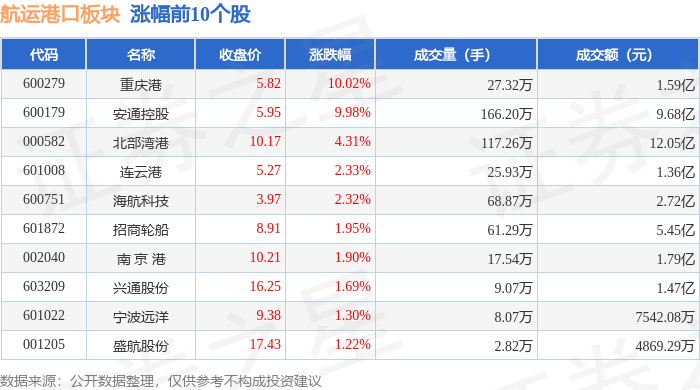
航运港口板块12月25日涨0.39%,重庆港领涨,主力资金净流出3.8亿元
Zheng Xing Xing Ye Ri Bao· 2025-12-25 09:07
Group 1 - The shipping and port sector increased by 0.39% on December 25, with Chongqing Port leading the gains [1] - The Shanghai Composite Index closed at 3959.62, up 0.47%, while the Shenzhen Component Index closed at 13531.41, up 0.33% [1] - Key stocks in the shipping and port sector showed significant price increases, with Chongqing Port rising by 10.02% to a closing price of 5.82 [1] Group 2 - The shipping and port sector experienced a net outflow of 380 million yuan from main funds, while retail investors saw a net inflow of 279 million yuan [2] - The trading volume and turnover for key stocks varied, with An Tong Holdings seeing a closing price of 5.95 and a trading volume of 1.662 million shares [2] - The net inflow of funds for Chongqing Port was negative at -39.11 million yuan, indicating a shift in investor sentiment despite its price increase [3]