BANK OF CHINA(601988)

Search documents
破解“种树”的密码!五家银行谋篇科技金融方法论
券商中国· 2025-12-02 03:45
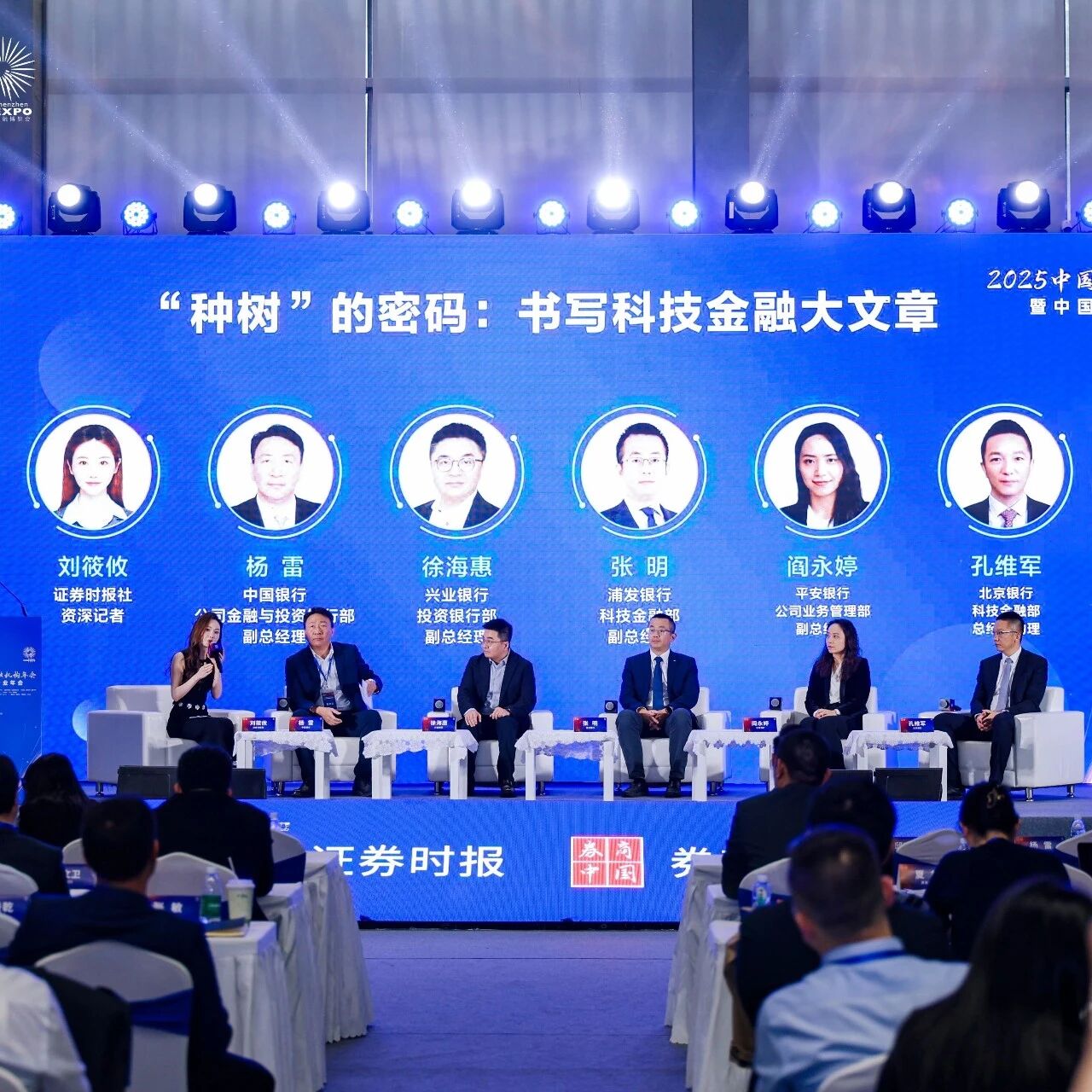
Core Viewpoint - The article emphasizes that technology finance has become a strategic focus for the banking industry, driven by policy guidance and market dividends, and highlights the ongoing exploration of effective lending mechanisms in this sector [1]. Group 1: Organizational Structure - All five banks prioritize technology finance in their strategic frameworks, with a consensus on the necessity of specialized teams and organizational setups to support this business [3][4]. - China Bank has established a multi-tiered organizational structure for technology finance, enhancing its ability to understand the needs of tech enterprises [3]. - SPD Bank aims to strengthen its position as the preferred banking partner for tech companies by creating a specialized organizational framework that includes a dedicated technology finance team [3]. Group 2: Product Offerings - Ping An Bank has set up technology finance centers at both the headquarters and key branches, focusing on a wide range of clients and offering products that span the entire business cycle, including investment banking and transaction banking services [4]. - Beijing Bank has developed a specialized technology finance system and launched the "Leading e-loan" product, which has seen significant uptake, with cumulative loans exceeding 140 billion yuan [5]. Group 3: Risk Management - The article discusses the challenges banks face in assessing the value and risks of tech companies, particularly smaller ones, due to their unique characteristics such as light assets and long R&D cycles [6]. - Ping An Bank has formed a research team to evaluate industry segments and has developed an evaluation system focusing on intellectual property and financial health [6][7]. - Beijing Bank has implemented a dual approach to risk assessment, combining offline credit committees with an online approval system to better understand tech enterprises [7]. Group 4: Market Dynamics - The article notes a mismatch between supply and demand in the technology finance sector, with a significant increase in loan coverage for tech SMEs but unmet needs from early-stage companies [8]. - SPD Bank has shifted its focus from traditional lending to technology investment banking, aiming for high-quality development in technology finance [8]. Group 5: Strategic Recommendations - Recommendations include focusing on the quality of development rather than just quantity, emphasizing product differentiation and innovation, and utilizing syndicate loans to spread risk [9][10]. - The article suggests that banks should collaborate to support promising tech enterprises, balancing equity and debt financing to mitigate risks associated with market fluctuations [9][10].






中国金融板块-追踪工业风险:制造业固定资产投资增速显著放缓,助力更快管控风险-China Financials-Tracking industrial risks further notable slowdown in manufacturing FAI growth to help contain risks more quickly
2025-12-02 02:08
Summary of Key Points from the Conference Call Industry Overview - **Industry**: China Financials, specifically focusing on manufacturing and infrastructure investments in China [1][5][7] Core Insights and Arguments - **Manufacturing FAI Growth**: There has been a notable slowdown in manufacturing Fixed Asset Investment (FAI) growth, dropping to 2.7% year-over-year (yoy) from 4.0% yoy in the previous month, indicating steady progress on capital expenditure (capex) slowdown [7] - **Liability Growth**: Total liability growth for industrial firms moderated to 5.0% yoy, while manufacturing firms saw a slight increase to 5.9% yoy. This moderation is expected to lead to more rational capacity expansion [2][7] - **Revenue Decline**: Manufacturing revenue declined by 4.3% yoy, attributed to lower production levels due to overcapacity control efforts. The Value-Added Industrial (VAI) growth also slowed to 4.9% yoy from 6.5% yoy in September [3][10] - **Profit Growth**: Manufacturing profit growth moderated to 7.7% yoy from 9.9% yoy in September, influenced by higher financing costs and lower production [10] Future Outlook - **Infrastructure Investment**: A potential increase in infrastructure investments, supported by a new RMB 500 billion fund from the China Development Bank, is expected to bolster demand in 2026 and aid in the digestion of overcapacity risks [8][3] - **Sector Performance**: 77.1% of sectors experienced a slowdown in capex in October 2025 compared to the first half of 2025, while 39.3% of sectors showed profit improvement [9][7] Additional Important Information - **PPI Trends**: The Producer Price Index (PPI) rebounded month-over-month for the first time since December 2024, with the year-over-year decline narrowing to 2.1% [7] - **Investment Sentiment**: The overall sentiment towards the China Financials sector remains attractive, with ongoing efforts in financial tightening contributing to anti-involution measures [5][4] This summary encapsulates the critical insights from the conference call, highlighting the current state and future expectations of the manufacturing and financial sectors in China.




风向变了!银行集体下架5年期定存!对普通人的钱包有啥影响?
Sou Hu Cai Jing· 2025-12-02 01:43
Group 1 - Recent months have seen a trend of banks, including small and medium-sized banks as well as major state-owned banks, reducing their 5-year fixed deposit and large certificate of deposit products, with small banks leading the way with cuts of up to 80 basis points [1][2] - The current round of deposit rate cuts is primarily a decentralized adjustment by small banks and does not yet reflect a comprehensive reduction led by major state-owned banks [2] - The People's Bank of China (PBOC) is expected to lower interest rates in January to support the 2026 growth target, with indications that deposit rates may decrease before the Loan Prime Rate (LPR) [5][6] Group 2 - As deposit rates decline, some funds are likely to shift from low-yield deposits to equity markets, indicating a potential change in investment behavior [7] - The government is showing unprecedented support for the stock market, with the approval of the first batch of seven dual-innovation artificial intelligence ETFs set to launch on November 28 [8] - The reduction in deposit rates, with current rates at 0.95% for 1-year and 1.05% for 2-year deposits, is expected to encourage residents to invest in the stock market and index funds [10] Group 3 - The dual inflow of resident and institutional funds into the market signifies a significant shift in investment patterns, moving away from traditional bank deposits and real estate towards equity markets [11]





2025全球系统重要性银行公布!五家大行评分齐涨,工行升至第三组
Xin Lang Cai Jing· 2025-12-02 00:50
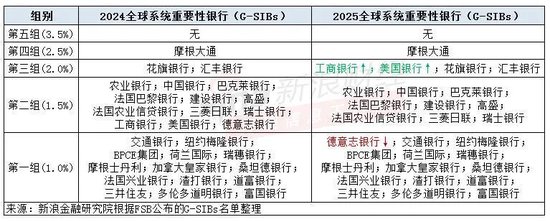
Core Points - The Financial Stability Board (FSB) released the 2025 Global Systemically Important Banks (G-SIBs) list, maintaining the number of Chinese banks at five, with the Industrial and Commercial Bank of China (ICBC) moving up to the third group, marking it as the first Chinese bank in this category [1][4][3] - The other four Chinese banks, namely Agricultural Bank of China, Bank of China, and China Construction Bank, remain in the second group, while Bank of Communications stays in the first group [4][5] Group Summaries - **G-SIB Group Rankings**: The 2025 G-SIB list includes five groups, with ICBC in the third group, requiring an additional capital requirement increase from 1.5% to 2.0%. The fourth group remains occupied by JPMorgan Chase, while the second group includes nine institutions, and the first group consists of 15 banks [4][5][12] - **Score Changes**: ICBC's score increased significantly by 33 points to 332, while Bank of China rose by 32 points to 314, Agricultural Bank by 15 points to 272, Construction Bank by 10 points to 259, and Bank of Communications by 9 points to 138 [8][10] - **Impact of Exchange Rates**: Analysts noted that exchange rate factors may have influenced the scoring of Chinese G-SIBs, with potential implications for their 2026 ratings. The historical context suggests that exchange rates have previously alleviated pressure on scores [10][7] - **TLAC Bond Issuance**: To meet the total loss-absorbing capacity (TLAC) requirements, major state-owned banks have been actively issuing TLAC bonds. For instance, Agricultural Bank issued TLAC bonds worth 20 billion yuan, and Bank of Communications issued bonds worth 30 billion yuan [13][12]
驻中国银行纪检监察组开展综合监督检查“回头看”
Zhong Yang Ji Wei Guo Jia Jian Wei Wang Zhan· 2025-12-02 00:33
Core Viewpoint - The Central Commission for Discipline Inspection and National Supervisory Commission has conducted a comprehensive supervision check on four branches of the Bank of China, focusing on the effectiveness of rectification measures and the overall improvement of discipline inspection work [2][3]. Group 1: Supervision and Inspection - A total of 84 issues were identified in the four branches regarding discipline enforcement, team building, and education training, with 74 issues rectified, 7 achieving partial success, and 3 still in the process of rectification [2]. - The comprehensive supervision check is part of a broader initiative to enhance the standardization, legalization, and normalization of discipline inspection work within the Bank of China [3]. Group 2: Rectification Measures - The inspection revealed that the inspected institutions have taken the feedback seriously, implementing corrective measures tailored to their specific situations, leading to a thorough rectification of issues [3]. - For instance, the Jiangxi branch has adopted a practical model involving the participation of secondary-level discipline inspection personnel in case reviews, while the Jilin branch has focused on legal education and training as a core rectification strategy [3]. Group 3: Ongoing Challenges - Despite progress, the inspection identified ongoing issues in enhancing the quality and efficiency of case handling, strengthening the discipline inspection team, and improving legal education and training [4]. - The Central Commission has mandated all first-level discipline inspection institutions to conduct self-examinations and rectify common issues identified during the inspections [4].
【华创金融 徐康团队】红利资产月报:多因素催化银行股涨幅居前,地产风险可控
Xin Lang Cai Jing· 2025-12-01 15:07
Monthly Performance - The banking sector increased by 2.99% from November 1 to November 28, 2025, outperforming the CSI 300 index by 5.4 percentage points, ranking second among 31 Shenwan first-level industries [1][6] - Institutional investors increased their holdings in bank stocks due to a stable improvement in fundamentals, shareholder buybacks, and expectations of valuation recovery [1][6] Valuation Trends - State-owned banks saw a significant increase in valuation, with their PB ratio rising from approximately 0.76X at the beginning of the month to 0.78X by the end, while the PB ratios for joint-stock banks and city commercial banks remained stable at 0.67X and 0.60X, respectively [1][9] - As of November 28, the overall PE ratio for the banking sector was 6.53 times, with a historical percentile of 56.18%, and the PB ratio was 0.56 times, with a historical percentile of 32.25% [21] Individual Bank Performance - Notable gainers included Bank of China (8.20%), China Everbright Bank (8.08%), China Construction Bank (5.81%), and Nanjing Bank (5.13%), while Qingdao Bank and rural commercial banks experienced significant declines [1][12] - The performance of banks with improved earnings and mid-term dividend payouts led to notable increases in their stock prices [1][12] Market Environment - The 10-year government bond yield rose from around 1.80% in early November to 1.84% by the end of the month, while the 1-year bond yield remained stable at approximately 1.40% [16] - The trading volume in the banking sector increased by 13.07% year-on-year, accounting for 1.65% of the total trading volume in the AB share market, although it decreased by 0.18 percentage points compared to the previous month [19] Social Financing and Credit Trends - In October, the social financing growth rate fell to 8.5%, with new social financing of 816.1 billion yuan, a year-on-year decrease of 5.959 billion yuan [25] - The decline in credit supply was attributed to a shift in government bond issuance timing and a decrease in demand for consumer loans [25]


中国银行:2025年9月30日普通股股东总数为678883户
Zheng Quan Ri Bao· 2025-12-01 13:20
Core Viewpoint - China Bank reported that as of September 30, 2025, the total number of ordinary shareholders is 678,883, which includes 519,660 A-share shareholders and 159,223 H-share shareholders [1] Summary by Category - **Shareholder Composition** - Total ordinary shareholders: 678,883 - A-share shareholders: 519,660 - H-share shareholders: 159,223 [1]
华润医药(03320.HK)附属拟发行30亿元中期票据获中国银行间市场交易商协会注册批准
Ge Long Hui· 2025-12-01 12:26
Core Viewpoint - China Resources Pharmaceutical (03320.HK) announced that its non-wholly owned subsidiary, China Resources Pharmaceutical Commercial Group Co., Ltd. ("China Resources Commercial"), has received a registration acceptance notice from the National Association of Financial Market Institutional Investors regarding the proposed issuance of medium-term notes in the People's Republic of China [1] Group 1 - The notice is valid for two years from the date of issuance, allowing China Resources Commercial to issue medium-term notes totaling RMB 3 billion in installments during this period [1] - The expected proceeds from the proposed issuance will be used to repay interest-bearing debts of China Resources Commercial or its subsidiaries [1]

《2025中国银行业竞争力100强》发布,浙江16家银行上榜
2 1 Shi Ji Jing Ji Bao Dao· 2025-12-01 11:13
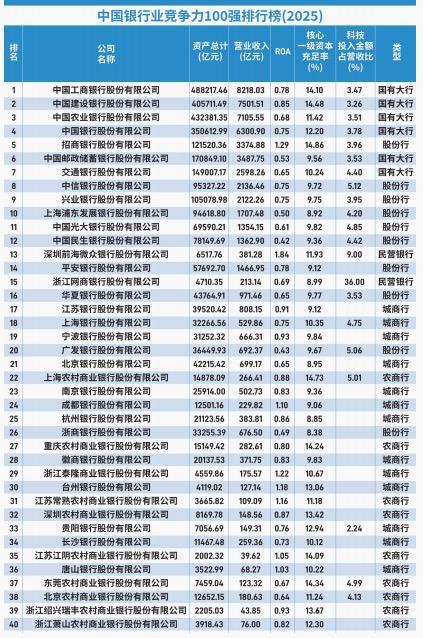
Core Insights - The "2025 China Banking Competitiveness Report" was released at the 21st Century Financial Annual Conference, highlighting the competitive landscape of the banking sector in China [1] - A total of 16 banks from Zhejiang province made it to the "Top 100 Competitiveness Rankings of Chinese Banks" [1] Rankings Overview - The rankings include 6 state-owned banks, 12 national joint-stock banks, 53 city commercial banks, 27 rural commercial banks, and 2 private banks, with 5 foreign banks also making the list [2][4] - The top three banks are Industrial and Commercial Bank of China, China Construction Bank, and Agricultural Bank of China, with total assets of 488.22 billion, 405.71 billion, and 532.38 billion respectively [2] Evaluation Framework - The evaluation framework consists of four categories: scale, profitability, stability, and growth, based on objective data from the 2024 annual reports [4] - Sub-rankings for scale, profitability, and growth provide a more detailed view of different types of banks' performances [4] Regional Insights - Zhejiang province's banks, such as Zhejiang Commercial Bank, ranked 26th, while Zhejiang Internet Bank and WeBank were the only two private banks to make the list, ranking 15th and 16th respectively [4][5] - City commercial banks from Zhejiang, including Ningbo Bank and Hangzhou Bank, ranked 19th and 25th, respectively, indicating a strong regional presence [5] Development Trends - The asset scale of China's banking industry continues to expand, with state-owned banks showing significant scale advantages, while smaller banks adopt differentiated growth strategies [6] - Profitability indicators show a widening gap, with larger banks benefiting from scale effects, while smaller banks face challenges due to factors like reduced loan prime rates [6] - Growth indicators reflect the potential for banks, focusing on core tier one capital adequacy, cost-to-income ratios, revenue growth, and technology investment [6]

透视上市银行盈利能力丨银行与保险
清华金融评论· 2025-12-01 10:46
Core Viewpoint - The overall performance of A-share listed banks shows a recovery in both revenue and net profit, with state-owned banks maintaining significant profitability, while the return on equity (ROE) continues to decline across the sector [2]. Revenue Performance - The revenue of listed banks is generally stable with internal differentiation, and state-owned banks continue to stand out [3]. - Over 60% of banks reported positive revenue growth in Q3 2025, with 29 banks showing growth and 13 experiencing declines [4]. - The six major state-owned banks achieved a total revenue of CNY 2.72 trillion, a year-on-year increase of 1.87% in Q3 2025, with all six banks reporting growth [4]. - Among the four major banks, Industrial and Commercial Bank of China (ICBC) had the highest revenue at CNY 821.80 billion, up 2.17% year-on-year [4]. - Joint-stock banks reported a total revenue of CNY 1.12 trillion, a decline of 2.56% year-on-year, with only two banks showing revenue growth [5][6]. - City commercial banks collectively generated CNY 402.08 billion in revenue, a year-on-year increase of 4.67%, with 14 out of 17 banks reporting growth [7]. - Rural commercial banks saw a slight decline in revenue, totaling CNY 790.64 billion, with 10 banks reporting a minor decrease of 0.03% year-on-year [8]. Net Profit Performance - The net profit of listed banks steadily increased, with 35 banks reporting year-on-year growth and 7 experiencing declines [10]. - The six major state-owned banks reported a combined net profit of CNY 1.09 trillion, a year-on-year increase of 1.32% in Q3 2025, with all six banks achieving positive growth [10]. - ICBC led the state-owned banks with a net profit of CNY 271.88 billion, up 0.52% year-on-year [10]. - Joint-stock banks collectively reported a net profit of CNY 406.10 billion, a slight decline of 0.10% year-on-year, with only four banks showing profit growth [11]. - City commercial banks achieved a net profit of CNY 173.60 billion, reflecting a year-on-year increase of 6.79%, with 16 banks reporting growth [12]. - Rural commercial banks reported a total net profit of CNY 377.78 billion, a year-on-year increase of 3.41%, with most banks showing varying degrees of growth [13]. Return on Equity (ROE) - The overall ROE for listed banks continued to decline, with only one bank exceeding the regulatory benchmark of 11% [14]. - Among state-owned banks, none met the 11% ROE requirement, with the highest being Construction Bank at 7.40% [15]. - Joint-stock banks also fell short of the 11% benchmark, with the best performer, China Merchants Bank, achieving an ROE of 9.13% [15]. - City commercial banks did not meet the 11% standard either, with only two banks exceeding 10% [16]. - In the rural commercial bank sector, only one bank met the regulatory requirement, with Jiangsu Changshu Rural Commercial Bank leading at 11.36% [18].