Sugon(603019)

Search documents
中科曙光正式公布scaleX万卡超集群:每节点640卡、总算力超500亿亿次
Ge Long Hui· 2025-12-23 02:34
Core Viewpoint - The launch of the scaleX supercluster by Zhongke Shuguang marks the first real machine appearance of a domestic AI supercluster with compatibility for open standards, showcasing significant advancements in computing power and efficiency [1] Group 1: Product Features - The scaleX supercluster consists of multiple scaleX640 ultra nodes, each housing 640 cards, totaling 10,240 acceleration cards with a computing power exceeding 5 EFlops (500 billion billion operations per second) [1] - The self-developed scaleFabric network chip provides a bandwidth of 400 Gb/s and latency below 1 microsecond, with the capability to expand to 100,000 cards, resulting in a 30% reduction in network costs [1] Group 2: Cooling and Efficiency - The system employs full immersion phase change liquid cooling, enhancing the computing density in a single cabinet by 20 times, achieving a Power Usage Effectiveness (PUE) of 1.04 [1] - A three-level collaborative optimization improves the training and inference efficiency of large models by 30-40%, with GPU utilization rates increasing by up to 55% [1] Group 3: Reliability and Availability - The cluster boasts a high availability rate of 99.99%, with less than 4 minutes of downtime over a 30-day period [1]

本月超470家上市公司获机构调研
2 1 Shi Ji Jing Ji Bao Dao· 2025-12-22 23:12
Core Viewpoint - The A-share market is experiencing increased volatility as the year-end approaches, but institutional research activity remains strong, focusing on companies with performance certainty and technological iteration potential [1][5]. Group 1: Institutional Research Activity - As of December 21, at least 472 A-share listed companies have undergone institutional research in December, with a focus on sectors such as computer equipment, integrated circuits, automotive manufacturing, and pharmaceuticals [1]. - The top five companies attracting the most institutional attention include Zhongke Shuguang, Haiguang Information, Changan Automobile, Jereh Group, and Boying Tehan, each receiving over 200 institutional visits [2]. - Companies like Aobi Zhongguang-UW and Weicai Technology also received significant attention, with institutional visits ranging from 73 to 77 [3]. Group 2: Industry Focus and Trends - The companies under research predominantly belong to high-tech sectors, including integrated circuits, computer equipment, and aerospace, aligning with the Wind New Quality Productivity Index [3]. - Institutions are particularly interested in companies with core patents and independent innovation capabilities in fields such as semiconductors, AI computing power, humanoid robots, and high-end medical technology [3][4]. - Recent policy initiatives encourage investment in hard technology sectors, with a focus on integrating technological and industrial innovation [4]. Group 3: Investment Strategies and Future Outlook - Institutions are adjusting their strategies for the upcoming year, focusing on companies with clear performance paths and technological barriers, particularly in hard technology sectors [4][7]. - The research activities reflect institutions' expectations for structural market opportunities in 2026, emphasizing technology innovation and traditional industry upgrades [7]. - Key investment areas identified for 2026 include domestic chips, artificial intelligence, humanoid robots, and the lithium battery supply chain, which align with national policies favoring hard technology [8].



“暴力计算”模式触及极限,算力进入系统工程时代
Mei Ri Jing Ji Xin Wen· 2025-12-22 12:12
Core Insights - The computing power industry is undergoing a significant shift from a focus on single-point performance to system efficiency and multi-party collaboration in response to the demands of large models [1][2][3] Group 1: Industry Trends - The consensus among industry leaders is that the competition in computing power has evolved, necessitating a shift from a full-stack approach to a collaborative system engineering model [1][2] - As the scale of models increases to trillions of parameters, the challenges faced by computing systems extend beyond peak computing power to include interconnect bandwidth, storage hierarchy, power cooling, and system stability [2][3] - Traditional computing nodes are becoming inadequate for supporting large-scale models, leading to a consensus shift towards super-node and super-cluster models that utilize high-speed buses to connect multiple GPUs [3] Group 2: Challenges in the Ecosystem - The full-stack self-research model adopted by many domestic manufacturers has led to increased internal competition and fragmentation, creating multiple closed ecosystems that complicate user experiences [4][5] - Users face significant challenges in adapting to various chip architectures, leading to high costs and reduced development efficiency due to the need for extensive optimization and adaptation [5][6] - The lack of a cohesive ecosystem in domestic AI development is seen as a bottleneck, with manufacturers struggling to achieve seamless integration between hardware and software [6] Group 3: Shift to Open Computing - Open computing is being emphasized as a necessary approach, requiring manufacturers to move away from a "one company does it all" mentality towards a collaborative model where multiple firms contribute to different layers of the system [7][8] - The transition to open computing involves significant challenges, including the need to relinquish some control and profit margins, as well as establishing effective coordination mechanisms among various stakeholders [7][8] - A layered decoupling of the industry chain is essential for open computing, where different companies work on components like chips, interconnects, and storage while maintaining unified standards to ensure system efficiency [8] Group 4: Future Outlook - The coexistence of tightly coupled closed systems and open collaborative systems is expected to persist in the rich application landscape of the domestic market [9] - The ability to create an efficient, collaborative, and sustainably evolving system will be a critical factor determining the survival of manufacturers in the evolving landscape of large models and super clusters [9]
机构岁末布局路线浮现!一批公司股价正在大涨!
Xin Lang Cai Jing· 2025-12-22 10:40
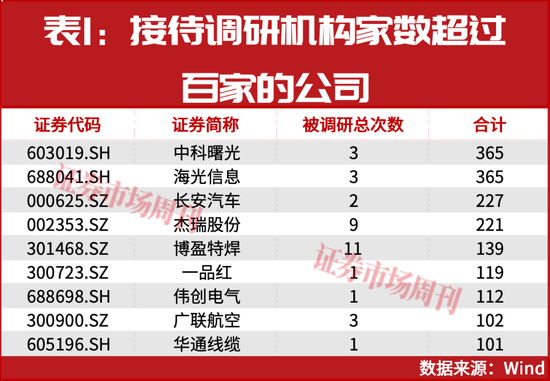
Group 1 - In December, nearly 500 companies have been surveyed by institutional investors, with a strong focus on the technology sector [1][12] - A total of 471 companies in the A-share market have been publicly surveyed by institutional investors since December, with 23 companies receiving over 50 institutional visits and 9 companies over 100 [2][13] - Among the most frequently surveyed companies, Zhongke Shuguang and Haiguang Information attracted the highest attention, with 365 institutions participating in their surveys [3][14] Group 2 - Zhongke Shuguang launched the scaleX Wanka Super Group at the 2025 Photonic Organization AI Innovation Technology Conference, focusing on trillion-parameter large models and scientific intelligence scenarios [4][15] - Jie Rui shares have made significant breakthroughs in the North American market, signing a sales contract for generator sets worth over 100 million USD, marking a key business breakthrough in the high-end power market [4][15] - Companies like Boying Welding and Ice Wheel Environment have organized over 10 survey activities each this month, indicating high interest in gas turbine concepts [5][16] Group 3 - Several companies that received institutional attention have seen significant stock price increases, with Hualing Cable experiencing an 83.61% increase in December [6][17] - Shaanxi Huada's stock surge is linked to its plan to acquire 100% of Huajing Microelectronics, entering the lucrative optical module market [8][18] - High-profile institutions, such as Gao Yi Asset, have conducted surveys on 11 companies this month, including Boying Welding and Jie Rui shares [9][19] Group 4 - The survey of Jie Rui shares revealed the company's commitment to continue deepening its presence in data centers, industrial energy, and new power systems [10][20] - The company has expanded its production capacity in the U.S. to meet the demand for gas turbine generator equipment in North America [10][20] - A focus on humanoid robots and AI vision technology was highlighted during the survey of Aobi Zhongguang, showcasing its competitive edge in the robotics sector [11][21]

F5G概念走强,58位基金经理发生任职变动
Sou Hu Cai Jing· 2025-12-22 08:10
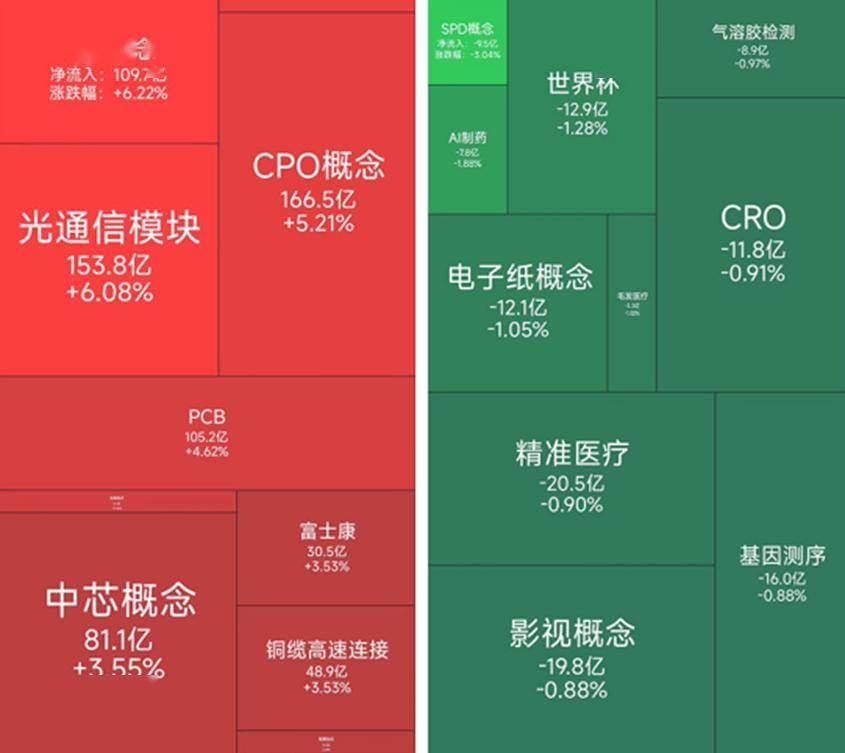
Market Performance - On December 22, A-shares saw a collective increase in the three major indices, with the Shanghai Composite Index rising by 0.69% to 3917.36 points, the Shenzhen Component Index increasing by 1.47% to 13332.73 points, and the ChiNext Index climbing by 2.23% to 3191.98 points [1] Fund Manager Changes - From December 20 to December 22, a total of 58 fund managers experienced changes in their positions, with 652 fund products having manager changes in the past 30 days [3] - The reasons for the changes included 23 fund managers leaving due to job changes, 5 due to product expiration, and 1 for personal reasons [3] - During the same period, 88 fund products announced new fund manager appointments involving 30 fund managers [5] Fund Manager Performance - Zhang Xiaonan, a fund manager at Invesco Great Wall, currently manages assets totaling 30.607 billion yuan, with the highest return product being the Invesco Great Wall Nasdaq Technology ETF, which achieved a return of 134.72% over 2 years and 316 days [4] - Zhang Dazheng, a fund manager at Yingda Fund, manages assets of 12.372 billion yuan, with the highest return product being Yingda Strategy Preferred A, which gained 77.05% over 5 years and 352 days [6] Fund Research Activity - In the past month (November 22 to December 22), Bosera Fund conducted the most company research, engaging with 39 listed companies, followed by Southern Fund, Huaxia Fund, and Huitianfu Fund, which researched 36, 32, and 31 companies respectively [8] - The most researched industry was specialized equipment, with 167 instances, followed by the semiconductor industry with 121 instances [8] Individual Stock Research - The most focused stock by public funds in the last month was Zhongke Shuguang, with 117 fund management companies participating in its research, followed by Haiguang Information and Changan Automobile, each with 117 and 82 participating fund managers respectively [9] - In the last week (December 15 to December 22), Changan Automobile was the most researched company, with 68 fund institutions involved [9]
中科曙光20251221
2025-12-22 01:45
Summary of Zhongke Shuguang Conference Call Company Overview - **Company**: Zhongke Shuguang (中科曙光) - **Product**: SCALE X640 Super Cluster Key Points Industry and Product Features - The SCALE X640 Super Cluster utilizes a 1:4 ratio of CPU to AI chips, with a single cabinet power consumption of approximately 860 kW, employing self-developed HSL interconnection technology and silent phase change liquid cooling technology [2][5] - The system's computing power is twice that of domestic competitors at BF16 precision, compatible with the CUDA ecosystem, featuring 10,240 AI chips and achieving a single cluster computing power of 500 million FLOPS [2][7] - The total HBM bandwidth is 18 PB/s, with a total capacity of 650 TB, inter-chip bandwidth of 4.5 PB/s, and inter-cabinet bandwidth of 500 TB/s, significantly enhancing large model inference and training capabilities [2][7] Technological Advancements - The self-developed Scale Fabric network supports over 100,000 cards, with a performance improvement of 2.33 times and a total cost reduction of 30% compared to traditional IP networks [2][8] - The network features a port speed of 400 Gbps, native RDMA support, and a switching capacity of 2,614 TB, surpassing competitors [8][9] - The system's architecture is compared favorably to NVIDIA and Huawei, with higher power density and advanced cooling technology [6][13] Storage Innovations - The company has optimized storage technology through tight coupling of computing and storage, achieving a 5.5 times increase in data access bandwidth for NVMe nodes [11] - Future plans include launching the next-generation Flash series FN9,000, targeting over 200 million IOPS and providing 10 TB access bandwidth for 100,000 cabinets [12] Market Position and Opportunities - The company’s super cluster capabilities exceed market expectations in scale, core network capability, and storage capacity, positioning it favorably in the context of AI localization and advanced computing trends [13][14] - The current AI development trend presents significant opportunities for Zhongke Shuguang and related ecosystem companies, suggesting continued investor interest [15] Valuation Insights - Potential valuation for Haiguang Information could exceed 2 trillion, with each business segment having a market value potential of 500 billion to 1 trillion [16] - Zhongke Shuguang's valuation model remains unchanged despite the termination of its merger with Haiguang Information, with significant growth potential in its core server business and related technologies [16] Risks - Caution is advised regarding transitional risks following the merger termination, including funding transitions, new product development delays, and intensified market competition [16]
看好市场向上趋势 基金经理为跨年行情做准备
Shang Hai Zheng Quan Bao· 2025-12-21 18:17
Group 1: Market Trends and Investment Opportunities - Recent preparations by professional investors for year-end market trends have been noted, with public funds conducting intensive research on companies such as Zhongke Shuguang, Haiguang Information, Luxshare Precision, Changan Automobile, and others, primarily in the manufacturing sector [1] - Institutions believe that the recent market adjustment will provide better investment opportunities for the upcoming year, with structural market trends making certain underperforming sectors more attractive [1] - Analysts from Penghua Fund and Xingzheng Global Fund express optimism about advanced manufacturing, cyclical stocks, and high-performing non-bank stocks, indicating that the upward market trend remains intact despite short-term fluctuations [1] Group 2: Sector-Specific Insights - The lithium battery industry is expected to maintain high demand due to the growth in electric vehicle sales and unexpected storage needs, leading to improved profitability across the supply chain [2] - The innovative drug sector in Hong Kong remains a focus for institutions, with a positive outlook on the industry’s fundamentals and the ongoing trend of innovative drugs going global, which is expected to enhance the upstream supply chain's performance [2] - The commercial aerospace and satellite industry is transitioning from speculative hype to a fundamentals-driven phase, with investment opportunities emerging across the supply chain, particularly in rocket and satellite manufacturing and related applications [3]



【数智周报】MiniMax和智谱通过港交所聆讯;OpenAI据悉计划以8300亿美元估值筹资至多1000亿美元;寒武纪:拟使用27.78亿元资本公积金弥补亏损
Tai Mei Ti A P P· 2025-12-21 04:23
Group 1 - Elon Musk publicly criticized nuclear fusion power, stating that building small fusion reactors on Earth is economically foolish, as the sun itself is a massive, free fusion reactor capable of meeting all energy needs in the solar system [2] - Musk plans to deploy 100GW of solar-powered AI satellites annually, which is equivalent to about a quarter of the total electricity consumption of the United States [2] Group 2 - Zhongke Shuguang unveiled the scaleX Wanka supercluster at the HAIC2025 conference, marking the first appearance of a domestic 10,000-card AI cluster system in physical form [3] - Unisoc announced the establishment of a Central Research Institute to focus on new architectures and models for edge AI chips, particularly for applications in autonomous driving and robotics [3] Group 3 - Cambricon announced plans to use 2.778 billion yuan of its capital reserve to cover cumulative losses, with the aim of bringing its negative retained earnings to zero by the end of 2024 [4] Group 4 - MiniMax has passed the Hong Kong Stock Exchange hearing and plans to go public in January 2026, potentially becoming the fastest AI company to IPO globally within four years of its establishment [6] - Zhiyuan Technology has officially passed the Hong Kong Stock Exchange IPO hearing, with CICC as the sole sponsor [6] Group 5 - Tencent has established an AI Infra department to enhance its large model research framework, with Vincesyao appointed as the chief AI scientist [6][7] - The AI Infra department will focus on building technical capabilities for large model training and inference platforms [7] Group 6 - ByteDance is advancing a collaboration with Lenovo to develop AI smartphones, aiming to pre-install AIGC plugins to gain user access [8] - Doubao released version 1.8 of its large model, enhancing its capabilities for multi-modal agent scenarios [9] Group 7 - Qianwen APP has integrated with Alibaba's ecosystem, enabling it to access underlying services like Gaode Map for enhanced geographical understanding [10] - Alibaba launched the new generation of the Wanxiang 2.6 model, which supports role-playing functions for video production [11] Group 8 - Baidu launched the Wenxin Health Manager, positioning it as a 24/7 "all-in-one family doctor" service [14] - The application offers a comprehensive AI health service system covering light symptom consultations and complex disease planning [14] Group 9 - Aishi Technology signed a comprehensive cooperation agreement with Alibaba Cloud to enhance global deployment and compliance capabilities for its video generation model [15] - Xiaomi open-sourced its MiMo-V2-Flash model, which boasts competitive capabilities at a significantly lower inference cost compared to closed-source models [16] Group 10 - Muxi Technology officially listed on the Shanghai Stock Exchange's Sci-Tech Innovation Board, aiming to raise 4.197 billion yuan to accelerate the development of "Chinese chips" [17] - The company focuses on high-performance general-purpose GPU products for AI training and inference [17] Group 11 - Meituan released and open-sourced the LongCat-Video-Avatar model, which supports multiple video generation tasks [18] - The model has achieved significant breakthroughs in action realism and video stability [18] Group 12 - Chinese scientists achieved a breakthrough in optical computing chips, enabling large-scale semantic media generation [19][20] - The LightGen chip demonstrates significant improvements in performance and energy efficiency compared to traditional digital chips [20] Group 13 - Baidu's Kunlun chip business is reportedly nearing completion of its restructuring, aiming for a potential listing in Hong Kong [20] - SenseTime's Seko series models have successfully adapted to the domestic AI chip Cambricon [20] Group 14 - Nvidia's CEO revealed that the company has not yet made any payments to OpenAI as part of a planned $100 billion investment [22] - Nvidia launched the Nemotron 3 open-source model series, significantly improving throughput compared to its predecessor [23] Group 15 - OpenAI plans to raise up to $100 billion, potentially valuing the company at $830 billion [24] - The new image model GPT-image-1.5 was launched, enhancing image generation capabilities significantly [25] Group 16 - Intel is in talks to acquire AI chip startup SambaNova for approximately $1.6 billion [30] - Multiple AI companies have recently completed significant funding rounds to support their growth and technology development [31][32][33][34][35][36][37]



海光终止合并中科曙光 国产算力产业协作未歇
Zhong Guo Jing Ying Bao· 2025-12-20 14:31
Core Viewpoint - The merger between Haiguang Information and Zhongke Shuguang has been officially terminated due to the large scale of the transaction, involvement of multiple parties, and significant changes in the market environment since the initial planning phase [1][3][4]. Group 1: Merger Details - The merger was initially announced in late May, with plans for Haiguang Information to acquire Zhongke Shuguang through a share swap, potentially exceeding a transaction scale of 100 billion yuan [3]. - The proposed share swap ratio was set at 0.5525:1, with Haiguang's share price at 143.46 yuan and Zhongke's at 79.26 yuan, leading to a total asset transaction value of 1159.67 billion yuan [3][4]. - Following the announcement, both companies experienced significant stock price increases, with Haiguang reaching a peak of 277.98 yuan and Zhongke hitting 128.12 yuan, resulting in a combined market value exceeding 650 billion yuan [4]. Group 2: Market Environment and Challenges - The termination of the merger is attributed to the complexities of integrating large-scale assets and the rapid technological evolution in the computing power industry, which may have led to missed opportunities [4][5]. - The market environment has changed dramatically, with intensified competition from companies like Huawei and Cambrian, and new policies promoting diverse and heterogeneous computing power integration [5][6]. - The independent growth potential for leading companies in the sector has increased, suggesting that the benefits of merging may not outweigh the need for agility in responding to market demands [6]. Group 3: Future Collaboration and Industry Trends - Despite the merger's termination, both companies are expected to maintain long-term collaborative relationships, focusing on their respective strengths in high-end CPU and DCU chip design [1][7]. - The domestic AI model training and inference market is projected to drive significant demand for accelerated servers, with the market expected to reach approximately 16 billion USD by mid-2025, reflecting over 100% year-on-year growth [2][7]. - The collaboration landscape in the domestic computing power industry is evolving, with companies exploring various cooperative models to build a self-sufficient ecosystem, driven by policy incentives and market demands [7][8].
国产算力迈入“万卡”时代:摩尔线程发布新一代GPU架构,中科曙光发布万卡超集群
Jing Ji Guan Cha Wang· 2025-12-20 06:47
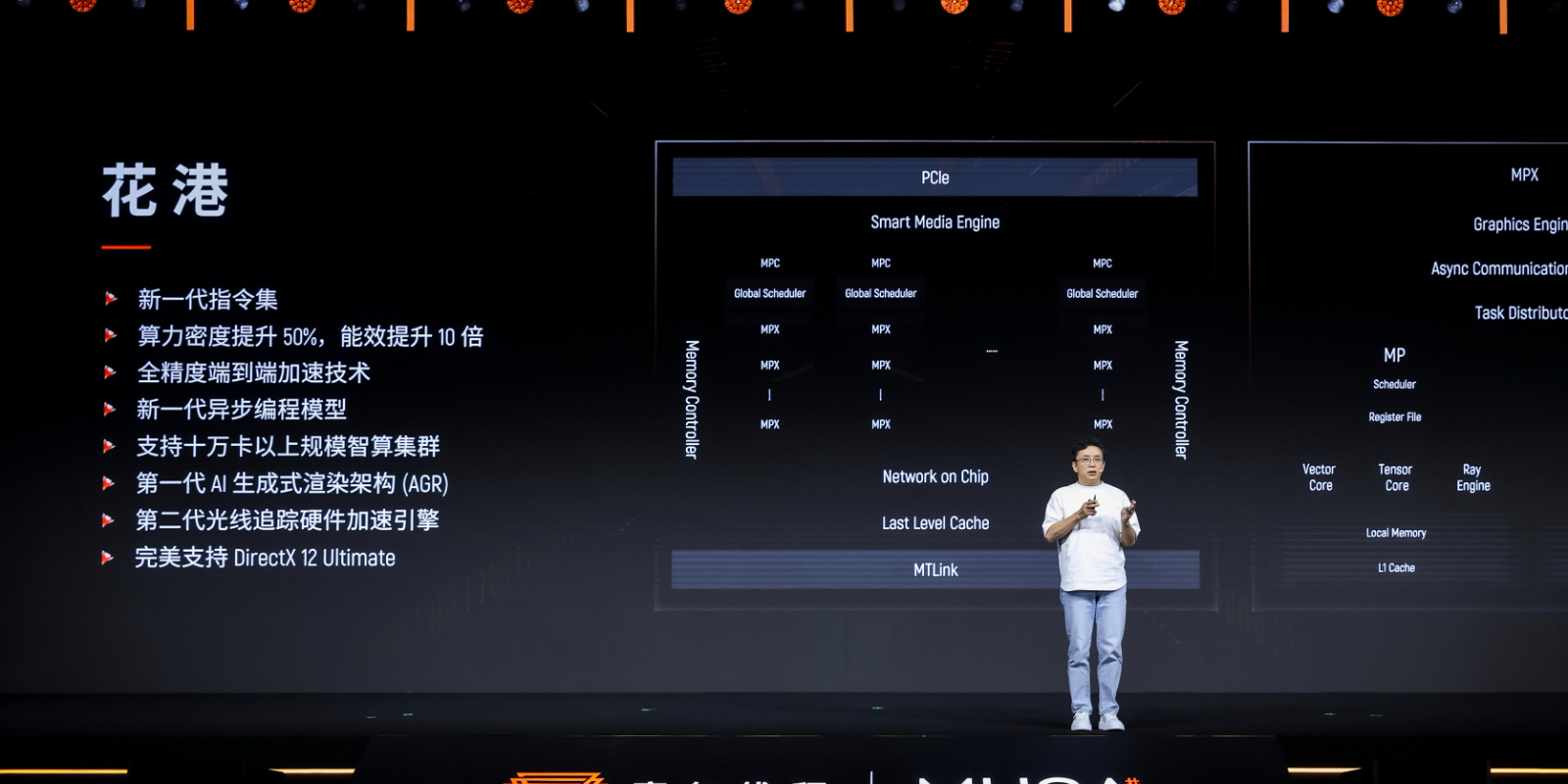
Core Insights - The article discusses the advancements in the domestic GPU industry, highlighting the launch of the "Huagang" architecture by Moore Threads and the "scaleX" supercluster system by Inspur, indicating a shift in focus from individual GPU performance to building scalable systems capable of handling massive computational tasks [2][6]. Group 1: Moore Threads Developments - Moore Threads unveiled its latest "Huagang" architecture, which boasts a 50% increase in computing density and a 10-fold improvement in efficiency compared to the previous generation [3]. - The "Huagang" architecture supports full precision calculations from FP4 to FP64 and introduces new support for MTFP6, MTFP4, and mixed low precision [3]. - Future chip plans include "Huashan," aimed at AI training and inference, and "Lushan," focused on high-performance graphics rendering, with "Lushan" showing a 64-fold increase in AI computing performance and a 50% improvement in ray tracing performance [4]. Group 2: Inspur Developments - Inspur's "scaleX" supercluster system, which publicly debuted, consists of 16 scaleX640 supernodes interconnected via the scaleFabric high-speed network, capable of deploying 10,240 AI accelerator cards [10]. - The scaleX system employs immersion phase change liquid cooling technology to address heat dissipation challenges, achieving a 20-fold increase in computing density per rack and a PUE (Power Usage Effectiveness) of 1.04 [11][12]. - The system supports multi-brand accelerator cards and has optimized compatibility with over 400 mainstream large models, reflecting a strategy to provide a versatile platform for various domestic computing resources [14]. Group 3: Industry Challenges and Solutions - The industry faces challenges in scaling up computational power, particularly in managing heat, power supply, and physical space limitations when deploying thousands of high-power chips in data centers [8][9]. - Both companies are addressing communication delays in distributed computing, with Moore Threads integrating a new asynchronous programming model and self-developed MTLink technology to support clusters exceeding 100,000 cards, while Inspur's scaleFabric network achieves 400 Gb/s bandwidth and sub-microsecond communication latency [12][13]. Group 4: Software Ecosystem and Compatibility - As the hardware specifications approach international standards, the focus is shifting towards optimizing the software stack, with Moore Threads announcing an upgrade to its MUSA unified architecture and achieving over 98% efficiency in core computing libraries [13]. - Inspur emphasizes the compatibility of its systems with various brands of accelerator cards, promoting an open architecture strategy that allows for coexistence of multiple chips [14].