
ECOVACS(603486)

Search documents
CES2026揭示的AI三场变革:从眼镜到机器人、从家庭到工业丨36氪直击CES
3 6 Ke· 2026-01-12 11:04
Core Insights - The CES 2026 event highlighted a significant shift in AI from being merely a tool to becoming a foundational operating system for human life, as articulated by NVIDIA CEO Jensen Huang [3] - AI is transitioning from virtual capabilities to being embedded in physical and tangible life scenarios, impacting various sectors including information interaction, home life, transportation, and industrial systems [3][5] - The year 2026 is marked as a pivotal year for AI technology integration and industrialization, with a focus on practical applications in real-world scenarios [5][6] AI in Consumer Electronics - The emergence of smart glasses is seen as a potential replacement for smartphones, with over 50 companies showcasing AI and AR glasses at CES 2026 [7][8] - Companies like Rokid and INMO are leading the charge in lightweight, multifunctional AI glasses, with Rokid's AI glasses weighing only 49 grams and featuring various capabilities such as real-time translation and navigation [9][12] - The global smart glasses market is expected to experience explosive growth, with predictions indicating a significant uptick in 2026, particularly in China [8] AI in Daily Life - AI is increasingly integrated into daily life, with innovations such as Elon Musk's brain-machine interface and products like LumiMind's sleep regulation device aimed at addressing sleep disorders [4][20] - Companies are developing advanced cleaning robots that can navigate complex environments, indicating a shift from simple cleaning tools to multifunctional household assistants [15][17] - The introduction of AI-powered personal assistants, such as LOONA DeskMate, aims to enhance productivity in work environments by seamlessly integrating AI into daily tasks [24][26] AI in Transportation and Industry - AI is reshaping the transportation and industrial sectors, with companies like Black Sesame showcasing advanced driver assistance systems and AI chips designed for autonomous vehicles [30][32] - The development of automated charging solutions and intelligent inspection robots indicates a move towards more integrated and efficient industrial operations [35][36] - The focus on AI's role in energy management and sustainability is becoming increasingly relevant, with innovations aimed at addressing the energy demands of AI technologies [36][38] Conclusion - The CES 2026 event illustrates a comprehensive transformation in lifestyle driven by AI, affecting various aspects from consumer electronics to industrial applications, with significant contributions from Chinese technology companies [34]



CES2026揭示的AI三场变革:从眼镜到机器人、从家庭到工业丨36氪直击CES
36氪· 2026-01-12 09:30
Core Insights - The article emphasizes that AI is transitioning from being merely a tool to becoming the "underlying operating system" of human life, as highlighted by NVIDIA CEO Jensen Huang at CES 2026 [3][4] - The event showcased a clear trend of AI embedding itself into physical reality and daily life, with significant advancements in AI chip performance expected in the coming years [4][6] Group 1: AI in Daily Life - AI is becoming ubiquitous, with a notable shift in information interaction methods, particularly through the rise of smart glasses, which are predicted to replace smartphones as the primary information access point [5][10] - Over 50 companies showcased AI and AR glasses, indicating a strong market growth, with predictions of a significant increase in the global smart glasses market by 2025 [10][11] - Chinese companies are leading the charge in the smart glasses market, with products like Rokid's AI glasses and INMO's offerings demonstrating advanced features and lightweight designs [12][15] Group 2: AI in Home and Industrial Applications - AI is increasingly integrated into home cleaning and organization, with advancements in robotic vacuum cleaners and other smart home devices that enhance user experience [18][21] - Companies like Ecovacs and Yunzhijia are pushing the boundaries of home cleaning technology, evolving from simple cleaning tools to comprehensive home management systems [18][21] - In industrial applications, AI is transforming operations, with companies like Black Sesame Technology showcasing advanced driver assistance systems and smart robotics that enhance automation and efficiency [38][41] Group 3: AI in Health and Work - AI is also making strides in health and wellness, with products like LumiMind's LumiSleep aimed at addressing sleep disorders through innovative brainwave monitoring technology [25][28] - The introduction of personal assistant robots, such as LOONA DeskMate, highlights the growing demand for AI in workplace settings, focusing on enhancing productivity and emotional well-being [29][31] - The CES 2026 event illustrates a shift towards AI systems that not only assist but also understand and adapt to human needs in various contexts [31][32] Group 4: Future Outlook - The article suggests that the next decade will see a significant transformation in consumer electronics due to AI, impacting various sectors including automotive, home appliances, and industrial systems [7][36] - The integration of AI into everyday life is expected to redefine how humans interact with technology, moving towards a more seamless and intuitive experience [43][48] - The participation of Chinese tech companies at CES indicates a collaborative future in technology development, moving beyond national narratives to a more global perspective [48][49]

科沃斯亮相CES2026 正式发布品牌新主张
Ren Min Wang· 2026-01-12 09:27
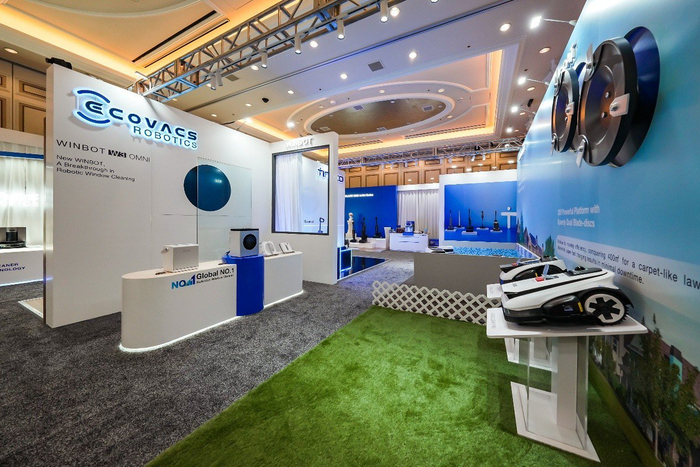
Core Insights - The core message of ECOVACS at CES 2026 is the introduction of a new brand proposition "ECOVACS Created for Ease," emphasizing the transformation of robots from mere tools to intelligent household assistants that enhance user experience and simplify daily life [1][2]. Group 1: Product Innovations - ECOVACS showcased a comprehensive range of innovative products for both indoor and outdoor cleaning, highlighting the new window cleaning robot, W3, which addresses safety concerns in high-altitude operations and aims for a maintenance-free user experience [1][2]. - The company introduced the floor cleaning robots, Deebot X12 and T90 series, featuring OZMO ROLLER 3.0 technology, reinforcing its stronghold in indoor cleaning while outlining a vision for a complete "home robot ecosystem" [3]. Group 2: Strategic Shift - The new brand philosophy reflects a strategic shift from a technology-driven approach to one centered on user value, indicating a transition towards a comprehensive service ecosystem rather than focusing solely on product functionality [2]. - ECOVACS is committed to maintaining rational pricing based on production cost reductions, leveraging smart factories and a mature supply chain to build sustainable competitive advantages beyond just pricing [3]. Group 3: Future Directions - The company is actively exploring embodied intelligence, as demonstrated by the introduction of the pet companion robot, LilMilo, which combines multimodal perception with pet-like behaviors, indicating new possibilities in human-robot interaction [3].
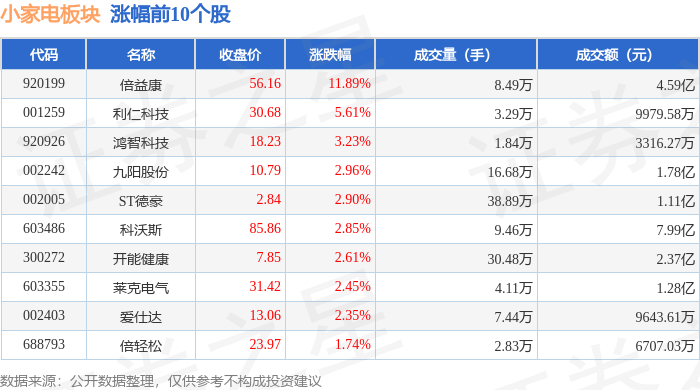
小家电板块1月12日涨0.96%,倍益康领涨,主力资金净流入2900.87万元
Zheng Xing Xing Ye Ri Bao· 2026-01-12 09:04
Market Performance - The small home appliance sector increased by 0.96% on January 12, with BeiYikang leading the gains [1] - The Shanghai Composite Index closed at 4165.29, up 1.09%, while the Shenzhen Component Index closed at 14366.91, up 1.75% [1] Stock Performance - BeiYikang (code: 6610Z6) closed at 56.16, rising by 11.89% with a trading volume of 84,900 shares and a transaction value of 459 million yuan [1] - LiRen Technology (code: 001259) closed at 30.68, up 5.61%, with a trading volume of 32,900 shares and a transaction value of 99.8 million yuan [1] - Other notable performers include JiZhi Technology (code: 920926) with a 3.23% increase, and JiuYang Co. (code: 002242) with a 2.96% increase [1] Capital Flow - The small home appliance sector saw a net inflow of 29.01 million yuan from main funds, while retail investors experienced a net outflow of 22.02 million yuan [2] - Main funds showed significant interest in BeiYikang, with a net inflow of 28.40 million yuan, representing 6.19% of its trading volume [3] - Stone Technology (code: 688169) experienced a net outflow of 1.08 billion yuan from retail investors, indicating a negative sentiment among smaller investors [3]


科沃斯股价连续3天上涨累计涨幅5.9%,财通证券资管旗下1只基金持1500股,浮盈赚取7170元
Xin Lang Cai Jing· 2026-01-12 07:52
Group 1 - The core point of the news is that Ecovacs Robotics has seen a stock price increase of 2.85% on January 12, reaching 85.86 CNY per share, with a total market capitalization of 49.706 billion CNY and a trading volume of 799 million CNY, marking a cumulative increase of 5.9% over three consecutive days [1] - Ecovacs Robotics, established on March 11, 1998, and listed on May 28, 2018, specializes in the research, design, production, and sales of various household service robots and smart home appliances, with service robots contributing 55.89% and smart living appliances 42.96% to its revenue [1] Group 2 - From the perspective of fund holdings, one fund under Caitong Securities Asset Management has a significant position in Ecovacs, with Caitong Zichan Xinrui Mixed A (004900) holding 1,500 shares, representing 0.86% of the fund's net value, making it the third-largest holding [2] - The fund has generated a floating profit of approximately 3,570 CNY today and 7,170 CNY during the three-day price increase period [2] - Caitong Zichan Xinrui Mixed A (004900) was established on December 6, 2017, with a current scale of 7.5953 million CNY, yielding 1.43% year-to-date and 10.57% over the past year [2]

科沃斯股价连续3天上涨累计涨幅5.9%,富荣基金旗下1只基金持2800股,浮盈赚取1.34万元
Xin Lang Cai Jing· 2026-01-12 07:48
Group 1 - The core viewpoint of the news is that Ecovacs Robotics has seen a significant increase in its stock price, rising 2.85% to 85.86 CNY per share, with a total market capitalization of 49.706 billion CNY and a cumulative increase of 5.9% over three days [1] - Ecovacs Robotics, established on March 11, 1998, and listed on May 28, 2018, specializes in the research, design, production, and sales of various household service robots and smart home appliances, with service robots contributing 55.89% and smart living appliances 42.96% to its revenue [1] - The trading volume for Ecovacs on the reporting day was 799 million CNY, with a turnover rate of 1.65% [1] Group 2 - From the perspective of fund holdings, the Fuyong Value Selection Mixed A Fund (006109) has a significant position in Ecovacs, holding 2,800 shares, which accounts for 0.59% of the fund's net value, ranking it as the fifth-largest holding [2] - The Fuyong Value Selection Mixed A Fund has generated a floating profit of approximately 6,664 CNY on the reporting day, with a total floating profit of 13,400 CNY during the three-day increase [2] - The fund was established on August 10, 2018, with a current size of 11.4196 million CNY, and has reported a year-to-date return of 2.51% and a one-year return of 3.89% [2]
CES-2026-扫地割草机器人篇-具身智能引领家庭消费机器人新方向
2026-01-12 01:41
Summary of Key Points from the Conference Call Industry Overview - The conference call discusses advancements in the home robotics industry, particularly focusing on vacuum and lawn mowing robots showcased at CES 2026. [1][2] Key Companies Mentioned - **Stone Technology (石头科技)**: Introduced the G Rover, a stair-climbing vacuum cleaner with a unique wheeled leg structure. - **Dreame (追觅)**: Launched the Cyber X, a bionic track-based stair-climbing vacuum. - **Mova**: Presented the Pilot 70, a flying module for cross-floor cleaning. - **Ecovacs (科沃斯)**: Showcased the X12 vacuum with advanced cleaning features and the GOAT series integrating lawn mowing with edge trimming. - **9号 (9号)**: Introduced the H2 lawn mower with advanced navigation technology. Core Insights and Arguments - **Technological Advancements**: The G Rover's design allows it to handle complex environments effectively, outperforming competitors like Cyber X and Mova in usability and versatility. [2][3] - **Market Potential**: The lawn mowing robot market in North America has low penetration, under 2%, but CES 2026 provided opportunities for brands to enhance their offerings with advanced technologies like LiDAR and all-wheel drive systems. [5][6] - **Sales Projections**: For 2026, Stone Technology is expected to generate revenue of 23 billion RMB with a net profit of approximately 2.4 billion RMB, while Ecovacs is projected to achieve 23.5 billion RMB in revenue and a net profit of around 2.35 billion RMB. Both companies have a price-to-earnings ratio of under 20. [2][14] Innovations in Cleaning Technology - **Vacuum Robots**: Innovations include the use of infrared stain detectors and high-pressure nozzles for deep cleaning (Ecovacs X12) and dual RGB cameras for object recognition (Yunzhihui Flow 2). [4] - **Lawn Mowing Robots**: Key innovations involve multi-sensor fusion navigation, all-wheel drive systems, and edge mowing optimizations, enhancing adaptability to various terrains. [7] Market Dynamics - **Domestic Market Outlook**: The domestic vacuum cleaner market is expected to benefit from potential subsidies for smart home products, alleviating concerns about sales. [9] - **International Market Growth**: Leading companies are anticipated to maintain rapid growth due to market expansion in Europe and Asia, alongside the exit of iRobot from the U.S. market, which opens up additional market share. [9] Strategic Differences Between Companies - **Stone Technology vs. Ecovacs**: Stone Technology aims to reduce costs through the introduction of roller products while maintaining a diverse product matrix. Ecovacs focuses on leveraging roller products to enhance its overseas market presence. [10] Profit Margin Expectations - **Profitability Trends**: Both companies are expected to see their domestic vacuum cleaner profit margins converge, with Ecovacs focusing on domestic profitability and Stone Technology stabilizing its overseas profit margins above 20%. [11][12] Future Growth Areas - **Washing Machines and Lawn Mowers**: Stone Technology's washing machine segment is expected to grow rapidly, while Ecovacs is positioned for significant growth in the lawn mowing sector due to its established channels and new products. [13] Valuation Insights - **Market Valuation**: The market has a clearer understanding of Ecovacs' valuation, while Stone Technology's advancements in embodied intelligence have not yet been fully reflected in its valuation, indicating potential for upward adjustment post-CES. [14]

中国扫地机器人正在成为全球消费者的热门选择
Yang Shi Wang· 2026-01-12 01:29
Core Insights - Chinese robotic vacuum cleaners are becoming a popular choice among global consumers, particularly in Europe and Southeast Asia [1][2] Group 1: Market Presence - In Germany, Chinese brands like Roborock and Dreame occupy prominent positions in the robotic vacuum cleaner section, with prices ranging from €200 to €2000 [1] - In Western Europe, over 60% of robotic vacuum cleaners sold are from China, while in Southeast Asia, the market share increased from 38.8% in 2024 to 64.1% [1] Group 2: Sales Performance - According to IDC, the global shipment of smart robotic vacuum cleaners reached 17.424 million units in the first three quarters of 2025, marking an 18.7% year-on-year growth [2] - Chinese brands, including Roborock, Ecovacs, Dreame, Xiaomi, and Yunji, dominate the global market, collectively holding nearly 70% of the market share [2] Group 3: Competitive Advantage - The strong performance of Chinese brands is attributed to their robust supply chain advantages and superior innovation capabilities, allowing them to lead in technology iterations by one to two generations compared to overseas markets [2]

科沃斯机器人股份有限公司关于变更办公地址、联系电话及传真的公告
Shang Hai Zheng Quan Bao· 2026-01-11 18:54
Group 1 - The company has relocated its office due to business development needs [1] - The new office address is 518 Songwei Road, Wusongjiang Industrial Park, Guoxiang Street, Wuzhong District, Suzhou, with postal code 215124 [2] - The company's contact telephone number is 0512-83880000-2 and the fax number is 0512-83880001 [2] Group 2 - The company's email and website remain unchanged [1]
科沃斯:关于变更办公地址、联系电话及传真的公告
Zheng Quan Ri Bao Zhi Sheng· 2026-01-11 13:05
Group 1 - The company, Ecovacs, announced its relocation to a new address in Suzhou, specifically to Wuzhong District, Guoxiang Street, Wusongjiang Industrial Park, at 518 Songwei Road, postal code 215124 [1] - The contact information for investors remains unchanged, including the phone number, fax number, email, and website [1]