GigaDevice(603986)

Search documents
A股公司赴港上市热情持续
Jing Ji Ri Bao· 2026-01-18 21:56
Core Viewpoint - The enthusiasm for "A+H" listings is increasing, with several A-share companies planning to issue H-shares and list on the Hong Kong Stock Exchange, driven by supportive policies and regulatory improvements [1][2]. Group 1: Market Trends - Companies such as Jucheng Co., Zhengtai Electric, and Penghui Energy are actively planning to issue H-shares and list on the Hong Kong Stock Exchange [1]. - The first "A+H" company to list in 2026 was Haowei Group, followed by Zhaoyi Innovation, indicating a growing trend of dual listings [1]. - The China Securities Regulatory Commission (CSRC) has released measures to support leading domestic companies in listing in Hong Kong, enhancing the development of A-share companies [1]. Group 2: Regulatory Environment - The collaboration between regulatory bodies in both regions has improved the efficiency of the listing application process for A-share companies, creating a more favorable environment for listings [2]. - The Hong Kong Securities and Futures Commission and the Hong Kong Stock Exchange have optimized the approval process for new listings, further facilitating A-share companies' access to the market [1][2]. Group 3: Strategic Motivations - Companies are motivated to list in Hong Kong to enhance their global strategy, improve international competitiveness, and create platforms for overseas capital operations [2][3]. - The sectors represented by companies planning to list include high-end electronics, new energy, artificial intelligence, and smart transportation, often featuring industry leaders or technology-driven firms [3]. - The "A+H" model serves not only as a financing tool but also as a strategic configuration that allows companies to mitigate market risks and advance their internationalization efforts [3].


国产存储龙头纷纷创新高,资金交易从“涨价”迈向“技术成长”逻辑
Di Yi Cai Jing· 2026-01-18 08:45
Core Insights - The global storage industry is undergoing a profound transformation driven by AI technology and a supply crisis, with DRAM contract prices expected to rise by 58% in Q1 2026, particularly for server and mobile DRAM, which may exceed 60% [1][2] - This shortage is characterized as a "structural supply-demand imbalance," with Micron's executives indicating that the shortage may not ease until 2028 [1][2] - The current price surge is attributed to the explosive growth in AI models and inference scenarios, with AI data center storage demand now accounting for 50%-60% of the market [3] Supply and Demand Dynamics - The supply-demand gap in the storage chip market is worsening faster than expected, with Micron's VP stating that the shortage will persist until at least 2028 [2] - UBS and JPMorgan have expressed a consensus that storage chip prices will continue to rise, with predictions for DDR contract prices increasing by 58% and NAND flash by 27% in Q1 2026 [2] - The supply chain is facing challenges, as traditional storage products are experiencing shortages, leading major suppliers like Samsung and SK Hynix to plan significant price increases [2] Market Reactions and Valuation Adjustments - The A-share market has seen significant trading activity in storage stocks, with companies like Biwei Storage, Zhaoyi Innovation, and Jiangbolong reaching new highs, indicating a systematic re-evaluation of the storage industry's valuation logic [1][4] - Investors are focusing on the dual aspects of price increases and technological advancements, which are reshaping the valuation of A-share storage-related companies [4][5] Company Strategies and Growth Projections - Micron is planning to expand its DRAM production through an $1.8 billion acquisition of a facility in Taiwan, which is expected to significantly increase DRAM wafer output starting in H2 2027 [3] - Biwei Storage has projected record revenue and net profit for 2025, with expected revenue between 10 billion to 12 billion yuan, reflecting a year-on-year growth of 49.36% to 79.23% [5][6] - The current price increase is driven by structural demand from AI applications, which is expected to provide a "growth premium" to storage companies, enhancing revenue visibility and sustainability [6]

明星公司扎堆上演上市“双城记” AH溢价指数小幅波动估值差距收窄
Zheng Quan Shi Bao· 2026-01-16 20:09
Group 1 - Recent star companies in technology, consumer, and high-end manufacturing sectors are driving market momentum, enhancing the linkage between capital markets in both regions [1] - Notable A-share companies are making significant progress in their listings in Hong Kong, including Longqi Technology, which is currently in the process of going public and has attracted investments from major institutions [2] - Dongpeng Beverage has successfully passed the listing hearing in Hong Kong and has maintained a leading market share in China's functional beverage market, increasing from 15% in 2021 to 26.3% in 2024 [2] Group 2 - The AH premium index has shown slight fluctuations, reflecting a recent increase in A-share performance compared to H-shares, with the index reported at 120.43 points as of January 16, up from 115.44 points at the end of the previous year [6] - The recent trend of A-share companies listing in Hong Kong has led to a decrease in the AH premium index, as high-quality A-share companies enhance liquidity in the Hong Kong market [6] - Currently, there are 37 companies with an AH premium exceeding 100%, with Zhejiang Shibao leading at a premium rate of 360.30% [7] Group 3 - Multiple factors are contributing to the current trend of A-share companies listing in Hong Kong, including a stronger A-share market driven by high-tech sectors, while the Hong Kong market remains influenced by traditional sectors [8] - The liquidity situation in the A-share market, supported by long-term capital allocations and individual investors leveraging, contrasts with the Hong Kong market, which is affected by external risk preferences [8] - The Hong Kong IPO market is expected to remain active in 2026, with a significant number of companies in the pipeline, including 105 A-share projects [9]



A股成交额重回3万亿元电网设备板块多股涨停
Shang Hai Zheng Quan Bao· 2026-01-16 18:34
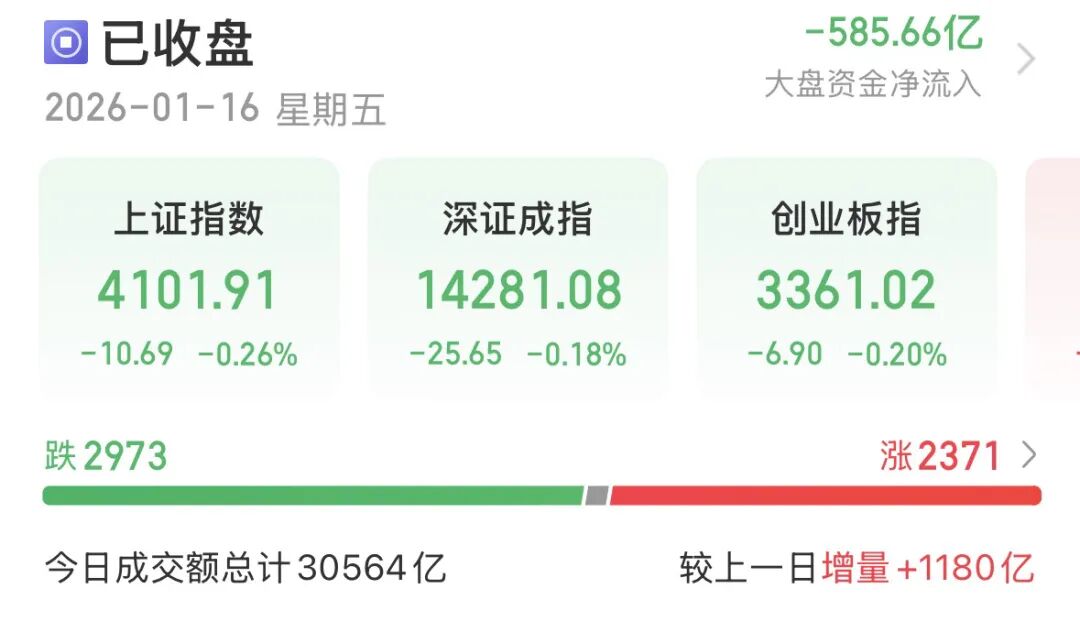
Group 1 - A-share market trading volume has returned to over 30 trillion yuan, with the Shanghai Composite Index closing at 4101.91 points, down 0.26% [1] - The semiconductor industry chain remains active, with stocks like Tianyue Advanced and Yongxi Electronics hitting the daily limit of 20% [1] - The electric grid equipment sector saw significant gains, with multiple stocks including Electric Power Research Institute and Senyuan Electric reaching their daily limit [1][2] Group 2 - The electric grid equipment sector is driven by supply-demand dynamics, with the State Grid Corporation announcing a planned investment of 4 trillion yuan during the 14th Five-Year Plan, a 40% increase from the previous plan [2] - The overseas market for electric grid investments is expected to accelerate, with supply shortages leading to extended delivery times for transformers and high-voltage cables [2] - The storage chip sector is experiencing strong performance, with companies like Baiwei Storage and Jibang Long hitting daily limits, driven by increased demand from AI and server capacity [4] Group 3 - Research indicates that the storage market is surpassing historical highs, with prices expected to rise by 40% to 50% in Q1 2026 and an additional 20% in Q2 [4] - The A-share market is anticipated to maintain a steady upward trend, supported by factors such as improved profitability and capital market reforms [5] - Investment strategies for 2026 suggest a balanced approach, focusing on high-yield opportunities, technology growth driven by AI, and cyclical recovery investments [6]


半导体大涨,下周A股怎么走?
Guo Ji Jin Rong Bao· 2026-01-16 15:54
Core Viewpoint - The A-share market experienced moderate fluctuations with a total trading volume returning to over 3 trillion yuan, indicating a shift in capital from popular sectors like AI applications and communications to storage chips, automotive chips, and robotics actuators [1][4][6]. Market Performance - The Shanghai Composite Index fell by 0.26% to 4101.91 points, while the ChiNext Index decreased by 0.2% to 3361.02 points, and the Shenzhen Component Index dropped by 0.18% [6]. - The total trading volume across the three markets reached 3.06 trillion yuan, with margin trading balances increasing to 2.72 trillion yuan as of January 15 [6][16]. Sector Performance - The storage chip sector rose by 5.54%, third-generation semiconductors by 3.88%, automotive chips by 4.94%, and robotics actuators by 4.26% [8]. - In contrast, sectors such as media and computing saw significant declines, with media down by 4.84% and computing by 2.23% [9]. Capital Flow and Investment Strategy - Capital is being reallocated due to regulatory measures aimed at risk prevention and monetary policies supporting liquidity, leading to a diversified market structure [4][16]. - Investment strategies should focus on policy guidance, performance support, and valuation matching, particularly in sectors benefiting from domestic substitution and global chip technology breakthroughs [4][22]. Future Market Outlook - The market is expected to continue its oscillation around the 4100-point mark, with potential for structural opportunities in policy-supported sectors and high-performing stocks [19][20]. - Analysts suggest maintaining a neutral position while avoiding high-volatility stocks and focusing on sectors with strong fundamentals [19][22].


ETF复盘资讯|沪指险守4100点!半导体逆市狂飙,电子ETF翘尾收涨2.7%!AI应用概念股全线回调,159363回踩5日线
Sou Hu Cai Jing· 2026-01-16 13:53
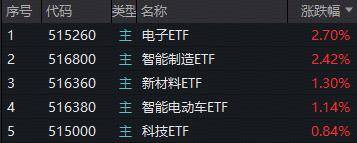
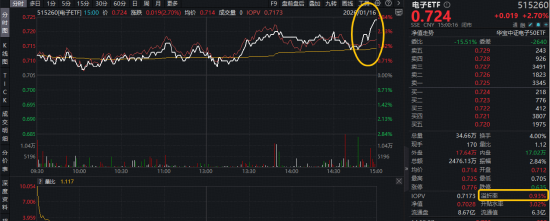
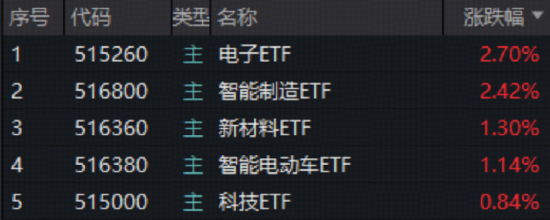
Core Viewpoint - The A-share market experienced a slight pullback on January 16, with the Shanghai Composite Index barely holding above the 4100-point mark, while the electronic sector showed resilience, leading gains in the market [1][4]. Market Performance - The Shanghai Composite Index closed down 0.26% at 4101.91 points, the Shenzhen Component Index fell 0.18%, and the ChiNext Index decreased by 0.20% [1]. - The total trading volume in the Shanghai, Shenzhen, and Beijing markets reached 30,568 billion yuan, an increase of 1,180 billion yuan compared to the previous day [1]. Sector Highlights - The electronic sector was the standout performer, with the electronic ETF (515260) rising by 2.7%, and the smart manufacturing ETF (516800) increasing by 2.42% [1][2]. - The new materials and new energy sectors also saw some individual stocks perform well, with the new materials ETF (516360) and the smart electric vehicle ETF (516380) both gaining over 1% [1]. Downward Trends - The AI medical concept continued to cool off, with the largest medical ETF (512170) dropping by 2.6% [1]. - AI application stocks experienced a broad pullback, with the ChiNext AI ETF (159363) declining by 1.81% [1]. Capital Inflows - The electronic sector attracted a net inflow of 30.511 billion yuan, leading all 31 first-level industries in terms of capital absorption [8]. - Key stocks within the electronic ETF, such as Zhaoyi Innovation and Changdian Technology, attracted significant capital inflows of 4.538 billion yuan and 3.181 billion yuan, respectively [8][9]. Policy Support - The central bank implemented a series of measures to support high-quality economic development, including a 0.25 percentage point reduction in re-lending and rediscount rates, and an increase in the re-lending quota for small and medium-sized enterprises by 500 billion yuan [2][3]. Future Outlook - Analysts predict that A-shares may see considerable incremental capital by 2026, potentially sustaining a slow bull market [3]. - The focus is expected to shift towards verifying economic conditions and performance, with active funds reinforcing a dual-line strategy of "technology + resource products" [3].



台积电业绩远超预期!半导体逆市狂飙,电子ETF(515260)翘尾收涨2.7%,尾盘溢价飙升!兆易创新等4股涨停
Xin Lang Ji Jin· 2026-01-16 11:27
Core Viewpoint - The electronic sector is leading the A-share market, with the electronic ETF (515260) showing strong performance, closing up 2.7% and achieving a premium rate of 0.93% at the end of the trading day, indicating strong buying interest [1] Group 1: Market Performance - The electronic sector received a net inflow of 30.511 billion, ranking first among all 31 Shenwan primary industries [2][3] - Major stocks in the electronic ETF, including Zhaoyi Innovation and Changdian Technology, attracted 4.538 billion and 3.181 billion respectively, topping the A-share inflow rankings [2][3] - Semiconductor leaders such as Changdian Technology, Zhaoyi Innovation, and Tongfu Microelectronics hit the daily limit, while Huazhong Microelectronics rose over 13% [4] Group 2: Industry Trends - TSMC's recent earnings report for Q4 2025 exceeded expectations, marking the seventh consecutive quarter of double-digit growth, and raised its 2026 capital expenditure guidance to 52-56 billion USD, reflecting strong and sustainable demand in the AI industry chain [5] - The U.S. government's recent imposition of a 25% tariff on specific semiconductors may create a stronger "accelerated replacement" window for domestic equipment amid increasing supply chain uncertainties [5] - The trend of "self-control and AI resonance" is expected to strengthen further in 2026, with a focus on domestic computing power and semiconductor equipment [5] Group 3: Investment Tools - The electronic ETF (515260) and its linked funds are designed to passively track the electronic 50 index, heavily investing in semiconductor and consumer electronics sectors, including AI chips, automotive electronics, and PCB [5] - The ETF serves as an efficient tool for investors to gain exposure to core assets in the electronic sector [5]
沪指险守4100点!半导体逆市狂飙,电子ETF翘尾收涨2.7%!AI应用概念股全线回调,159363回踩5日线
Xin Lang Cai Jing· 2026-01-16 11:24
Market Overview - The three major A-share indices experienced slight declines on January 16, with the Shanghai Composite Index closing at 4101.91 points, down 0.26% [1][22] - The total trading volume in the Shanghai, Shenzhen, and Beijing markets reached 30,568 billion yuan, an increase of 1,180 billion yuan compared to the previous day [1][22] Sector Performance - The electronic sector led the market, with the Electronic ETF (515260) rising by 2.7%, marking three consecutive days of gains [3][24] - The Intelligent Manufacturing ETF (516800) also performed well, closing up 2.42% [1][22] - The New Materials ETF (516360) and the Intelligent Electric Vehicle ETF (516380) both saw gains of over 1% [1][22] Notable Stocks - Semiconductor leaders such as Longji Technology, Zhaoyi Innovation, and Tongfu Microelectronics hit the daily limit, while Huazhong Microelectronics rose over 13% [5][26] - The largest medical ETF (512170) fell by 2.6%, indicating a cooling trend in AI medical concepts [1][22] Monetary Policy Impact - The central bank implemented a series of measures to support high-quality economic development, including a 0.25 percentage point reduction in re-lending and rediscount rates, and an increase of 500 billion yuan in re-lending for small and micro enterprises [2][23] - Analysts expect these measures to enhance market stability and support the "14th Five-Year Plan" [2][23] Future Outlook - CITIC Securities anticipates a significant influx of capital into A-shares by 2026, potentially sustaining a slow bull market [2][23] - The focus will shift towards verifying economic conditions and performance, with active funds likely to strengthen the "technology + resource" dual-line market [2][23] ETF Insights - The Electronic ETF (515260) and its linked funds are designed to track the electronic 50 index, heavily investing in semiconductor and consumer electronics sectors [29] - The Hong Kong Information Technology ETF (159131), which focuses on the Hong Kong chip industry, closed up 0.31% despite overall market weakness [10][31] Investment Themes - The "Physical AI Year" is emerging, with significant investment opportunities in AI data centers and related technologies expected to drive growth in 2026 [33][34] - The valuation of the Hong Kong chip ETF is considered attractive compared to other major tech indices, indicating potential for future gains [34]
存储芯片概念上涨4.08%,43股主力资金净流入超亿元
Zheng Quan Shi Bao Wang· 2026-01-16 10:04
Core Viewpoint - The storage chip sector has seen a significant increase, with a rise of 4.08% on January 16, leading the concept sectors in terms of growth, driven by strong performances from several stocks [1][2]. Group 1: Sector Performance - The storage chip concept led the market with a 4.08% increase, while other sectors like Sora concept and advanced packaging saw declines of -4.67% and -4.34% respectively [2]. - Within the storage chip sector, 145 stocks experienced gains, with notable performers including Jin Sun (20% increase), Yingxin Development (10.16%), and Baicheng Co. (10.02%) [1][3]. Group 2: Capital Inflow - The storage chip sector attracted a net inflow of 16.514 billion yuan, with 116 stocks receiving net inflows, and 43 stocks exceeding 1 billion yuan in net inflow [2]. - The top stock for net capital inflow was Zhaoyi Innovation, with an inflow of 2.480 billion yuan, followed by Changdian Technology and Tongfu Microelectronics with inflows of 2.413 billion yuan and 1.418 billion yuan respectively [2]. Group 3: Stock Performance - Stocks with the highest net inflow ratios included Yingxin Development (30.62%), Changdian Technology (25.98%), and Baicheng Co. (20.63%) [3]. - Notable stock performances included Zhaoyi Innovation and Changdian Technology, both achieving a 10% increase, while other stocks like Yingxin Development and Baicheng Co. also showed strong gains [3][4].

电子行业资金流入榜:兆易创新、长电科技等净流入资金居前
Zheng Quan Shi Bao Wang· 2026-01-16 09:49
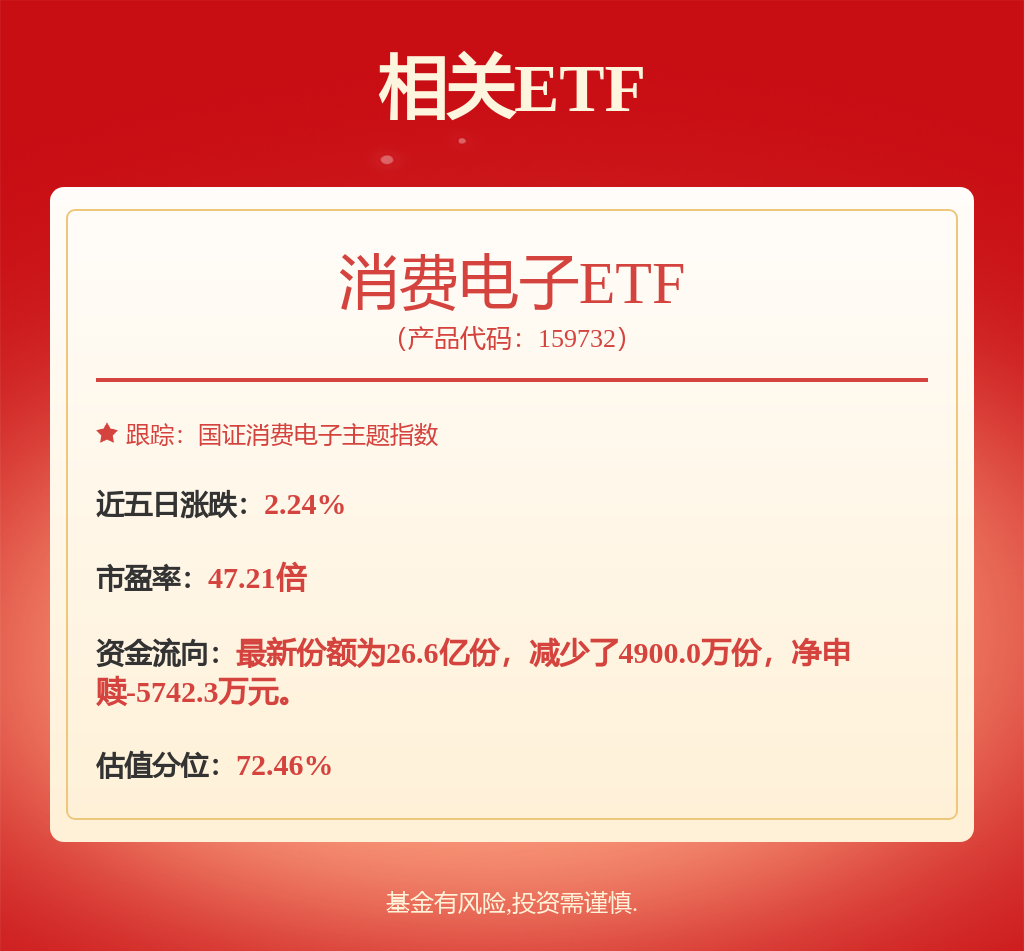
Market Overview - The Shanghai Composite Index fell by 0.26% on January 16, with 7 out of the 28 sectors rising, led by the electronics and automotive sectors, which increased by 2.64% and 1.69% respectively [1] Electronics Sector Performance - The electronics sector saw a rise of 2.64%, with a net inflow of 23.701 billion yuan in main funds. Out of 476 stocks in this sector, 381 stocks rose, with 10 hitting the daily limit, while 88 stocks declined [1] - The top three stocks with the highest net inflow were: - Zhaoyi Innovation: 2.480 billion yuan - Changdian Technology: 2.413 billion yuan - Industrial Fulian: 2.025 billion yuan [1] Electronics Sector Fund Outflow - The electronics sector also experienced significant fund outflows, with the following stocks seeing the largest net outflows: - Shenghong Technology: -729 million yuan - Unisoc: -649 million yuan - Nanda Optoelectronics: -449 million yuan [2] ETF Information - The Consumer Electronics ETF (Product Code: 159732) tracks the Guozheng Consumer Electronics Theme Index and has seen a 5-day change of 2.24%. The current P/E ratio is 47.21 times, with a recent reduction of 49 million shares, resulting in a net redemption of 57.423 million yuan [4]