
VeriSilicon(688521)

Search documents
科创50增强ETF(588460)涨超3.5%,AI驱动存储超级周期提振板块情绪
Xin Lang Cai Jing· 2026-01-14 03:52
Group 1 - Domestic wafer fabs are experiencing a recovery in capacity utilization and a strong willingness to expand production, driven by AI, which is expected to lead to a super cycle in storage [1] - The semiconductor equipment demand is anticipated to rise due to increased domestic production rates and the push for self-sufficiency in logic chips [1] - The market is witnessing a significant increase in trading volume, indicating a high risk appetite, although short-term volatility is expected due to the further increase in margin financing [1] Group 2 - The AI-driven global storage chip industry is entering a "super cycle," with supply-demand mismatches leading to higher-than-expected price increases [1] - Domestic and international storage expansions are ongoing, with companies like Changxin and Changcun accelerating their IPO processes, which is expected to boost upstream semiconductor equipment investment opportunities [1] - The low domestic production rate of semiconductor equipment and tightening export controls from the US, Japan, and the Netherlands are likely to accelerate the progress of domestic semiconductor equipment production [1]





定增市场双周报:解禁收益回暖,竞价询价遇冷-20260113
Shenwan Hongyuan Securities· 2026-01-13 10:44
Group 1: Market Dynamics - As of January 12, 2026, there were 19 new private placement projects added in the last two weeks, a decrease of 5 projects compared to the previous period[7] - The number of projects terminated increased by 1 to 6, with 2 being competitive bidding projects[7] - The approval rate for projects was 100%, with 11 projects approved by the review committee, an increase of 1[19] Group 2: Fundraising and Valuation - The total fundraising amount for the 4 projects listed in the last two weeks was 2.825 billion yuan, a decrease of 61.23%[34] - The average price discount rate for competitive bidding projects was 22.76%, an increase of 10.20 percentage points[34] - The PE and PB ratios for Dongfang Tantalum were 71.14x and 6.92x, respectively, significantly higher than the industry average[22] Group 3: Performance Metrics - The absolute return rate for newly unlocked competitive bidding projects averaged 60.55%, with an excess return rate of 26.36%, both up over 36 percentage points[4] - The average industry beta during the "issuance-unlocking" period was 43.76%, an increase of 14.97 percentage points[4] - The average individual stock alpha during the same period was 35.66%, up 29.54 percentage points[4] Group 4: Risk Factors - Potential risks include slower-than-expected approval processes, fluctuations in secondary market stock prices, and changes in the competitive bidding market environment[4]



2026拥抱超级周期的核心资产
Ge Long Hui· 2026-01-13 08:33
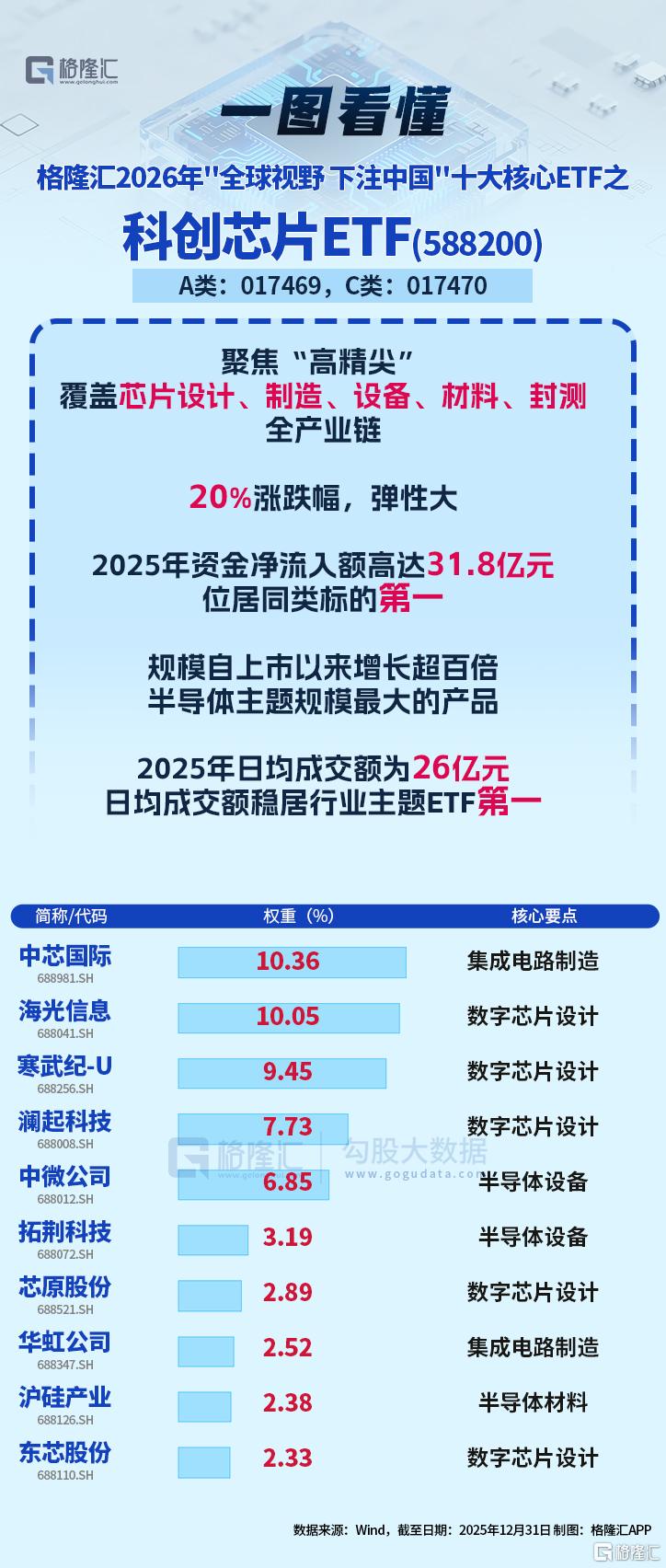
Core Insights - The global semiconductor industry underwent significant changes in 2025, transitioning from chaos to order and from divergence to consensus, driven by macroeconomic policies and the rise of artificial intelligence [1] - The A-share semiconductor sector experienced a recovery trajectory throughout the year, culminating in a strong performance in the second half [1] - The Kexin Chip ETF (588200) emerged as the largest product in the semiconductor theme, achieving a return of 154.35% since its listing, with an annualized yield of 34.88% [1] Industry Overview - The semiconductor industry is at a critical juncture, with AI transitioning from training to inference and domestic substitution moving into deeper waters [1][28] - The Kexin Chip Index has shown a cumulative increase of 69.94% since April 8, 2025, outperforming other semiconductor indices [4] - The market sentiment shifted positively towards semiconductor stocks, with 54% of tracked A-share semiconductor companies achieving record quarterly revenues in 2025 [6][12] Market Performance - The Kexin Chip ETF (588200) has seen significant inflows, with a net inflow of 3.18 billion yuan in 2025 and an average daily trading volume of 2.6 billion yuan [2][24] - The index's constituent stocks demonstrated impressive growth, with a 39% year-on-year revenue increase and a 94% rise in net profit in the first three quarters of 2025 [22] - The semiconductor market is expected to experience double-digit growth for three consecutive years, driven by AI infrastructure and traditional chip demand recovery [14] Investment Opportunities - The Kexin Chip ETF (588200) provides a convenient way to invest in core assets of the semiconductor industry, covering the entire supply chain from design to manufacturing [18][21] - The ETF's liquidity and strong market recognition make it an attractive option for both institutional and individual investors [24][25] - The underlying assets of the ETF include leading companies in the semiconductor sector, such as SMIC and Cambrian, which are positioned to benefit from ongoing industry trends [19][30] Future Outlook - The semiconductor industry is poised for growth, with domestic companies benefiting from increased production capacity and innovation in AI applications [28][30] - The Kexin Chip Index is expected to maintain its status as one of the most growth-oriented indices in the A-share market, capitalizing on trends in AI computing and domestic substitution [30][31]



存储价格继续上涨!芯片ETF(159995)跌2.89%,三安光电跌8%
Mei Ri Jing Ji Xin Wen· 2026-01-13 05:49
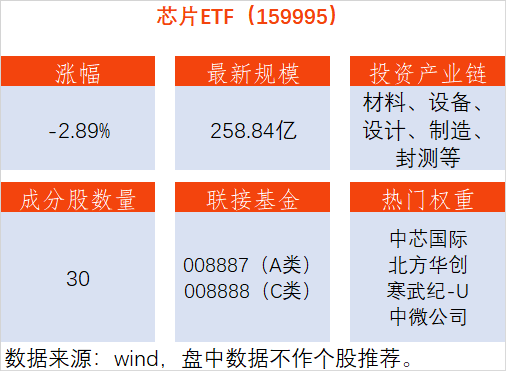
Group 1 - The A-share market experienced a collective decline on January 13, with the Shanghai Composite Index dropping by 0.55%. The biotechnology, education, and cultural media sectors showed positive performance, while aerospace and military, as well as chemical fiber sectors, faced significant declines [1] - The semiconductor sector remained sluggish, with the semiconductor ETF (159995) falling by 2.89%. Notable declines were observed in individual stocks such as Sanan Optoelectronics, which dropped by 8.10%, Loongson Technology by 7.82%, and Cambrian Technologies-U by 6.03%. However, some stocks like Zhaoyi Innovation and Chipone Technology saw increases of 2.24% and 0.55%, respectively [1] Group 2 - Global semiconductor sales are projected to grow by 29.8% year-on-year in November 2025, reaching $75.28 billion, marking 25 consecutive months of positive year-on-year growth. In China, semiconductor sales are expected to reach $20.23 billion, with a year-on-year growth of 22.9% and a quarter-on-quarter increase of 3.9% [3] - The trend of the global AI industry is shifting from model training to inference, which is expected to drive demand for high-performance chips. Domestic cloud service providers' AI computing power center construction plans will further stimulate the demand for SOC chips and other core components [3] - The semiconductor ETF (159995) tracks the National Chip Index, comprising 30 leading companies in the A-share semiconductor industry, including SMIC, Cambrian Technologies, Changdian Technology, and Northern Huachuang [3]


芯片龙头ETF(516640)开盘跌0.08%,重仓股中芯国际跌0.13%,寒武纪跌1.65%
Xin Lang Cai Jing· 2026-01-13 04:14
Core Viewpoint - The Chip Leader ETF (516640) opened with a slight decline of 0.08%, indicating a mixed performance in the semiconductor sector [1] Group 1: ETF Performance - The Chip Leader ETF (516640) opened at 1.188 yuan [1] - Since its establishment on August 19, 2021, the fund has achieved a return of 19.13% [1] - The fund's return over the past month is reported at 13.34% [1] Group 2: Major Holdings Performance - Major holdings in the ETF include: - SMIC: down 0.13% [1] - Cambricon: down 1.65% [1] - Haiguang Information: unchanged [1] - Northern Huachuang: down 0.37% [1] - Lattice Semiconductor: unchanged [1] - Zhaoyi Innovation: up 1.59% [1] - Zhongwei Company: down 1.20% [1] - OmniVision: up 0.19% [1] - Chipone: up 0.23% [1] - Changdian Technology: down 0.41% [1]


半导体并购估值博弈加剧?差异化定价成各方共识
Zheng Quan Shi Bao Wang· 2026-01-12 23:29
Core Viewpoint - The semiconductor merger and acquisition (M&A) landscape is experiencing increased valuation disputes, leading to a rise in failure rates of deals, despite a more accommodating regulatory environment [1][2][4]. Group 1: M&A Activity and Trends - In 2025, the number of M&A cases in the semiconductor sector increased by nearly 25% year-on-year, reaching 161 cases, with 12 failures, marking a five-year high [2][3]. - The total M&A amount in China's semiconductor industry reached approximately 279.67 billion, with 496 cases and 32 failures, a more than twofold increase compared to previous years [3]. - The overall M&A market in A-shares saw about 4,773 cases in 2025, a 5% increase year-on-year, with a slight decline in overall failure rates [2][3]. Group 2: Valuation Discrepancies - There is a significant divergence in valuations between buyers and sellers, particularly as sellers' expectations remain high due to previous market conditions, while buyers are cautious due to industry adjustments [4][5]. - The average price-to-earnings ratio for the semiconductor industry peaked at 291 times in 2021 but fell to 53 times by 2024, reflecting a substantial valuation correction [5]. - The termination of several high-profile M&A deals, such as the merger between Haiguang Information and Zhongke Shuguang, was attributed to disagreements over core terms, particularly valuation [4][5]. Group 3: Differentiated Pricing Strategies - Industry experts suggest implementing differentiated pricing strategies to address valuation discrepancies, allowing for tailored exit options for different investor types [10][11]. - Recent M&A cases have shown a trend towards differentiated arrangements in terms of valuation, payment methods, and performance commitments, which can help align interests among diverse stakeholders [10][11]. - Regulatory support for differentiated M&A practices has increased, encouraging the use of various assessment methods and flexible payment structures [11][12]. Group 4: Challenges in M&A Execution - The semiconductor industry is characterized by high cyclicality, complicating M&A negotiations as both parties seek to capitalize on market recovery while managing inherent risks [6][12]. - The presence of a "trilemma" in M&A—high seller expectations, buyer performance commitments, and high success rate targets—poses significant challenges, especially during industry downturns [12][14]. - The need for performance guarantees in M&A deals has led to complications, particularly for unprofitable semiconductor firms, as they may resist signing performance commitments [12][14].


半导体并购估值博弈加剧 差异化定价成各方共识
Zheng Quan Shi Bao· 2026-01-12 18:23
Core Viewpoint - The semiconductor M&A activity in A-shares is experiencing a surge in 2025, with a notable increase in the number of cases and a focus on asset integration and strategic cooperation, despite a rising failure rate in M&A transactions [1][2][3]. Group 1: M&A Activity and Trends - In 2025, the number of M&A cases in the A-share market reached approximately 4,773, reflecting a year-on-year increase of about 5%, while semiconductor-related M&A cases rose to 161, up nearly 25% year-on-year [2][3]. - The total M&A amount in China's semiconductor sector reached 279.67 billion yuan, with 496 cases reported, and 32 failures, marking a more than twofold increase in failures compared to previous years [3]. - The overall failure rate of M&A transactions in the semiconductor industry has increased, with 12 failures reported in 2025, the highest in five years [2][3]. Group 2: Valuation Discrepancies and Challenges - There is a significant divergence in valuations between buyers and sellers, complicating the consensus on core terms such as price and performance commitments, which has become a critical reason for M&A failures [1][4][5]. - The average price-to-earnings ratio in the semiconductor industry dropped from 291 times in 2021 to 53 times in 2024, reflecting a substantial valuation correction amid changing market conditions [5]. - The introduction of the "M&A Six Guidelines" in 2024 accelerated M&A activities, but the valuation discrepancies have intensified in 2025, particularly as sellers' expectations remain high due to historical peaks in valuations [4][10]. Group 3: Strategic Recommendations - Industry experts suggest adopting differentiated M&A strategies, including staged incubation through M&A funds, to mitigate risks associated with semiconductor M&A transactions [1][7][10]. - Companies are encouraged to implement differentiated pricing strategies based on various financing rounds, allowing for more flexible exit options for investors [8][10]. - Regulatory support for differentiated M&A is evident, with a shift towards more inclusive and prudent approval processes, allowing for diverse valuation methods and payment structures [11][12].
国产AI果然补涨?三大拐点来临,AI应用集体爆发!科创人工智能ETF华宝(589520)盘中涨近3%
Xin Lang Cai Jing· 2026-01-09 05:29
Core Viewpoint - The domestic AI sector continues to show strong upward momentum, with the Huabao Science and Technology Artificial Intelligence ETF (589520) experiencing significant trading activity and price increases, indicating a potential bullish trend in the market [1][8]. Group 1: Market Performance - The Huabao ETF saw a price increase of nearly 3% during intraday trading, currently up 2.36%, with a trading volume exceeding 500 million yuan [1][8]. - AI application concept stocks led the gains, with notable increases: Xinghuan Technology up over 11%, Yaxin Security up over 10%, and Tianzhun Technology up over 9% [3][10]. - Key weight stocks also performed well, with Cambrian Technology rising over 2% and Kingsoft up over 3% [3][10]. Group 2: Future Outlook - Huaxin Securities predicts that 2026 will be the "golden year" for AI applications, driven by three main factors: technological maturity, supportive policies, and resonating market demand [4][12]. - According to Founder Securities, the investment cycle in the tech industry suggests that 2026 will mark a significant year for AI application investments, following a period of model advancements from 2022 to 2025 [5][12]. - Zhongyou Securities notes that China's large model industry is transitioning from technology catch-up to systematic layout and ecological construction, with the potential to lead in certain areas by 2026 [5][12]. Group 3: ETF Characteristics - The Huabao ETF focuses on the domestic AI industry chain, with over 70% of its top ten holdings concentrated in semiconductor and software sectors, indicating a strong offensive strategy [6][13]. - The ETF is designed to be an efficient tool for investing in domestic computing power, reflecting a shift from reliance on foreign technology to self-sufficiency [6][13].


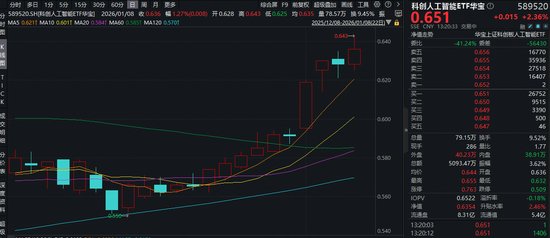
AI主线持续火热!芯原股份涨超4%,科创人工智能ETF汇添富(589560)涨2%冲击两连阳!利好政策密集来袭,行情将如何演绎?
Sou Hu Cai Jing· 2026-01-09 05:25
Group 1 - The A-share market experienced a rebound, with the Shanghai Composite Index reaching 4100 points for the first time in 10 years as of January 9 [1] - The AI-focused ETF, Huatai-PB (589560), saw a 2% increase, indicating strong investor interest in AI technology [1][5] - Major stocks in the AI sector, such as Zhongke Xingtou and Chip Origin, reported significant gains, with Zhongke Xingtou rising over 8% [5] Group 2 - UBS Securities noted a growing interest from international investors in Chinese AI technology companies, suggesting the emergence of trillion-dollar companies is only a matter of time [3] - A recent policy document from eight departments outlined goals for AI development, aiming for secure supply of core technologies and maintaining a leading position in the industry by 2027 [3] - The policy emphasizes enhancing AI applications in manufacturing through innovation, capability improvement, and product development [4] Group 3 - The focus of AI policy is shifting from "digital transformation" to "AI+", aiming to leverage advanced technologies for complex decision-making and innovation [4] - The policy framework includes promoting computational power and algorithm supply tailored to industrial scenarios, supporting the development of AI applications across various sectors [4] - The market consensus on AI industry trends is strong, with expectations for continued growth in AI infrastructure and applications leading up to 2026 [6] Group 4 - The investment strategy suggests focusing on domestic computational power and AI applications, particularly in the internet and media sectors, as they present high valuation and growth potential [6][7] - The AI industry is expected to benefit from a combination of policy support, technological advancements, and stable fundamental growth, creating a favorable environment for investment [7]


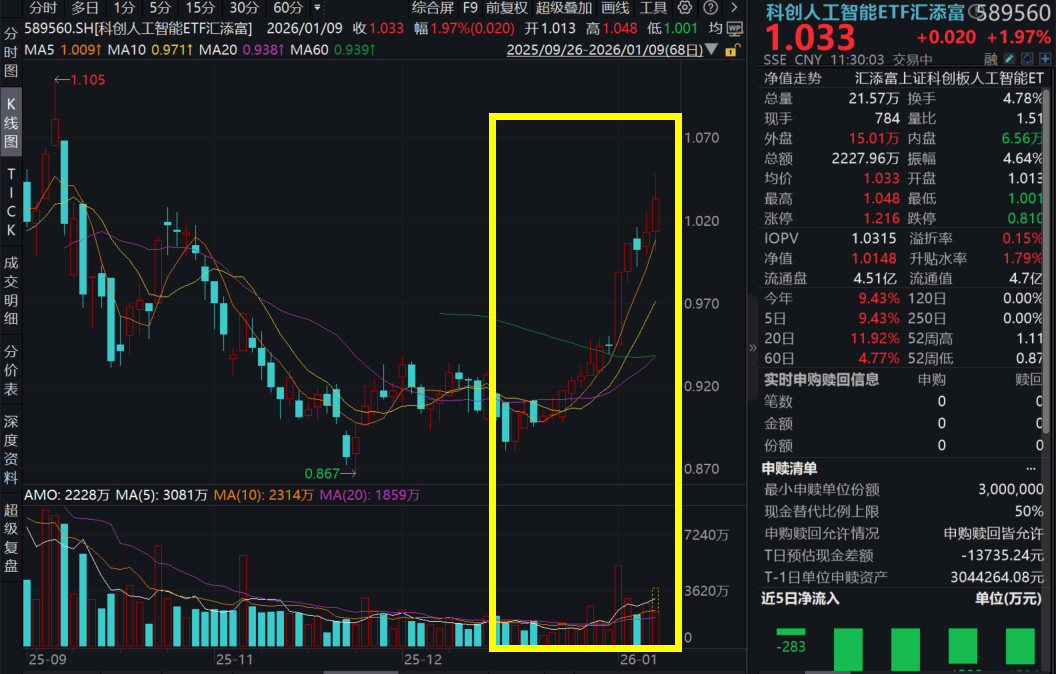
半导体板块午后短线拉升,芯原股份、灿芯股份涨超10%
Xin Lang Cai Jing· 2026-01-09 05:14
Group 1 - The semiconductor sector experienced a short-term surge in the afternoon, with significant gains observed in several companies [1] - Chipone Technology and Sanxin Technology both saw their stock prices increase by over 10% [1] - Other companies such as Hangyu Micro, Changguang Huaxin, Juguang Technology, Hongwei Technology, and Changdian Technology also experienced upward movement in their stock prices [1]