VANKE(000002)

Search documents
万科债普遍下跌,“21万科06”和“23万科01”跌超12%
Mei Ri Jing Ji Xin Wen· 2025-11-26 02:35
Group 1 - Vanke bonds experienced a significant decline, with "21 Vanke 04" dropping over 20% and being suspended from trading [1] - Other bonds such as "21 Vanke 06" and "23 Vanke 01" fell more than 12%, while "22 Vanke 02" decreased nearly 12% and "21 Vanke 02" dropped over 7% [1]

资讯早班车-2025-11-26-20251126
Bao Cheng Qi Huo· 2025-11-26 02:00
1. Report Industry Investment Rating No relevant content provided. 2. Core Views of the Report - The US economy may face challenges as inflation re - heats in September, retail sales growth slows, and the Fed may need to cut interest rates. The peace plan for the Russia - Ukraine conflict is making progress, which could potentially impact global markets. In the domestic market, the A - share market rebounds, and the bond market shows mixed performance. The commodity market has different trends in various sectors such as metals, energy, and agriculture [3][22][31] - The report also provides macro - economic data, which shows the current economic situation such as GDP growth, PMI, and inflation rates in the domestic market, and also includes information on international economic data and events that may affect the global and domestic investment environment [1] 3. Summary by Relevant Catalogs 3.1 Macro Data - GDP growth in Q3 2025 was 4.8% year - on - year, lower than the previous quarter's 5.2%. The manufacturing PMI in October 2025 was 49%, down from 49.8% in the previous month. The non - manufacturing PMI was 50.1%, slightly up from 50% [1] - Social financing scale in October 2025 was 816.1 billion yuan, a significant drop from 3529.9 billion yuan in the previous month. M0, M1, and M2 growth rates all declined compared to the previous month [1] - CPI in October 2025 was 0.2% year - on - year, up from - 0.3% in the previous month. PPI was - 2.1% year - on - year, an improvement from - 2.3% [1] 3.2 Commodity Investment 3.2.1 Comprehensive - The China - US leaders' phone call was initiated by the US, with a positive atmosphere. The US is making progress in the Russia - Ukraine peace plan, and the Fed may cut interest rates [2][3] - On November 25, 47 domestic commodity varieties had positive basis, and 22 had negative basis.沪镍, 郑棉, and铸造铝合金 had the largest basis [2] 3.2.2 Metals - International precious metal futures generally rose due to factors such as the Fed's potential rate cut, the uncertain situation in the Russia - Ukraine conflict, and concerns about the US fiscal deficit [5] - Zinc, copper, aluminum, lead, tin, and nickel inventories in the London Metal Exchange changed on November 24. Hong Kong's gold exports to the Chinese mainland decreased in October [5] 3.2.3 Coal, Coke, Steel, and Minerals - As of mid - November, the prices of coke, coking coal, and rebar all increased. However, the increase in coke prices has squeezed steel mills' profits, and coke prices may face downward pressure at the end of the month or early December [7] 3.2.4 Energy and Chemicals - Norway aims to maintain its oil and gas production at 2020 levels by 2035 and will invest about 60 billion Norwegian kroner. European natural gas prices are expected to decline [9] - Iraq's oil exports in October were 110.9 million barrels, and measures are taken to maintain the production of the West Qurna - 2 oilfield [9] 3.2.5 Agricultural Products - As of mid - November, the prices of corn, wheat, and rice increased, while the price of cotton decreased. The price of natural rubber rose [11] - The inventory of breeding sows in China decreased, and the pig price is expected to rise moderately before the Spring Festival. The breeding of poultry and eggs is expected to face losses [12] 3.3 Financial News 3.3.1 Open Market - On November 25, the central bank conducted 302.1 billion yuan of 7 - day reverse repurchase operations, with a net withdrawal of 105.4 billion yuan [14] 3.3.2 Key News - The US is making progress in the Russia - Ukraine peace plan, and the China - US leaders' phone call is positive. The Chinese government will hold a press conference on promoting consumption [15][16] - China's foreign direct investment and overseas project contracting increased from January to October. Local government special bonds are being issued for government investment funds [16] 3.3.3 Bond Market - The A - share market is strong, while the bond market is weak. The yields of medium - and long - term interest - rate bonds generally increased, and the prices of some bonds of Vanke decreased significantly [22] - The exchange - traded bond market had mixed performance, and the convertible bond index rose. The money market interest rates had different trends [23] 3.3.4 Foreign Exchange Market - The on - shore RMB against the US dollar rose, and the US dollar index fell. Non - US currencies generally rose [27] 3.3.5 Research Report Highlights - Whether the Fed will cut interest rates in December is uncertain. Active management bond funds can break the situation through strategies such as "fixed income +" and medium - long - term credit amortization [28][29] - For 2026, it is recommended to set the GDP target at around 5% and implement more active fiscal and monetary policies [29] 3.4 Stock Market - The A - share market rebounded, with lithium mines and the Fujian sector performing strongly. The Hong Kong stock market also rose, and the repurchase amount of A - shares and Hong Kong stocks reached a high level this year [31][32] - Multiple funds have reported new ETF products [32]
京华烟云 左晖与刘肖的万科贝壳往事
3 6 Ke· 2025-11-26 01:52
Core Viewpoint - The relationship between Vanke and Beike has deteriorated significantly, culminating in Vanke's complete divestment from Beike's shares, marking the end of an eight-year partnership [2][10][11]. Group 1: Personnel Changes - Zhao Ran, formerly the marketing deputy manager at Vanke, has joined Beike's subsidiary Beihome to lead marketing efforts [1]. - In 2023, Beike also recruited Xiao Zheng, Vanke's financial head for the Northeast region, to serve as the general manager of its financial center [1]. Group 2: Historical Context - Vanke and Beike's relationship began with a partnership that was mutually beneficial, with Vanke providing product capabilities and Beike offering a vast customer base and channel resources [6]. - The collaboration led to the establishment of a joint venture, Wanlian, in 2015, which aimed to redefine the home decoration industry and achieved significant growth in its early years [7][9]. Group 3: Financial Developments - Vanke invested 3 billion yuan in Beike in 2017, which included a 2.6 billion yuan stake in Beike's predecessor, Lianjia [8]. - Vanke's divestment from Beike was confirmed in November 2023, with the company stating it had sold all its shares, which were valued at approximately 5.725 billion yuan based on Beike's market capitalization [10][11]. Group 4: Strategic Shifts - Vanke's decision to exit its investment in Beike is seen as a strategic move to improve its cash flow and debt structure amid ongoing challenges within the company [11][12]. - The management indicated plans to further divest non-core assets and businesses to enhance financial stability [12].

万科频现土拍市场 在杭州和武汉连续拿下两宗地块
Cai Jing Wang· 2025-11-26 01:20
Core Insights - Vanke has been actively participating in land auctions, recently acquiring two plots in Hangzhou and Wuhan on November 25, showcasing a strategy of joint ventures and acquiring land at base prices [1][2] - The company is focusing on innovative investment models, emphasizing the importance of good cities, good plots, and good houses through methods like construction agency and collaboration [1][2] Group 1: Recent Land Acquisitions - On November 25, Vanke, in partnership with Hangzhou Anju Construction Investment Group, acquired a plot in the Gongshu District of Hangzhou for a total price of 1.015 billion yuan, with a floor price of 14,931 yuan per square meter [1] - Vanke, in collaboration with Hubei Keti Investment, also secured a residential plot in Wuhan's Optics Valley Financial Port for a base price of 394 million yuan, with a floor price of 6,400 yuan per square meter [1] - Vanke's recent land acquisitions in Chongqing and Chengdu also reflect a strategy of "increasing positions," with a focus on low plot ratios and small land parcels [2] Group 2: Strategic Focus and Resource Management - Vanke's new chairman, Huang Liping, emphasized the need for strategic focus and risk management during a recent shareholders' meeting, aiming for high-quality development in real estate [3] - The company is prioritizing the activation of existing resources, with a reported 22.8 billion yuan in new salable value generated in the first ten months of the year [3] - Vanke's management highlighted the importance of revitalizing historical resources through methods such as resource exchange and optimization, especially in a context of tight funding and limited new investments [3]
万科频现土拍市场 合作拿地备战区域深耕
Zheng Quan Shi Bao Wang· 2025-11-25 23:42
Core Insights - Vanke has been actively participating in land auctions, recently acquiring two plots in Hangzhou and Wuhan on November 25, showcasing a strategy of joint ventures and bottom-price bidding [1][2] Group 1: Recent Land Acquisitions - On November 25, Vanke, in collaboration with Hangzhou Anju Construction Investment Group, acquired a plot in Hangzhou's Gongshu District at a starting and final price of 1.015 billion yuan, with a floor price of 14,931 yuan per square meter [1] - Vanke, in partnership with Hubei Keti, also secured a residential plot in Wuhan's Optics Valley Financial Port for a bottom price of 394 million yuan, with a floor price of 6,400 yuan per square meter [1][2] - Vanke's recent land acquisitions in Chongqing and Chengdu also reflect a strategy of "increasing positions," with a focus on low plot ratios and small land parcels [2] Group 2: Investment Strategy and Market Trends - Analysts indicate that real estate companies are adopting more rational and conservative investment strategies, focusing on good cities, good plots, and good houses through innovative investment models [1][2] - Vanke's new chairman, Huang Liping, emphasized the importance of stabilizing residential development while optimizing business layout and structure, focusing on resource revitalization [3] - Vanke reported an increase in available saleable value of 22.8 billion yuan in the first ten months, highlighting the significance of revitalizing historical resources amid tight funding [3]
万科已全部出售所持贝壳股票;懋源地产超50亿元竞得北京朝阳宅地 | 房产早参
Mei Ri Jing Ji Xin Wen· 2025-11-25 22:09
Group 1 - Qingdao has introduced a new housing subsidy policy to attract high-level talent, offering 300,000 yuan for doctoral graduates and 200,000 yuan for master's graduates [1] - The policy aims to encourage key industries to recruit outstanding young scientific and technological talents, promoting long-term employment in the city [1] Group 2 - Wuhan has auctioned 12 plots of state-owned construction land for a total transaction price of approximately 3.97 billion yuan, with over 95% of the total coming from residential land [2] - The land auction reflects a rational and stable tone in the current land market, with state-owned enterprises and brand real estate companies being the main players [2] Group 3 - Vanke has confirmed the complete sale of its shares in Beike, a strategic move to focus on its core business amid industry adjustments [3] - The divestment is part of a broader strategy to optimize financial structure and concentrate resources to face industry challenges [3] Group 4 - Tianyu Real Estate has received a winding-up order from a Bermuda court, highlighting the difficulties faced by highly leveraged real estate companies during market downturns [4] - This event serves as a warning for investors regarding the risks in the real estate sector and emphasizes the need for companies to strengthen debt management [4] Group 5 - Maoyuan Real Estate successfully acquired a residential land plot in Beijing's Chaoyang District for 5.024 billion yuan, with a premium rate of approximately 18% [5] - This acquisition not only expands Maoyuan's high-end project reserves but also enhances its brand image in a market dominated by state-owned enterprises [5]
万科年末低调买地,新任董事长黄力平现身股东会表态“继续支持”
Xin Lang Cai Jing· 2025-11-25 12:21
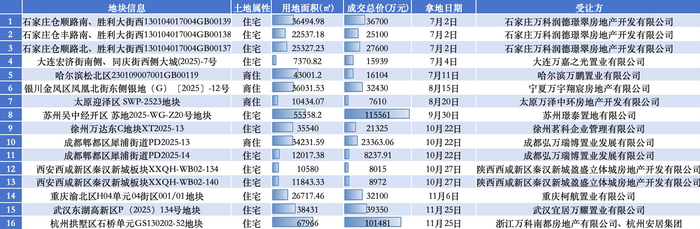
Core Viewpoint - Vanke is accelerating its land acquisition activities as the year-end approaches, with significant investments in key cities like Hangzhou and Wuhan, totaling over 1.4 billion yuan in a single day, signaling a proactive strategy in a challenging market environment [1][2]. Group 1: Land Acquisition - On November 25, Vanke, in partnership with Hangzhou Anju Group, acquired a residential land parcel in Hangzhou for a base price of 1.015 billion yuan, marking it as the first public transport-oriented residential project in the city [1]. - The same day, Vanke and Hubei Ketiou successfully acquired a residential land parcel in Wuhan for 393.5 million yuan, following a previous acquisition in June [1]. - Since July 2025, Vanke has acquired 16 land parcels across 12 major cities, with a total investment of approximately 5.199 billion yuan [1]. Group 2: Financial Performance - For the first nine months of 2025, Vanke reported a revenue of 161.39 billion yuan, with a net loss attributable to shareholders of 28.02 billion yuan [4]. - The pre-tax gross margin for the real estate development business was 7.8%, while the post-tax gross margin dropped to 2.0% [4]. - The losses were attributed to a decline in the scale of business settlements, low gross margins, and provisions for inventory depreciation [4]. Group 3: Debt and Financial Strategy - Vanke's total domestic debt amounts to 21.798 billion yuan, with a peak repayment of 5.871 billion yuan due in December 2025 [5]. - As of September 2025, Vanke held cash reserves of 65.68 billion yuan against total interest-bearing liabilities of 362.93 billion yuan, resulting in a debt-to-asset ratio of 73.5% [5]. - The company has sold all its shares in Beike, marking the end of a six-year partnership, and is actively working on asset disposals to improve cash flow [5][7].

万科:公司持有贝壳股票已全部出售
Xin Lang Cai Jing· 2025-11-25 11:49
Core Viewpoint - Vanke has completely sold its shares in Beike, marking the end of a significant investment relationship that began in 2017, as a response to financial pressures and cash flow challenges [1] Group 1: Investment History - Vanke invested a total of 3 billion RMB in 2017 to acquire shares in Lianjia Group, with 2.6 billion RMB going to Lianjia Real Estate and 400 million RMB to another company in the Lianjia system [1] - Following a major restructuring in 2018, Vanke's shares transitioned from Lianjia to Beike as Beike was officially established and began operations [1] - After Beike's successful IPO in August 2020, Vanke's shareholding was diluted to approximately 4.13%, although the market value of its holdings increased due to Beike's rising stock price [1] Group 2: Recent Developments - In June 2023, Vanke indicated that it still held some shares in Beike, but the recent decision to sell all shares reflects a strategic move to alleviate financial strain [1] - Vanke is facing multiple risks, including debt maturities and declining sales, which have severely pressured its cash flow starting from the end of 2023 [1]
万科再拿地
Zheng Quan Shi Bao· 2025-11-25 11:40
Core Insights - Multiple hot cities are accelerating land supply, and real estate companies are actively seeking opportunities [1][3] - Vanke has successfully acquired land in key cities, indicating a strategic focus on core areas despite ongoing debt pressures [1][2] - The trend in the real estate sector is shifting towards more rational and conservative investments, with a focus on low-density and small plots [2] Group 1: Vanke's Land Acquisitions - On November 25, Vanke secured two plots in Wuhan and Hangzhou at base prices of 393.5 million yuan and 1.015 billion yuan respectively [1] - In October, Vanke and a partner acquired two residential plots in Chengdu for a total of 316 million yuan [1] - Vanke's strategy includes joint ventures to mitigate financial pressure while targeting core urban areas [1][2] Group 2: Market Trends and Supply Dynamics - The Wuhan government announced the auction of 20 plots with a total starting price of approximately 7.815 billion yuan, primarily for residential use [3] - Guangzhou is also increasing land supply, with 20 residential plots set to be auctioned in December, totaling over 25.4 billion yuan in starting prices [3] - The fourth quarter typically sees a peak in land supply, accounting for about 40% of annual offerings, with market supply expected to increase [3]
万科再拿地
证券时报· 2025-11-25 11:35
Group 1 - The article highlights that multiple hot cities are accelerating land supply, with Vanke actively seeking opportunities in the land market [1][3] - On November 25, Vanke acquired two land parcels in Wuhan and Hangzhou at base prices of 393.5 million yuan and 1.015 billion yuan respectively [1] - In October, Vanke and its partners secured two residential land parcels in Chengdu for a total of 316 million yuan, indicating a strategic focus on core urban areas [1] Group 2 - Data shows that from the beginning of 2025, Shenzhen Metro Group has provided Vanke with loans totaling 30.796 billion yuan [2] - Vanke's management stated at a recent shareholder meeting that the company is working to improve operations and cash flow by divesting non-core assets [2] - Industry experts believe that real estate companies are adopting more rational and conservative investment strategies, focusing on low-density, small land parcels [2] Group 3 - The Wuhan Natural Resources and Urban Construction Bureau announced the auction of 20 state-owned construction land parcels with a total starting price of approximately 7.815 billion yuan [3] - Guangzhou is also accelerating land supply, with 20 residential land parcels set to be auctioned in December, totaling over 25.4 billion yuan in starting prices [3] - The trend indicates that the fourth quarter is typically a peak period for land supply, accounting for about 40% of annual supply, with expectations for increased market supply [3]