
CHANGAN AUTOMOBILE-B(000625)

Search documents
钠电池商业化进程提速多元场景落地激活产业链
Zhong Guo Zheng Quan Bao· 2026-02-09 20:25
Core Viewpoint - Changan Automobile and CATL have launched the world's first mass-produced sodium battery passenger vehicle, marking the beginning of large-scale application of sodium batteries in the passenger car sector [1][2]. Industry Development - Sodium batteries have entered a new stage of maturity and technological iteration after five years of industrial exploration, with costs stabilizing and a significant acceleration in industry layout [1]. - CATL's sodium battery has achieved a maximum energy density of 175Wh/kg and over 90% capacity retention at -40°C, with future electric range potentially reaching 500-600 km [2]. - The sodium battery's advantages include abundant resources, wide distribution, and reduced reliance on scarce minerals like lithium and cobalt, enhancing supply chain security [2]. Market Dynamics - The sodium battery is currently in the initial stage of commercialization, with lower cost and energy density compared to lithium batteries [3]. - It is expected that within 2-3 years, sodium battery energy density will reach levels comparable to lithium iron phosphate batteries, with significant cost advantages emerging when lithium prices exceed 120,000 yuan/ton [3]. - By the second half of 2026, sodium batteries are projected to achieve comprehensive competitiveness in terms of cost, even if lithium prices remain stable [3]. Technological Coexistence - The sodium battery industry is still in its early development phase, but its direction is clear, with expectations for it to play a significant role in energy transformation [4]. - The sodium battery is anticipated to enter a year of large-scale application in 2026, with promising prospects for industry scale expansion [4]. Industry Collaboration - Companies across the sodium battery supply chain are actively pursuing technological research, capacity construction, and strategic partnerships to accelerate their presence in this field [4][5]. - Notable developments include the establishment of a production base for sodium battery materials and ongoing collaborations with major players like CATL [5]. - Companies like Electric Science Blue Sky and Puli Te are advancing their sodium battery initiatives, with plans for mass production and increased output expected in the coming years [5].


钠电池商业化进程提速 多元场景落地激活产业链
Zhong Guo Zheng Quan Bao· 2026-02-09 20:21
Core Viewpoint - Changan Automobile and CATL have launched the world's first mass-produced sodium battery passenger vehicle, marking the beginning of large-scale application of sodium batteries in the passenger car sector [1][2]. Group 1: Sodium Battery Development - Sodium batteries have transitioned from laboratory research to large-scale application, showing advantages such as abundant resource availability, wide temperature range, long cycle life, and high safety [1]. - The sodium battery industry has seen accelerated development, with significant cost reductions and improved product maturity over the past five years [2]. - CATL's sodium battery, with a maximum energy density of 175Wh/kg, has demonstrated over 90% capacity retention in extreme cold conditions, with future electric ranges potentially reaching 500km to 600km [2]. Group 2: Market Dynamics and Competitive Landscape - The sodium battery market is expected to reach a scale of 100GWh by 2028, transitioning from a commercialization phase to a large-scale era [5]. - Sodium batteries are anticipated to achieve competitive cost advantages by 2026, especially if lithium prices remain stable [4]. - The unique application value of sodium batteries in cold regions is highlighted, with expectations for various technologies to coexist and complement each other in the energy transformation [5]. Group 3: Industry Collaboration and Capacity Expansion - Companies across the sodium battery supply chain are actively enhancing their positions through technology development, capacity building, and strategic partnerships [6]. - ZHONGDA Energy has established a production base for sodium iron phosphate materials, while other companies are also making strides in sodium battery applications in electric two-wheelers and energy storage systems [6]. - PULIT has achieved mass production of sodium batteries and is expanding its capacity, with new production lines expected to come online in the third quarter of this year [7].
宁德时代、长安汽车合资公司成立新动力电池公司
Zhong Guo Qi Che Bao Wang· 2026-02-09 09:27
近日,时代长安(重庆)动力电池有限公司成立,法定代表人为朱云峰,注册资本10亿人民币,经 营范围含电池制造、电池销售、新兴能源技术研发、新材料技术研发、电子专用材料制造、电子专用材 料销售、工程和技术研究和试验发展等。股权全景穿透图显示,该公司由时代长安动力电池有限公司全 资持股,后者由宁德时代(300750)、深蓝汽车科技有限公司、长安汽车(000625)共同持股。 ...
【出海日报】一汽解放与菜鸟达成战略合作,构建汽车及零部件全球跨境电商平台
Xin Lang Cai Jing· 2026-02-09 09:08
Group 1 - FAW Jiefang and Cainiao Group signed a strategic cooperation agreement to build a global cross-border e-commerce platform for automobiles and auto parts, leveraging Alibaba's ecosystem and logistics technology [1] - 800 Changan brand vehicles were exported from Wenzhou to the UAE, marking the first batch of domestic car exports in the new year and setting a record for single-batch exports at the port [2] - Dora Group launched the "Dora Outbound" brand, providing comprehensive services for companies looking to expand into Southeast Asia, including company registration, office leasing, and cross-border recruitment [3] Group 2 - Chinese capital inflow to Singapore surged eightfold in the past year, with Chinese investments reaching a double-digit percentage for the first time since 2013, accounting for nearly 50% of total business expenditures [4]

时代长安(重庆)动力电池有限公司成立 注册资本10亿元
Mei Ri Jing Ji Xin Wen· 2026-02-09 09:00
t t — 国有控股 - 国有控股 - 深蓝汽车科技有限公司 重庆长安汽车股份有限公司 宁德时代新能源科技股份有 限公司 融资轮次:C轮 融资轮次:定向增发 51% 30% 19% 时代长安动力电池有限公司 100% 时代长安(重庆)动力电池有限公司 | 企业名称 | 时代长安(重庆)动力电池有限公司 | | | | --- | --- | --- | --- | | 法定代表人 | 朱 朱云峰 猛 关联企业 16 | 登记状态 ② | | | | | 成立日期 | | | 统一社会信用代码 ⑦ | 91500109MAK5UC944D | 注册资本 ② | | | 工商注册号 | 500109020559199 | 纳税人识别号 ② | | | 营业期限 | 2026-02-04 至 无固定期限 | 纳税人资质 | | | | 有限责任公司(非自然人投资或控股的 | 国标行业 | | | | 法人独资) | | | | | | 英文名称 | | | | 重庆市北碚区市场监督管理局 | 注册地址 ② | ﺃ | | 经营范围 ① | 一般项目:电池制造;电池销售;新兴能源技术研发;新材料技术研发 让、技术推广 ...

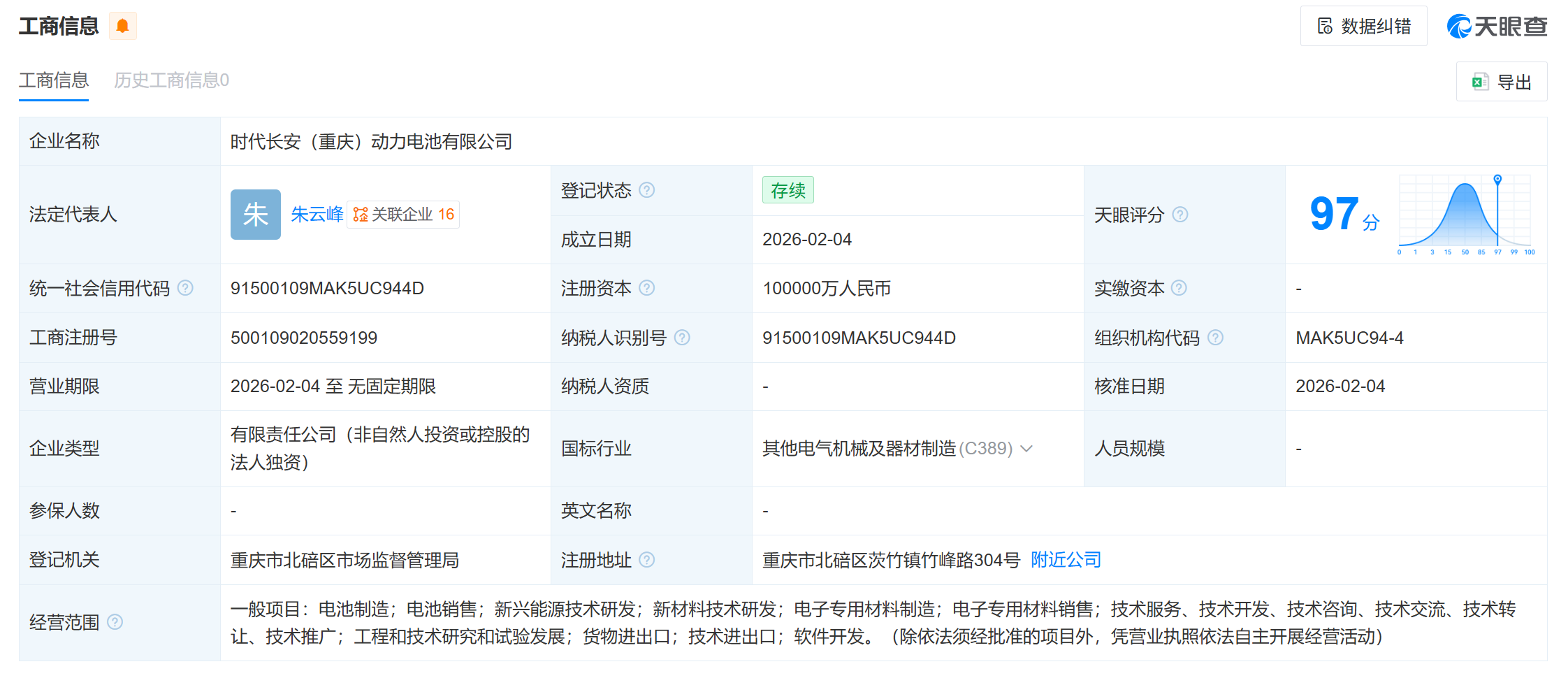
时代长安(重庆)动力电池有限公司成立,注册资本10亿
Xin Lang Cai Jing· 2026-02-09 08:49
天眼查工商信息显示,2月4日,时代长安(重庆)动力电池有限公司成立,法定代表人为朱云峰,注册 资本10亿人民币,经营范围含电池制造、电池销售、新兴能源技术研发、新材料技术研发、电子专用材 料制造、电子专用材料销售、工程和技术研究和试验发展等。股权全景穿透图显示,该公司由时代长安 动力电池有限公司全资持股,后者由宁德时代、深蓝汽车科技有限公司、长安汽车共同持股。 ...
长安汽车(000625):(.SZ)筹划回购公司股份,彰显长期发展信心
INDUSTRIAL SECURITIES· 2026-02-09 05:19
Investment Rating - The investment rating for the company is "Buy" (maintained) [1] Core Views - The company is planning to repurchase shares, demonstrating confidence in its long-term development. The repurchase amount is set to be no less than RMB 1 billion and no more than RMB 2 billion, with a price cap not exceeding 150% of the average trading price over the previous 30 trading days [3] - The separation of the automotive business from the state-owned enterprise has been completed, upgrading the company to a first-level central enterprise. This restructuring is expected to enhance resource support for the company in areas such as new energy, intelligence, and globalization, thereby strengthening its long-term strategic advancement and core competitiveness [3] - The company has shown a steady revenue growth of 3.6% year-on-year in the first three quarters of 2025, with a total revenue of RMB 114.9 billion. However, the net profit attributable to the parent company decreased by 14.7% year-on-year due to investments in new energy brands [3] - The investment suggestion highlights a clear trend of profitability improvement for three major new energy brands, alongside sustained high growth in overseas business, indicating a relatively high certainty of performance growth. Additionally, the robotics and flying car businesses are expected to provide valuation flexibility and open up long-term growth potential [3] Financial Summary - Total revenue is projected to grow from RMB 159.73 billion in 2024 to RMB 225.10 billion in 2027, with year-on-year growth rates of 5.6%, 15.0%, 10.2%, and 11.2% respectively [3] - The net profit attributable to the parent company is expected to recover from RMB 4.99 billion in 2025 to RMB 9.20 billion in 2027, reflecting growth rates of -31.8%, 43.0%, and 28.8% [3] - The gross margin is anticipated to improve gradually from 14.9% in 2024 to 15.9% in 2027 [3] - The return on equity (ROE) is projected to increase from 6.1% in 2025 to 9.4% in 2027 [3] - Earnings per share (EPS) is expected to rise from RMB 0.50 in 2025 to RMB 0.93 in 2027 [3]
多重困局,启源待解
Zhong Guo Qi Che Bao Wang· 2026-02-09 03:51
Core Viewpoint - The Chinese new energy vehicle market continues to surge in 2025, with Changan Automobile achieving a total sales volume of 2.913 million units, marking a nine-year high, and the new energy vehicle segment experiencing explosive growth of 51% [1] Group 1: Sales Performance - Changan's new energy strategy, particularly through its brand Changan Qiyuan, saw sales surpassing 400,000 units in 2025, despite facing challenges such as high-end positioning setbacks and product quality issues [1][3] - The overall sales figure of 411,000 units for Changan Qiyuan appears impressive but reveals structural issues that could hinder sustainable growth [8][9] Group 2: Product Strategy and Positioning - Changan Qiyuan's product strategy is fundamentally flawed due to unclear brand positioning, leading to internal competition among models with overlapping features and price ranges [3][4] - The flagship model E07, priced between 199,900 to 319,900 yuan, failed to meet market expectations, resulting in sales of less than 1,000 units in 2025 [4][5] - The internal model overlap and lack of differentiation have created confusion among consumers and challenges for dealers [4][5] Group 3: Innovation and Technology - Changan Qiyuan's technological innovation is lagging behind industry leaders, with only one model featuring advanced driving assistance systems, while others remain at a basic level [6][7] - The brand's reliance on external suppliers for battery technology and lack of proprietary advancements have hindered its competitive edge [6][7] - The innovation approach appears reactive rather than proactive, failing to address critical user needs and market trends [7] Group 4: Market Challenges - The sales structure is heavily reliant on a few models, with the Lumin electric vehicle accounting for 39% of total sales, indicating vulnerability to market fluctuations [8][9] - The disconnect between sales targets and actual performance suggests that growth is primarily driven by low-cost models rather than breakthroughs in higher-end markets [9][10] - The challenges faced by Changan Qiyuan reflect broader issues within traditional automakers transitioning to new energy vehicles, emphasizing the need for a return to core user value [9][10]
2025年1-12月汽车制造业企业有20572个,同比增长4.06%
Chan Ye Xin Xi Wang· 2026-02-09 03:30
Group 1 - The core viewpoint of the article highlights the growth in the number of automotive manufacturing enterprises in China, which reached 20,572 in 2025, an increase of 803 enterprises compared to the previous year, representing a year-on-year growth of 4.06% [1] - The automotive manufacturing sector accounts for 3.91% of the total industrial enterprises in China [1] - The data referenced is sourced from the National Bureau of Statistics and compiled by Zhiyan Consulting, indicating the reliability of the statistics presented [2] Group 2 - The report titled "2026-2032 China Automotive Manufacturing Industry Market Panorama Survey and Investment Prospects Analysis" by Zhiyan Consulting provides insights into the automotive industry [1] - The threshold for scale industrial enterprises has been raised from an annual main business income of 5 million to 20 million yuan since 2011, which reflects a significant change in the criteria for enterprise classification [1] - Zhiyan Consulting is recognized as a leading industry consulting firm in China, specializing in deep industry research and providing comprehensive industry solutions [2]






长安旗下引力、深蓝品牌负责人换岗
Cai Jing Wang· 2026-02-09 02:04
Core Viewpoint - The leadership change between Chang'an Inertia and Deep Blue Automotive signifies a strategic shift in brand management for both companies, with a focus on enhancing brand communication and market presence [1] Group 1: Leadership Changes - Fang Nan, the global brand manager of Chang'an Inertia, will now oversee brand communication for Deep Blue Automotive [1] - Li Pan, the former chief brand officer of Deep Blue Automotive, will take over the brand communication responsibilities at Chang'an Inertia [1]