
CHANGAN AUTOMOBILE-B(000625)

Search documents
印证天枢智能新安全成果,2026长安汽车全球炼车季正式开启
Bei Jing Ri Bao Ke Hu Duan· 2026-02-09 01:03
Core Viewpoint - Changan Automobile held a global launch event for its "Tianshu Intelligent New Safety" achievements and sodium battery strategy in extreme cold conditions, marking the start of the 2026 global vehicle testing season with five major brands participating in extreme scenario validations [1]. Group 1: Event Highlights - The event took place in Yakeshi, where the temperature reached minus 30 degrees Celsius, showcasing the performance of various models under extreme conditions [1]. - The Avita 12 successfully completed lane change tests on snow and icy surfaces at speeds of 92.3 km/h and 70.7 km/h without deviation [3]. - The Qiyuan A06 demonstrated stable driving at 95 km/h even after a tire blowout [3]. Group 2: Battery Technology - Changan, in collaboration with CATL, launched the world's first mass-produced passenger vehicle equipped with sodium batteries, achieving an energy density of 175 Wh/kg [5]. - The sodium battery's discharge power at minus 30 degrees Celsius is three times higher than that of conventional lithium iron phosphate models, and it maintains over 90% capacity at minus 40 degrees Celsius [5]. - The battery has passed extreme tests, including penetration by a drill and cutting with a saw, demonstrating safety with no smoke or fire, addressing winter range and safety concerns [5]. Group 3: Testing Achievements - Changan has completed over 58 million kilometers of extreme cold testing over 28 years, with more than 4,000 vehicles involved [7]. - The new Avita 12 completed high-speed lane change tests and tire blowout tests without deviation, while the Qiyuan A06 also successfully managed a blowout without veering off course [7]. - The Deep Blue S09 passed the moose test with AEB, and the Kai Cheng V919 successfully tackled a 15% incline with nine passengers [7].



电力设备与新能源行业2月第1周周报:马斯克团队计划光伏扩产,钠电应用加速-20260208
Bank of China Securities· 2026-02-08 06:46
Investment Rating - The report maintains an "Outperform" rating for the power equipment and new energy industry [1]. Core Insights - The global sales of new energy vehicles are expected to maintain rapid growth by 2026, driving demand for batteries and materials [1]. - Recent fluctuations in material prices for power batteries warrant attention to the pricing situation along the supply chain [1]. - Solid-state batteries are entering a critical phase of engineering validation, with a focus on related materials and equipment companies [1]. - In the photovoltaic sector, "anti-involution" and "space photovoltaics" are identified as the two main investment themes for 2026, with increased demand for photovoltaic equipment [1]. - The domestic market is seeing a rise in high-power component demand, with downstream battery components relying on efficiency improvements for market clearing [1]. - Wind power demand is expected to continue growing, with recommendations to focus on wind turbines and offshore wind power [1]. - The energy storage sector remains highly prosperous, with a recommendation to pay attention to energy storage cells and large-scale integrated plants [1]. - Hydrogen energy is anticipated to open up demand for green hydrogen, with a focus on downstream hydrogen-based energy applications [1]. - Nuclear fusion is seen as a long-term catalyst for energy development, with recommendations to focus on core suppliers in the nuclear fusion power sector [1]. Summary by Sections Industry Performance - The power equipment and new energy sector rose by 2.2%, outperforming the Shanghai Composite Index, which fell by 1.27% [10]. - The photovoltaic sector saw the highest increase at 3.43%, while the wind power sector experienced a slight decline of 0.01% [13]. Key Industry Information - The China Passenger Car Association estimates that 900,000 new energy vehicles will be wholesaled in January 2026, a 1% year-on-year increase [27]. - Changan Automobile and CATL announced the global launch of the first sodium battery mass-produced passenger vehicle, expected to be available by mid-2026 [27]. - Tesla has achieved large-scale production of dry electrode technology [27]. - The domestic energy storage tender for January 2026 reached 36.3 GWh, with notable bidding scales in Ningxia, Hebei, and Xinjiang [27]. Company Developments - Foster is collaborating with professional institutions to invest in a private equity fund focused on flexible thin-film gallium arsenide battery companies [29]. - Guoxuan High-Tech plans to raise up to 5 billion yuan through a private placement for a 20 GWh power battery project [29]. - TCL Zhonghuan's subsidiary Maxeon Solar signed a patent licensing agreement with Aisuo, with a five-year licensing fee of 1.65 billion yuan [29].




长安汽车一月销量腰斩,引发市场关注
Bei Jing Ri Bao Ke Hu Duan· 2026-02-08 06:34
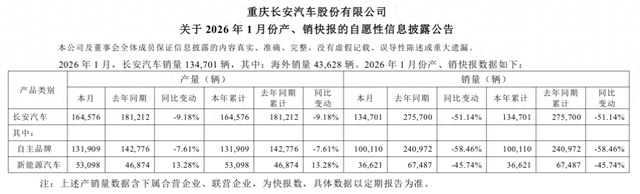
Core Viewpoint - Changan Automobile reported a significant decline in sales for January 2026, with total sales dropping by 51.14% year-on-year to 134,701 units [1][2]. Group 1: Overall Performance - In January 2026, Changan Automobile's production was 164,576 units, a decrease of 9.18% compared to the same month last year [2]. - The cumulative sales for the year so far stand at 134,701 units, reflecting the same year-on-year decline of 51.14% [2]. Group 2: Brand Performance - The main brand's sales reached 100,110 units in January 2026, down 58.46% year-on-year [2]. - The production of the main brand was 131,909 units, which is a 7.61% decrease compared to the previous year [2]. Group 3: New Energy Vehicles - New energy vehicle sales amounted to 36,621 units, showing a year-on-year decline of 45.74% [2]. - The production of new energy vehicles was 53,098 units, which represents a 13.28% increase compared to the same month last year [2].
长安汽车:公告点评电动智能化稳步推进,计划回购强信心-20260208
GUOTAI HAITONG SECURITIES· 2026-02-08 02:25
Investment Rating - The report maintains a "Buy" rating for Changan Automobile [2][5]. Core Views - Changan Automobile announced a share buyback plan of 1-2 billion yuan, reflecting strong confidence in its long-term strategic layout and intrinsic value [2][11]. - The company is steadily advancing its electrification and intelligentization strategies, with a projected total sales target of 3.3 million vehicles in 2026, representing a year-on-year increase of 13.3% [11]. - The report anticipates earnings per share (EPS) of 0.56 yuan, 0.79 yuan, and 1.01 yuan for the years 2025, 2026, and 2027, respectively [11]. Financial Summary - Total revenue is projected to grow from 151.3 billion yuan in 2023 to 234.1 billion yuan in 2027, with a compound annual growth rate (CAGR) of approximately 16.6% [4][12]. - Net profit attributable to shareholders is expected to decline from 11.3 billion yuan in 2023 to 5.5 billion yuan in 2025, before recovering to 10.0 billion yuan in 2027 [4][12]. - The company’s price-to-earnings (P/E) ratio is projected to be 20.14 in 2025, decreasing to 11.04 by 2027 [4][12]. Market Data - The stock is currently trading within a 52-week price range of 11.01 to 14.18 yuan, with a total market capitalization of 110.9 billion yuan [6]. - The report sets a target price of 13.47 yuan based on a 17x P/E ratio for 2026 [11][5]. Strategic Developments - Changan has launched a sodium-ion battery strategy, introducing its first mass-produced vehicle equipped with this technology, which offers a range of over 400 kilometers [11]. - The company is also advancing in high-level autonomous driving, having received a formal license for L3 level autonomous driving, indicating its readiness for market-scale operations [11].
长安汽车(000625):公告点评:电动智能化稳步推进,计划回购强信心
GUOTAI HAITONG SECURITIES· 2026-02-08 01:11
Investment Rating - The report maintains a "Buy" rating for Changan Automobile [2][5] Core Views - Changan Automobile announced a share buyback plan of 1-2 billion yuan, reflecting strong confidence in its long-term strategic layout and intrinsic value [2][11] - The company is steadily advancing its electrification and intelligence strategies, with a projected total sales target of 3.3 million vehicles in 2026, representing a year-on-year increase of 13.3% [11] - The report anticipates earnings per share (EPS) of 0.56 yuan, 0.79 yuan, and 1.01 yuan for the years 2025, 2026, and 2027 respectively, with a target price of 13.47 yuan based on a 17x PE ratio for 2026 [11][12] Financial Summary - Total revenue is projected to grow from 151.3 billion yuan in 2023 to 234.1 billion yuan in 2027, with a compound annual growth rate (CAGR) of approximately 16.6% [4][12] - Net profit attributable to shareholders is expected to decline from 11.3 billion yuan in 2023 to 5.5 billion yuan in 2025, before recovering to 10.0 billion yuan in 2027 [4][12] - The company’s net asset return rate is forecasted to improve from 15.8% in 2023 to 10.2% in 2027 [4][12] Sales and Production Outlook - In 2025, Changan's cumulative sales reached 2.913 million vehicles, a year-on-year increase of 8.5%, with new energy vehicle sales growing by 51.1% to 1.109 million units [11] - The company plans to enhance its new energy product lineup, targeting 1.4 million new energy vehicles in 2026, which is a 26.2% increase year-on-year [11] Strategic Developments - Changan has launched its sodium-ion battery strategy and introduced its first mass-produced vehicle equipped with this technology, aiming to enhance its competitive edge in the electric vehicle market [11] - The company is also advancing its high-level intelligent driving and robotics initiatives, having received a formal license for L3 autonomous driving, indicating its readiness for market-scale operations [11]
全球首款钠电池正式“上车”长安
Nan Fang Du Shi Bao· 2026-02-07 14:56
Core Insights - Changan Automobile recently held the Tian Shu Intelligent New Safety Achievements Release and Sodium Battery Strategy Global Launch in Yakeshi, successfully passing technical verification for extreme winter scenarios [1] Group 1: Vehicle Performance - Multiple models under Changan Automobile have achieved impressive results, with the Changan Qiyuan A06 featuring the Tian Shu Intelligent Tire Blowout Stability System, maintaining a speed of 95 km/h on icy roads, ranking first in its class [3] - The Avita 07 introduces a zero-energy catalytic range enhancement technology, improving low-temperature range achievement to 61.2%, leading the industry [3] - The Avita 12, equipped with a unique distributed electric drive system and intelligent dynamic torque control technology, successfully changed lanes at speeds of 92.3 km/h and 70.7 km/h on snow and icy roads, setting industry testing records [3] - The Avita 12 also demonstrated excellent performance in climbing icy slopes, utilizing pulse escape and four-wheel drive vector control technology to quickly extricate itself from challenging winter conditions [3] Group 2: Battery Technology - Changan has made significant advancements in battery safety by partnering with CATL to launch a sodium battery ecological solution, creating the world's first mass-produced passenger vehicle with sodium batteries [4] - The new sodium battery from CATL has an energy density of up to 175 Wh/kg, representing the highest level in the industry [4] - Vehicles equipped with the sodium battery can achieve nearly three times the discharge power at -30°C compared to conventional lithium iron phosphate models, with over 90% capacity retention at -40°C, and stable discharge even at -50°C [4] - The sodium battery has passed extreme tests, including drill penetration and cell sawing, demonstrating safety features such as no smoke or fire during these tests [4]
长安汽车发布首款钠电量产车,冬测验证智能安全与电池低温性能
Jing Ji Guan Cha Wang· 2026-02-07 12:51
Core Insights - Changan Automobile is conducting winter extreme testing in Inner Mongolia, showcasing multiple models from its brands, including Avita, Deep Blue, and Qiyuan, under extreme conditions [2] - The company has a long history of winter testing since 1998, accumulating over 58 million kilometers of testing mileage and over 4,000 vehicles [2] - Several models achieved industry records during the tests, including Avita 12 with a stable lane change speed of 92.3 km/h and Qiyuan A06 maintaining stability at 95 km/h during high-speed tire blowout tests [2] - Changan's "Tianshu Intelligent" technology system is central to these achievements, supported by significant investments in testing facilities [2] Technology and Safety Innovations - The world's first mass-produced passenger vehicle equipped with sodium-ion batteries has been developed in collaboration with CATL, featuring an energy density of 175 Wh/kg [3] - The sodium battery demonstrates superior performance in extreme cold, with discharge power nearly three times that of lithium iron phosphate batteries at -30°C and over 90% capacity retention at -40°C [3] - Changan's "New Safety" strategy is being implemented, transitioning safety from passive protection to active intelligent management [3] - The Tianshu Intelligent system aims to ensure comprehensive safety verification across all lifecycle and regional scenarios [3] Future Plans - Changan plans to launch over 50 new energy models by 2030, all equipped with the Tianshu Intelligent system [3] - The Avita 12 is set to participate in an 18-month polar verification mission in Antarctica, with further testing planned in various climates globally [3]

宁德时代纳电池首搭乘用车,首款车型为长安欧尚520
Jing Ji Guan Cha Wang· 2026-02-07 12:51
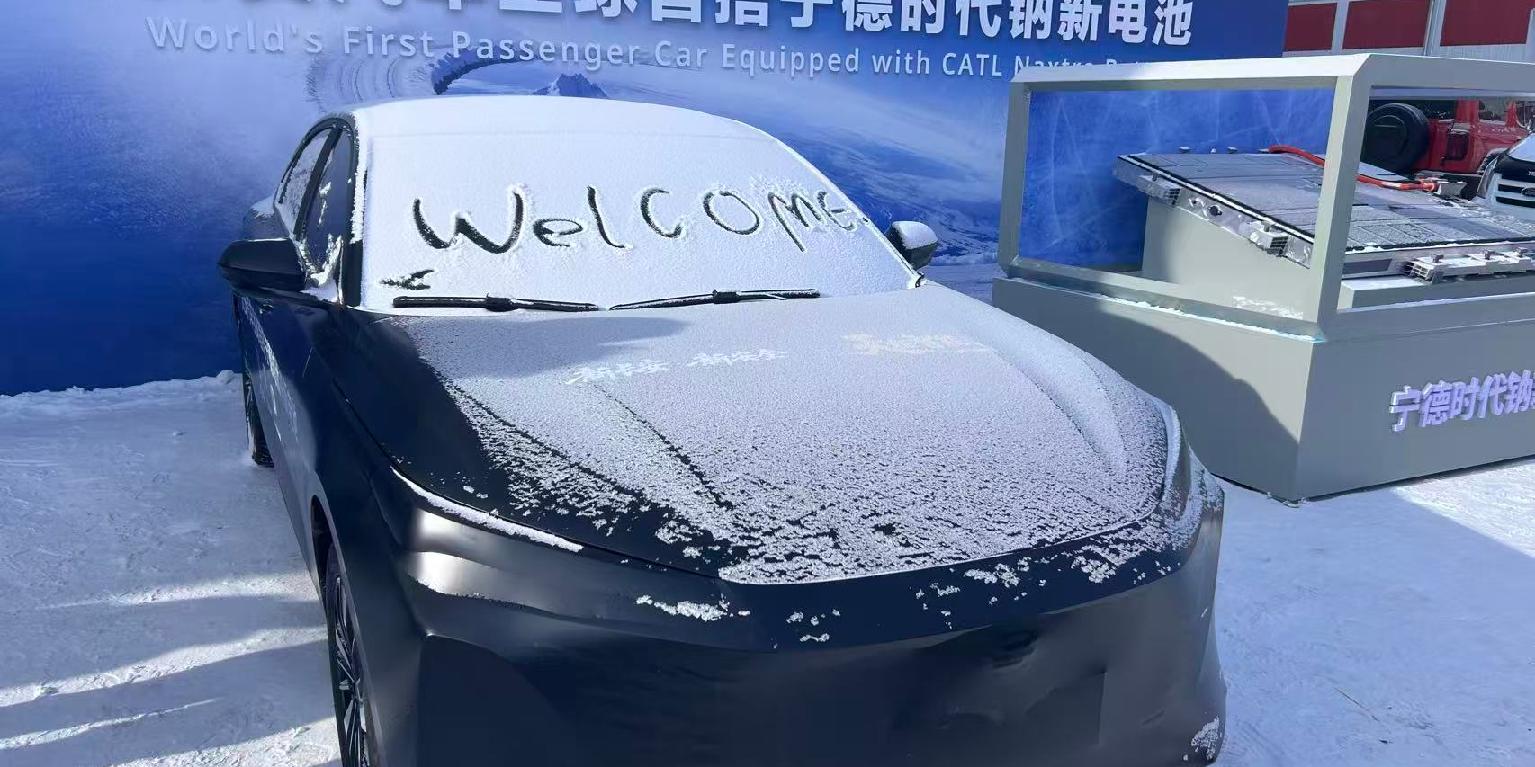
Core Viewpoint - CATL and Changan Automobile have jointly unveiled their first sodium-ion mass-produced passenger vehicle, set to launch mid-year, highlighting the sodium battery's low-temperature performance in harsh winter conditions [2][3]. Group 1: Product Launch and Features - The sodium-ion battery maintains over 90% capacity at -40°C and can discharge stably at -50°C, with an energy density of up to 175Wh/kg [3]. - The sodium battery's energy density is lower compared to lithium batteries, which range from 250-300Wh/kg for ternary lithium and 150-200Wh/kg for lithium iron phosphate [3]. - The sodium battery industry has faced slow development due to the lack of a complete supply chain and reliance on lithium battery production lines [3]. Group 2: Market Implications and Strategic Partnerships - The collaboration between CATL and Changan, a major player in the automotive industry, is expected to accelerate the adoption of sodium batteries in passenger vehicles [4]. - Changan's various brands, including Avita and Deep Blue, will incorporate CATL's sodium batteries, indicating a strategic push towards this new technology [4]. - The initial vehicle showcased at the launch was disguised, leading to speculation about its branding, but it was identified as an Oshan 520 [4]. Group 3: Consumer Acceptance and Cost Considerations - Consumer acceptance of sodium batteries is still uncertain, and Changan is cautious about using its main brands for initial launches [5]. - The cost of sodium batteries remains a concern, currently around 0.45 yuan/Wh, compared to lithium iron phosphate's cost of 0.340-0.410 yuan/Wh [5]. - Despite current challenges, sodium batteries have significant long-term market potential in various applications beyond vehicles, such as energy storage and starting batteries [5]. Group 4: Future Outlook and Industry Standards - CATL views sodium and lithium batteries as complementary technologies that can enhance the overall electric vehicle ecosystem [6]. - The sodium battery sector is entering a new phase with the implementation of standards for energy storage applications, marking a shift towards industrialization [6]. - By 2026, CATL plans to scale up sodium battery applications across multiple sectors, including energy storage and electric vehicles [6].
长安汽车:系列点评三十五股份回购彰显发展底气,智驾与全球化驱动长期成长-20260207
Guolian Minsheng Securities· 2026-02-07 10:20
Investment Rating - The report maintains a "Recommended" rating for the company [2]. Core Insights - The company has announced a share repurchase plan, demonstrating confidence in its strategic development and intrinsic value. The repurchase will utilize self-owned funds, with a total planned amount between 1 billion and 2 billion yuan, aimed at enhancing shareholder value [7]. - The company has achieved significant technological advancements, including the first L3 level autonomous driving license and the launch of new models equipped with advanced technology, reinforcing its competitive edge in the smart electric vehicle market [7]. - The company's global expansion strategy is yielding results, with operations in 117 countries and plans to introduce new models in the European market over the next three years, supported by local production capabilities [7]. Financial Forecast Summary - Projected revenue for 2024 is 159.73 billion yuan, with a growth rate of 5.6%. By 2027, revenue is expected to reach 233.54 billion yuan, with a growth rate of 11.5% [2][8]. - The net profit attributable to shareholders is forecasted to be 7.32 billion yuan in 2024, declining to 6.31 billion yuan in 2025, before rebounding to 10.94 billion yuan by 2027, reflecting a growth rate of 34.1% [2][8]. - Earnings per share (EPS) is expected to be 0.74 yuan in 2024, decreasing to 0.64 yuan in 2025, and then increasing to 1.10 yuan by 2027 [2][8].
长安汽车(000625):系列点评三十五:股份回购彰显发展底气,智驾与全球化驱动长期成长
Guolian Minsheng Securities· 2026-02-07 09:52
Investment Rating - The report maintains a "Buy" rating for Changan Automobile (000625.SZ) [2] Core Insights - The company's share buyback plan, with a total investment of no less than 1 billion and no more than 2 billion yuan, reflects its confidence in long-term development and financial stability [7] - Changan's technological advancements in autonomous driving and global expansion are expected to drive long-term growth [7] - The company aims to enhance shareholder value through capital reduction and improved earnings per share [7] Financial Forecast Summary - Projected revenue for 2024 is 159.73 billion yuan, with a growth rate of 5.6%, increasing to 233.54 billion yuan by 2027 with a growth rate of 11.5% [2][8] - Net profit attributable to shareholders is forecasted to be 7.32 billion yuan in 2024, declining to 6.31 billion yuan in 2025, before rising to 10.94 billion yuan by 2027 [2][8] - Earnings per share (EPS) is expected to be 0.74 yuan in 2024, decreasing to 0.64 yuan in 2025, and then increasing to 1.10 yuan by 2027 [2][8] - The price-to-earnings (PE) ratio is projected to be 15 in 2024, decreasing to 10 by 2027 [2][8] Strategic Developments - Changan has achieved significant milestones in autonomous driving technology, including obtaining the first batch of L3 level autonomous driving licenses [7] - The company is expanding its global footprint, with operations in 117 countries and plans to launch 8 new models in Europe over the next three years [7] - Collaborations with major partners like Huawei and CATL are enhancing Changan's technological capabilities and product offerings [7]