
GREE(000651)

Search documents
格力电器:不存在应披露而未披露的重大信息
Zheng Quan Ri Bao Wang· 2025-09-11 10:44
Core Viewpoint - Gree Electric Appliances (000651) stated that its stock price fluctuations are influenced by multiple factors including industry cycles, short-term performance, and market expectations [1] Summary by Relevant Categories Company Information - The company strictly adheres to relevant laws and regulations regarding information disclosure and confirms that there are no significant undisclosed matters [1]

行业投资策略报告:红利为正,新品类为奇-20250911
CAITONG SECURITIES· 2025-09-11 10:29
Core Insights - The home appliance industry shows steady revenue growth with a net profit margin stability, with 1H2025 revenue and net profit reaching 868.5 billion and 70.3 billion yuan, respectively, representing year-on-year increases of 8.4% and 12.9% [5][11][15] - The white goods sector demonstrates robust growth, particularly in domestic sales, with significant increases in air conditioning, refrigerators, and washing machines, while export growth has slowed [5][27][35] - The small appliance sector, especially cleaning appliances, has seen rapid growth, with revenues increasing by 28.4% year-on-year, while traditional small appliances face challenges [5][45][47] Industry Overview - The overall revenue and net profit of the home appliance sector increased, with a gross margin of 24.1% and a net profit margin of 8.1% in 1H2025, showing a slight decline in gross margin but an increase in net profit margin compared to the previous year [5][11][12] - The operating cash flow improved significantly, reaching 93.7 billion yuan, a year-on-year increase of 51.1% [11][12] White Goods Sector - The white goods sector's revenue and net profit for 2Q2025 increased by 13.8% and 5.9% year-on-year, respectively, although growth rates have slowed compared to 1Q2025 [35][37] - Domestic sales for air conditioning, refrigerators, and washing machines showed notable growth, with air conditioning sales reaching 39.2 million units, up 12% year-on-year [27][28][32] Small Appliances Sector - The cleaning appliance segment has experienced rapid growth, with key players like Ecovacs and Roborock showing year-on-year revenue increases of 37.6% and 73.8%, respectively [45][46] - Traditional small appliances are under pressure, with a slight decline in revenue, highlighting a shift in consumer preference towards cleaning appliances [45][47] Black Goods Sector - The black goods sector reported stable revenue growth of 1.8% in 2Q2025, but net profit declined by 9.0%, indicating pressure on profitability [53] - Haier Vision led the sector with revenue and net profit growth of 8.6% and 36.8%, respectively, outperforming competitors [53] Investment Recommendations - The report suggests focusing on companies with strong domestic and overseas sales growth, particularly in the cleaning appliance category and those with robust supply chains and manufacturing capabilities [5][21][45] - Key companies to watch include Midea Group, Haier Smart Home, Gree Electric, and Ecovacs in the small appliance sector [5][17]





家电行业2025年中报总结:家电收入利润延续增长关税扰动逐渐明晰
Shenwan Hongyuan Securities· 2025-09-11 09:23
Investment Rating - The report maintains a positive investment outlook for the home appliance industry, highlighting three main investment themes: white goods, export opportunities, and core components [4][5][6]. Core Insights - The home appliance industry experienced a revenue growth of 7.34% year-on-year in Q2 2025, with total revenue reaching 482.5 billion yuan. Net profit increased by 3.14% to 37.41 billion yuan [4][15][18]. - The report identifies a divergence in performance among sub-sectors, with white goods showing steady growth, while kitchen appliances faced declines in both revenue and profit [4][38][43]. Summary by Sections 1. Industry Performance Overview - The home appliance sector underperformed the market, with a decline of 5.3% from April to June 2025, lagging behind the 1.3% increase in the CSI 300 index [10][11]. 2. Q2 2025 Revenue and Profit Trends - The home appliance industry saw a total revenue of 482.5 billion yuan, marking a 7.34% increase year-on-year. The net profit for the same period was 37.41 billion yuan, reflecting a 3.14% growth [4][15][18]. 3. Sub-sector Performance 3.1 White Goods - White goods revenue reached 300.21 billion yuan, growing by 5.81% year-on-year, while net profit was 30.38 billion yuan, with a growth rate of 5.86% [38][39]. 3.2 Kitchen Appliances - Kitchen appliance revenue fell by 8.36% to 7.944 billion yuan, with net profit declining by 13.80% to 0.813 billion yuan [43][44]. 3.3 Small Appliances - Small appliances achieved a revenue increase of 14.10% to 37.23 billion yuan, but net profit decreased by 14.68% to 2.599 billion yuan [49][50]. 3.4 Black Goods - Black goods revenue grew by 8.23% to 100.34 billion yuan, with net profit increasing by 13.93% to 1.342 billion yuan [53][55]. 3.5 Components - The components sector reported a revenue increase of 15.74% to 36.739 billion yuan, with net profit rising by 14.38% to 2.278 billion yuan [58][61]. 4. Key Investment Targets - The report recommends focusing on leading companies in the white goods sector, export-oriented firms, and key component manufacturers, highlighting their potential for growth amid favorable market conditions [4][5][6].
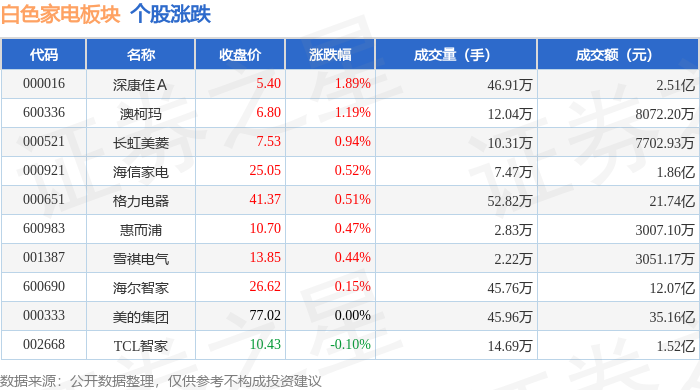
白色家电板块9月11日涨0.19%,深康佳A领涨,主力资金净流入4203.17万元
Zheng Xing Xing Ye Ri Bao· 2025-09-11 08:43
Market Overview - On September 11, the white goods sector rose by 0.19% compared to the previous trading day, with Shenzhen Konka A leading the gains [1] - The Shanghai Composite Index closed at 3875.31, up 1.65%, while the Shenzhen Component Index closed at 12979.89, up 3.36% [1] Stock Performance - Key stocks in the white goods sector showed varied performance: - Shenzhen Konka A: Closed at 5.40, up 1.89% with a trading volume of 469,100 shares and a turnover of 251 million [1] - Aucma: Closed at 6.80, up 1.19% with a trading volume of 120,400 shares and a turnover of 80.72 million [1] - Changhong Meiling: Closed at 7.53, up 0.94% with a trading volume of 103,100 shares and a turnover of 77.03 million [1] - Hisense Home Appliances: Closed at 25.05, up 0.52% with a trading volume of 74,700 shares and a turnover of 186 million [1] - Gree Electric Appliances: Closed at 41.37, up 0.51% with a trading volume of 528,200 shares and a turnover of 2.174 billion [1] - Whirlpool: Closed at 10.70, up 0.47% with a trading volume of 28,300 shares and a turnover of 30.07 million [1] - Midea Group: Closed at 77.02, unchanged with a trading volume of 459,600 shares and a turnover of 3.516 billion [1] Capital Flow - The white goods sector experienced a net inflow of 42.03 million from main funds, while retail funds saw a net inflow of 12.8 million [1] - Notable capital flows for specific companies include: - Haier Smart Home: Main funds net inflow of 10.4 million, retail funds net outflow of 64.02 million [2] - Shenzhen Konka A: Main funds net inflow of 31.45 million, retail funds net outflow of 22.25 million [2] - Midea Group: Main funds net inflow of 20.70 million, retail funds net inflow of 71.68 million [2]


家电行业2025年中报总结:家电收入利润延续增长,关税扰动逐渐明晰
Shenwan Hongyuan Securities· 2025-09-11 05:44
Investment Rating - The report maintains a positive outlook on the home appliance industry, indicating a "Look Forward" investment rating for 2025 [3][5]. Core Insights - The home appliance industry experienced a year-on-year revenue growth of 7.34% in Q2 2025, with total revenue reaching 482.5 billion yuan [4][19]. - The net profit for the industry in Q2 2025 was 37.41 billion yuan, reflecting a year-on-year increase of 3.14% [4][22]. - The report identifies three main investment themes: 1) White goods benefiting from real estate policy changes and trade-in incentives; 2) Export opportunities driven by large customer orders; 3) Core components seeing increased demand due to the favorable market conditions for white goods [4][6]. Summary by Sections 1. Industry Performance Overview - The home appliance sector underperformed the market, with a decline of 5.3% from April 1 to June 30, 2025, compared to a 1.3% increase in the CSI 300 index [14][18]. 2. Q2 2025 Home Appliance Industry Performance - Revenue growth of 7.34% year-on-year, with total revenue of 482.5 billion yuan [4][19]. - Net profit growth of 3.14% year-on-year, totaling 37.41 billion yuan [4][22]. - The gross margin decreased by 1.36 percentage points to 23.21% [25]. 3. Sub-Industry Performance 3.1 White Goods - Revenue reached 300.21 billion yuan, growing by 5.81% year-on-year [41]. - Net profit was 30.38 billion yuan, with a year-on-year growth of 5.86% [42]. 3.2 Kitchen Appliances - Revenue declined by 8.36% to 7.944 billion yuan, with net profit down 13.80% to 0.813 billion yuan [46]. 3.3 Small Appliances - Revenue increased by 14.10% to 37.23 billion yuan, but net profit fell by 14.68% to 2.599 billion yuan [51]. 3.4 Black Goods - Revenue grew by 8.23% to 100.34 billion yuan, with net profit increasing by 13.93% to 1.342 billion yuan [55]. 4. Key Investment Targets - The report recommends investing in leading companies in the white goods sector, such as Hisense, Midea, Haier, and Gree, due to their favorable valuation and growth potential [4][5][6].
格力渠道大洗牌:核心代理商时代将落幕
Di Yi Cai Jing· 2025-09-10 12:14
Core Viewpoint - Gree Electric Appliances is undergoing a significant transformation in its distribution channels, shifting from a model reliant on core agents to a more streamlined and digital approach, which aims to enhance control over retail channels and improve market responsiveness [2][6][8]. Distribution Channel Transformation - Gree has transitioned its online procurement system from the "Shengshi" series to the newly established "Hengxin" series, indicating a move towards a flatter distribution model that reduces reliance on traditional agents [2][3]. - The new "Hengxin" series companies are primarily composed of professional managers associated with Gree, contrasting with the previous model that was heavily tied to core agents [4][7]. - This change is expected to simplify the sales process, reduce costs, and enhance competitiveness by eliminating layers of pricing that previously inflated retail prices [6][8]. Market Response and Sales Strategy - Gree's new retail model is currently in a transitional phase, with both traditional and online procurement systems operating simultaneously [7][11]. - The company aims to expand its product categories beyond air conditioners to include refrigerators, washing machines, and water purifiers, thereby diversifying its revenue streams [8][9]. - Recent reports indicate that the procurement prices for mid-range air conditioners have decreased by approximately 10% year-on-year, reflecting the impact of the new model [7]. Financial Performance and Competitive Landscape - Gree's revenue for the first half of 2025 was reported at 97.325 billion yuan, a decrease of 2.46% year-on-year, while net profit increased by 1.95% [9]. - The company faces increasing competition in the home appliance market, necessitating a shift from its traditional air conditioning business to other product lines to sustain growth [9][10]. - Competitors like Midea and Haier have already made significant strides in digital channel transformation, which Gree is now striving to catch up with [9][10]. Future Trends in Retail - The future of retail for Gree is expected to focus on "factory sales" and experiential retail, emphasizing direct consumer engagement and reducing intermediary costs [11][12]. - Gree is enhancing its offline channels to improve customer experience and integrate online and offline sales processes, aiming for a more cohesive retail strategy [12].
“消失”的10大国产手机品牌
创业邦· 2025-09-10 10:31
Core Viewpoint - The article discusses the evolution and decline of various Chinese mobile phone brands, highlighting the competitive landscape and the challenges faced by companies like Waveguide, Gionee, and Meitu, while also emphasizing the rise of new leaders in the industry. Group 1: Market Dynamics - Huawei and Apple are in direct competition, with Huawei's Mate XT and Apple's iPhone 17 series launching in September [6][10] - The latest IDC report indicates that by Q2 2025, Huawei is expected to regain the top position in the domestic market with an 18.1% share, followed closely by Vivo and OPPO [9][10] - The combined market share of Huawei, Xiaomi, OPPO, and Vivo accounts for approximately 66% of the Chinese smartphone market, indicating a strong domestic presence [10] Group 2: Historical Context - Over the past 20 years, more than 87 mobile phone brands have disappeared in China, with a survival rate of less than 15% [11] - Waveguide was the first Chinese brand to gain significant market share in the feature phone era, achieving sales of 700,000 units in 2000 and becoming the top domestic brand for four consecutive years [19] - The launch of the first iPhone in 2007 marked a significant shift in the mobile phone industry, leading to the decline of feature phone giants like Nokia [21][23] Group 3: Brand Decline - Gionee, once a leader in the market, faced a decline due to late entry into the smartphone segment and poor product reception, leading to its eventual bankruptcy in 2018 [27][28] - Meitu and Douwai targeted the female market but failed to maintain their competitive edge as other brands improved their camera technology and overall value [30][37] - The entry of cross-industry players like Haier and Gree into the smartphone market was marked by poor performance and eventual exit due to lack of market presence [40][41] Group 4: Lessons Learned - The article emphasizes that successful marketing and distribution strategies alone are insufficient; companies must also focus on technology and innovation to survive in the competitive landscape [28][49] - The experiences of brands like Meizu and Smartisan illustrate the risks of prioritizing product aesthetics over market demands and operational capabilities [50][57] - The evolution of the smartphone industry in China reflects a shift from following global trends to establishing new standards and innovations [66][67]




2025H1家电行业财报综述:稳中有进
Guolian Minsheng Securities· 2025-09-10 07:13
Investment Rating - The report maintains an "Outperform" rating for the home appliance industry [8][15]. Core Insights - The home appliance sector shows steady growth, with white goods domestic sales improving and external tariff impacts becoming evident. Leading brands demonstrate resilience, while cleaning product leaders experience high growth. Increased marketing expenses in discretionary categories have led to a slight decline in profitability. Future outlook suggests that trade-in programs will support domestic demand, and leading brands along with emerging categories will contribute to revenue growth, indicating investment value [4][15]. Summary by Sections Overall Performance - In Q2 2025, the home appliance sector's revenue increased by 4.78% year-on-year to 431.5 billion yuan, with a net profit attributable to shareholders rising by 3.38% to 38.1 billion yuan. The first half of 2025 saw revenue growth of 8.59% to 842.6 billion yuan and net profit growth of 11.23% to 71.2 billion yuan. The cost environment improved due to a decline in raw material prices and shipping costs [19][29]. White Goods - The white goods segment's revenue grew by 4.64% year-on-year to 303.2 billion yuan in Q2 2025, with net profit increasing by 6.08% to 30.6 billion yuan. Domestic demand is supported by favorable policies and high temperatures driving air conditioning needs. However, external sales showed weakness due to tariff impacts [10][20]. Black Goods - The black goods segment reported a revenue increase of 5.81% year-on-year to 50.8 billion yuan, but net profit decreased by 1.04% to 1.0 billion yuan. The segment faced challenges from fluctuating U.S. tariff policies and varying performance between self-owned brands and OEMs [11][29]. Kitchen Appliances - Kitchen appliance revenue declined by 6.95% year-on-year to 12.4 billion yuan, with net profit down by 16.75% to 1.96 billion yuan. The decline is attributed to sluggish real estate conditions and increased difficulty in subsidy applications [12][19]. Smart Home - The smart home segment experienced a significant revenue increase of 32.09% year-on-year to 12.6 billion yuan, although net profit fell by 12.95% to 1.0 billion yuan due to increased marketing expenditures [13][19]. Traditional Small Appliances - Revenue for traditional small appliances decreased by 0.69% year-on-year to 23.1 billion yuan, with net profit down by 12.44% to 1.3 billion yuan. The segment faced challenges from changing tariff policies and reduced external demand [14][19]. Upstream Performance - The upstream sector saw a revenue increase of 5.07% year-on-year to 29.5 billion yuan, with net profit rising by 12.56% to 2.2 billion yuan. The upstream segment's profitability improved due to better cost management [19][25].
电子、非银等权重行业领涨,大湾区ETF投资机会备受关注
Xin Lang Cai Jing· 2025-09-10 05:55
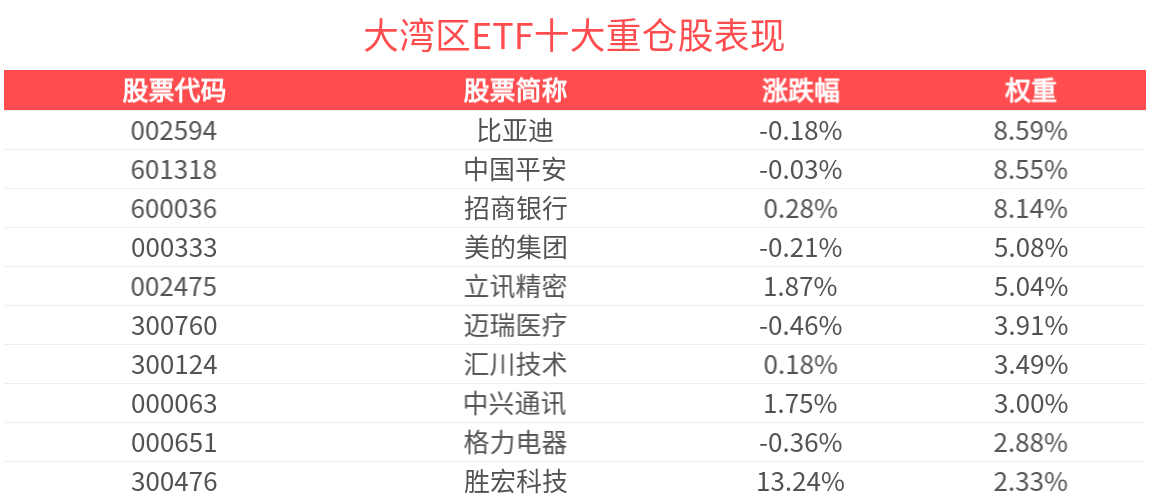
Core Insights - The China Securities Index for the Guangdong-Hong Kong-Macao Greater Bay Area (931000) has shown a strong increase of 1.10% as of September 10, 2025, with notable gains in constituent stocks such as Shenghong Technology (300476) up by 13.24% and Industrial Fulian (601138) up by 10.00% [1] Performance Summary - The Greater Bay Area ETF (512970) has risen by 0.92%, with a latest price of 1.43 yuan, and has accumulated a 9.48% increase over the past month as of September 9, 2025 [1] - Over the past year, the Greater Bay Area ETF has seen a net value increase of 47.70%, with the highest single-month return recorded at 21.99% and the longest consecutive monthly gain lasting 4 months with a total increase of 26.18% [1] - The average monthly return during the rising months is 5.38%, and the ETF has outperformed its benchmark with an annualized excess return of 8.81% over the last three months [1] Liquidity and Trading Activity - The trading volume for the Greater Bay Area ETF was 3.68 million yuan with a turnover rate of 0.04% as of September 9, 2025, and the average daily trading volume over the past month was 748,200 yuan [1] Risk and Fee Structure - The Greater Bay Area ETF has a management fee rate of 0.15% and a custody fee rate of 0.05% [2] Tracking Accuracy - The tracking error for the Greater Bay Area ETF was 0.029% over the past month, indicating a close alignment with the underlying index [3] Top Holdings - As of August 29, 2025, the top ten weighted stocks in the index include China Ping An (601318), BYD (002594), and China Merchants Bank (600036), collectively accounting for 49.06% of the index [4]





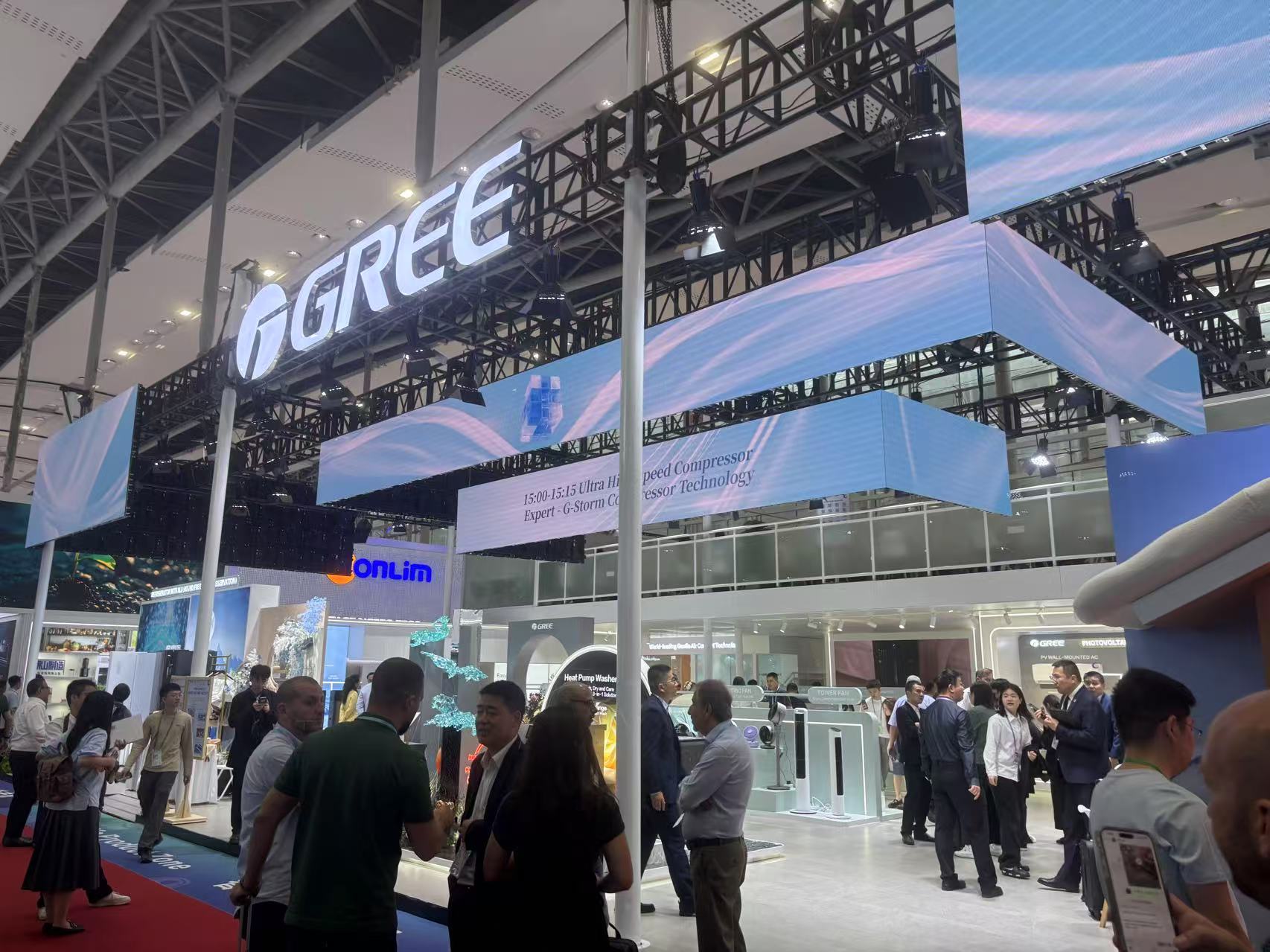
格力电器2025半年报发布,净利润、海外业务创新高
Jing Ji Wang· 2025-09-08 03:03
Financial Performance - Gree Electric's total revenue for the first half of 2025 was 97.619 billion yuan, a year-on-year decrease of 2.66% [1] - The net profit attributable to shareholders was 14.412 billion yuan, an increase of 1.95% year-on-year [1] - Revenue from industrial products and green energy, as well as smart equipment, grew by 17.13% and 20.90% respectively [2] Innovation and R&D - Gree increased its R&D investment by 7.05% in the first half of 2025, reflecting its commitment to technological innovation [2] - New product launches included advanced air conditioning systems and smart home appliances, showcasing Gree's latest R&D achievements [2] - Gree's self-developed CNC machine tool won a gold medal at the 50th Geneva International Invention Exhibition, highlighting its innovation capabilities [2] International Expansion - Gree's overseas business revenue reached 16.335 billion yuan, a year-on-year increase of 10.19%, marking a historical high [3] - The proportion of Gree's self-branded products in total exports rose from 30% in 2015 to 70% currently, with over 85% of exports going to Belt and Road Initiative countries [3] - The establishment of Gree's Singapore office aligns with its global strategy and enhances its brand presence in the ASEAN market [3] Standardization and Sustainability - Gree led the development of two international standards for refrigeration compressors, marking a significant achievement in the ISO standards landscape [4] - The company has processed over 69.72 million units of discarded electrical and electronic products, contributing to significant reductions in carbon emissions [5] Social Responsibility - Gree hired 5,467 college graduates in the first half of 2025, addressing employment challenges for new graduates [6] - The company has actively participated in rural infrastructure projects, improving living conditions for rural residents [6] - Gree received national honors for its contributions to green development and social responsibility, reinforcing its role as an industry leader [6]