GREE(000651)

Search documents
一天两起车辆起火事件!小米回应:动力电池均处于正常状态;俞敏洪宣布聘请陈行甲,年薪150万;日本电视荣光不再!TCL拟控股索尼电视业务
雷峰网· 2026-01-21 00:26
Key Points - Sony officially announced the spin-off of its television business, forming a joint venture with TCL, where TCL will hold 51% and Sony 49% [4][5] - The new company will manage the entire global operations of television and home audio equipment, with plans to start operations by April 2027, pending regulatory approvals [4][5] - Sony's market share in China has significantly declined, with foreign brands collectively holding less than 5% of the market share in 2024, averaging around 1.25% each [4][5] - The overall shipment of televisions in China is projected to drop by 8.5% in 2025, reaching a new low since 2010, with the top eight brands dominating 94.1% of the market [5] - Xiaomi responded to two vehicle fire incidents, stating that the power batteries were functioning normally at the time of the incidents [10][11] - MiHoYo announced the closure of the Genshin Impact server operated in partnership with Xiaomi, effective January 20, 2025, due to strategic adjustments [12] - New Oriental's founder, Yu Minhong, announced the hiring of Chen Xingjia as a consultant with an annual salary of 1.5 million RMB, amidst controversy over high salaries in the nonprofit sector [7][8] - The mobile phone market in China for 2025 shows Vivo, Xiaomi, and Apple as the top three brands by activation volume, with Xiaomi's growth attributed to the success of its 17 series [21][22] - Hikvision reported a slight increase in revenue for 2025, achieving 92.517 billion RMB, with a net profit of 14.188 billion RMB, reflecting a growth of 18.46% year-on-year [30]






俞敏洪聘请陈行甲为新东方总顾问,年薪150万元;马斯克称推动特斯拉转型为机器人公司,估值25万亿美元;SK海力士发放巨额年终奖丨邦早报
创业邦· 2026-01-21 00:08
Group 1 - New Oriental Education Technology Group has appointed Chen Xingjia as a senior consultant with an annual salary of 1.5 million RMB, following public scrutiny over his previous salary exceeding 700,000 RMB [2][3] - New Oriental commits to donating no less than 1 million RMB annually to the Henghui Foundation, which focuses on the health and growth of Chinese youth [2][3] Group 2 - SK Hynix announced a record performance bonus of over 1.36 million KRW (approximately 640,000 RMB) per employee, marking the highest in the company's history, with a stock option plan for employees [4] - The stock option plan allows employees to receive up to 50% of their bonuses in company stock, with additional cash rewards for holding the stock for a year [4] Group 3 - Gree Electric Appliances is set to mass-produce silicon carbide chips for various applications, including photovoltaic storage and logistics vehicles, with plans to supply half of the chips for GAC Group's vehicles [7] - The company aims to enhance its semiconductor capabilities in the growing electric vehicle market [7] Group 4 - iQIYI announced the resignation of CFO Wang Jun for personal reasons, with senior vice president Zeng Ying taking over as acting CFO [11] - iQIYI is in the process of selecting a suitable candidate for the CFO position [11] Group 5 - The AI companionship company Nature Select has raised over 30 million USD in a recent funding round, with investments from Alibaba and Ant Group among others [13] - The funding will support the development of AI companionship products [13] Group 6 - Tesla's CEO Elon Musk is pushing for the company to transition into a robotics firm, with the Optimus humanoid robot as a key focus, despite production challenges [9] - The company aims for a valuation of 25 trillion USD based on its robotics division, which is expected to surpass its current automotive business [9]



8点1氪:小米通报两起汽车起火事件;嫣然基金会已筹款超2300万;信用卡分期还款能享受财政贴息
36氪· 2026-01-21 00:05
Group 1 - Xiaomi reported two incidents of vehicle fires, emphasizing that the battery status was normal during both events [3][5] - In the first incident on January 19, a vehicle in Haikou experienced a fire shortly after being parked, but no injuries were reported [3] - The second incident involved a collision on a highway in Henan, where the vehicle caught fire after the accident, with no casualties [5] Group 2 - Gree Electric plans to mass-produce silicon carbide chips for automotive use, with expectations that half of the chips used by GAC Group will come from Gree [4] - The company is expanding its production capabilities to include chips for photovoltaic storage and logistics vehicles [4] Group 3 - OpenAI's CFO announced that the company's annual revenue for 2025 is projected to exceed $20 billion, a significant increase from $6 billion in 2024 [16] - The growth is attributed to the expansion of computing capabilities and the introduction of advertising in ChatGPT [16] Group 4 - Hikvision reported a net profit of 14.188 billion yuan for 2025, representing an 18.46% year-on-year increase [22] - The company's total revenue reached 92.518 billion yuan, with a slight growth of 0.02% [22] Group 5 - Zhaoyan New Drug expects a significant increase in net profit for 2025, projecting a rise of approximately 214% to 371% [23] - The company anticipates a decrease in revenue, estimating between 1.573 billion to 1.738 billion yuan, a decline of about 13.90% to 22.10% [23] Group 6 - Hongyuan Green Energy forecasts a turnaround in net profit for 2025, estimating between 180 million to 250 million yuan [24] - The improvement is attributed to a vertically integrated supply chain and the sale of equity in a subsidiary, contributing approximately 291 million yuan to profits [24] Group 7 - Bright Dairy expects a net loss of 120 million to 180 million yuan for 2025, a significant decline from a profit of 722 million yuan in the previous year [25] - The loss is primarily due to production issues at its overseas subsidiary, leading to increased costs and inventory write-offs [25]




8点1氪丨小米通报两起汽车起火事件;嫣然基金会已筹款超2300万;信用卡分期还款能享受财政贴息
3 6 Ke· 2026-01-21 00:03
Group 1 - Xiaomi reported two incidents of car fires involving its vehicles, with no injuries reported. The first incident occurred in Haikou, where a vehicle caught fire shortly after being parked, and the second incident involved a collision in Henan, which also resulted in a fire after the vehicle was safely pulled over [1][2][3] - Gree Electric plans to mass-produce silicon carbide chips for automotive applications, with the CEO stating that half of the chips used by GAC Group in the future will be supplied by Gree [5][6] - The Renminbi cash payment regulations will take effect on February 1, 2026, prohibiting the refusal of cash payments and allowing the public to report discriminatory practices against cash [8][9] Group 2 - The personal consumption loan subsidy policy has been extended until the end of 2026, with credit card installment payments now included in the subsidy program [2][3] - The charity organization, Yanyuan Foundation, has raised over 23 million yuan for medical assistance to patients, with funds being allocated based on donor specifications [2] - HSBC's market value is approaching 300 billion pounds, with expectations of significant stock price increases [11]


珠海格力电器股份有限公司 关于第三期员工持股计划锁定期届满且继续履行自愿锁定期承诺的公告
Zhong Guo Zheng Quan Bao - Zhong Zheng Wang· 2026-01-20 23:30
本公司及董事会全体成员保证信息披露的内容真实、准确、完整,没有虚假记载、误导性陈述或重大遗 漏。 珠海格力电器股份有限公司(以下简称"公司")于2024年8月2日召开第十二届董事会第十九次会议、第 十二届监事会第十六次会议,审议通过了《关于〈珠海格力电器股份有限公司第三期员工持股计划(草 案)〉的议案》(以下简称《草案》)等相关议案,并于2024年8月19日召开2024年第一次临时股东大 会审议通过了《关于〈珠海格力电器股份有限公司第三期员工持股计划(草案)〉的议案》等相关议 案,同意公司实施第三期员工持股计划(以下简称"本员工持股计划")。具体内容详见公司在巨潮资讯 网披露的相关公告。 根据中国证监会《关于上市公司实施员工持股计划试点的指导意见》《深圳证券交易所上市公司自律监 管指引第1号一一主板上市公司规范运作》及公司《草案》的相关规定,公司本员工持股计划锁定期于 2026年1月20日届满。同时,本员工持股计划持有人承诺在2034年5月1日前,因本员工持股计划股票权 益过户至个人证券账户而直接持有的股票,未经工会事先书面确认,不得自行出售或设定质押,否则工 会有权收回其对应的股份收益(统称"自愿锁定期承诺 ...
财经早报:国家发改委研究扩大内需战略实施方案,美国”股债汇“三杀来袭!丨2026年1月21日
Xin Lang Cai Jing· 2026-01-20 23:29
Group 1 - The National Development and Reform Commission (NDRC) plans to implement a strategy to expand domestic demand from 2026 to 2030, addressing the current issue of weak demand in the economy [2][50] - The NDRC aims to strengthen the domestic circulation of the economy and enhance the resilience of economic operations by 2025 [2][50] - The NDRC is also working on policies to promote consumption, stabilize investment, and cultivate emerging industries as part of the "14th Five-Year Plan" [58] Group 2 - Six departments, including the Ministry of Finance, have extended tax and fee incentives for the elderly care, childcare, and domestic service sectors until December 31, 2027, to support the development of community family services [3][51] - The tax incentives were first introduced in June 2019 and have been viewed as a significant support measure for the industry [3][51] Group 3 - The semiconductor company Nexperia is currently involved in a control dispute, with a court hearing held in Amsterdam regarding its management and ownership [16][64] - The dispute involves Nexperia's temporary European management and its sole shareholder, Wingtech Technology from China, following a government order that temporarily froze the company's operations [16][64] Group 4 - The stock market has experienced significant volatility, with major indices like the Dow Jones dropping over 870 points due to new tariff threats from the U.S. [10][59] - Nvidia's market value decreased by approximately $195.6 billion (around 1361.7 billion RMB) in a single day, reflecting the broader impact on technology stocks [11][60] Group 5 - Several companies are reporting substantial profit increases for 2025, with notable projections including: - Langzi Co., Ltd. expecting a net profit increase of 245.25% to 302.8% [69] - Zhaoyan New Drug forecasting a net profit increase of 214% to 371% [70] - Huachen Equipment projecting a net profit increase of 193.64% to 242.04% [71] - Other companies like Qianyuan Power and Jin Fang Energy are also expecting significant profit growth, with projections of 160% to 190% and 123.97% to 193.7% respectively [72][73]



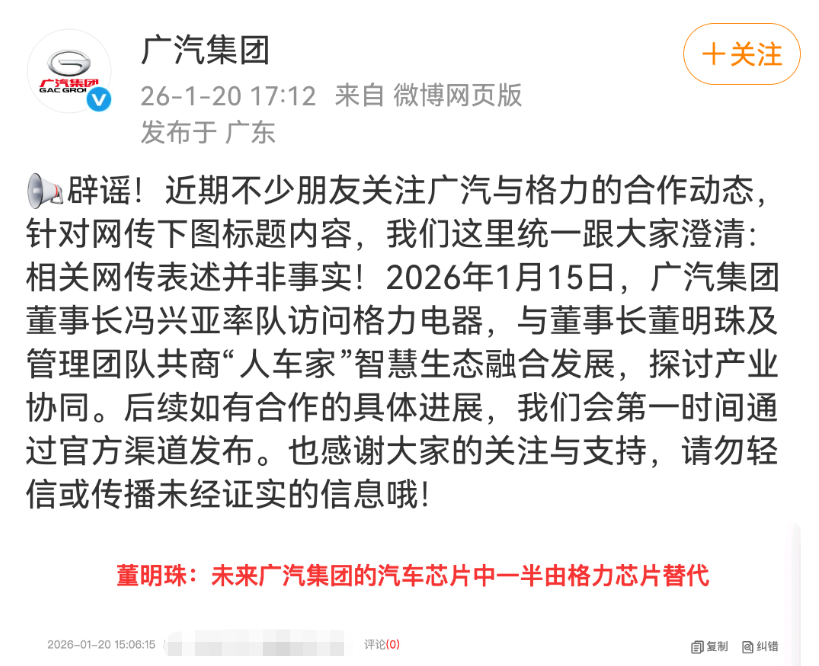
广汽紧急辟谣:“未来广汽汽车芯片一半由格力产品替代”的说法不属实
Zhong Guo Ji Jin Bao· 2026-01-20 21:12
Core Viewpoint - GAC Group officially refuted claims that "half of the automotive chips in future GAC vehicles will be replaced by Gree products," stating that such assertions are not true [2][3]. Group 1: Company Statements - On January 15, GAC Group Chairman Feng Xingya visited Gree Electric, where Gree Chairman Dong Mingzhu did not mention any chip collaboration during their discussions [3]. - GAC Group emphasized that the discussions focused on "smart integration of people, vehicles, and homes," and industry collaboration [3][4]. - GAC Group will announce any specific progress regarding cooperation with Gree through official channels [7]. Group 2: Industry Context - Both GAC Group and Gree Electric are involved in the chip business, with Gree planning to mass-produce silicon carbide chips for various applications by 2026 [8]. - Gree's subsidiary, Zhuhai Gree Electronics Components Co., is engaged in manufacturing third-generation semiconductor silicon carbide wafers and has capabilities for producing reliable household and automotive-grade chips [9]. - GAC Group has developed a comprehensive automotive chip product matrix, launching 12 types of automotive chips covering various fields, and initiated a collaborative ecosystem for automotive chips with multiple partners [9].
制造业企业加速向“智”迈进
Zheng Quan Ri Bao· 2026-01-20 16:25
Core Insights - The exhibition "Building a Strong Nation Road - Achievements of China's Manufacturing during the 14th Five-Year Plan" showcases significant advancements in China's manufacturing sector, particularly in core technologies, industrial foundations, and innovation ecosystems [1] - During the 14th Five-Year Plan, China's manufacturing industry has enhanced its role as a "ballast," with steady increases in innovation investment and optimization of industrial structure [1] - By the end of 2025, China aims to establish 4.83 million 5G base stations and achieve an artificial intelligence core industry scale exceeding 900 billion yuan [1] Company Highlights - Gree Electric Appliances, a representative of China's manufacturing enterprises, has established three core areas: "Industrial Foundation," "Intelligent Manufacturing," and "Better Life" [1] - Gree's leading intelligent factory has achieved a 200% increase in production efficiency compared to traditional factories, with a digital coverage rate of 100% [1] - The factory employs over 2,000 industrial robots, all developed in-house, to perform critical tasks such as welding [2] Technological Breakthroughs - A significant number of key core technologies in China's manufacturing sector have achieved breakthroughs, impacting various supply chains including new materials and basic components [3] - Taiyuan Iron and Steel Group has developed the world's thinnest stainless steel foil, measuring only 0.015 mm, which is used in high-end applications like foldable smartphones and electric vehicle batteries [3][4] - The "Cangyuan" shield machine, with a diameter of 16.66 meters and a domestic technology localization rate of 98%, represents a major achievement in China's construction machinery [4] Financial and Industrial Development - The integration of technological and industrial innovation is driving China's manufacturing sector from large to strong [4] - The Ministry of Industry and Information Technology reported that financing cooperation has deepened, with a cumulative financing amount exceeding 1.3 trillion yuan, providing strong financial support for "Chinese Intelligent Manufacturing" and the modernization of the industrial system [4]
广汽,紧急辟谣!
Zhong Guo Ji Jin Bao· 2026-01-20 14:49
Core Viewpoint - GAC Group officially refuted rumors that half of its automotive chips will be replaced by products from Gree Electric, clarifying that this statement is not true [1] Group 1: Company Statements - On January 15, GAC Group's Chairman, Feng Xingya, visited Gree Electric, where discussions focused on the integration of "people, vehicles, and home" for smart ecological development and industrial collaboration [2] - Both Feng Xingya and Gree Electric's Chairman, Dong Mingzhu, shared insights on their discussions via social media, emphasizing deep exchanges on industrial synergy and full-scenario integration [2][4] - GAC Group stated that any specific progress in collaboration with Gree Electric regarding the "people, vehicles, and home" smart ecosystem will be announced through official channels [7] Group 2: Industry Developments - Gree Electric is expanding its chip business, with plans to mass-produce silicon carbide chips for household appliances and later for photovoltaic storage and logistics vehicles by 2026 [8] - Gree's subsidiary, Zhuhai Gree Electronic Components Co., is engaged in manufacturing third-generation semiconductor silicon carbide wafers and has capabilities for producing high-reliability household and automotive-grade chips [8] - GAC Group has established a comprehensive automotive chip product matrix, having launched 12 automotive chips covering various fields, with partners including ZTE, Rixin Technology, and others [8]
广汽,紧急辟谣!
中国基金报· 2026-01-20 14:42
Core Viewpoint - GAC Group officially refuted claims that "half of the automotive chips in the future will be replaced by Gree products," stating that this information is not accurate [2][4]. Group 1: Company Statements - On January 15, GAC Group's chairman, Feng Xingya, visited Gree Electric, where Gree's chairman, Dong Mingzhu, hosted the meeting [2][4]. - Both parties discussed "smart integration of people, vehicles, and homes," focusing on industrial synergy and collaboration [4][7]. - GAC Group emphasized that any specific progress in cooperation with Gree Electric will be announced through official channels [10]. Group 2: Chip Business Developments - Gree Electric has plans to mass-produce silicon carbide chips for photovoltaic storage and logistics vehicles by 2026, following the production of chips for home appliances [12]. - GAC Group has established a comprehensive automotive chip product matrix, launching 12 automotive chips that cover various fields such as computing, control, power, drive, sensing, and analog [12]. - GAC Group's chip ecosystem initiative includes partnerships with companies like ZTE, Horizon Robotics, and Huahong Semiconductor, aiming to build a collaborative automotive chip ecosystem [12].