
GF SECURITIES(000776)

Search documents
非银金融行业周报:公募费率改革收官,非银板块向上突破动能充盈-20260105
Shenwan Hongyuan Securities· 2026-01-05 02:05
Investment Rating - The report maintains a "Positive" outlook on the non-bank financial sector for 2026, indicating strong upward momentum for the industry [3][4]. Core Insights - The brokerage sector is expected to experience a significant upward breakthrough in 2026, driven by improved chip structure, reduced turnover rates, and a favorable valuation environment. The sector is currently undervalued compared to its earnings potential [4]. - The insurance sector shows signs of stabilization post the interest rate switch, with premium growth expected to improve in 2026, particularly in the life insurance segment [4]. - Regulatory changes, including the completion of public fund fee reforms, are anticipated to benefit the non-bank financial sector by reducing costs for investors and enhancing market participation [4][22]. Summary by Sections Market Review - The Shanghai Composite Index closed at 4,629.94 with a decline of 0.59% over the week. The non-bank index fell by 1.84%, with brokerages and insurance indices declining by 1.37% and 3.33%, respectively [8][10]. Non-Bank Financial Insights - The brokerage sector's index underperformed the Shanghai Composite Index by 0.78 percentage points in 2025, with a total decline of 2.05% for the year. In contrast, major A-share indices saw significant gains [4]. - The insurance sector's original premium income reached 5.76 trillion yuan from January to November 2025, reflecting a year-on-year growth of 7.6%. The life insurance segment grew by 9.2% during the same period [4][31]. Investment Analysis - For brokerages, the report recommends focusing on leading firms with strong competitive advantages, such as Guotai Junan and CITIC Securities, as well as those with high earnings elasticity like Huatai Securities [4]. - In the insurance sector, companies like China Life and Ping An are highlighted for their potential in the upcoming market revaluation, with a focus on the growth of new business premiums [4]. Regulatory Developments - The China Securities Regulatory Commission (CSRC) has implemented new rules for public real estate investment trusts (REITs), expanding financing options for commercial properties [21]. - The completion of the public fund fee reform is expected to lower overall fund costs by approximately 20%, saving investors around 51 billion yuan annually [22].




广发证券刘晨明:2026年A股市场有望延续“慢牛”格局
Zheng Quan Shi Bao Wang· 2026-01-05 01:12
Group 1 - The core viewpoint is that in 2026, debt issues will be a global challenge, and there are three main ways to address this: real growth exceeding real interest rates (growth-based debt reduction), inflation exceeding expectations (inflation-based debt reduction), and fiscal tightening (fiscal-based debt reduction) [1] - AI and gold are expected to benefit from these pathways, forming a dual mainline logic for asset performance [1] - The A-share market is anticipated to continue a "slow bull" pattern in 2026, driven by a significant change in corporate profit structures despite weaknesses in real estate, infrastructure, consumption, social financing, and PPI [1] Group 2 - Non-financial companies in the A-share market have stabilized their net asset return on equity (ROE) over several quarters, with profits from eight advanced manufacturing industries increasing to 38% [1] - Companies with overseas revenue have seen their overseas revenue proportion rise to 20%, with overseas market gross margins exceeding domestic margins by 5 percentage points, which may drive overall ROE recovery in the A-share market [1] - Current valuation increases are relatively restrained, with limited overextension, suggesting potential for valuation improvement if profits recover [1] Group 3 - Investment direction should focus on industries with supply constraints and clear prosperity trends, such as the AI industry chain, which has strong capital expenditure demand and limited short-term supply release [1] - Other areas of interest include energy storage and metals, which have undergone capacity clearing [1] - Tactically, it is recommended to utilize market adjustments to position for spring rallies, prioritizing the aforementioned high-prosperity sectors [1]
拨康视云-B(02592)股东将股票存入广发证券香港 存仓市值16.05亿港元

智通财经网· 2026-01-05 00:25
拨康视云-B发布公告,于2026年1月3日,根据2023年股权激励计划配发及发行178.5万股股份。 香港联交所最新资料显示,1月2日,拨康视云-B(02592)股东将股票存入广发证券香港,存仓市值16.05 亿港元,占比36.55%。 ...
拨康视云-B股东将股票存入广发证券香港 存仓市值16.05亿港元
Zhi Tong Cai Jing· 2026-01-05 00:24
香港联交所最新资料显示,1月2日,拨康视云-B(02592)股东将股票存入广发证券香港,存仓市值16.05 亿港元,占比36.55%。 拨康视云-B发布公告,于2026年1月3日,根据2023年股权激励计划配发及发行178.5万股股份。 ...
收藏!十大券商首席解码2026投资策略!
Zheng Quan Shi Bao Wang· 2026-01-04 23:39
Group 1 - The core viewpoint is that 2026 will be a crucial year for China's economic work, marking the beginning of the "15th Five-Year Plan" and the transition to a period of solid foundation and comprehensive efforts [1] - Analysts from ten major securities firms provide insights on market trends, industry allocations, and major investment opportunities for 2026, aiming to clarify the investment landscape for investors [1] Group 2 - CITIC Securities predicts that A-share company profit growth will show a trend of low growth initially followed by a recovery [2] - The market is expected to be influenced by the US-China trade agreement and the US midterm elections, with three phases of market performance anticipated [4] - Key investment themes include global pricing power in manufacturing, the expansion of Chinese companies overseas, the continuation of the tech trend with AI, and the potential recovery of domestic demand [4] Group 3 - CICC highlights that the restructuring of international order and China's industrial innovation will support A-share performance, with a market trend of initial growth followed by stabilization [5] - Analysts suggest focusing on growth sectors such as AI applications, industries benefiting from external demand, and cyclical sectors nearing recovery [7] Group 4 - GF Securities indicates that the A-share market is likely to maintain a "slow bull" pattern, with corporate profit structures undergoing significant changes [8][10] - The expected nominal GDP growth for China in 2026 is projected to reach 6.45%, significantly higher than in 2025, supporting the overall improvement in corporate profits [21] Group 5 - Analysts from various firms suggest that the market will shift from valuation-driven to profit-driven dynamics, with traditional and emerging industries contributing to profit recovery [15][17] - The focus on new production capabilities and the impact of policies like "anti-involution" are expected to improve competition in traditional industries and boost domestic demand [17] Group 6 - Analysts predict that more industries will enter a profit recovery phase in 2026, with nominal economic recovery and price increases being the most evident trends [18][20] - UBS forecasts that A-share company profit growth could rise to 8% due to improved nominal GDP growth and the narrowing of PPI declines [32] Group 7 - Analysts recommend focusing on four main investment themes: technological self-reliance, consumer sector recovery, "anti-involution" related sectors, and the global competitiveness of Chinese companies [34] - The market is expected to maintain a balanced style between growth and value, with cyclical sectors likely to outperform defensive sectors as the economy recovers [34]



收藏!十大券商首席,解码2026投资策略!
Xin Lang Cai Jing· 2026-01-04 23:35
Core Viewpoint - The analysis highlights the expected trends and investment opportunities in the A-share market for 2026, emphasizing a shift towards profitability-driven growth amid a recovering economy and evolving global dynamics [1][28]. Group 1: Economic Outlook - 2026 marks the beginning of the "15th Five-Year Plan," focusing on solidifying foundations and comprehensive efforts for economic modernization [1][28]. - The A-share market is anticipated to experience a recovery in corporate profitability, with a projected increase in earnings growth to 8% driven by improved nominal GDP growth and narrowing PPI declines [53][52]. Group 2: Market Phases - The market is expected to be segmented into three phases influenced by U.S.-China trade agreements and U.S. midterm elections, with a potential for sustained growth in a stable external environment [3][30]. - Analysts predict a "slow bull" market pattern, with corporate profitability stabilizing and the return of investment interest from insurance and high-net-worth individuals [7][34]. Group 3: Investment Themes - Key investment themes include: - The manufacturing sector's pursuit of global pricing power, particularly in non-ferrous metals, chemicals, and new energy [3][30]. - The globalization of Chinese enterprises, opening up new market opportunities in machinery, innovative pharmaceuticals, and military industries [3][30]. - Continued growth in the AI sector, with a focus on semiconductors, computing power, and AI applications [3][30]. - Recovery opportunities in domestic demand, particularly in sectors with potential for valuation elasticity [3][30]. Group 4: Sector Focus - Analysts suggest focusing on sectors with clear growth trends, such as AI, where capital expenditure is expected to expand, and cyclical industries like chemicals and renewable energy that may benefit from policy support [5][38]. - The technology sector is projected to maintain high profit growth, although the valuation gap with traditional sectors may pose challenges [40][42]. Group 5: Policy and Market Dynamics - The market is expected to transition from valuation-driven to profitability-driven dynamics, supported by fiscal policies aimed at boosting domestic demand and improving competition in traditional industries [38][40]. - Analysts emphasize the importance of capital market reforms to enhance flexibility and attract long-term investments, particularly in emerging industries [45][48].

收藏!十大券商首席,解码2026投资策略!
券商中国· 2026-01-04 23:34
Core Viewpoint - The article discusses the outlook for the A-share market in 2026, emphasizing the importance of economic work and investment strategies as China enters a critical period of its "14th Five-Year Plan" [1][2]. Group 1: Market Trends and Economic Outlook - A-share company profit growth is expected to show a "low first, high later" trend in 2026, influenced by the US-China trade dynamics and the upcoming US midterm elections [3][5]. - The international order's restructuring and China's industrial innovation are anticipated to support A-share performance, with a market trend of initial growth followed by stabilization [6][8]. - The nominal GDP growth in China is projected to reach 6.45% in 2026, significantly higher than in 2025, indicating a recovery in corporate earnings [21]. Group 2: Investment Opportunities and Sector Focus - Key investment themes include the global pricing power in manufacturing, the expansion of Chinese companies overseas, the continuation of the tech trend with AI, and the potential recovery in domestic demand [5][8][19]. - Analysts suggest focusing on sectors with clear growth trends, such as AI applications, machinery, innovative pharmaceuticals, and energy equipment [5][8][19]. - The A-share market is expected to maintain a "slow bull" pattern, with a focus on industries experiencing supply constraints and clear growth trends, such as AI and energy storage [11][25]. Group 3: Policy and Structural Changes - The article highlights the need for policies that support long-term market stability and the development of new industries, particularly in technology and innovation [6][17][24]. - The "anti-involution" policies are expected to improve competition in traditional industries and stimulate domestic demand, contributing to overall market recovery [15][17]. - The capital market is anticipated to transition from valuation-driven to profit-driven dynamics, with a focus on sectors that can benefit from both traditional and emerging growth drivers [15][19].

广发证券26年港股策略展望:日积跬步,水涨船高
Xin Lang Cai Jing· 2026-01-04 23:25
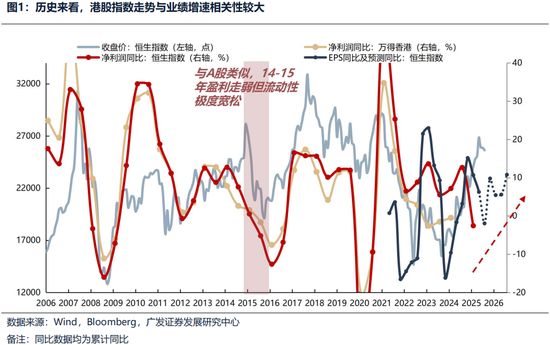
Group 1 - The current rise in Hong Kong stocks is supported by fundamentals, with signs of structural recovery in profitability starting from the second half of 2024 due to stabilization in both domestic and external demand and macroeconomic policy support [1][24] - The Hang Seng Index is transitioning from traditional economic cycles to focus on hard technology sectors such as AI applications, new energy, and semiconductors, with the weight of new economy sectors in the index increasing from 17% to nearly 50% [1][34] - The performance of Hong Kong stocks is expected to shift from being liquidity-driven to being driven by both profitability and liquidity, with earnings growth projected to rebound to 10.8% in 2026 [1][25] Group 2 - The current low valuation levels of quality companies in Hong Kong stocks highlight their growth potential, and the market sentiment has likely adjusted to current liquidity and emotional factors [6][24] - The structural recovery in profitability is evident, with emerging industries experiencing rapid growth while traditional sectors are still stabilizing [28][29] - The performance of individual stocks correlates positively with earnings growth, with high-growth companies significantly outperforming those under profit pressure [33] Group 3 - The upcoming liquidity improvements, including potential dovish signals from the new Federal Reserve chair and a decrease in HIBOR rates, could provide upward momentum for Hong Kong stocks [52][70] - The AH premium is expected to decline further due to increased investment from insurance funds in H-shares and the growing convenience for foreign capital to allocate resources in Hong Kong [71][74] - The spring market rally in Hong Kong stocks has historically shown a high probability of positive returns, indicating a potential opportunity for investors [56][60]



上银基金管理有限公司关于上银医疗创新混合型发起式证券投资基金新增广发证券为销售机构的公告
Shang Hai Zheng Quan Bao· 2026-01-04 23:02
根据上银基金管理有限公司(以下简称"本公司")与广发证券股份有限公司(以下简称"广发证券")签署 的销售协议和相关业务准备情况,自2026年1月5日起,广发证券将开始销售本公司旗下部分基金。 一、适用基金范围 客户服务电话:95575 ■ 注:在遵守基金合同、招募说明书及相关业务公告的前提下,销售机构办理各项基金销售业务的具体日 期、时间、流程、业务类型及费率优惠活动(如有)以销售机构的安排和规定为准。 二、投资者可通过以下途径咨询有关详情 1、广发证券股份有限公司 网站:www.gf.com.cn 二〇二六年一月五日 2、上银基金管理有限公司 网站:www.boscam.com.cn 客户服务电话:021-60231999 风险提示:本基金管理人承诺以诚实信用、勤勉尽责的原则管理和运用基金资产,但不保证基金一定盈 利,也不保证最低收益。基金投资有风险,投资者在做出投资决策之前,请认真阅读基金合同、招募说 明书(更新)和基金产品资料概要(更新)等法律文件,充分认识基金的风险收益特征和产品特性,认 真考虑基金存在的各项风险因素,并根据自身的投资目的、投资期限、投资经验、资产状况等因素充分 考虑自身的风险承受能力 ...
广发证券刘晨明:A股市场将延续“慢牛”格局
Zheng Quan Shi Bao· 2026-01-04 17:48
Core Viewpoint - In 2026, under the global challenge of debt issues, there are three main ways to address debt: real growth exceeding real interest rates (growth-driven debt reduction), inflation exceeding expectations (inflation-driven debt reduction), and fiscal tightening (fiscal-driven debt reduction). Both AI and gold are expected to benefit from these paths, forming a dual mainline logic for asset performance [1]. Group 1: Market Outlook - The A-share market is expected to maintain a "slow bull" pattern in 2026, driven by a profound change in corporate profit structures. Despite weakness in real estate, infrastructure, consumption, social financing, and PPI, the net asset return on equity (ROE) of non-financial enterprises has stabilized over several quarters [1]. - The profit share of the eight major advanced manufacturing industries has increased to 38%, while the overseas revenue share of companies operating abroad has risen to 20%, with overseas market gross margins exceeding domestic margins by 5 percentage points. These factors are likely to drive the overall ROE of A-shares to recover after stabilization [1]. - Current valuation increases are relatively restrained, with limited overextension. If profits recover, there is still room for valuation improvement. Additionally, the migration of deposits from insurance and high-net-worth individuals will bring incremental capital [1]. Group 2: Investment Direction - The focus should be on industries with constrained supply and clear upward trends, such as the AI industry chain, which has strong capital expenditure demand and is unlikely to see supply release in the short term. Other areas include energy storage and metals, which have undergone capacity clearing [1]. - Tactically, it is recommended to utilize market adjustments to position for the spring rally, prioritizing the aforementioned high-prosperity sectors [1].