
WLY(000858)

Search documents
每日报告精选-20250829




GUOTAI HAITONG SECURITIES· 2025-08-29 02:04
Macroeconomic Insights - The average import tax rate in the U.S. increased by 6.6 percentage points compared to the end of 2024, which is lower than market expectations[5] - If the average import tax rate rises by 10% this year, it could push the PCE year-on-year growth rate to 3.1% and the core PCE to 3.4% under stable demand conditions[7] Consumer and Business Impact - As of June, U.S. businesses bore approximately 63% of the tariff costs, while consumers accounted for less than 40%[6] - The consumer price sensitivity may lead businesses to absorb a significant portion of tariff costs, affecting pricing strategies[6] Durable Goods and Construction Sector - Domestic demand for construction remains weak, with steel and glass prices declining, while cement prices have rebounded due to enhanced production management[9] - Retail sales of passenger vehicles increased, with a year-on-year growth of 8% in daily sales from August 11 to August 17[10] Insurance Sector Performance - The insurance industry reported a total premium income of CNY 420.85 billion from January to July 2025, reflecting a year-on-year growth of 6.8%[14] - Life insurance premiums reached CNY 258.61 billion in July, marking a significant year-on-year increase of 33.5%[15] Steel Industry Outlook - China's crude steel production from January to July 2025 was 594 million tons, a decrease of 3.1% year-on-year, indicating a contraction in production capacity[25] - The steel industry is expected to stabilize in 2025 due to a combination of demand recovery and supply-side reductions[27]
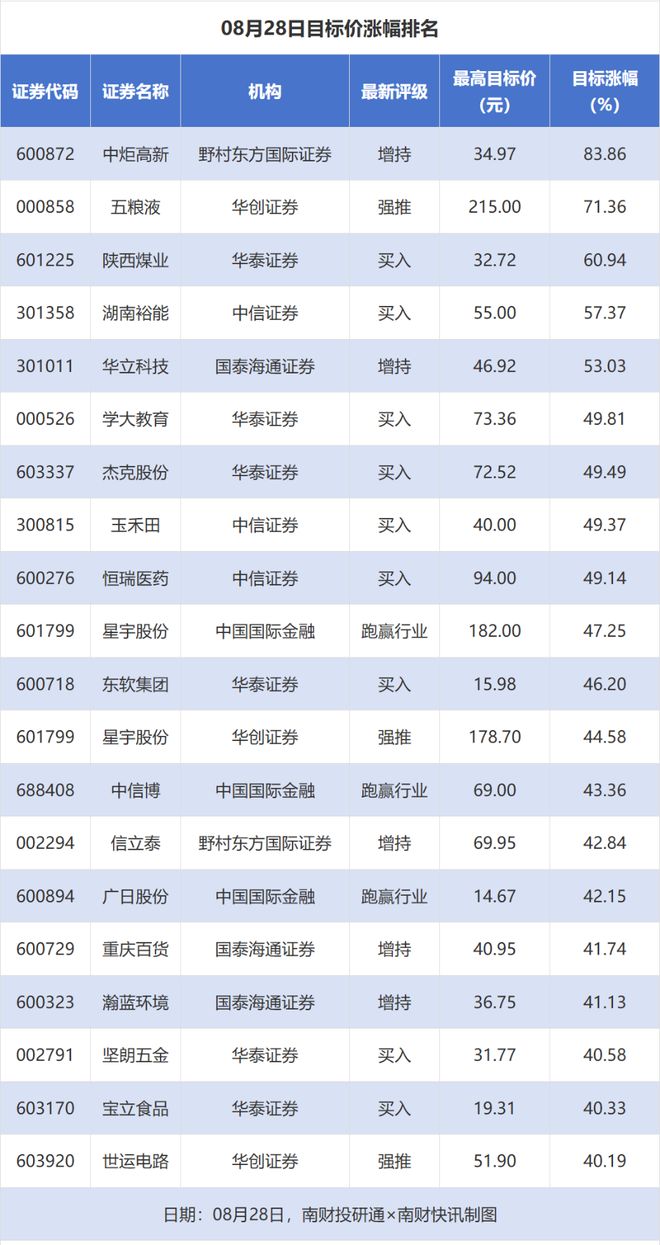
中炬高新目标价涨幅超83%,五粮液等10股评级被调低丨券商评级观察
2 1 Shi Ji Jing Ji Bao Dao· 2025-08-29 01:47
Core Viewpoint - On August 28, 2023, brokerage firms provided target prices for listed companies a total of 225 times, with notable increases in target prices for companies such as Zhongju Gaoxin, Wuliangye, and Shaanxi Coal, showing increases of 83.86%, 71.36%, and 60.94% respectively, across the seasoning, liquor, and coal mining industries [1][2]. Target Price Increases - Zhongju Gaoxin received a target price increase of 83.86%, with a new target price of 34.97 yuan [2] - Wuliangye's target price increased by 71.36%, with a new target price of 215.00 yuan [2] - Shaanxi Coal's target price rose by 60.94%, with a new target price of 32.72 yuan [2] - Other companies with significant target price increases include Hunan YN (57.37%), Huali Technology (53.03%), and Xueda Education (49.81%) [2][3] Brokerage Recommendations - A total of 379 listed companies received brokerage recommendations on August 28, with Wuliangye receiving the highest number of recommendations at 10 [3][4] - China Life received 8 recommendations, while Shaanxi Coal received 7 [3][4] Rating Adjustments - Six companies had their ratings upgraded, including Hualing Steel from "Hold" to "Buy" by Zhongtai Securities, and Wanhe Electric from "Hold" to "Buy" by CITIC Securities [5] - Ten companies had their ratings downgraded, including Tiens Wind Power from "Buy" to "Hold" by Everbright Securities, and China Nuclear Power from "Strong Buy" to "Hold" by CMB Securities [6] First Coverage - On August 28, 11 companies received their first coverage from brokerages, including Xin'an Shares rated "Buy" by Debon Securities and Zhujiang Beer rated "Hold" by Western Securities [7]


五粮液成立智创数字经济产业发展基金 出资额10.1亿
Xin Lang Cai Jing· 2025-08-29 01:44
Group 1 - The Yibin Zhichuang Digital Economy Industry Development Fund Partnership has been established with a total investment of 1.01 billion RMB [1] - The fund is managed by Yibin Wuliangye Fund Management Co., Ltd., and its business scope includes private equity investment, investment management, and asset management [1] - The partners of the fund include Sichuan Yibin Wuliangye Group Co., Ltd. and Yibin Wuliangye Fund Management Co., Ltd. [1]
389股获券商买入评级,五粮液目标涨幅达71.36%
Xin Lang Cai Jing· 2025-08-29 01:38
Group 1 - A total of 389 stocks received buy ratings from brokerages on August 28, with 81 stocks announcing target prices [1] - Based on the highest target prices, Wuliangye, Tailin Microelectronics, and Shaanxi Coal & Chemical Industry ranked highest in potential price increases, with expected rises of 71.36%, 61.4%, and others [1] - Among the stocks rated, 380 maintained their ratings, 3 stocks had their ratings upgraded, and 6 stocks received their first ratings [1] Group 2 - 69 stocks received attention from multiple brokerages, with Wuliangye, Shaanxi Coal & Chemical Industry, and Shuanghuan Transmission leading in the number of ratings, receiving 9, 5, and others respectively [1] - The sectors with the highest number of stocks receiving buy ratings include Capital Goods, Materials II, and Food, Beverage & Tobacco, with 71, 62, and 41 stocks respectively [1]
海通国际发布五粮液研报:业绩整体符合预期,稳健增长彰显韧性
Mei Ri Jing Ji Xin Wen· 2025-08-29 01:07
免责声明:本文内容与数据仅供参考,不构成投资建议,使用前请核实。据此操作,风险自担。 每经AI快讯,海通国际8月29日发布研报称,给予五粮液(000858.SZ,最新价:125.47元)优于大市评 级。评级理由主要包括:1)量增价缓特征显著,东部市场增速亮眼;2)2025Q2盈利能力小幅下滑, 资金周转效率显著提升;3)2025年紧扣核心战略定位,三大维度应对行业调整。风险提示:食品安全 风险,市场竞争加剧,经营策略成效不及预期。 每经头条(nbdtoutiao)——申请超2万份,已开出41家,加盟海底捞,你要准备多少钱?1000万元不算 多,真实"账单"公布 (记者 王晓波) ...
国海证券晨会纪要-20250829
Guohai Securities· 2025-08-29 00:02
Group 1 - The report highlights a sustained strengthening of GMV inflection points, indicating optimism for long-term growth in the education sector, particularly for Oriental Selection [4][5] - The report notes a significant increase in the dividend payout ratio to 60% for Excellence Education Group, which may support revenue growth in the second half of 2025 [10][11] - Shanghai Film's performance is under short-term pressure, but the release of "Wang Wang Mountain Little Monster" is expected to provide performance elasticity [13][15] Group 2 - Huabei Mining's revenue for H1 2025 decreased by 45% year-on-year, but cost control measures are expected to enhance future performance as quality projects are gradually put into production [19][21] - The report indicates that the pet ecosystem construction by Reap Bio is becoming increasingly comprehensive, with a notable increase in revenue and net profit in H1 2025 [24][25] - Silver Wheel's revenue and net profit showed significant growth in Q2 2025, driven by dual engines of "server liquid cooling + robotic joints" [27][29] Group 3 - Shaanxi Coal's production and sales volumes remained stable, with a slight increase in coal production in H1 2025, despite a decrease in revenue [31][33] - China Ruyi's net profit turned from loss to profit in H1 2025, driven by game publishing and content investment [36][37] - Light Media's animation production capacity continues to improve, with IP operations expected to become a new growth point [40][42] Group 4 - Cambrian's revenue for H1 2025 saw an extraordinary increase of 4347.82% year-on-year, with net profit also experiencing substantial growth [46]



透视A股白酒板块中期业绩:产业格局正深度重塑
Zheng Quan Ri Bao Zhi Sheng· 2025-08-28 16:35
Core Viewpoint - The Chinese liquor industry is undergoing a deep adjustment, with no company remaining unaffected, as evidenced by the financial performance of 13 listed liquor companies in the first half of 2025, indicating that the industry has not yet emerged from its cyclical downturn [1] Financial Performance - The 13 listed liquor companies reported a total revenue of 176.88 billion yuan in the first half of 2025, a year-on-year decrease of 1.01% [1] - The total net profit attributable to shareholders was 74.14 billion yuan, down 0.76% year-on-year [1] - The net cash flow from operating activities totaled 45.76 billion yuan, reflecting a significant decline of 14.94% year-on-year [1] Company-Specific Insights - Among the 13 companies, only Guizhou Moutai, Wuliangye, and Jinhui Wine achieved year-on-year growth in both revenue and net profit [2] - Guizhou Moutai and Wuliangye reported net profits of 45.40 billion yuan and 19.49 billion yuan, respectively, with growth rates of 8.89% and 2.28%, although these rates have slowed compared to the previous year [2] - The average gross profit margin for the 13 companies was 64.61%, down 5.5 percentage points from the previous year, with 10 companies experiencing declines [2] Inventory and Market Strategies - The total inventory for the 13 companies reached 123.60 billion yuan, an increase of 11.55% year-on-year, indicating ongoing inventory pressure [3] - To address price inversion and restore channel confidence, several companies implemented "control quantity and maintain price" strategies, including issuing stop shipment notices [3] Market Valuation and Recovery Potential - The total market capitalization of 21 listed liquor companies was 3.25 trillion yuan, down 5.25% from the beginning of the year, with 17 companies experiencing declines [4] - The current price-to-earnings ratios for major companies like Guizhou Moutai and Wuliangye are 20.20 and 15.08, respectively, suggesting that the liquor sector is currently undervalued [4] - Analysts indicate that the sector is at a historical low valuation, with potential for recovery as market expectations for short-term performance pressures have been priced in [4] Industry Outlook and Recommendations - Experts suggest that liquor companies should accelerate inventory reduction and price stabilization, focus on product innovation targeting younger consumers, and leverage digital channels for better market penetration [5] - The industry is expected to continue its deep adjustment until the second half of 2026, with potential signs of recovery by the end of 2025, particularly during peak seasons [5]

深沪北百元股数量达148只 电子行业占比最高
Zheng Quan Shi Bao Wang· 2025-08-28 13:54
Market Overview - The average stock price of A-shares is 13.39 yuan, with 148 stocks priced over 100 yuan, an increase of 10 from the previous trading day [1] - The Shanghai Composite Index closed at 3843.60 points, up 1.14%, while stocks over 100 yuan had an average increase of 3.93%, outperforming the index by 2.79 percentage points [1] Performance of High-Value Stocks - The highest closing price among stocks over 100 yuan is Cambricon Technologies at 1587.91 yuan, up 15.73%, followed by Kweichow Moutai and Meowai Optics at 1446.10 yuan and 475.34 yuan respectively [1] - In the past month, stocks over 100 yuan have averaged a 31.18% increase, significantly higher than the Shanghai Composite Index's 6.96% [2] Sector Analysis - The electronics sector has the highest representation among stocks over 100 yuan, with 51 stocks, accounting for 34.46% of the total [2] - Other notable sectors include computer and pharmaceutical industries, with 19 and 16 stocks respectively, representing 12.84% and 10.81% of the total [2] Institutional Ratings - 20 stocks priced over 100 yuan received buy ratings from institutions, with five stocks showing an upside potential exceeding 20% [3] - Wuliangye has the highest projected target price of 215.00 yuan, indicating an upside potential of 71.35% [3] Recent Market Movements - Two stocks, Guangku Technology and Dongtian Micro, have recently surpassed the 100 yuan mark, closing at 101.01 yuan and 111.03 yuan respectively, with significant trading volumes [2][3] - The trading activity indicates a net inflow of 74.24 million yuan for Guangku Technology and a net outflow of 52.67 million yuan for Dongtian Micro [2]

五粮液上半年日赚超1亿!接下来将剑指年轻化
Guan Cha Zhe Wang· 2025-08-28 13:04
Core Viewpoint - The article highlights the resilient growth of Wuliangye during a period of deep adjustment in the liquor industry, emphasizing its ability to maintain stable performance despite a slowdown in growth rates compared to previous years [3][4]. Financial Performance - In the first half of 2025, Wuliangye achieved revenue of 52.77 billion yuan, a year-on-year increase of 4.19%, and a net profit attributable to shareholders of 19.49 billion yuan, up 2.28% year-on-year [3][4]. - The company's growth rate is noted to be the first single-digit growth in nearly a decade, indicating a significant slowdown compared to past performance [4]. Product Performance - Wuliangye's main product line generated revenue of 40.99 billion yuan, growing by 4.57%, while other liquor products contributed 8.12 billion yuan, with a growth of 2.73% [5]. - The overall price per ton of liquor decreased by 27.89% to 433,600 yuan/ton, with a slight decline in gross margin to 82.2% [5]. Production and Sales - The production volume of Wuliangye products increased by 11.56% to 25,559 tons, with sales rising by 12.75% to 27,278 tons. In contrast, the production of series liquor surged by 60.15% to 76,650 tons, with sales increasing by 58.81% to 86,005 tons [6][7]. Channel Strategy - Wuliangye is focusing on enhancing direct sales and improving the profitability of distributors. Direct sales generated revenue of 21.20 billion yuan, up 8.6%, accounting for 43.15% of total revenue [7][8]. - The company has reduced the number of distributors to 2,510, while increasing the number of Wuliangye's own distributors to 1,077 [8]. New Product Launches - Wuliangye is targeting younger consumers with the launch of a new low-alcohol product, "Yijian Qingxin," and a new craft beer, "Fenghuolun," aiming to capture the growing low-alcohol market [9][13][15]. - The low-alcohol market in China is projected to exceed 74 billion yuan by 2025, with a compound annual growth rate of 25%, indicating strong growth potential [13]. Market Position - As of August 28, Wuliangye's stock price was 125.47 yuan, with a market capitalization of approximately 487 billion yuan, reflecting its strong position in the market [15][16].

五粮液(000858):业绩韧性彰显,渠道改革精进
Guohai Securities· 2025-08-28 13:04
Investment Rating - The investment rating for the company is "Buy" (maintained) [1] Core Insights - The company's performance shows resilience, with a focus on channel reform and steady growth in revenue and profit [4][8] - In H1 2025, the company achieved total revenue of 52.771 billion yuan, a year-on-year increase of 4.19%, and a net profit attributable to shareholders of 19.492 billion yuan, up 2.28% year-on-year [8] - The company is expected to continue its marketing reforms and maintain a strong brand value, with a projected dividend payout of no less than 70% and at least 20 billion yuan (including tax) [9] Summary by Sections Financial Performance - In H1 2025, the company's revenue from Wuliangye products was 40.998 billion yuan, up 4.57% year-on-year, while other liquor products generated 8.122 billion yuan, an increase of 2.73% [8] - In Q2 2025, total revenue was 15.831 billion yuan, with a slight year-on-year increase of 0.10%, but net profit decreased by 7.58% [8] - The company’s gross profit margin in Q2 2025 was 74.69%, down 0.32 percentage points year-on-year [8] Market and Channel Analysis - Revenue from the eastern region in H1 2025 was 20.109 billion yuan, up 7.88% year-on-year, indicating significant growth in this market [8] - The company’s wholesale and direct sales channels generated revenues of 27.925 billion yuan and 21.195 billion yuan, respectively, with year-on-year increases of 8.60% and 1.20% [8] Profitability and Cash Flow - The company’s net profit margin recorded in Q2 2025 was 30.11%, down 2.71 percentage points year-on-year [8] - Operating cash flow showed stability, with a year-on-year increase of 18.40% in Q2 2025 [8] Earnings Forecast - The company’s projected revenues for 2025-2027 are 90.870 billion yuan, 93.050 billion yuan, and 98.540 billion yuan, respectively, with corresponding net profits of 31.945 billion yuan, 32.358 billion yuan, and 34.384 billion yuan [10][11] - The expected earnings per share (EPS) for 2025, 2026, and 2027 are 8.23 yuan, 8.34 yuan, and 8.86 yuan, respectively [10][11]