
WLY(000858)

Search documents
茅台逆势扩张文化版图!吃喝板块回调,食品ETF(515710)盘中跌近2%!布局时机或至?
Xin Lang Ji Jin· 2025-08-28 12:30
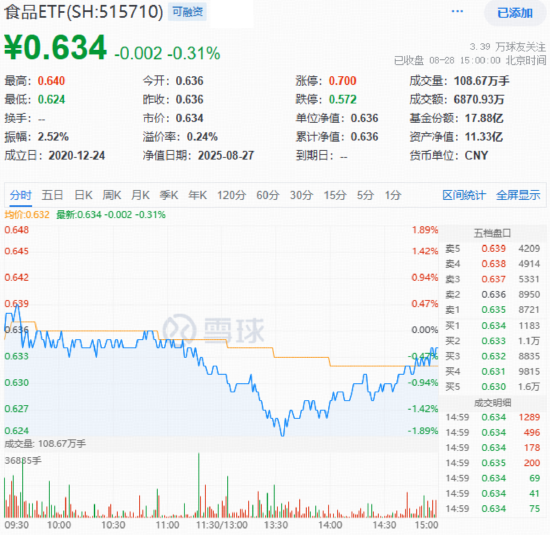
Group 1 - The food and beverage sector continues to experience a pullback, with the Food ETF (515710) showing a decline of 0.31% at the close after a drop of nearly 2% during the day [1][3] - Major consumer goods stocks, particularly leading liquor brands, have also performed poorly, with companies like Qianhe Flavor, Miaokelando, and others dropping over 3% [3] - The launch of three Moutai cultural experience centers in Xinjiang and Zhengzhou is seen as a strategic move to deepen market penetration in the northwest and central regions, enhancing consumer engagement and cultural marketing [3] Group 2 - The current valuation of the food and beverage sector is considered low, with the food index's price-to-earnings ratio at 20.8 times, indicating a favorable long-term investment opportunity [4] - Analysts from Ping An Securities suggest that the liquor sector is stabilizing, with expectations for increased consumption during the upcoming Mid-Autumn Festival and National Day [5] - Huashang Securities notes that the liquor demand has been under pressure since the second quarter, but the marginal impact of policies is expected to diminish, setting a foundation for recovery [5] Group 3 - The Food ETF (515710) is recommended for investment, with approximately 60% of its portfolio allocated to leading high-end and mid-range liquor stocks, and nearly 40% in other beverage and dairy segments [5] - The top ten weighted stocks in the ETF include major brands like Moutai, Wuliangye, and Yili, indicating a strong focus on established market leaders [5]




五粮液(000858):业绩整体符合预期,稳健增长彰显韧性
Haitong Securities International· 2025-08-28 11:26
Investment Rating - The investment rating for Wuliangye is maintained at OUTPERFORM with a target price adjusted from RMB 172 to RMB 164 [2][5]. Core Insights - The company reported total revenue of RMB 52.77 billion for the first half of 2025, reflecting a year-on-year increase of 4.2%, while net profit attributable to shareholders was RMB 19.49 billion, up 2.3% year-on-year [3][10]. - The growth in revenue was primarily driven by volume increases, particularly in the eastern market, which saw a revenue growth of 7.9% year-on-year [11]. - The company is focusing on marketing innovation and capacity upgrades to navigate the current bottoming-out phase of the baijiu industry, demonstrating operational resilience [15]. Financial Performance Summary - For the first half of 2025, Wuliangye's revenue was RMB 52.77 billion, with a net profit of RMB 19.49 billion. In Q2 alone, revenue was RMB 15.83 billion, showing a slight increase of 0.1% year-on-year, while net profit decreased by 7.6% year-on-year to RMB 4.63 billion [3][10]. - The gross profit margin for the first half of 2025 was 77.1%, with a slight decline compared to previous periods, attributed to increased costs and tax impacts [4][12]. - The company expects revenues for 2025-2027 to reach RMB 91.7 billion, RMB 95.8 billion, and RMB 101.1 billion, respectively, with net profits projected at RMB 32.0 billion, RMB 33.7 billion, and RMB 35.9 billion [5][15]. Market and Product Insights - Wuliangye's product revenue increased by 4.6% year-on-year in the first half of 2025, driven by a 12.7% increase in volume, while prices decreased by 7.2% [11]. - The company is implementing a youth-oriented product strategy and optimizing its distribution channels to enhance market presence [13]. - The eastern market's strong performance is linked to a significant increase in sales revenue share from the top five distributors [11].
格隆汇公告精选︱信捷电气:拟投资8亿元建设机器人智能驱控系统生产项目;中国人寿:上半年净利润为409.31亿元,同比增长6.9% 上半年取得总保费5250.88亿元
Ge Long Hui· 2025-08-28 11:18
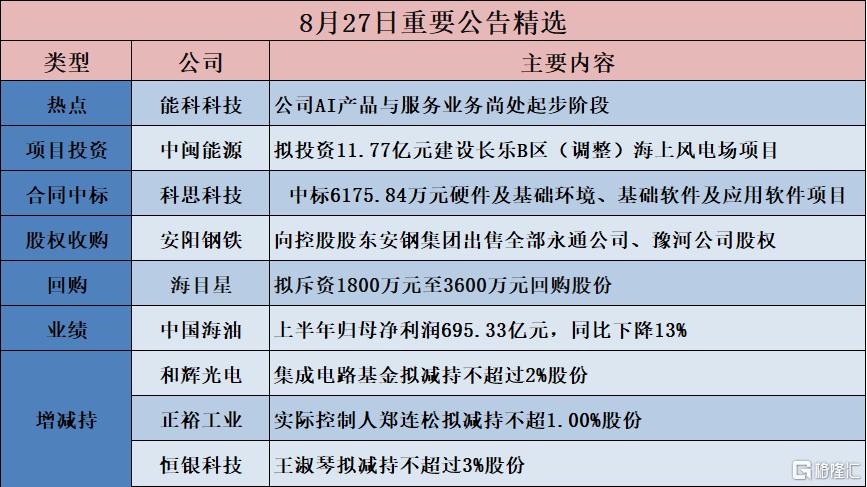
Group 1: Company Announcements - Nengke Technology's AI products and services are still in the early stages of development [1] - Zhongmin Energy plans to invest 1.177 billion yuan in the construction of the Changle B District offshore wind farm project [1] - Kesi Technology won a bid for a project worth 61.7584 million yuan for hardware and software [1] - Anyang Iron and Steel is selling all shares of Yongtong Company and Yuhe Company to its controlling shareholder, Angang Group [1] - Haomuxing intends to repurchase shares worth between 18 million to 36 million yuan [1] Group 2: Performance Reports - Wuliangye reported a net profit of 19.49 billion yuan for the first half of the year, an increase of 2.28% year-on-year [2] - Transsion Holdings experienced a net profit of 1.213 billion yuan, a decrease of 57.48% year-on-year [2] - China National Offshore Oil Corporation (CNOOC) reported a net profit attributable to shareholders of 69.533 billion yuan, a decrease of 13% year-on-year [2] - China Life Insurance achieved a net profit of 40.931 billion yuan, an increase of 6.9% year-on-year, with total premiums of 525.088 billion yuan [2] Group 3: Shareholding Changes - Hehui Optoelectronics plans to reduce its holdings by no more than 2% [2] - Zheng Liansong, the actual controller of Zhengyu Industrial, intends to reduce his holdings by no more than 1% [2] - Wang Shuqin from Hengyin Technology plans to reduce her holdings by no more than 3% [2]




五粮液(000858):2025Q2收入同比正增 产品及渠道端展现韧性
Xin Lang Cai Jing· 2025-08-28 10:40
Core Viewpoint - The company reported steady growth in revenue and net profit for the first half of 2025, although the net profit margin faced slight pressure in Q2 2025 [1][3]. Financial Performance - In H1 2025, the company achieved total revenue of 52.77 billion yuan, a year-on-year increase of 4.2%, and a net profit of 19.49 billion yuan, up 2.3% year-on-year [1]. - For Q2 2025, total revenue was 15.83 billion yuan, showing a marginal increase of 0.1% year-on-year, while net profit was 4.63 billion yuan, down 7.6% year-on-year [1]. - The company's liquor revenue reached 49.12 billion yuan in H1 2025, with a year-on-year growth of 4.26%, driven by a volume increase of 44.59% but offset by a price decline of 27.89% [1][2]. Product Performance - The revenue from Wuliangye products in H1 2025 was 41 billion yuan, reflecting a year-on-year increase of 4.6%, with sales volume up 12.7% but a price drop of 7.3% [1][2]. - Other liquor products generated revenue of 8.12 billion yuan in H1 2025, a year-on-year increase of 2.7%, with sales volume up 58.5% but a price decline of 35.3% [2]. Sales Channels - Direct sales channels outperformed overall growth, with revenue of 21.19 billion yuan in H1 2025, a year-on-year increase of 8.6% [2]. - The company successfully developed 60 enterprise clients in H1 2025, contributing to group purchase revenue [2]. - Revenue from the eastern region was 20.11 billion yuan, up 7.9% year-on-year, while the southern and northern regions saw increases of 1.9% and 1.8%, respectively [2]. Cost and Margin Analysis - In Q2 2025, the gross profit margin decreased by 0.32 percentage points, attributed to product mix effects [3]. - The company increased promotional expenses to stimulate consumer purchases, with promotional costs reaching 3.56 billion yuan in H1 2025, a year-on-year increase of 3.5% [3]. Future Outlook - The company has revised its revenue and net profit forecasts downward for 2025-2027, now expecting revenues of 91.07 billion yuan, 95.70 billion yuan, and 101.28 billion yuan, with year-on-year growth rates of 2.1%, 5.1%, and 5.8% respectively [4]. - The expected net profit for the same period is 31.13 billion yuan, 32.06 billion yuan, and 34.35 billion yuan, with a projected decline of 2.3% in 2025 followed by growth in subsequent years [4]. - The current stock price corresponds to a P/E ratio of 15.8 for 2025 and 15.3 for 2026, with a dividend yield of 4.4% based on a 70% payout ratio [4].
五粮液(000858):2Q25业绩符合预期 关注股息率托底
Xin Lang Cai Jing· 2025-08-28 10:40
Core Viewpoint - The company reported its 2Q25 performance, showing a slight revenue increase but a decline in net profit, indicating challenges in the current consumption environment and increased expenses [1][3]. Financial Performance - In 1H25, the company achieved revenue of approximately 52.771 billion yuan, a year-on-year increase of 4.19%, and a net profit of about 19.492 billion yuan, up 2.28% year-on-year [1]. - For 2Q25, revenue was 15.831 billion yuan, a marginal increase of 0.10% year-on-year, while net profit was 4.632 billion yuan, reflecting a decline of approximately 7.58% year-on-year [1]. Development Trends - The company's direct sales channels and low-alcohol products performed well in the first half of the year, with 1H25 revenue from Wuliangye products reaching 40.998 billion yuan, a year-on-year increase of 4.57% [2]. - The sales volume of Wuliangye products increased by 12.75%, while the price decreased by 7.25%, primarily due to the contribution from direct sales channels [2]. - The revenue from the series of wines in 1H25 was 8.122 billion yuan, up 2.73% year-on-year, with a significant increase in sales volume but a decrease in price [2]. - The company’s sales cash collection in 2Q25 was 31.23 billion yuan, a year-on-year increase of 12%, attributed to the concentration of bill maturities [2]. Profitability and Outlook - The net profit margin for 2Q25 decreased by 2.4 percentage points to 29.3%, mainly due to a weak consumption environment and increased expenses for promotions and logistics [3]. - The company plans to maintain high expenditure levels to support distributor confidence during peak seasons like the Mid-Autumn Festival and National Day [3]. - The company commits to a dividend payout of no less than 70% for 2025, projecting a dividend yield of 4.3% for the year [3]. Earnings Forecast and Valuation - Due to industry demand pressures, the company has revised its revenue forecasts for 2025 and 2026 down by 5.4% to 88.545 billion yuan and 92.717 billion yuan, respectively [4]. - The net profit forecasts for 2025 and 2026 have been reduced by 9.9% and 9.0% to 30.126 billion yuan and 32.133 billion yuan, respectively [4]. - The target price is maintained at 174 yuan, corresponding to a price-to-earnings ratio of 22.4x for 2025 and 21.0x for 2026, with the current stock price reflecting a significant upside potential of 37.4% [4].
五粮液(000858)2025年中报点评:降速调整 深耕渠道谋长远
Xin Lang Cai Jing· 2025-08-28 10:40
Core Insights - The company reported a total revenue of 52.771 billion yuan (+4.19%) and a net profit attributable to shareholders of 19.492 billion yuan (+2.28%) for the first half of 2025 [1] - In Q2 2025, total revenue was 15.831 billion yuan (+0.10%), while net profit attributable to shareholders decreased to 4.632 billion yuan (-7.58%) [1] Revenue and Sales Performance - For H1 2025, the company's revenue from Wuliangye products and other liquor products was 40.998 billion yuan (+4.57%) and 8.122 billion yuan (+2.73%) respectively, with sales volumes of 273,000 tons (+12.75%) and 86,000 tons (+58.81%) [1] - The average price per 500ml for Wuliangye products decreased by 7.25% to 751.49 yuan, while other liquor products saw a significant drop of 35.31% to 47.22 yuan due to a shift towards lower-priced products [1] Channel Development - The company focused on channel development, with revenue from distribution and direct sales channels reaching 27.925 billion yuan (+1.20%) and 21.195 billion yuan (+8.60%) respectively in H1 2025 [1] - By the end of H1 2025, the number of Wuliangye distributors was 2,510, a net decrease of 20, while the number of specialty stores was 1,768, a net decrease of 18 [2] Regional Performance - Revenue growth was led by the eastern region, with H1 2025 revenues of 20.109 billion yuan (+7.88%), while the southern and northern regions reported revenues of 21.886 billion yuan (+1.93%) and 7.124 billion yuan (+1.82%) respectively [2] Profitability Metrics - The gross margin for Wuliangye products slightly decreased by 0.24 percentage points, with a company-wide gross margin of 76.83% (-0.53 percentage points) for H1 2025 [2] - The net profit margin attributable to shareholders for H1 2025 was 36.94% (-0.69 percentage points), while Q2 2025 saw a further decline to 29.26% (-2.43 percentage points) due to increased sales and financial expenses [3] Future Outlook - The company forecasts net profits attributable to shareholders of 30.835 billion yuan, 32.376 billion yuan, and 33.803 billion yuan for 2025, 2026, and 2027 respectively, with expected growth rates of -3.20%, 5.00%, and 4.41% [4]
8月28日晚间重要公告一览
Xi Niu Cai Jing· 2025-08-28 10:28
Group 1 - Xinhua Media achieved a net profit of 32.34 million yuan in the first half of 2025, a year-on-year increase of 9.29% [1] - Xinhua Media's operating income for the first half of 2025 was 631 million yuan, a year-on-year growth of 2.45% [1] - China Galaxy reported a net profit of 6.488 billion yuan, up 47.86% year-on-year, with an operating income of 137.47 billion yuan, a 37.71% increase [2] Group 2 - Lek Electric's net profit decreased by 29.01% to 428 million yuan, despite a slight revenue increase of 0.65% to 4.781 billion yuan [3] - Honghui Fruits and Vegetables reported a net profit of 6.9243 million yuan, down 44.82%, with revenue of 470 million yuan, up 7.86% [4] - Bull Group's net profit fell by 8% to 2.06 billion yuan, with a revenue decline of 2.6% to 8.168 billion yuan [5] Group 3 - Nanshan Aluminum achieved a net profit of 2.625 billion yuan, a year-on-year increase of 19.95%, with operating income of 17.274 billion yuan, up 10.25% [6] - Zhujiang Beer reported a net profit of 612 million yuan, a 22.51% increase, with revenue of 3.198 billion yuan, up 7.09% [8] - Baolong Technology's net profit decreased by 9.15% to 135 million yuan, with revenue growth of 24.06% to 3.95 billion yuan [10] Group 4 - Jindi Co. reported a net profit of 75.93 million yuan, a year-on-year increase of 32.86%, with operating income of 835 million yuan, up 40.57% [12] - China Vision Media turned a profit with a net profit of 19.9811 million yuan, compared to a loss of 18.4349 million yuan in the previous year, despite a revenue decline of 10.75% to 229 million yuan [14] - Botao Bio's net profit fell by 82.82% to 12.4024 million yuan, with revenue down 23.91% to 203 million yuan [16] Group 5 - Caitong Securities reported a net profit of 1.083 billion yuan, a year-on-year increase of 16.85%, with operating income of 2.959 billion yuan, down 2.19% [18] - Yili Group's net profit decreased by 4.39% to 7.2 billion yuan, with revenue growth of 3.49% to 61.777 billion yuan [19] - Springlight Technology achieved a net profit of 7.3787 million yuan, a year-on-year increase of 83.73%, with revenue of 251 million yuan, up 39.6% [20] Group 6 - China Haifeng reported a net profit of 94.5739 million yuan, a year-on-year increase of 25.48%, with operating income of 1.385 billion yuan, up 19.64% [21] - Zhongke Titanium White's net profit decreased by 14.83% to 259 million yuan, with revenue growth of 19.66% to 3.77 billion yuan [23] - Huasheng Tiancai turned a profit with a net profit of 14 million yuan, compared to a loss in the previous year, despite a revenue decline of 10.75% to 226 million yuan [25] Group 7 - Shen Zhou Cell reported a net loss of 33.7711 million yuan, with revenue down 25.50% to 972 million yuan [26] - Meihu Co. achieved a net profit of 101 million yuan, a year-on-year increase of 10.26%, with operating income of 1.075 billion yuan, up 10.74% [28] - Jifeng Technology plans to apply for a comprehensive credit of 170 million yuan to supplement working capital [29] Group 8 - Foton Motor reported a net profit of 777 million yuan, a year-on-year increase of 87.57%, with operating income of 30.371 billion yuan, up 26.71% [41] - BOE Technology achieved a net profit of 3.247 billion yuan, a year-on-year increase of 42.15%, with operating income of 110.278 billion yuan, up 8.45% [42] - CIMC reported a net profit of 1.278 billion yuan, a year-on-year increase of 47.63%, with operating income of 76.09 billion yuan, down 3.82% [43]



五粮液(000858):2025Q2收入同比正增,产品及渠道端展现韧性
Guoxin Securities· 2025-08-28 08:57
Investment Rating - The investment rating for the company is "Outperform the Market" [7][22]. Core Views - The company has shown resilient revenue and net profit growth in H1 2025, with total revenue reaching 52.77 billion yuan, a year-on-year increase of 4.2%, and net profit of 19.49 billion yuan, up 2.3% year-on-year. However, Q2 2025 net profit margin faced slight pressure [1][5]. - The company’s product revenue growth outpaced the average, although overall unit prices experienced a slight decline. The revenue from liquor products in H1 2025 was 49.12 billion yuan, a year-on-year increase of 4.26%, with sales volume up 44.59% but unit price down 27.89% [2][5]. - The direct sales model is growing faster than the overall market, with direct sales channel revenue in H1 2025 reaching 21.19 billion yuan, a year-on-year increase of 8.6% [3][5]. Summary by Sections Revenue and Profitability - In H1 2025, the company achieved total revenue of 52.77 billion yuan, with a year-on-year growth of 4.2%, and a net profit of 19.49 billion yuan, reflecting a 2.3% increase year-on-year. Q2 2025 saw total revenue of 15.83 billion yuan, a slight increase of 0.1%, but net profit decreased by 7.6% to 4.63 billion yuan [1][5]. Product Performance - The company’s liquor revenue in H1 2025 was 49.12 billion yuan, up 4.26% year-on-year, driven by a 12.7% increase in sales volume for its flagship product, while the unit price decreased by 7.3%. The revenue from other liquor products was 8.12 billion yuan, a 2.7% increase year-on-year, with significant promotional efforts impacting pricing [2][5]. Channel Strategy - The company is enhancing its channel layout, with revenue from the distribution channel in H1 2025 at 27.92 billion yuan, a 1.2% increase year-on-year. The top five distributors contributed 30.06 billion yuan, a significant increase of 181% year-on-year. The direct sales channel revenue was 21.19 billion yuan, reflecting an 8.6% year-on-year growth [3][5]. Financial Forecast - The company has adjusted its revenue and net profit forecasts for 2025-2027, expecting revenues of 91.07 billion yuan, 95.70 billion yuan, and 101.28 billion yuan, representing year-on-year growth rates of 2.1%, 5.1%, and 5.8% respectively. The forecasted net profit for the same period is 31.13 billion yuan, 32.06 billion yuan, and 34.35 billion yuan, with a slight decline in 2025 [5][6].
五粮液(000858):推进产品焕新与渠道下沉 拓展市场新空间
Xin Lang Cai Jing· 2025-08-28 08:38
Core Insights - The company reported a revenue of 52.771 billion yuan for the first half of 2025, a year-on-year increase of 4.19%, and a net profit attributable to shareholders of 19.492 billion yuan, up 2.28% year-on-year [1] - The company continues to enhance its product lineup, focusing on both high-end and mid-to-low-end markets, with significant sales growth in its core products [1][4] Revenue and Profitability - In Q2 2025, the company achieved a revenue of 15.831 billion yuan, a slight increase of 0.10% year-on-year, but the net profit decreased by 7.58% to 4.632 billion yuan [1] - The company's gross margin for H1 2025 was 76.83%, down 0.53 percentage points year-on-year, while the net margin was 38.16%, down 0.99 percentage points [3] Product Performance - The revenue from the company's core products, including Wuliangye liquor, other alcoholic beverages, and plastic products, reached 40.998 billion yuan, 8.122 billion yuan, and 2.010 billion yuan respectively, with Wuliangye liquor sales volume increasing by 12.75% year-on-year [1] - New product launches include various Wuliangye variants, which are expected to enhance market presence and consumer engagement [1][4] Channel Development - The company has deepened its channel layout, with revenue from distribution and direct sales reaching 27.925 billion yuan and 21.195 billion yuan respectively, marking increases of 1.20% and 8.60% year-on-year [2] - The number of distributors for Wuliangye liquor decreased by 20 to 2,510, while the number of distributors for Wuliang Nuo Xiang liquor increased by 107 to 3,587 [2] Regional Performance - Revenue from different regions showed varied performance, with the eastern region achieving a revenue of 13.552 billion yuan, up 15.70% year-on-year, while the southern region saw a slight decline of 0.58% [2] Cost Management - The company's operating expense ratio for H1 2025 was 11.48%, a slight decrease from the previous year, with sales expenses accounting for 10.23% [3] - The company is focusing on cost control while increasing investment in research and development to enhance product quality and innovation [4] Future Outlook - The company is expected to achieve revenues of 93.206 billion yuan, 99.986 billion yuan, and 110.613 billion yuan for the years 2025 to 2027, with net profits projected at 33.230 billion yuan, 35.723 billion yuan, and 39.870 billion yuan respectively [4]
五粮液(000858):降速调整,深耕渠道谋长远
Guoyuan Securities· 2025-08-28 08:16
Investment Rating - The report maintains a "Buy" rating for the company [6][12]. Core Views - The company reported a total revenue of 52.771 billion yuan in the first half of 2025, representing a year-on-year increase of 4.19%, while the net profit attributable to the parent company was 19.492 billion yuan, up 2.28% [2]. - The company is focusing on channel construction and deepening its market presence, with stable sales growth in the first half of 2025 [3][4]. - The gross margin for the company's products slightly decreased by 0.24 percentage points, and increased expenses affected the net profit margin in Q2 [5]. Summary by Sections Financial Performance - In H1 2025, the company's revenue from Wuliangye products and other liquor products was 40.998 billion yuan and 8.122 billion yuan, respectively, with year-on-year growth of 4.57% and 2.73%. Sales volume increased by 12.75% and 58.81%, while average prices decreased by 7.25% and 35.31% [3]. - The company's total revenue for Q2 2025 was 15.831 billion yuan, with a slight increase of 0.10%, but net profit decreased by 7.58% [2]. Channel Development - The company achieved steady growth in revenue from distribution and direct sales channels, with revenues of 27.925 billion yuan and 21.195 billion yuan, respectively, reflecting year-on-year increases of 1.20% and 8.60% [4]. - The number of distributors for Wuliangye and Wuliang Nuo Xiang products decreased by 20 and increased by 127, respectively, while the number of specialty stores decreased by 18 [4]. Regional Performance - Revenue growth in the eastern region led the company, with H1 2025 revenues of 20.109 billion yuan, up 7.88%, compared to 21.886 billion yuan in the southern region (up 1.93%) and 7.124 billion yuan in the northern region (up 1.82%) [4]. Profitability and Forecast - The company's gross margin for H1 2025 was 76.83%, a decrease of 0.53 percentage points year-on-year, with the gross margins for Wuliangye and other liquor products at 86.45% and 60.74%, respectively [5]. - The report forecasts net profits for 2025, 2026, and 2027 to be 30.835 billion yuan, 32.376 billion yuan, and 33.803 billion yuan, with year-on-year growth rates of -3.20%, 5.00%, and 4.41% [6].