
WLY(000858)

Search documents
小摩:对中国股市看法正面 首选腾讯控股(00700)等
智通财经网· 2026-02-11 03:36
Group 1 - Morgan Stanley maintains a positive outlook on the Chinese stock market, emphasizing the need for more refined stock selection [1] - The preferred sectors during the Lunar New Year period include high-end liquor, quality protein (new dairy products and black-haired cattle), key condiments, gold, and the tourism industry [1] - Historical data indicates that the appreciation of the RMB against the USD will boost returns in the Chinese stock market, with cyclical or growth stocks typically outperforming defensive stocks [1] Group 2 - The top stock picks include Tencent Holdings (00700), Lao Poo Gold (06181), MGM China (02282), TAL Education (TAL.US), Trip.com (09961, TCOM.US), Haitian Flavoring (03288, 603288.SH), Kweichow Moutai (600519.SH), Mengniu Dairy (02319), and Wuliangye (000858.SZ) [1]




小摩:对中国股市看法正面 首选腾讯控股等
Zhi Tong Cai Jing· 2026-02-11 03:35
Core Viewpoint - Morgan Stanley reaffirms its bullish trading strategy on the Chinese consumer market ahead of the Lunar New Year (February 15 to 23), favoring high-end liquor, premium protein (new dairy products and black-haired cattle), key condiments, gold, and the tourism industry [1] Group 1: Market Strategy - Historical data indicates that the appreciation of the RMB against the USD will boost returns in the Chinese stock market, with cyclical or growth stocks typically outperforming defensive stocks [1] - Morgan Stanley maintains a positive outlook on the Chinese stock market but emphasizes the need for more refined stock selection [1] Group 2: Preferred Stocks - The preferred stocks include Tencent Holdings (00700), Lao Poo Gold (06181), MGM China (02282), TAL Education (TAL.US), Trip.com (09961, TCOM.US), Haitian Flavoring (603288) (03288, 603288.SH), Kweichow Moutai (600519) (600519.SH), Mengniu Dairy (02319), and Wuliangye (000858) (000858.SZ) [1]
共庆新春 共享团圆 五粮液焕新和美文化表达
Xin Hua Cai Jing· 2026-02-11 03:18
Core Viewpoint - Wuliangye is leveraging the cultural significance of the Spring Festival to enhance its brand presence and emotional connection with consumers through various innovative activities and media expressions [1][2][3]. Group 1: Brand Activities and Cultural Engagement - Wuliangye will launch a themed microfilm titled "The Year Beast Returns to the Mountain" during the Spring Festival, creatively intertwining traditional folklore with contemporary themes of homecoming [1]. - The company will host the "Harmony Wuliangye Celebrates the New Spring" event globally, featuring wine tasting and cultural interaction activities to foster a festive atmosphere and promote cultural exchange [2]. - Wuliangye's collaboration with the Central Radio and Television Station for the 2026 Spring Festival Gala marks its fourth partnership, showcasing the brand's commitment to honoring and innovating traditional Chinese culture [2]. Group 2: Consumer Engagement and Marketing Strategies - The company will introduce a series of New Year activities aimed at enhancing the festive experience, including countdown displays and special product launches in collaboration with popular influencers [3]. - Wuliangye's marketing strategy includes interactive promotions such as bottle scanning for rewards and live-streaming events to engage consumers across various platforms [3]. - The brand emphasizes its dedication to blending tradition with innovation, aiming to resonate with the emotional values of consumers during the Spring Festival [3].

酒价内参2月11日价格发布,古井贡古20小涨2元
Xin Lang Cai Jing· 2026-02-11 01:24
Core Viewpoint - The Chinese white liquor market has shown a slight decline in retail prices for the top ten products, with the overall price dropping to 9183 yuan, marking a new low in four days, indicating a high-level consolidation and structural differentiation in the market [1][6][7]. Price Trends - Among the top ten products, six experienced price declines, three saw increases, and one remained stable. The price of Xijiu Junpin increased by 7 yuan per bottle, while Guizhou Moutai Feitian rose by 6 yuan per bottle due to pre-holiday consumption and channel replenishment demands. Other products like Gujing Gong 20 saw a minor increase of 2 yuan per bottle [1][6][7]. - Conversely, products such as Qinghua Lang and Yanghe Dream Blue M6+ both fell by 13 yuan per bottle, and Guojiao 1573 decreased by 11 yuan per bottle, likely due to pre-holiday inventory adjustments. Other declines included a 6 yuan drop for boutique Moutai, a 3 yuan decrease for Shuijing Jianan Chun, and a slight 1 yuan drop for Qinghua Fen 20. Wuliangye Pu 58 maintained its price stability [1][6][7]. Data Collection Methodology - The daily data for "Wine Price Reference" is sourced from approximately 200 collection points across various regions, including designated distributors, social distributors, e-commerce platforms, and retail outlets. The data aims to provide an objective, real, and scientifically traceable representation of the market prices for well-known white liquors [2][7]. Market Impact of New Channels - The introduction of new sales channels for Guizhou Moutai Feitian at 1499 yuan per bottle and boutique Moutai at 2299 yuan per bottle has begun to show a magnetic influence on the market's terminal retail prices for these products [2][7]. Company Insights - Dongwu Securities has maintained a "buy" rating for Shanxi Fenjiu, highlighting its steady national expansion and significant growth potential in the clear aroma liquor market. The company is expected to achieve a revenue of 600-700 billion yuan in the medium to long term, with projected net profits for 2025-2027 being 122.5 billion yuan, 124.2 billion yuan, and 137.2 billion yuan respectively [2][7].





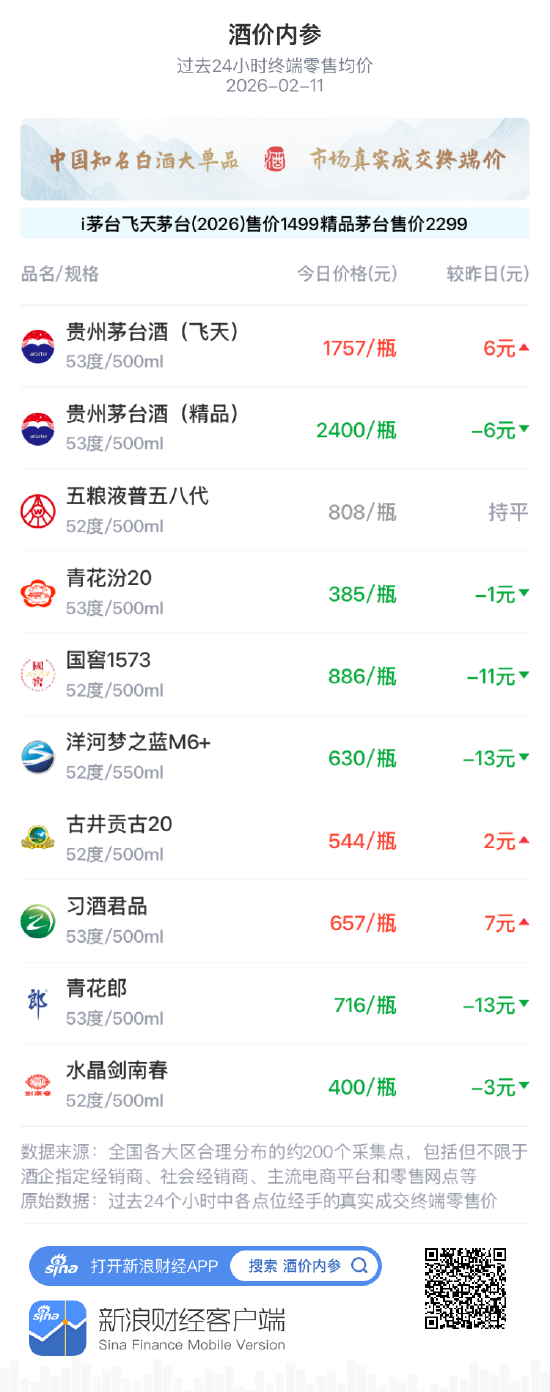
酒价内参2月11日价格发布,洋河梦之蓝M6+回落13元
Xin Lang Cai Jing· 2026-02-11 01:24
Group 1 - The core viewpoint of the article indicates that the retail prices of the top ten Chinese liquor products have slightly weakened, with a total price of 9183 yuan, down 32 yuan from the previous day, marking a recent low [1][6][7] - Among the top ten products, six saw price declines, three increased, and one remained stable. The price increases were led by Xijiu Junpin, which rose by 7 yuan per bottle, and Guizhou Moutai Feitian, which increased by 6 yuan per bottle due to pre-holiday consumption and channel replenishment demand [1][6][7] - The report highlights that the market is experiencing high-level consolidation and structural differentiation, with some brands like Qinghua Lang and Yanghe Dream Blue M6+ dropping by 13 yuan per bottle, and Guojiao 1573 decreasing by 11 yuan per bottle, likely due to pre-holiday inventory adjustments [1][6][7] Group 2 - The data for the liquor prices is sourced from approximately 200 collection points across various regions, including designated distributors, social distributors, e-commerce platforms, and retail outlets, aiming to provide an objective and traceable market price for well-known liquors [2][7] - The introduction of new sales channels for Guizhou Moutai Feitian at 1499 yuan per bottle and premium Moutai at 2299 yuan per bottle has begun to show a magnetic influence on the market retail prices of these products [2][7] - Dongwu Securities maintains a "buy" rating for Shanxi Fenjiu, noting its steady national expansion and significant growth potential in the clear liquor market, with projected revenues reaching 600-700 billion yuan in the medium to long term [2][7]

五粮液:公司将聚焦主业,持续做好生产经营
Zheng Quan Ri Bao Zhi Sheng· 2026-02-10 14:08
Group 1 - The core viewpoint of the article is that the company's valuation is influenced by multiple factors including macroeconomic environment, industry cycles, and market sentiment [1] - The company emphasizes its focus on core business operations and aims to maintain steady production and management practices [1] - The company is committed to long-term stable development and continuous dividend returns to investors [1]
五粮液:公司高度重视中小投资者利益
Zheng Quan Ri Bao· 2026-02-10 13:12
证券日报网讯 2月10日,五粮液在互动平台回答投资者提问时表示,股价涨跌受宏观环境、行业周期、 市场情绪等多重因素影响,公司高度重视中小投资者利益,近年来通过持续加大分红力度、承诺三年期 分红、股东优惠购酒等方式积极回馈广大投资者。 (文章来源:证券日报) ...
五粮液:以体育精神赋能品牌价值提升
Zheng Quan Ri Bao· 2026-02-10 13:11
Core Viewpoint - Wuliangye will leverage its sponsorship of the 2026 North America World Cup to enhance its global brand recognition and convey its "Harmony and Coexistence" philosophy to an audience of 5 billion people through various marketing strategies [2] Group 1 - The company is the official naming brand for the 2026 North America World Cup [2] - Wuliangye aims to achieve global brand exposure and cultural value output through immersive experiences and digital marketing [2] - The initiative is expected to strengthen international recognition and enhance brand value through sports [2]
板块旺季景气度延续,建议逢低布局
HTSC· 2026-02-10 13:03
Investment Rating - The report maintains a "Buy" rating for the food and beverage sector, suggesting investors take advantage of low prices to acquire quality leading companies [6]. Core Insights - The report highlights a positive outlook for the food and beverage sector, driven by seasonal demand and improved sales performance during the Chinese New Year [1]. - It emphasizes the importance of focusing on leading brands with strong fundamentals, particularly in the liquor and dairy segments, as they are expected to outperform their peers [2][4]. Summary by Category Liquor - The liquor industry is experiencing a divergence in performance, with top brands like Kweichow Moutai and Wuliangye showing strong sales, while others face challenges [1]. - Kweichow Moutai benefits from marketing reforms and strong demand, with its product prices stabilizing above 1600 RMB [1]. - Recommendations include Kweichow Moutai, Wuliangye, and other leading brands for investment [1]. Dairy Products - Major dairy companies like Yili and Mengniu are expected to achieve strong sales during the Chinese New Year, with inventory levels remaining healthy [2]. - The report anticipates a turning point in the raw milk cycle, with prices expected to stabilize, benefiting leading dairy firms [2]. - Recommended stocks include Yili and Mengniu, which are expected to gain market share in 2026 [2]. Restaurant Supply Chain and Condiments - The report sees a recovery in the restaurant sector, supported by government policies and improved consumer confidence [3]. - Leading companies are adjusting pricing strategies to enhance profitability, with inventory levels remaining healthy [3]. - Key recommendations include Anjijia and Haitian Flavoring, which are expected to benefit from improved market conditions [3]. Snacks - The snack industry is poised for growth, with increased sales during the Chinese New Year and a shift towards efficient retail channels [4]. - Recommended stocks include Weilian and Qiaqia, which are expected to maintain high profitability levels [4].




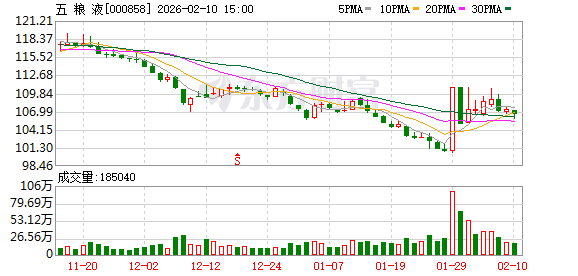
19只白酒股下跌 贵州茅台1504.8元/股收盘
Bei Jing Shang Bao· 2026-02-10 10:05
Core Viewpoint - The liquor sector, particularly the baijiu market, is experiencing a downturn with significant declines in stock prices of major companies, indicating a potential shift in supply-demand dynamics and financial pressures within the industry [1] Industry Summary - The Shanghai Composite Index closed at 4128.37 points, up 0.13%, while the baijiu sector index closed at 2288.11 points, down 0.80% [1] - A total of 19 baijiu stocks declined, with notable drops in major brands: Kweichow Moutai at 1504.80 CNY/share (-1.32%), Wuliangye at 106.50 CNY/share (-0.80%), Shanxi Fenjiu at 170.28 CNY/share (-2.53%), Luzhou Laojiao at 118.19 CNY/share (-2.56%), and Yanghe at 55.08 CNY/share (-1.04%) [1] Company Insights - Huachuang Food and Beverage's report highlights a persistent mismatch between supply and demand over the past three years, with an expanding gap between "reporting" and "sales" [1] - The report suggests that Kweichow Moutai may lower its growth targets starting in Q3 of this year, which could lead to accelerated financial pressure across the industry [1] - The first turning point in supply-demand dynamics is anticipated in Q4 2025, with expectations for the "sales-reporting" gap to narrow [1] - Continuous observation of industry bottoming signals is necessary through 2026, focusing on changes in cash flow for channels and liquor companies, as well as the transition from inventory pressure to orderly clearance [1] - The price of Moutai's aged liquor is still in a bottoming phase and is expected to recover [1]