
Asia-Potash(000893)

Search documents
化工板块继续回调!资金疯狂扫货,化工ETF(516020)近10日吸金超5.6亿元!机构密集看好
Xin Lang Ji Jin· 2026-01-08 11:30
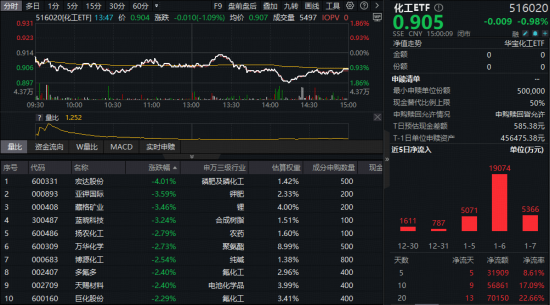
Group 1 - The chemical sector experienced a decline on January 8, with the Chemical ETF (516020) showing a low-level fluctuation, reaching a maximum intraday drop of 1.86% and closing down 0.98% [1] - Key stocks in the sector, including Hongda Co., Yaqi International, and Cangge Mining, saw significant declines, with Hongda Co. dropping 4.01% and others falling over 3% [1][2] - Despite the recent downturn, the Chemical ETF (516020) has seen substantial capital inflows, with a net inflow of 319 million yuan over the last five trading days and over 568 million yuan in the last ten days [1][3] Group 2 - According to Guotou Securities, the chemical industry is at the bottom of a four-year down cycle, with indicators suggesting it has nearly bottomed out, and 2026 is expected to be a turning point for the cycle [3] - The China Chemical Product Price Index (CCPI) was reported at 3930 points on December 31, 2025, a 39% decrease from the peak in 2021, indicating the industry is in a historical low range [3] - The basic chemical sector achieved a net profit of 112.7 billion yuan in the first three quarters of 2025, reflecting a year-on-year increase of 7.5%, suggesting initial stabilization of the sector [3] Group 3 - Future outlook indicates that the chemical industry will be influenced by tariff policies and fluctuations in crude oil prices, with recommendations to focus on undervalued leading companies and sectors benefiting from strong downstream demand [3] - Huazhong Securities suggests that the industry may continue to experience a trend of divergence, recommending attention to sectors such as synthetic biology, pesticides, and vitamin production [3] - The Chemical ETF (516020) tracks the CSI sub-sector chemical industry index, with nearly 50% of its holdings in large-cap leading stocks, providing an efficient way to invest in the chemical sector [3]




农化行业:2025年12月月度观察:钾肥供需紧平衡,储能拉动磷矿石需求,草甘膦价格下行-20260108
Guoxin Securities· 2026-01-08 11:29
Investment Rating - The report maintains an "Outperform" rating for the agricultural chemical industry [5][9]. Core Views - The potassium fertilizer supply and demand are tightly balanced, with international prices rising. China, being the largest consumer, has a high import dependency exceeding 60%. The domestic production of potassium chloride is expected to decrease by 2.7% in 2024, while imports are projected to reach a historical high of 12.633 million tons, a year-on-year increase of 9.1% [1][24]. - The long-term price of phosphate rock is expected to remain high due to declining grades and increasing extraction costs, coupled with growing demand from new applications like lithium iron phosphate [2][50]. - The price of glyphosate has shown volatility, with a significant increase during the South American planting season, followed by a decline due to high North American inventories [4][49]. Summary by Sections Potassium Fertilizer - The global potassium fertilizer market is characterized by a supply-demand imbalance, with prices expected to recover due to resource scarcity and geopolitical factors affecting supply chains [1][44]. - Domestic potassium chloride prices have shown an upward trend, with the average price at 3,282 RMB/ton by the end of December, reflecting a year-on-year increase of 30.45% [1][40]. Phosphate Chemicals - The phosphate rock market is experiencing tight supply conditions, with prices for 30% grade phosphate rock remaining high at around 1,040 RMB/ton in Hubei and 970 RMB/ton in Yunnan [2][50]. - The production capacity of lithium iron phosphate is projected to grow significantly, with a year-on-year increase of 48.59% expected in 2025 [2][51]. Pesticides - The glyphosate market is expected to see price improvements in 2026, following a period of price fluctuations influenced by seasonal demand and inventory levels [4][49]. - The report highlights several key companies in the pesticide sector, including Yangnong Chemical and Lier Chemical, which are positioned to benefit from rising prices and demand [8][49]. Investment Recommendations - Key recommendations include focusing on companies with strong potassium and phosphate resources, such as Yara International and Yun Tianhua, which are expected to benefit from the ongoing demand and supply dynamics in the agricultural chemical sector [7][9].


农化行业:2025年12月月度观察:肥供需紧平衡,储能拉动磷矿石需求,草甘膦价格下行-20260108
Guoxin Securities· 2026-01-08 09:55
Investment Rating - The report maintains an "Outperform" rating for the agricultural chemical industry [5][9]. Core Views - The potassium fertilizer supply and demand are tightly balanced, with international prices rising. China, being the largest consumer, has a high import dependency exceeding 60%. The domestic production of potassium chloride is expected to decrease by 2.7% in 2024, while imports are projected to reach a historical high of 12.633 million tons, a year-on-year increase of 9.1% [1][24]. - The long-term price center for phosphate rock is expected to remain high due to declining grades and increasing extraction costs, alongside growing demand from new applications like lithium iron phosphate. The domestic supply-demand situation for phosphate rock is tightening, with prices for 30% grade phosphate rock remaining elevated [2][50]. - The price of glyphosate has shown volatility, with a peak during the South American planting season and a subsequent decline due to high North American inventories. The report anticipates a recovery in glyphosate prices in 2026 [4][49]. Summary by Sections Potassium Fertilizer - The global potassium fertilizer market is characterized by a supply-demand imbalance, with prices expected to recover due to resource scarcity and geopolitical factors affecting supply chains [1][44]. - Domestic potassium chloride prices are projected to stabilize around 3,100-3,200 CNY/ton, with expectations of maintaining high inventory levels for food security [24][40]. Phosphate Chemicals - The phosphate rock market is experiencing a tightening supply-demand balance, with prices for 30% grade phosphate rock remaining above 900 CNY/ton for over three years. The report highlights the increasing demand from lithium battery applications [2][50]. - Phosphate chemical prices have shown upward trends for products like lithium iron phosphate, while glyphosate prices have decreased significantly [49][51]. Pesticides - The report suggests a potential recovery in the pesticide sector, particularly for glyphosate and its derivatives, as the industry undergoes restructuring to improve profitability [4][8]. - Companies such as Yangnong Chemical and Lier Chemical are highlighted as key players in the pesticide market, with recommendations for investment [7][8].

ETF盘中资讯|化工板块低位震荡,化工ETF(516020)跌近1%!资金持续加码,机构看好盈利估值双升
Sou Hu Cai Jing· 2026-01-08 02:15
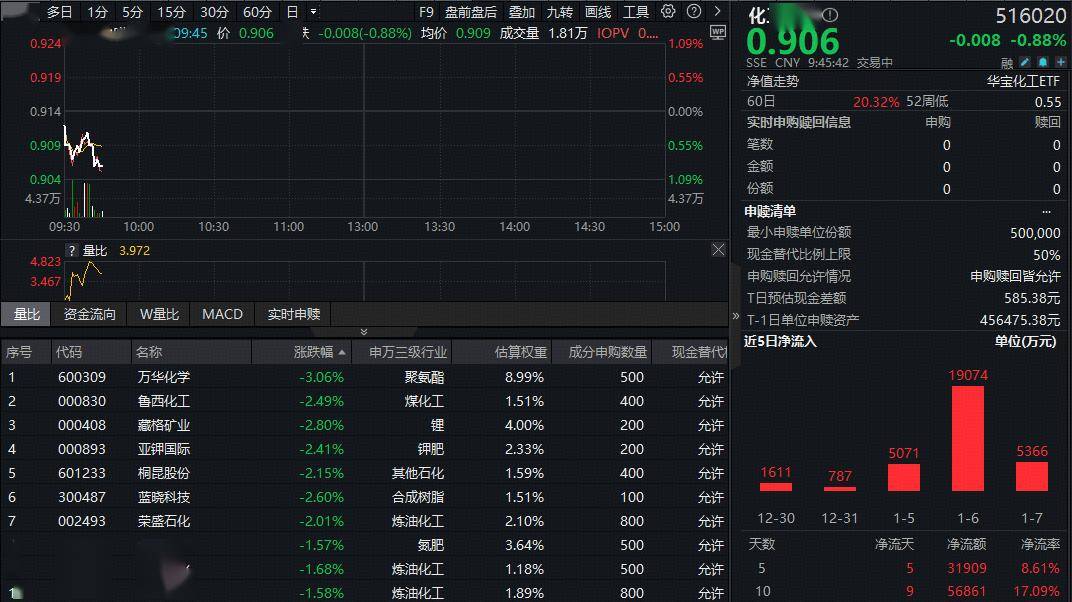
Group 1 - The chemical sector is experiencing a pullback, with the chemical ETF (516020) showing a decline of 0.88% as of the latest report [1] - Key stocks in the sector, including Wanhua Chemical, Luxi Chemical, and Cangge Mining, have seen significant declines, with Wanhua Chemical dropping over 3% [1][2] - The chemical ETF has attracted substantial capital inflows, with a net subscription of 319 million yuan over the last five trading days and over 568 million yuan in the last ten days [2][3] Group 2 - The construction of projects in the basic chemical industry has decreased by 10% year-on-year, indicating a nearing end to capital expenditures, while domestic demand and export resilience are improving the supply-demand balance [3] - The chemical industry is expected to benefit from policies aimed at reducing competition, leading to potential improvements in performance and valuation [3] - The current state of the chemical industry is at a cyclical bottom, with expectations for enhanced profitability and valuation for leading companies as competition dynamics improve [3] Group 3 - The chemical ETF (516020) tracks the CSI sub-sector chemical industry index, covering various segments and focusing on large-cap leading stocks [4] - Nearly 50% of the ETF's holdings are concentrated in major companies like Wanhua Chemical and Salt Lake Co., allowing investors to capitalize on strong market leaders [4] - Investors can also access the chemical sector through linked funds of the chemical ETF [4]


股票行情快报:亚钾国际(000893)1月7日主力资金净卖出5927.24万元
Sou Hu Cai Jing· 2026-01-07 13:35
Group 1 - The core viewpoint of the news is that Yara International (000893) has shown significant financial growth in the first three quarters of 2025, with a notable increase in both revenue and net profit compared to the previous year [2] - As of January 7, 2026, Yara International's stock closed at 53.18 yuan, reflecting a 2.17% increase, with a trading volume of 125,400 hands and a total transaction amount of 666.5 million yuan [1] - The company reported a main revenue of 3.867 billion yuan for the first three quarters of 2025, which is a 55.76% year-on-year increase, and a net profit attributable to shareholders of 1.363 billion yuan, up 163.01% year-on-year [2] Group 2 - In the third quarter of 2025, Yara International achieved a single-quarter main revenue of 1.345 billion yuan, representing a 71.37% year-on-year increase, and a net profit of 508 million yuan, which is a 104.69% increase year-on-year [2] - The company has a debt ratio of 32.61% and reported investment income of 44.8025 million yuan, with financial expenses amounting to 65.2958 million yuan, and a gross profit margin of 58.91% [2] - Over the last 90 days, 12 institutions have rated the stock, with 10 giving a buy rating and 2 giving a hold rating [3]

推荐炼油炼化、钾肥、磷化工、SAF投资方向
Zhong Guo Neng Yuan Wang· 2026-01-05 01:42
Core Viewpoint - The petrochemical industry is currently facing significant "involution" competition, leading to a situation where companies are experiencing increased production without corresponding profit growth. The industry's overall operating revenue profit margin has declined from 8.03% in 2021 to an expected 4.85% in 2024. However, since 2025, some sub-industries have begun to recover, with a year-on-year net profit growth of 10.56% in the first three quarters, indicating a gradual stabilization and recovery in industry profitability [1][2]. Supply Side - The cumulative fixed asset investment in the chemical raw materials and chemical products manufacturing industry turned negative starting June 2025, with capital expenditures in the SW basic chemical industry and several sub-industries declining for multiple consecutive quarters. The current expansion cycle in the industry is nearing its end. In September, policies aimed at stabilizing growth in the petrochemical industry were introduced to address low-price disorderly competition and promote the orderly exit of backward production capacity. Sub-industries such as silicone, caprolactam, and PTA polyester have responded by developing or drafting industry guidelines to combat "involution." It is anticipated that there will be stricter approvals for new chemical product capacities, and the elimination of backward production capacity (e.g., small scale, high energy consumption, and high pollution) will accelerate, effectively alleviating the issue of supply surplus in the petrochemical industry [2][3]. Demand Side - Traditional demand is expected to see moderate recovery due to global central banks entering a rate-cutting cycle and pausing balance sheet reductions, supported by monetary and fiscal policy stimuli. Emerging demand from sectors such as new energy, SAF (Sustainable Aviation Fuel), and AI continues to drive the need for key chemical materials that support technological upgrades in industries [3]. - The overseas chemical capacity reduction, driven by high energy costs and aging facilities, has led to a wave of plant closures in the European chemical industry since 2025. Currently, China's chemical product sales account for over 40% of the global market. With a complete domestic petrochemical industry chain and many chemical products being highly competitive globally, it is expected that Chinese chemical companies will continue to increase their market share, accelerating the digestion of surplus capacity [3]. Macro and Chemical Product Prices - As of December 2025, the manufacturing PMI index was reported at 50.1%, an increase of 0.9 percentage points from the previous month, indicating expansion. The China Chemical Product Price Index (CCPI) was reported at 3927 points, a decrease of 9.4% from 4333 points at the beginning of the year, reflecting a decline in the ex-factory prices of major chemical products [3]. Oil Prices - In 2025, the international oil market experienced a downward trend, with Brent crude futures averaging approximately $69.15 per barrel and WTI crude futures averaging about $65.87 per barrel. This was influenced by a mix of factors including OPEC+ gradual production increases, geopolitical conflicts, fluctuations in U.S. oil inventories, and macroeconomic sentiment. OPEC+ announced a pause in production increases at the beginning of 2026 after a cumulative increase of 411,000 barrels per day from October to December 2025 to alleviate surplus pressure. The demand from non-OECD countries and aviation fuel, along with petrochemical raw materials, has become a major support for oil prices. Major institutions have narrowed their demand growth expectations for 2025-2026 to between 700,000 and 1.4 million barrels per day [4]. Investment Recommendations - The refining and chemical sector is expected to see a recovery in overall profits due to moderate oil prices and reduced cost volatility. The supply-demand relationship in the refining and chemical industry, particularly in the aromatics industry chain, is expected to continue to optimize. Key recommendations include China Petroleum (601857) and Rongsheng Petrochemical (002493) [5]. - In the potassium fertilizer sector, potassium salt resources are expected to remain scarce, with global supply and demand expected to maintain a tight balance over the next 2-3 years. Key recommendations include Yara International (000893), which has significant potassium salt mining rights in Laos [6]. - In the phosphorus chemical sector, the demand for lithium iron phosphate batteries is expected to enhance the marginal pull on phosphorus ore demand, leading to a revaluation of phosphorus ore. Key recommendations include Chuanheng Co., Ltd. (002895) and Yuntianhua Co., Ltd. (600096) [6]. - In the sustainable aviation fuel (SAF) sector, the EU has mandated a gradual increase in SAF content in aviation fuel, with global SAF demand expected to double to 2 million tons by 2025. Key recommendations include Zhuoyue New Energy, a leading domestic biodiesel company [6].



推荐炼油炼化、钾肥、磷化工、SAF投资方向 | 投研报告
Sou Hu Cai Jing· 2026-01-05 01:33
Core Viewpoint - The petrochemical industry is currently facing significant "involution" competition, leading to a situation where companies are experiencing increased production without corresponding profit growth. The industry's operating revenue profit margin has declined from 8.03% in 2021 to an expected 4.85% in 2024. However, since 2025, some sub-industries have begun to recover, with a year-on-year increase of 10.56% in net profit attributable to the parent company in the first three quarters, indicating a gradual stabilization and recovery in industry profitability [2][3]. Supply Side - Investment in fixed assets in the chemical raw materials and chemical products manufacturing industry has turned negative since June 2025, with capital expenditures in the basic chemical industry and several sub-industries declining for multiple consecutive quarters. The current expansion cycle in the industry is nearing its end. In September, policies aimed at stabilizing growth in the petrochemical industry were introduced to address low-price and disorderly competition and to promote the orderly exit of backward production capacity. Sub-industries such as silicone, caprolactam, and PTA polyester have responded to these "anti-involution" measures by either issuing or formulating industry guidelines. It is anticipated that there will be stricter approvals for new chemical product capacities, and the elimination of backward production capacity (such as small scale, high energy consumption, and high pollution) will accelerate, effectively alleviating the issue of supply surplus in the petrochemical industry [2][3]. Demand Side - Traditional demand is expected to see a moderate recovery due to global central banks entering a rate-cutting cycle and pausing balance sheet reductions, supported by monetary and fiscal policy stimuli. Emerging demand from sectors such as new energy, SAF (Sustainable Aviation Fuel), and AI continues to drive the need for key chemical materials that support technological upgrades in industries [3]. - The overseas chemical capacity reduction, driven by high energy costs and aging facilities, has led to a wave of plant closures in the European chemical industry since 2025. Currently, China's chemical product sales account for over 40% of the global market, with a well-established domestic petrochemical industry chain. As overseas capacity continues to clear and demand is expected to recover, Chinese chemical companies are likely to see an increase in global market share, accelerating the digestion of surplus capacity [3]. Macro and Chemical Product Prices - As of December 2025, the manufacturing PMI index was reported at 50.1%, an increase of 0.9 percentage points from the previous month, indicating expansion. The China Chemical Product Price Index (CCPI) was reported at 3927 points, a decrease of 9.4% from 4333 points at the beginning of the year, reflecting a decline in the ex-factory prices of major chemical products [3]. Oil Prices - In 2025, international oil prices exhibited a fluctuating downward trend, with Brent crude futures averaging approximately $69.15 per barrel and WTI crude futures averaging about $65.87 per barrel. This fluctuation was influenced by a combination of factors, including OPEC+'s gradual production increases, geopolitical conflicts, and macroeconomic sentiment. OPEC+ announced a pause in production increases at the beginning of 2026 to alleviate surplus pressures after a cumulative increase of 411,000 barrels per day from October to December. The demand from non-OECD countries, along with aviation fuel and petrochemical raw material needs, has become a major support for oil prices. Major institutions have narrowed their demand growth expectations for 2025-2026 to a range of 700,000 to 1.4 million barrels per day [4]. Investment Recommendations - The refining and chemical sector is expected to see a recovery in overall profits due to moderate oil prices and reduced cost fluctuations. The industry is also experiencing a shift towards "reducing oil and increasing chemicals," supported by clear anti-involution policy signals. Recommended companies include China Petroleum and Rongsheng Petrochemical [5][6]. - In the potassium fertilizer sector, potassium salt resources are expected to remain scarce, with a tight balance in global supply and demand over the next 2-3 years. Recommended company: Yara International, which holds significant potassium salt mining rights in Laos [6]. - In the phosphorus chemical sector, the demand for lithium iron phosphate in energy storage is expected to enhance the marginal pull on phosphorus ore demand, leading to a revaluation of phosphorus ore. Recommended companies include Chuanheng Co. and Yuntianhua [6]. - In the sustainable aviation fuel (SAF) sector, the EU has mandated a gradual increase in SAF blending ratios, with global SAF demand expected to double to 2 million tons by 2025. Recommended company: Zhuoyue New Energy, a leading domestic biodiesel enterprise [6][7].

长江大宗2026年1月金股推荐
Changjiang Securities· 2026-01-04 11:39
Group 1: Metal Sector - Yun Aluminum Co. (000807.SZ) is projected to achieve a net profit of CNY 44.12 billion in 2024, increasing to CNY 75.75 billion by 2026, with a PE ratio decreasing from 25.82 to 15.04[9] - The company has a comprehensive production capacity of 305,000 tons of green aluminum and 140,000 tons of alumina, positioning it as a leader in the green aluminum sector[18] - The company's debt-to-asset ratio is expected to decrease to 23% by 2024, maintaining a strong ROE of 15.6%[24] Group 2: Construction Materials - Huaxin Cement (600801.SH) is forecasted to have a net profit of CNY 24.16 billion in 2024, growing to CNY 36.58 billion by 2026, with a PE ratio dropping from 18.60 to 12.29[9] - China National Materials (002080.SZ) is expected to see its net profit rise from CNY 8.92 billion in 2024 to CNY 25.87 billion in 2026, with a PE ratio decreasing from 68.38 to 23.57[9] Group 3: Transportation Sector - SF Holding (002352.SZ) is projected to achieve a net profit of CNY 101.70 billion in 2024, increasing to CNY 124.78 billion by 2026, with a PE ratio declining from 18.82 to 15.34[9] - The Beijing-Shanghai High-Speed Railway (601816.SH) is expected to see a slight increase in profit, with a PE ratio of 1973.38 in 2024, dropping to 1758.94 by 2026[9] Group 4: Chemical Sector - Senqcia (002984.SZ) is forecasted to have a net profit of CNY 21.86 billion in 2024, with a PE ratio of 10.03, expected to rise to CNY 21.26 billion by 2026[9] - Yara International (000893.SZ) is projected to achieve a net profit of CNY 9.50 billion in 2024, increasing to CNY 39.34 billion by 2026, with a PE ratio decreasing from 46.64 to 11.27[9]



联合研究|组合推荐:长江研究2026年1月金股推荐
Changjiang Securities· 2026-01-04 08:46
Market Overview - The market is expected to experience style differentiation as it approaches the Spring Festival, maintaining a structural trend under narrow fluctuations[4] - Key focus areas include the release of December and annual economic data in late January and a concentrated period of earnings forecasts[4] Investment Strategy - The strategy emphasizes three main lines: 1. High-growth and high-elasticity sectors, including AI hardware (e.g., optical modules), energy storage, lithium batteries, and non-ferrous metals[4] 2. Market hot tracks such as commercial aerospace, robotics, and cultural tourism[4] 3. Low-position large financial sectors, focusing on high-certainty performance in brokerage, insurance, and banks with dividend expectations[4] Recommended Stocks - **Metals**: Yun Aluminum Co., Ltd. (000807.SZ) with a projected EPS of 1.87 in 2025 and a PE of 17.6[28] - **Chemicals**: Yara International (000893.SZ) with a projected EPS of 2.06 in 2025 and a PE of 23.3[28] - **New Energy**: Slin Smart Drive (301550.SZ) with a projected EPS of 1.32 in 2025 and a PE of 105.0[28] - **Machinery**: Hengli Hydraulic (601100.SH) with a projected EPS of 2.19 in 2025 and a PE of 50.2[28] - **Aerospace**: AVIC Xi'an Aircraft Industry Group (000768.SZ) with a projected EPS of 0.42 in 2025 and a PE of 60.3[28] - **Banking**: Jiangsu Bank (600919.SH) with a projected EPS of 1.76 in 2025 and a PE of 5.9[28] - **Non-Banking**: New China Life Insurance (601336.SH) with a projected EPS of 11.82 in 2025 and a PE of 5.9[28] - **Social Services**: Jin Jiang International (600754.SH) with a projected EPS of 0.89 in 2025 and a PE of 28.3[28] - **Electronics**: Dongshan Precision (002384.SZ) with a projected EPS of 0.77 in 2025 and a PE of 109.8[28] - **Telecommunications**: Zhongji Xuchuang (300308.SZ) with a projected EPS of 9.47 in 2025 and a PE of 64.4[28] Risk Factors - Economic recovery may fall short of expectations, leading to slow growth or stagnation[34] - Significant changes in individual stock fundamentals could adversely affect performance[34]



2026年石化化工行业1月投资策略:推荐炼油炼化、钾肥、磷化工、SAF投资方向
Guoxin Securities· 2026-01-04 08:37
Core Insights - The petrochemical industry is currently facing significant "involution" competition, leading to a decline in profit margins from 8.03% in 2021 to 4.85% in 2024, with a slight recovery in net profit by 10.56% year-on-year in the first three quarters of 2025 [15][16][18] - The report recommends investment in refining and chemical, potash fertilizer, phosphorus chemicals, and sustainable aviation fuel (SAF) sectors due to expected improvements in supply-demand dynamics and profitability [15][18] Supply Side - The cumulative fixed asset investment in the chemical raw materials and products manufacturing sector turned negative in June 2025, indicating the end of the current expansion cycle [15] - Policies aimed at stabilizing growth in the petrochemical industry have been introduced to combat low-price competition and promote the orderly exit of outdated capacities [15][16] - The approval for new chemical product capacities is expected to tighten, alleviating the oversupply issue in the petrochemical industry [15][18] Demand Side - Traditional demand is anticipated to recover moderately due to global central banks entering a rate-cutting cycle, supported by monetary and fiscal policy stimuli [2] - Emerging demands from sectors such as renewable energy, SAF, and AI are expected to drive the need for key chemical materials [2] - China's chemical product sales account for over 40% of the global market, and the domestic industry is expected to gain market share as overseas capacities are cleared [2][18] Oil Prices and Market Trends - Brent crude oil averaged around $69.15 per barrel and WTI at $65.87 per barrel in 2025, with prices fluctuating due to various geopolitical and economic factors [3][17] - The overall cost for refining and chemical industries is expected to decrease, leading to a recovery in profitability [18] Investment Recommendations - The report highlights specific companies for investment: - **China Petroleum**: A leading comprehensive energy company with a strong position in the natural gas sector [20] - **Rongsheng Petrochemical**: Expected to see profit recovery with sulfur providing performance increments [20] - **Yaka International**: A rare potash fertilizer producer with ongoing capacity expansion [20] - **Chuanheng Co.**: Strong foundation in phosphate with significant resource increments [20] - **CNOOC**: A well-managed offshore oil and gas giant [20] - **Zhuoyue New Energy**: A leader in the domestic biodiesel sector focusing on SAF [20] Key Industry Research - The refining and chemical sector is expected to see continuous improvement in supply-demand dynamics, with profitability likely to recover due to policy and self-regulation measures [21][22] - The PTA industry is transitioning from "involution" competition to "high-quality development," with expectations for product price recovery [29][40] - The polyester bottle chip market is projected to stabilize with steady demand growth, despite recent price pressures [34][40]
