Bank of Ningbo(002142)

Search documents
城商行板块10月17日跌0.17%,上海银行领跌,主力资金净流出4.03亿元
Zheng Xing Xing Ye Ri Bao· 2025-10-17 08:35
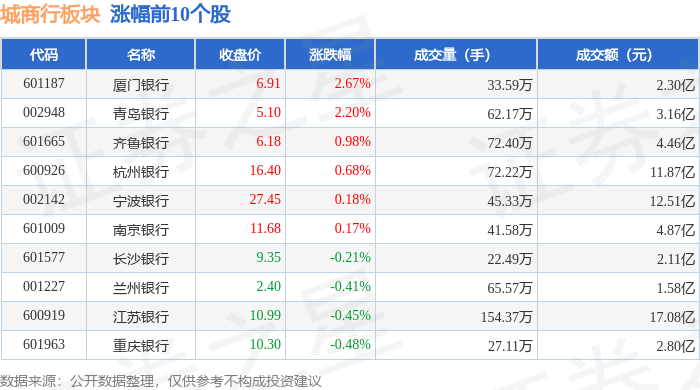
Market Overview - The city commercial bank sector experienced a decline of 0.17% on October 17, with Shanghai Bank leading the drop [1] - The Shanghai Composite Index closed at 3839.76, down 1.95%, while the Shenzhen Component Index closed at 12688.94, down 3.04% [1] Individual Bank Performance - Xiamen Bank saw a closing price of 6.91, with an increase of 2.67% and a trading volume of 335,900 shares, amounting to a transaction value of 230 million [1] - Qingdao Bank closed at 5.10, up 2.20%, with a trading volume of 621,700 shares and a transaction value of 316 million [1] - In contrast, Shanghai Bank closed at 9.49, down 1.04%, with a trading volume of 768,900 shares and a transaction value of 734 million [2] Capital Flow Analysis - The city commercial bank sector saw a net outflow of 403 million from institutional investors, while retail investors contributed a net inflow of 308 million [2] - The table indicates that Suzhou Bank had a net inflow of 24.27 million from institutional investors, while it faced a net outflow of 14.17 million from speculative funds [3] - Jiangsu Bank experienced a net outflow of 24.10 million from institutional investors but had a net inflow of 1.78 million from retail investors [3]


多家银行上调代销基金风险评级
Zhong Guo Jing Ying Bao· 2025-10-17 07:13
Core Viewpoint - Recent adjustments in risk ratings for fund distribution by banks are closely related to market changes, with increased asset risk and a shift from static to dynamic risk management practices [1][2][3] Group 1: Risk Rating Adjustments - Multiple banks, including CITIC Bank, have raised the risk ratings of 15 out of 17 asset management products, indicating a trend towards higher risk assessments in response to market conditions [2][5] - The adjustments are part of a broader regulatory requirement for banks to independently conduct risk ratings and ensure consistency with fund managers' ratings [3][4] - The adjustments reflect a need to align risk ratings with the actual risk profiles of funds, particularly for equity and pension-themed funds, which have shown structural changes in risk characteristics [6][7] Group 2: Regulatory and Market Influences - The implementation of the "Commercial Bank Agency Sales Business Management Measures" starting October 1, 2025, mandates banks to independently assess risk ratings, influencing recent adjustments [3][4] - Data analysis revealed a mismatch between clients' risk profiles and the actual risk levels of funds they held, prompting banks to raise ratings to mitigate overexposure to risk [3][6] - Market volatility, particularly in the A-share market, has led to increased risk for equity funds, necessitating adjustments in their risk ratings [6][7] Group 3: Investor Risk Assessment Changes - Some banks, like Jiangnan Rural Commercial Bank, have revised their investor risk assessment rules to enhance consumer protection and ensure appropriate risk evaluations [4] - The new rules limit the frequency of risk assessments and establish a one-year validity period for assessment results, emphasizing the importance of timely evaluations in light of changing financial circumstances [4] - The overall trend indicates that banks are striving to improve their suitability management practices to better protect investors' interests [4][5]


金价再创新高!有投资者欲贷款炒金,银行密集提示市场风险
Sou Hu Cai Jing· 2025-10-17 06:43
Core Insights - Gold prices have reached new highs, touching $4,380 per ounce on October 17, with an increase of over 40% year-to-date [2] - The rising gold prices have sparked interest among investors, with many considering investing in gold, including some planning to use loans for funding [2] Investment Behavior - Some investors are utilizing consumer loans with interest rates around 3% to invest in gold, while others are leveraging credit card interest-free periods of 20 to 56 days to fund their investments [2] - Additionally, some investors are using online lending platforms like Huabei to finance their gold investments [2] Risk Warnings from Banks - Major banks such as ICBC and CCB have issued warnings regarding the risks associated with precious metal investments due to increased market volatility [3] - ICBC advised investors to be aware of market changes and to enhance their risk awareness, suggesting a diversified approach to gold investments [3] - CCB highlighted the need for clients to manage their positions and margin balances carefully in light of heightened market risks [3] Market Cooling Measures - Several banks have raised the minimum purchase amounts for gold accumulation products to cool down the market [4] - Bank of China announced an increase in the minimum purchase amount for gold accumulation products from 850 yuan to 950 yuan [4] - ICBC raised the minimum investment for its "Ruyi Jin" accumulation product from 850 yuan to 1,000 yuan, while maintaining a minimum of 1 gram for weight-based accumulation [4] - Ningbo Bank also adjusted its minimum purchase amount for gold accumulation from 900 yuan to 1,000 yuan due to significant price fluctuations [4]




黄金牛市博弈加剧 积存金“门槛”频上调
Zhong Guo Jing Ying Bao· 2025-10-17 05:16
Core Viewpoint - The international gold price has been rising significantly, with London gold prices reaching $4208.757 per ounce as of October 16, 2025, marking a year-to-date increase of 61% [1][3]. Group 1: Market Performance - London gold has consistently remained above the $4000 per ounce mark, with a notable increase since August due to strong demand for gold as a safe-haven asset amid economic uncertainties [3][6]. - The scale of gold ETFs has rapidly expanded, with 14 commodity gold ETFs collectively nearing 200 billion yuan, reflecting a net inflow of 73.8 billion yuan from January to October 16, 2025 [3]. Group 2: Banking Sector Response - Major commercial banks, including Bank of China, Industrial and Commercial Bank of China, and China Construction Bank, have raised the minimum purchase amounts for gold accumulation products to manage investor risk amid rising gold prices [2][5]. - The minimum purchase amount for Bank of China’s gold accumulation products was increased from 850 yuan to 950 yuan, while ICBC raised its minimum from 850 yuan to 1000 yuan [2]. Group 3: Investor Behavior - There has been a notable increase in inquiries and trading activity in gold accumulation products, as traditional investment options yield lower returns, prompting a shift in asset allocation towards gold [4]. - Investors are increasingly attracted to gold accumulation due to its flexible investment thresholds and risk smoothing features, especially in a volatile market [3][4]. Group 4: Economic Factors Influencing Gold Prices - The rise in gold prices is attributed to geopolitical uncertainties and concerns over the potential devaluation of the US dollar, leading investors to seek refuge in gold and other precious metals [6][7]. - The expectation of further monetary easing by the Federal Reserve has also contributed to the bullish sentiment surrounding gold prices [7][8]. Group 5: Future Outlook - Analysts predict that gold prices may continue to rise, with potential targets of $4300 per ounce if the Federal Reserve opts for further rate cuts [8]. - The ongoing high demand for gold from central banks and the geopolitical landscape are expected to support gold prices in the medium term [7][8].
金价涨至1248元!多家银行紧急提醒,金价疯涨背后隐藏着怎样的秘密
Sou Hu Cai Jing· 2025-10-17 04:58
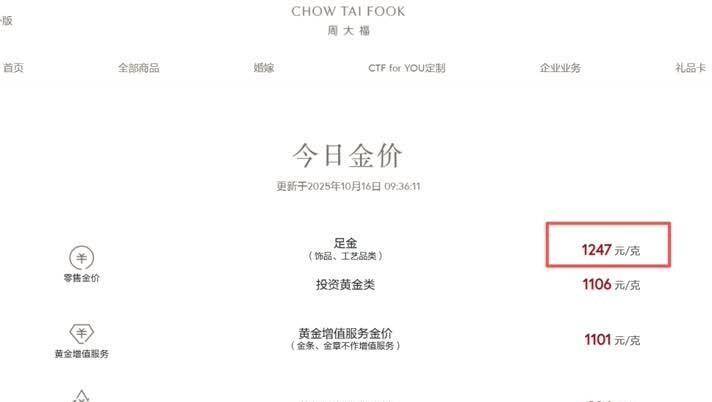
Core Insights - The price of gold jewelry in China has surged, with Lao Miao Gold's price reaching 1248 RMB per gram on October 15, 2025, marking a 13 RMB increase from the previous day, leading to concerns among potential buyers about affordability [1][3] - International gold prices have also hit record highs, with prices exceeding 4200 USD per ounce for the first time, reflecting a year-to-date increase of over 50%, potentially marking the strongest year since 1979 [3][5] - The Federal Reserve's recent interest rate cut has been a significant driver of rising gold prices, as lower interest rates reduce the opportunity cost of holding non-yielding assets like gold [5][13] Market Dynamics - The surge in gold prices is attributed to various factors, including the Federal Reserve's monetary policy, global risk aversion due to geopolitical tensions, and trade disputes, particularly between the U.S. and China [5][7] - Central banks worldwide have been accumulating gold, with emerging market central banks actively seeking to reduce reliance on the U.S. dollar, leading to increased demand for gold [7][17] - Investment banks have raised their gold price forecasts, with Goldman Sachs predicting a price of 4900 USD per ounce by 2026 due to strong demand from central banks and private sectors [7] Investor Behavior - Institutional investors are becoming more cautious, as evidenced by a decrease in speculative net long positions in COMEX gold, while retail investors remain optimistic about gold's potential for appreciation [9][19] - The shift in consumer behavior is notable, with many buyers now prioritizing investment value over aesthetic appeal when purchasing gold [15][19] - Financial institutions have raised investment thresholds for gold products, indicating a cautious approach to the current market volatility [11][15] Technical Indicators - Current technical indicators suggest potential overbought conditions for gold, with the 14-day Relative Strength Index (RSI) reaching 78, indicating a buildup of selling pressure [11][24] - Historical trends show that while gold often performs well during crises, significant price increases are typically followed by periods of correction [24][22] Economic Context - The ongoing high inflation rates in the U.S. and Europe have led to increased interest in gold as a traditional hedge against inflation, although historical data suggests that timing is crucial for successful investment [24][22] - The fluctuation of the U.S. dollar and its impact on gold prices remains a critical factor, with analysts warning that a strengthening dollar could exert downward pressure on gold prices [15][24]

10月16日13家公司获基金调研
Zheng Quan Shi Bao Wang· 2025-10-17 03:39
Group 1 - On October 16, a total of 19 companies were investigated by institutions, with 13 companies being surveyed by funds, highlighting a significant interest in 聚灿光电, 海光信息, and 宁波银行 [1] - 聚灿光电 received the most attention with 10 funds participating in its survey, while 海光信息 and 宁波银行 were surveyed by 8 and 6 funds respectively [1] - Among the surveyed companies, 3 are from the main board of the Shenzhen Stock Exchange, 5 from the ChiNext board, 3 from the main board of the Shanghai Stock Exchange, and 2 from the Sci-Tech Innovation Board [1] Group 2 - The total market capitalization of the surveyed companies includes 2 with a market cap over 500 billion, specifically 海光信息 and 宁波银行, while 9 companies have a market cap below 100 billion [1] - In terms of market performance, 3 stocks among the surveyed companies increased in value over the past 5 days, with 宁波银行, 共同药业, and 海新能科 showing gains of 4.66%, 3.05%, and 1.10% respectively [1] - Conversely, 10 stocks experienced declines, with 海光信息, 明新旭腾, and 中际联合 showing the largest drops of 11.42%, 9.11%, and 8.75% respectively [1] Group 3 - Among the surveyed companies, 中际联合 saw the highest net inflow of funds in the past 5 days, amounting to 47.81 million, followed by 宁波银行 and 海新能科 with net inflows of 10.76 million and 10.31 million respectively [2] - In terms of earnings, 海光信息 and 聚灿光电 reported the highest year-on-year net profit growth of 28.56% and 8.43% respectively [2] - A detailed list of surveyed companies includes 聚灿光电, 海光信息, 宁波银行, and others, with their respective fund participation and recent stock performance [2]


城商行板块10月16日涨0.81%,重庆银行领涨,主力资金净流出4059.77万元
Zheng Xing Xing Ye Ri Bao· 2025-10-16 08:27
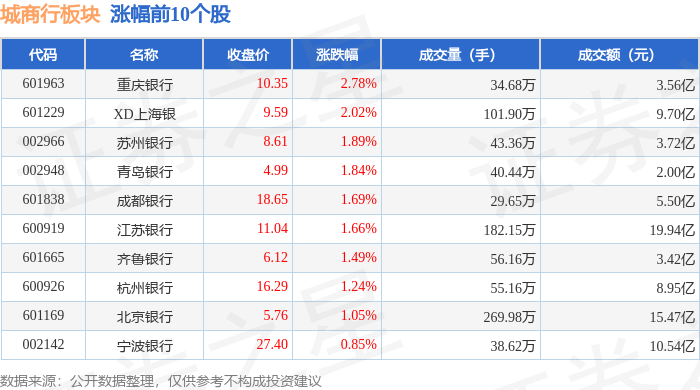
Market Performance - The city commercial bank sector increased by 0.81% on October 16, with Chongqing Bank leading the gains [1] - The Shanghai Composite Index closed at 3916.23, up 0.1%, while the Shenzhen Component Index closed at 13086.41, down 0.25% [1] Individual Stock Performance - Chongqing Bank (601963) closed at 10.35, up 2.78% with a trading volume of 346,800 shares [1] - XD Shanghai Bank (601229) closed at 9.59, up 2.02% with a trading volume of 1,019,000 shares [1] - Suzhou Bank (002966) closed at 8.61, up 1.89% with a trading volume of 433,600 shares [1] - Other notable performances include Qingdao Bank (002948) up 1.84% and Chengdu Bank (601838) up 1.69% [1] Capital Flow Analysis - The city commercial bank sector experienced a net outflow of 40.6 million yuan from institutional investors and a net outflow of 188 million yuan from speculative funds, while retail investors saw a net inflow of 228 million yuan [1] - Jiangsu Bank (600919) had a significant net inflow of 1.4 billion yuan from institutional investors, despite a net outflow of 114 million yuan from speculative funds [2] - Ningbo Bank (002142) reported a net inflow of 58.6 million yuan from institutional investors, while experiencing a net outflow from both speculative and retail investors [2]


宁波银行(002142) - 2025年10月16日投资者关系活动记录表
2025-10-16 08:26
Group 1: Financing and Growth - The company focuses on balancing dividends and internal capital growth to ensure a solid capital foundation for sustainable business development [2] - Internal capital is expected to create greater value for the company's development, with a commitment to enhancing performance and maintaining steady internal capital growth for shareholder returns [2] Group 2: Loan Growth and Support - The company has been actively supporting key sectors such as small and micro enterprises, manufacturing, and consumer services, leading to steady loan growth [2] - Future loan growth is anticipated to be supported by ongoing policy benefits aimed at expanding domestic demand and promoting consumption [2] Group 3: Asset Quality Management - The company acknowledges new challenges in asset quality management due to economic fluctuations and external conditions [2] - A focus on risk management through a specialized service system and strict credit policies is in place to maintain asset quality at a competitive level within the industry [2] Group 4: Compliance and Communication - The company ensured that all communications during the investor relations activity adhered to disclosure regulations, with no significant undisclosed information leaked [2]
银行密集上调积存金起购门槛,门槛最高已达1000元
Jin Rong Jie· 2025-10-16 07:31
Core Insights - International gold prices have surpassed $4,200 per ounce, marking the strongest surge in nearly 46 years, prompting domestic banks in China to enhance risk control measures for gold investment [1][2] - Major Chinese banks, including Bank of China, Industrial and Commercial Bank of China, Ningbo Bank, and Industrial Bank, have raised the minimum investment amounts for gold accumulation products, with thresholds generally exceeding 1,000 yuan [1] Group 1: Bank Adjustments - Industrial and Commercial Bank of China increased the minimum investment for its gold accumulation business from 850 yuan to 1,000 yuan, the highest among state-owned banks [1] - Bank of China raised its minimum purchase amount from 850 yuan to 950 yuan, maintaining a flexible additional purchase amount of 200 yuan [1] - Both Ningbo Bank and Industrial Bank have set their minimum investment at 1,000 yuan, with Industrial Bank indicating potential future adjustments due to international macroeconomic and geopolitical factors [1] Group 2: Market Dynamics - This is not the first adjustment of the year; for instance, the minimum investment for Industrial and Commercial Bank's gold accumulation has increased by 53.8% from 650 yuan at the beginning of the year [2] - The gold market is characterized by high volatility and significant price increases, with international gold prices rising over 57% since 2025, the best performance since 1979 [2] - Domestic gold prices have also surged, with notable increases in retail prices for gold jewelry, such as Chow Tai Fook and Lao Feng Xiang [2] Group 3: Risk Factors - The recent surge in gold prices has been accompanied by significant fluctuations, with international gold prices experiencing a rise of over $300 within ten days and daily volatility exceeding 2% [2] - The Shanghai Gold Exchange has issued risk warnings twice in October, advising investors to trade rationally due to the heightened market risks [2]
金价,飙太猛!银行紧急上调
Jing Ji Wang· 2025-10-16 03:08
Core Viewpoint - The price of gold has surged approximately 55% this year, driven by expectations of interest rate cuts from the Federal Reserve, global central bank gold purchases, and increased holdings in gold ETFs, prompting several banks to adjust their gold accumulation business [1] Group 1: Bank Adjustments to Gold Accumulation Business - On October 14, Bank of China announced an increase in the minimum purchase amount for its gold accumulation products from 850 yuan to 950 yuan, effective October 15, 2025 [2] - On October 11, Industrial and Commercial Bank of China raised the minimum investment amount for its gold accumulation business from 850 yuan to 1000 yuan, while maintaining the minimum weight accumulation at 1 gram [2] - Ningbo Bank announced on October 9 that it would increase the minimum purchase amount for its gold accumulation business from 900 yuan to 1000 yuan, effective October 11, 2025 [4] - Agricultural Bank of China has adjusted its gold accumulation product's minimum purchase point to fluctuate with gold prices, marking its third adjustment this year [4][5] Group 2: Reasons for Adjustments - Banks are raising the minimum purchase thresholds primarily due to compliance requirements to ensure the minimum amount covers the real-time price of 1 gram of gold and to control risks by reducing speculative behavior [4][5] - The recent volatility in domestic gold prices has prompted these adjustments, with industry insiders expecting more banks to follow suit [5] Group 3: Historical Adjustments - Throughout 2023, several banks have repeatedly raised the minimum purchase amounts for their gold accumulation products, with Industrial and Commercial Bank of China increasing its minimum investment from 650 yuan to 1000 yuan in several steps [7][9] - Ningbo Bank also raised its minimum purchase amount from 700 yuan to 800 yuan earlier this year [8] Group 4: Market Adjustments and Risk Management - On September 24, Agricultural Bank of China announced adjustments to the trading limits for gold contracts, increasing the price fluctuation limits for various gold and silver contracts [6] - Banks are also enhancing risk management measures, with China Construction Bank and other institutions advising investors to be cautious due to increased market volatility [10]