SF Holding(002352)

Search documents
交通运输行业8月投资策略:快递“反内卷”举措持续兑现,业绩期关注优质个股
Guoxin Securities· 2025-08-15 02:11
Group 1: Shipping Industry - The oil shipping market is expected to see a recovery in rates due to OPEC+'s decision to increase production, with VLCC freight rates experiencing significant increases [1][21] - The current supply situation is relatively tight, and any marginal changes in demand could have a multiplier effect on freight rates, leading to recommendations for COSCO Shipping Energy and China Merchants Energy [1][21] - The container shipping sector is facing pressure on profitability due to weakening cargo volumes and ongoing trade risks, with a recommendation to monitor COSCO Shipping Holdings for potential alpha opportunities [1][25] Group 2: Aviation Industry - The domestic passenger flight volume has shown a slight increase, with overall and domestic flight volumes up by 0.6% and 0.5% respectively compared to the previous week, indicating a recovery trend [2][36] - The average ticket price for domestic routes has decreased by 8.7% year-on-year, while the passenger load factor has improved slightly, suggesting a mixed performance in the aviation sector [2][36] - Investment recommendations include China Southern Airlines, China Eastern Airlines, and Spring Airlines, as the aviation sector is expected to benefit from economic recovery [2][45] Group 3: Express Delivery Industry - The "anti-involution" policy initiated on July 1 aims to reduce competition in the express delivery sector, with price increases already observed in regions like Zhejiang and Guangdong [3][53] - The policy is expected to lead to improved profitability and service quality in the express delivery industry, with a focus on monitoring the execution and sustainability of price increases [3][54] - Recommendations include SF Express, ZTO Express, YTO Express, and Shentong Express, as these companies are likely to benefit from the policy changes and market dynamics [3][66] Group 4: Logistics Sector - The logistics sector is facing challenges due to external economic pressures and internal strategy adjustments, with companies like DeBang Logistics experiencing significant profit declines [79] - Eastern Airlines Logistics is highlighted as a leader in the air cargo market, benefiting from a strong market share and operational efficiencies [79][80] - Investment focus should be on companies that can adapt to the changing market conditions and maintain competitive advantages [79][80]



顺丰控股20250814
2025-08-14 14:48
Summary of SF Express Conference Call Company Overview - **Company**: SF Express (顺丰控股) - **Industry**: Logistics and Express Delivery Key Points and Arguments Strategic Adjustments - SF Express faced significant challenges due to blind diversification and product downscaling, leading to cost overruns and its first loss since going public in Q1 2021. The company quickly adjusted its strategy by exiting unprofitable businesses and stabilizing the average order value at approximately 15 RMB [2][4] - The "Four Network Integration" strategy was implemented to merge large and small parcel networks, warehousing, and franchise networks, reducing asset redundancy and improving network efficiency, generating an annual profit increment of about 1 billion RMB [2][4] Capital Expenditure and Cash Flow - The capital expenditure cycle is entering a downward phase, expected to maintain between 8 billion to 10 billion RMB in the future. Asset turnover and ROE are on the rise, significantly improving free cash flow [3][10] - The company has increased the number of transfer stations and optimized routing, resulting in a daily business volume of 40 million parcels across approximately 250 stations by 2024, showcasing a significant cost advantage [3][5] Operational Efficiency - SF Express has adopted direct sorting and a cage-free direct delivery model, which is expected to cover 10% of its network by the end of 2024. This has improved the efficiency of delivery personnel from an average of 80 parcels per day in 2019 to 166 parcels in 2024, optimizing overall network costs [2][5] Organizational Changes - The company has undergone three significant organizational transformations: transitioning from a franchise model to a direct operation model, implementing a partner program, and activating operational actions to enhance organizational capabilities and adapt to market changes [6][7] - The future direction includes an industry transformation, providing standardized logistics solutions for sectors such as e-commerce, telecommunications, automotive, and industrial manufacturing, with a revenue growth rate exceeding 20% in vertical segments by 2024 [8][9] Shareholder Returns - SF Express has introduced a five-year dividend return plan, with a regular dividend yield exceeding 2%. The dividend payout ratio is expected to increase from 20% to 40% by 2024, alongside enhanced stock buyback efforts [3][11][12] Valuation and Investment Potential - The current valuation of SF Express is considered attractive, transitioning from a growth stock to a value growth stock. The company has improved its profitability through strategic adjustments, making it a high-investment value opportunity [13] Additional Important Insights - The company is focusing on international expansion, leveraging its logistics capabilities to support Chinese brands entering overseas markets, with a significant portion of revenue coming from international operations [8][9]
物流板块8月14日跌0.66%,万林物流领跌,主力资金净流出5.1亿元
Zheng Xing Xing Ye Ri Bao· 2025-08-14 08:33
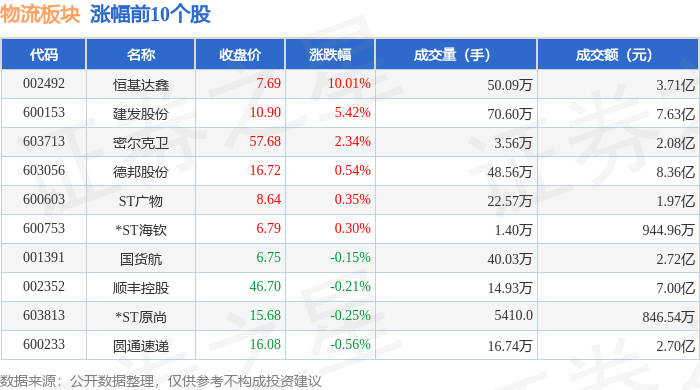
Market Overview - On August 14, the logistics sector declined by 0.66%, with Wanlin Logistics leading the drop [1] - The Shanghai Composite Index closed at 3666.44, down 0.46%, while the Shenzhen Component Index closed at 11451.43, down 0.87% [1] Individual Stock Performance - Hengji Dazheng (002492) saw a significant increase of 10.01%, closing at 7.69 with a trading volume of 500,900 shares and a turnover of 371 million yuan [1] - Jianfa Co. (600153) increased by 5.42%, closing at 10.90 with a trading volume of 706,000 shares and a turnover of 763 million yuan [1] - Wanlin Logistics (603117) experienced a decline of 5.34%, closing at 5.50 with a trading volume of 248,700 shares and a turnover of 138 million yuan [2] Capital Flow Analysis - The logistics sector experienced a net outflow of 510 million yuan from institutional investors, while retail investors saw a net inflow of 426 million yuan [2] - The table of capital flow indicates that Hengji Dazheng had a net inflow of 74.71 million yuan from institutional investors, while retail investors had a net outflow of 37.49 million yuan [3] Summary of Key Stocks - The top performers in terms of net inflow from institutional investors included Hengji Dazheng and Shunfeng Holdings (002352), which had a net inflow of 55.99 million yuan [3] - Other notable stocks with significant trading activity included Mierkewei (603713) and ST Guangwu (600603), with net inflows of 14.32 million yuan and 12.32 million yuan from institutional investors, respectively [3]




即时零售大战,快递行业慌了
3 6 Ke· 2025-08-14 00:06
Core Insights - The express delivery industry is facing a triple crisis, with growth primarily driven by order splitting rather than value increase, and low-cost e-commerce losing its rapid growth potential [1] - The rise of instant retail by 2025 is expected to impact consumer habits and take away growth space from e-commerce and express delivery [1] Industry Overview - The express delivery market's growth rate has declined, with Q1 2025 showing a year-on-year growth of 21.6%, dropping to 19.3% in the first half of 2025, compared to 21.5% in 2024 [1] - The express delivery industry has experienced significant growth since the early 2000s, with a compound annual growth rate of nearly 50% from 2006 to 2021, but growth slowed to 2.1% in 2022 due to market transformations [4][5] Impact of Instant Retail - Instant retail is expected to explode in 2025, with major platforms like JD.com and Meituan launching aggressive subsidy campaigns to capture market share [5][6] - The combined daily order volume of major platforms could reach 200 million, with total business volume projected to reach hundreds of billions of orders and a GMV of over one trillion [6] Competitive Landscape - The most affected companies in the express delivery sector may not be the traditional e-commerce-focused firms but rather high-end logistics providers like JD Logistics, which cater to premium products [8] - The competition between instant retail and traditional express delivery is intensifying, with companies like Meituan and JD.com vying for dominance in the market [9] Future Outlook - The market consensus suggests that instant retail service providers will benefit in the short term, while traditional express delivery companies must adapt to the evolving landscape [12] - The instant retail market is projected to reach 2 trillion yuan by 2030, with potential growth to 3-4 trillion yuan in the long term [12] Operational Challenges - The express delivery industry is entering a phase of efficiency and service competition, necessitating upgrades in operational models and resource utilization [13] - Companies that fail to innovate and adapt to the new market dynamics may face significant risks before the full impact of instant retail is realized [13]
快递行业研究框架培训
2025-08-13 14:53
Summary of the Express Delivery Industry Research Conference Call Industry Overview - The express delivery industry is characterized by high labor costs, with labor accounting for nearly 50% of total costs in both headquarters and franchise networks [4][7] - The industry is segmented into two main categories: economical express delivery represented by Tongda system and high-end express delivery represented by SF Express [2] Key Insights - In 2024, the growth rate of express delivery package volume is expected to exceed the growth rate of e-commerce GMV and social retail sales, with Taobao's contribution dropping below 30% and Pinduoduo, Douyin, and Kuaishou reaching 35% and 30% respectively [1][4] - The express delivery industry has undergone four stages: 1. **Emergence Phase (Pre-2011)**: The industry was just starting [5] 2. **Growth Phase (2011-2016)**: Package volume grew at a compound annual growth rate (CAGR) of 50% [5] 3. **Capitalization Phase (2017-2021)**: Leading companies completed IPOs and expanded capacity, leading to an oversupply situation [5][6] 4. **Clearing Phase (2022-Present)**: Regulatory interventions have slowed the clearing process, but market share continues to concentrate among leading players [6] Financial Performance and Market Dynamics - Price wars have led to a decline in profitability, with headquarters' single ticket profit dropping from 0.5 yuan to around 0.2 yuan [8] - Recent regulatory interventions have improved profitability at headquarters, but terminal prices remain suppressed by low-cost e-commerce brands, increasing pressure on franchise operators [8] - The Guangdong province has raised the minimum price for e-commerce express delivery to approximately 1.4 yuan, which is expected to stabilize the market [9] Strategic Adjustments by SF Express - SF Express has diversified its operations into areas such as express freight, cold chain, and local delivery, while also penetrating the lower-end market, resulting in a decline in average order value from 25 yuan in 2019 to 15 yuan in 2021 [11] - The company has implemented a strategy to reduce redundancy and improve operational efficiency, aiming to cut costs by 1 billion yuan annually [12] - SF Express has undergone three major transformations, shifting from a franchise model to a direct operation model, enhancing service quality and operational efficiency [13] Future Outlook - SF Express plans to focus on industry transformation and international expansion, providing comprehensive logistics solutions and enhancing its cross-border logistics network through acquisitions [14][15] - The company has seen a decline in capital expenditures, stabilizing between 8 billion to 10 billion yuan annually, which has improved its operational and profitability metrics [16] - From 2024 to 2028, SF Express aims to gradually increase its cash dividend ratio from 35% to 40%, reflecting its transition into a value growth stock [17] Conclusion - The express delivery industry is poised for growth, driven by e-commerce trends and regulatory support, while companies like SF Express are strategically positioning themselves to enhance profitability and market share through operational efficiencies and diversified service offerings [1][10][18]
中国物流版图“西拓”,又一个新枢纽诞生了?
Mei Ri Jing Ji Xin Wen· 2025-08-13 14:04
想要接住流量的,不只是西安 全国物流格局又有新变化。 8月12日,丝路电商班列(西安—乌鲁木齐)开行突破500列。据本地媒体报道,该趟班列较公路运输快5小时左右,能降低10%物流成本。自其去年3月开 行以来,京东、顺丰、极兔等快递公司陆续加入,最高能实现55车满编。 这趟班列有多特殊?从数据上看,它连接的两头,新疆和陕西,已经成为近两年快递业的"增长极"。今年上半年,陕西快递业务量增长48.6%至约15.5亿 件,增速高居全国第一,而新疆也增长35.6%至约2.5亿件,增速位居第五。 | 0 | | 500000 | 10000000 | 1500000 | | 20000000 | | | --- | --- | --- | --- | --- | --- | --- | --- | | 广东 | 2342903.9 | | 17.70 | | | | | | 浙江 | 1614384.3 | 8.4 0 | | | | | | | 江苏 | 755439.2 | | 18.5 . | | | | | | 河北 | 572120.9 | | | | | 38.2-0 | | | 河南 | 542275.4 ...



快递涨价了,但快递公司都在准备价格战
远川研究所· 2025-08-13 13:11
Core Viewpoint - The article discusses the recent price increase in the express delivery industry in Guangdong, which is seen as a response to the ongoing price war and declining average prices in the sector. The price adjustment is expected to have significant implications for the market dynamics and competition among delivery companies [4][6]. Group 1: Price Increase and Market Dynamics - Guangdong's express delivery base price was raised to 1.4 yuan per ticket, marking a 40% increase, aimed at curbing low-price competition and ensuring market stability [4][6]. - The express delivery sector in Guangdong is crucial, accounting for approximately 25% of the national total, with 234.3 billion packages sent in the first half of the year [4][6]. - Despite the price increase, the underlying issues of fierce competition and price wars in the express delivery industry remain unresolved [4][6]. Group 2: Historical Price Trends - The average price per express delivery ticket in China dropped from 8.14 yuan to 7.52 yuan in the first half of the year, a year-on-year decline of 7.7% [6]. - Over the past five years, the express delivery industry has experienced a continuous decline in average ticket prices, with a total decrease of 32% [11][22]. - The express delivery market has seen a tenfold increase in volume over the past decade, with a projected 1.758 billion packages to be delivered in 2024, reflecting a year-on-year growth of 21.5% [22][29]. Group 3: Competitive Landscape - The express delivery industry is characterized by intense competition, with major players struggling to establish a stable market structure. The top eight companies hold 85.2% of the market share, a modest increase of 2.7% over five years [19][22]. - The market remains fragmented, with new entrants and investments continuing to flood in, exacerbating the price competition [26][29]. - The industry's growth is heavily tied to the e-commerce sector, which drives demand for delivery services, further intensifying competition among providers [26][29]. Group 4: Investment and Operational Challenges - Companies in the express delivery sector are investing heavily in fixed assets, such as sorting facilities and transportation vehicles, often outpacing revenue growth [27][29]. - The fixed asset growth for companies like YTO Express has been significantly higher than revenue growth, indicating a focus on capacity expansion despite ongoing price wars [27][29]. - The article suggests that as long as the express delivery volume continues to grow rapidly, the price wars are unlikely to cease, creating a challenging environment for profitability [29].


中证沪港深500工业指数报1568.91点,前十大权重包含三一重工等
Jin Rong Jie· 2025-08-13 07:57
Core Points - The CSI Hong Kong-Shanghai-Shenzhen 500 Industrial Index reported a value of 1568.91 points, with a monthly increase of 3.27%, a quarterly increase of 5.53%, and a year-to-date increase of 2.32% [1] - The index is categorized into 11 industries based on the classification standards of the CSI Hong Kong-Shanghai-Shenzhen 500, CSI Hong Kong-Shanghai-Shenzhen Small Cap Composite, and CSI Hong Kong-Shanghai-Shenzhen Composite Index [1] Company Holdings - The top ten weighted companies in the CSI Hong Kong-Shanghai-Shenzhen 500 Industrial Index are: CATL (9.95%), Beijing-Shanghai High-Speed Railway (3.5%), Sungrow Power Supply (2.8%), Sany Heavy Industry (2.71%), Inovance Technology (2.7%), China State Construction (2.55%), SF Holding (2.47%), COSCO Shipping Holdings (2.16%), LONGi Green Energy (2.1%), and CRRC Corporation (2.01%) [1] - The market share of the index holdings is distributed as follows: Shanghai Stock Exchange 54.36%, Shenzhen Stock Exchange 36.51%, and Hong Kong Stock Exchange 9.14% [1] Industry Composition - The industry composition of the CSI Hong Kong-Shanghai-Shenzhen 500 Industrial Index is as follows: Electric Power Equipment 34.48%, Transportation 23.00%, Machinery Manufacturing 22.14%, Construction Decoration 10.55%, Aerospace and Defense 8.05%, and Commercial Services and Supplies 1.79% [2] - The index samples are adjusted biannually, with adjustments implemented on the next trading day after the second Friday of June and December [2]






丝路电商班列(西安—乌鲁木齐)开行量超过500列
Shan Xi Ri Bao· 2025-08-12 22:39
Core Insights - The launch of the Silk Road e-commerce train (X387) from Xi'an to Urumqi has surpassed 500 trips since its inaugural run on March 26, 2024, transporting a total of 20,619 freight cars of e-commerce goods, significantly enhancing logistics efficiency and reducing costs for e-commerce companies [1][2] Group 1: Operational Efficiency - The X387 train operates daily, departing at 9:09 AM from Xi'an International Port and reaching Urumqi in an average of 36.18 hours, with a speed of 120 km/h [1] - The train service reduces transportation time by approximately 5 hours compared to road transport and lowers logistics costs by 10%, while also significantly decreasing cargo damage rates, resulting in a 70% increase in customer satisfaction [1] Group 2: Customer and Service Expansion - The number of clients for the Silk Road e-commerce train has grown from 3 to 10 stable partners, including major brands like JD.com, SF Express, and others, indicating a rising brand appeal [2] - The variety of transported goods has expanded from 650 to over 2,000 types, covering sectors such as auto parts and daily necessities [2] - The introduction of a mixed booking model (contract and open booking) has enhanced service flexibility, allowing even single shipments to be sent, which attracts more scattered cargo sources [2] Group 3: Performance During Peak Seasons - The train service has successfully completed the transportation of over 20 million express parcels, particularly excelling during peak sales seasons like the "6.18" promotion, with delivery times reduced to as fast as 48 hours [2]

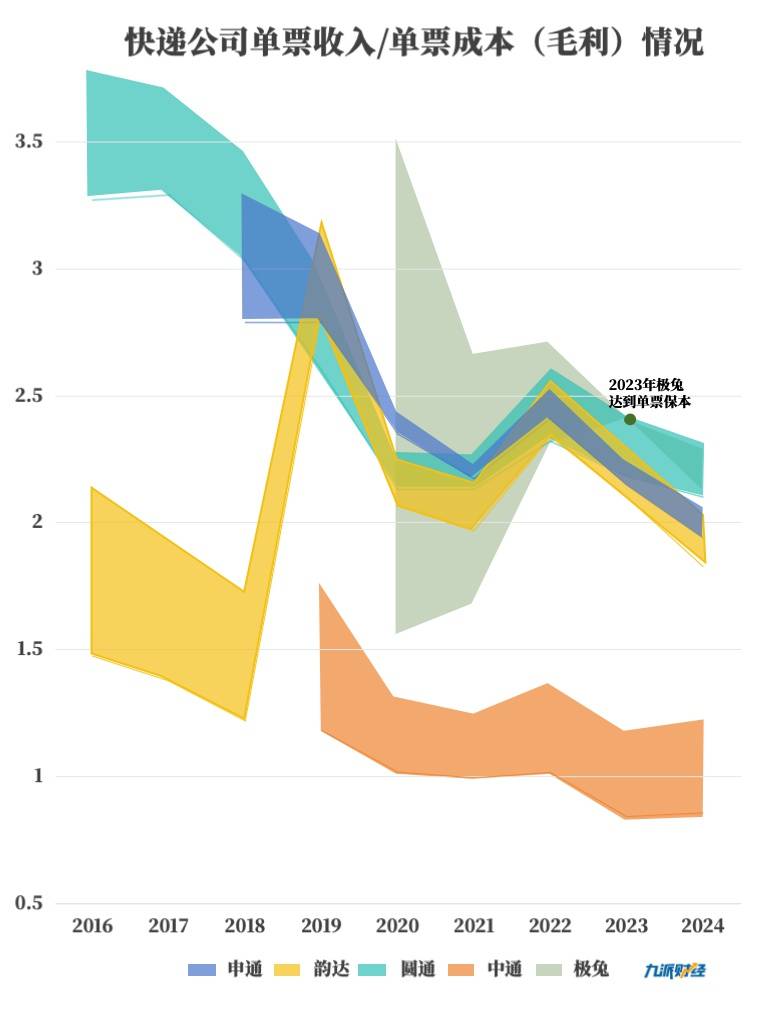
广东快递底价上调0.4元:运费整体上涨,对低客单价商家影响大
Sou Hu Cai Jing· 2025-08-12 09:13
Core Viewpoint - The recent increase in express delivery base prices in Guangdong and Yiwu reflects concerns over the intense competition and low profitability in the express delivery industry, which has led to a downward trend in per-package revenue for major companies [1][2][3]. Group 1: Price Adjustments - Starting from August 4, the base price for express delivery in Guangdong has been raised by 0.4 yuan per package, bringing the average price to over 1.4 yuan [1]. - Yiwu also raised its express delivery base price by 0.1 yuan to 1.2 yuan starting July 18 [1]. - The overall express delivery costs have increased by approximately 0.4 yuan, although delivery personnel have not yet received news of a corresponding increase in their compensation [1]. Group 2: Revenue Trends - Major express companies, including Shentong, Yunda, Zhongtong, and Yunda, have seen a significant decline in per-package revenue, with figures for 2024 projected at 2.05 yuan, 2.3 yuan, 1.21 yuan, and 2.01 yuan respectively, representing a decrease of about 30% to 40% compared to 2019 [3]. - In June, Shentong and Yunda reported further declines in per-package revenue, dropping below the 2 yuan mark to 1.99 yuan and 1.91 yuan respectively, while Zhongtong decreased to 2.1 yuan [5]. - SF Express maintains a relatively stable per-package revenue of around 15 to 16 yuan, but has also experienced a decline of 11% to 14% compared to the previous year due to industry price wars [5][12]. Group 3: Delivery Challenges - The continuous decline in per-package revenue has led express companies to implement cost control measures, including reducing delivery fees for last-mile services [7]. - The delivery personnel face pressure to choose between home delivery and depositing packages at collection points, with a significant increase in the use of collection points, reaching a 72% entry rate in 2022 [11]. - Complaints regarding non-delivery to specified addresses have surged, with over 19,000 complaints related to this issue, highlighting the challenges in balancing delivery efficiency and service quality [11]. Group 4: Impact on Low-Cost Merchants - The recent price adjustments in express delivery services are expected to significantly impact low-cost merchants, as the low logistics cost is crucial for their survival [15]. - Merchants have indicated that a delivery cost exceeding 3 yuan is no longer sustainable for their profit margins, as the historical rate has been around 1 yuan for small packages [15].