DBN Group(002385)

Search documents
饲料板块1月23日跌0.29%,中宠股份领跌,主力资金净流出7063.74万元
Zheng Xing Xing Ye Ri Bao· 2026-01-23 09:04
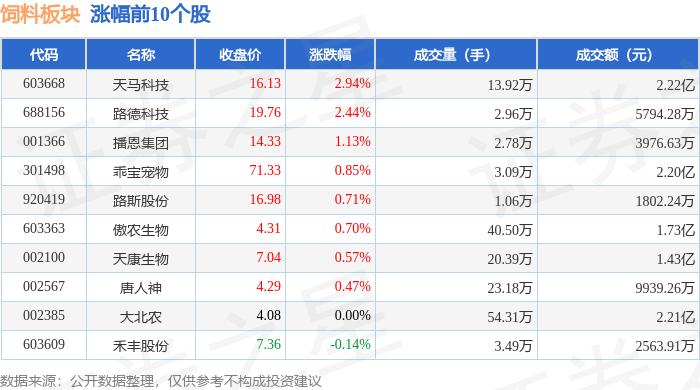
Group 1 - The feed sector experienced a decline of 0.29% on January 23, with Zhongchong Co., Ltd. leading the drop [1] - The Shanghai Composite Index closed at 4136.16, up 0.33%, while the Shenzhen Component Index closed at 14439.66, up 0.79% [1] - Key stocks in the feed sector showed varied performance, with Tianma Technology rising by 2.94% to a closing price of 16.13, while Zhongchong Co., Ltd. fell by 1.55% to 49.52 [2] Group 2 - The feed sector saw a net outflow of 70.64 million yuan from institutional investors, while retail investors had a net inflow of 90.51 million yuan [2] - The trading volume and turnover for major stocks in the feed sector varied, with major stocks like Tianma Technology and Haida Group showing significant trading activity [3] - The net inflow and outflow of funds for specific stocks indicated a mixed sentiment among investors, with some stocks like Haida Group experiencing a net inflow of 13.67 million yuan from institutional investors [3]




【读财报】上市猪企12月销量同比上升3.51% 金新农、正邦科技销量增速超过70%
Xin Hua Cai Jing· 2026-01-22 23:11
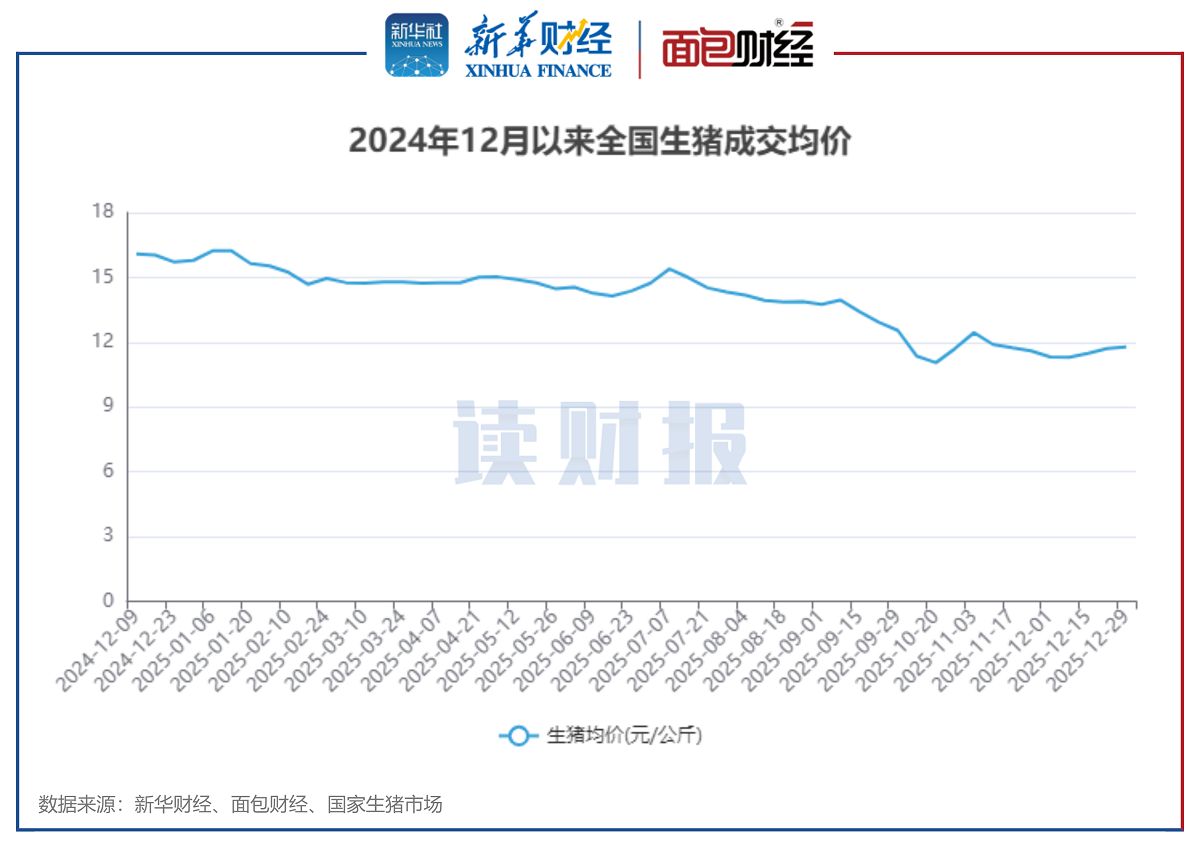
Core Insights - In December 2025, 16 major pig farming companies in China achieved a total sales volume of 17.72 million pigs, marking a year-on-year increase of 3.51% and a month-on-month increase of 7.15% [1][5][6] - The total revenue for these companies in December was 22.104 billion yuan, reflecting a year-on-year decline of 26.85% but a month-on-month increase of 4.87% [1][5][11] Sales Volume Analysis - The leading company, Muyuan Foods, sold 6.98 million pigs in December, while Wens Foodstuffs and New Hope reported sales of over 1.8 million pigs each [1][6] - Jin Xin Nong and Zhengbang Technology experienced significant sales growth, with increases exceeding 70% year-on-year, while four companies, including Muyuan Foods and Tangrenshen, saw declines of over 10% [1][6][10] Revenue Analysis - The revenue figures for December showed that Jin Xin Nong and Zhengbang Technology had revenue growth rates exceeding 20%, while four companies, including Zhenghong Technology and Tiankang Biological, reported revenue declines of over 30% [1][11] - Muyuan Foods generated 9.667 billion yuan in revenue for December, down 36.06% year-on-year, while Wens Foodstuffs and New Hope also reported declines of 11.38% and 10.75%, respectively [10][12] Price Trends - The average transaction price for pigs in the national market fluctuated around 15 yuan per kilogram in early 2025, dropping to a low of 11.05 yuan per kilogram in the latter half of the year [2]





饲料板块1月21日跌0.69%,傲农生物领跌,主力资金净流出9594.33万元
Zheng Xing Xing Ye Ri Bao· 2026-01-21 08:48
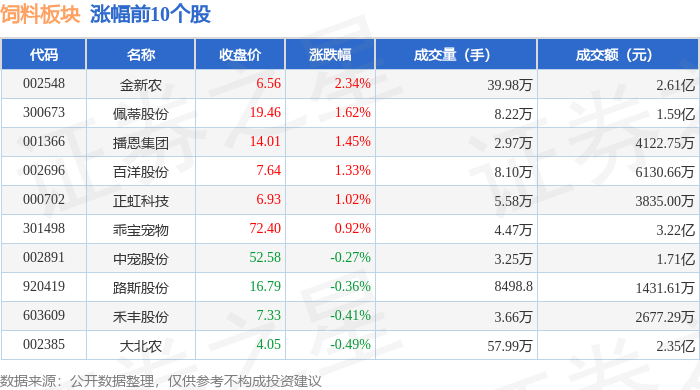
Market Overview - The feed sector experienced a decline of 0.69% on January 21, with Aonong Biological leading the drop [1] - The Shanghai Composite Index closed at 4116.94, up 0.08%, while the Shenzhen Component Index closed at 14255.12, up 0.7% [1] Individual Stock Performance - Jin Xin Nong (002548) closed at 6.56, up 2.34% with a trading volume of 399,800 shares and a transaction value of 261 million [1] - Petty Holdings (300673) closed at 19.46, up 1.62% with a trading volume of 82,200 shares and a transaction value of 159 million [1] - Aonong Biological (603363) closed at 4.27, down 1.84% with a trading volume of 430,600 shares and a transaction value of 184 million [2] - Other notable declines include Tian Kang Biological (002100) down 1.26% and Hai Da Group (002311) down 1.17% [2] Capital Flow Analysis - The feed sector saw a net outflow of 95.94 million from institutional investors, while retail investors had a net inflow of 63.31 million [2] - The capital flow for individual stocks shows Jin Xin Nong with a net inflow of 21.61 million from institutional investors, while Aonong Biological had a net outflow of 1.32 million [3] - Petty Holdings experienced a net outflow of 1.99 million from institutional investors but a net inflow of 6.27 million from retail investors [3]


趋势研判!2026年中国花生种子行业发展现状、进出口情况及未来发展趋势分析:进出口量稳质升,高油酸品种突围[图]
Chan Ye Xin Xi Wang· 2026-01-21 01:08
Core Insights - The peanut seed industry is crucial for oil security and economic development, with the government implementing various policies to support its growth towards quality, intensification, and scale [5][6][8] - China's peanut processing industry is projected to reach a value of 214 billion yuan in 2024, with stable planting areas and increasing consumption [6][7] - The domestic peanut seed market is dominated by local varieties, with imports primarily for research purposes, and a recovery in trade expected in 2025 [9][10] Industry Overview - Peanut seeds are essential oil and economic crops, requiring strict quality standards, including a germination rate of ≥92% and purity of ≥98% [2][3] - The industry is characterized by a high domestic seed ratio of 98.7%, with a focus on high-oil and disease-resistant varieties [9][10] Policy Background - The government has positioned the seed industry as a key component of agricultural development, launching initiatives to enhance breeding innovation and regulatory frameworks [5][6] Current Development Status - China leads globally in peanut production, processing, and trade, with a total production of 19.23 million tons in 2024, accounting for 38.8% of the world's total [7][8] - The planting area remains stable at over 4.7 million hectares, with significant contributions from key provinces [7][8] Consumption Trends - The peanut consumption market is growing steadily, with a compound annual growth rate of 1.48%, driven by diverse applications including oil extraction and direct consumption [8] Import and Export Analysis - The peanut seed trade is characterized by significant fluctuations, with imports and exports expected to rebound in 2025 after a decline in 2024 [9][10] - The average import price has shown considerable volatility, influenced by factors such as scarcity and logistics costs [10] Future Development Trends - The industry is expected to focus on specialized and resilient varieties, with advancements in breeding technology to shorten development cycles [11][12] - A shift towards an integrated and collaborative industry structure is anticipated, enhancing market concentration and service offerings [13] - Continuous policy support and market demand will drive standardization and internationalization efforts, promoting domestic seeds in emerging markets [14]


节前消费旺季支撑猪价抬升,养殖ETF(516760)备受关注
Xin Lang Cai Jing· 2026-01-20 03:07
Group 1 - The core viewpoint of the articles highlights the positive trend in pig prices driven by the consumption peak season, with the average price of lean pigs reaching 12.49 CNY/kg, a 2.6% increase month-on-month [1] - The stock performance of the livestock breeding index shows mixed results, with leading stocks like Ruisheng Biological rising by 9.91% and the Livestock ETF priced at 0.68 CNY [1] - The overall pig farming sector is experiencing a "tug-of-war" state, where companies with cost advantages are more resilient in competition [1] Group 2 - According to Huaxi Securities, the average price of external three yuan pigs reached 12.7 CNY/kg, a week-on-week increase of 1.26%, indicating a steady rise in pig prices [2] - As of the end of October, the number of breeding sows in China was 39.9 million, a decrease of 1.1% month-on-month, reflecting ongoing adjustments in pig production capacity [2] - The self-breeding and external purchasing pig farming models have turned profitable, with profits of 7.39 CNY/head and 2.31 CNY/head respectively [2] Group 3 - The CSI Livestock Breeding Index (930707) includes companies involved in livestock feed, veterinary drugs, and livestock farming, reflecting the overall performance of listed companies in the livestock sector [2] - The top ten weighted stocks in the CSI Livestock Breeding Index account for 67.66% of the index, with major companies including Muyuan Foods, Haida Group, and Wens Foodstuffs [2]


农林牧渔行业周报第2期:消费旺季推动猪价抬升,看好节后去化加速
HUAXI Securities· 2026-01-19 05:45
Investment Rating - Industry Rating: Recommended [3] Core Insights - The pork price is rising due to the peak consumption season, and there is an expectation for accelerated destocking after the holiday [2][12] - The Ministry of Agriculture and Rural Affairs emphasizes the importance of agricultural modernization and the commercialization of genetically modified crops to enhance yield and self-sufficiency [1][11] - The report highlights the profitability recovery in pig farming, with self-breeding and purchased piglets turning profitable, indicating a short-term challenge for capacity destocking [2][12] Summary by Sections Planting Industry Chain - The Ministry of Agriculture and Rural Affairs is supporting Shandong Province in enhancing grain production and agricultural modernization, focusing on rural revitalization and technological innovation [1][11] - Key recommended stocks in the planting sector include Beidahuang and Suqian Agricultural Development, with a focus on leading seed companies like Dabeinong and Longping High-Tech [1][11] Swine Farming - The average price of live pigs is 12.72 CNY/kg, with a week-on-week increase of 1.26%. The number of breeding sows is 39.9 million, showing a decrease of 1.1% month-on-month and 2.1% year-on-year [2][12] - The report suggests focusing on companies with significant cost improvements and high future output elasticity, including stocks like Muyuan Foods and Wens Foodstuffs [2][12] Key Agricultural Product Data Tracking - Corn: The average price is 2359.57 CNY/ton, with a week-on-week increase of 0.26% [24] - Wheat: The average price is 2513.57 CNY/ton, remaining stable week-on-week [27] - Soybeans: The average price is 4053.16 CNY/ton, with a slight increase of 0.12% [38] - Cotton: The average price is 15640.00 CNY/ton, with a week-on-week increase of 0.18% [43]


农林牧渔行业周报第2期:消费旺季推动猪价抬升,看好节后去化加速-20260119
HUAXI Securities· 2026-01-19 05:03
Investment Rating - Industry rating: Recommended [3] Core Insights - The pork price is rising due to the peak consumption season, and there is an expectation for accelerated destocking after the holiday [2][12] - The Ministry of Agriculture and Rural Affairs emphasizes the importance of agricultural modernization and the commercialization of genetically modified crops to enhance yield and self-sufficiency [1][11] - The report highlights the profitability recovery in pig farming, with self-breeding and purchased piglets turning profitable, indicating a short-term challenge for capacity destocking [2][12] Summary by Sections Planting Industry Chain - The Ministry of Agriculture and Rural Affairs is supporting Shandong province in enhancing grain production and agricultural modernization, focusing on technology and innovation [1][11] - Key recommended stocks in the planting sector include Beidahuang and Suqian Agricultural Development, with a focus on genetically modified seed companies like Dabeinong and Longping High-Tech [1][11] Swine Farming - The average price of live pigs is 12.72 CNY/kg, with a week-on-week increase of 1.26% [2][12] - The number of breeding sows is 39.9 million, showing a decrease of 1.1% month-on-month and 2.1% year-on-year, indicating a steady adjustment in production capacity [2][12] - Recommended stocks in the swine sector include Muyuan Foods, WH Group, and others, with a focus on companies that show significant cost improvements and high future output elasticity [2][12]
饲料板块1月16日跌0.52%,傲农生物领跌,主力资金净流出7100.75万元
Zheng Xing Xing Ye Ri Bao· 2026-01-16 08:49
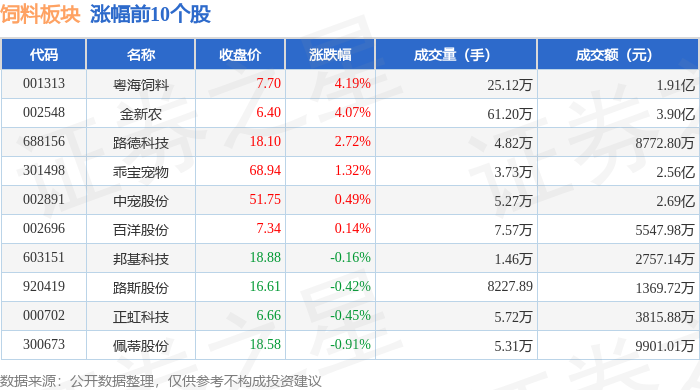
Market Overview - The feed sector experienced a decline of 0.52% on January 16, with Aonong Biological leading the drop [1] - The Shanghai Composite Index closed at 4101.91, down 0.26%, while the Shenzhen Component Index closed at 14281.08, down 0.18% [1] Individual Stock Performance - The top gainers in the feed sector included: - Jinxinnong (002548) with a closing price of 6.40, up 4.07% on a trading volume of 612,000 shares and a turnover of 1.76 million [1] - Just Update (001313) with a closing price of 7.70, up 4.19% on a trading volume of 251,200 shares and a turnover of 191 million [1] - The top decliners included: - Aonong Biological (603363) with a closing price of 4.16, down 1.65% on a trading volume of 623,800 shares and a turnover of 261 million [2] - Tiankang Biological (002100) with a closing price of 7.07, down 1.26% on a trading volume of 247,400 shares and a turnover of 176 million [2] Capital Flow Analysis - The feed sector saw a net outflow of 71.01 million from institutional investors, while retail investors contributed a net inflow of 31.24 million [2] - The capital flow for individual stocks showed: - Jinxinnong (002548) had a net inflow of 21.44 million from institutional investors, but a net outflow of 26.24 million from retail investors [3] - Just Update (001313) had a net inflow of 20.81 million from institutional investors, with a net outflow of 25.93 million from retail investors [3]

锚定养殖主线,布局畜牧新周期
Xin Lang Cai Jing· 2026-01-15 14:15
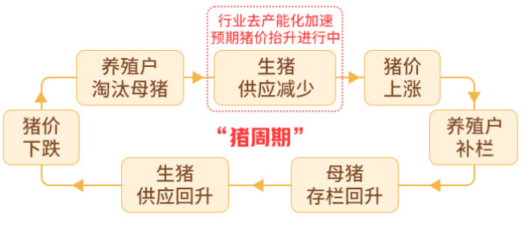
Group 1 - The livestock farming industry in China is undergoing a significant transformation, with the Ministry of Agriculture and Rural Affairs and the National Development and Reform Commission calling for capacity reduction and operational control as of September 2025 [1][19] - The pig cycle typically follows a pattern of price fluctuations, with each upward cycle lasting about 1-2 years and downward cycles lasting about 1-3 years, indicating potential for price increases following supply reductions [1][19] - Current signals suggest that the pig farming industry is at a relatively low valuation, with indications that capacity reduction may accelerate [1][19] Group 2 - The CSI Livestock Farming Industry Index, launched on December 31, 2021, includes 50 listed companies in sectors such as livestock products, animal health, feed, meat products, and dairy products, serving as a benchmark for the overall performance of the livestock farming sector [2][20] - The index has a base point of 1000 and aims to reflect the core fluctuations of the livestock farming industry, with a high concentration of leading companies [4][23] - The top five constituent stocks account for 50.1% of the index, while the top ten account for 67.6%, indicating a significant concentration advantage in the industry [4][23] Group 3 - The CSI Livestock Farming Industry Index has outperformed its peers by 5 percentage points since its inception, with a current PE (TTM) ratio of 19.02, indicating a low valuation at the bottom of the cycle and potential for valuation recovery [6][26] - The index's historical performance has shown significant volatility due to the cyclical nature of the livestock farming industry [6][26] - The index is designed to provide a high-purity tool for tracking the cyclical movements of pig farming, benefiting from the resilience and profit elasticity of leading enterprises during current cost-focused cycles [4][23] Group 4 - The top ten constituent stocks of the index include major players such as Muyuan Foods (15.6% weight), Wens Foodstuff Group (14.7%), and Haida Group (9.1%), highlighting the dominance of leading companies in the livestock sector [25] - The index is positioned to benefit from ongoing policy incentives and signals of cyclical reversal, making it an attractive investment option for those optimistic about the long-term development of the livestock farming industry [33]


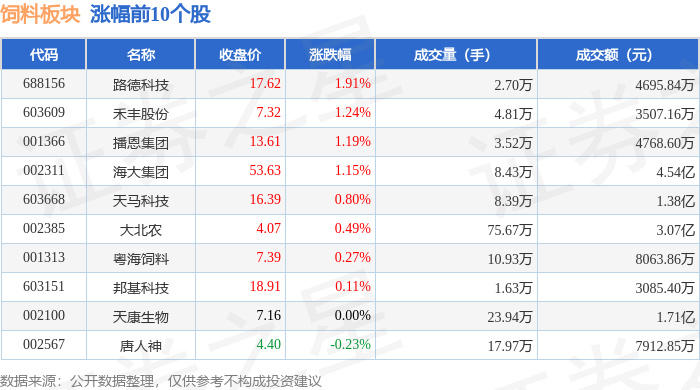
饲料板块1月15日涨0.13%,路德科技领涨,主力资金净流出1.16亿元
Zheng Xing Xing Ye Ri Bao· 2026-01-15 08:53
Group 1 - The feed sector experienced a slight increase of 0.13% on January 15, with Lude Technology leading the gains [1] - The Shanghai Composite Index closed at 4112.6, down 0.33%, while the Shenzhen Component Index closed at 14306.73, up 0.41% [1] - Key stocks in the feed sector showed varied performance, with Lude Technology closing at 17.62, up 1.91%, and Tangrenshen closing at 4.40, down 0.23% [1] Group 2 - The feed sector saw a net outflow of 116 million yuan from institutional investors, while retail investors contributed a net inflow of 116 million yuan [2] - The trading volume for Lude Technology was 27,000 hands, with a transaction amount of 46.9584 million yuan [1] - The stock performance of major companies included Hada Group with a closing price of 53.63, up 1.15%, and Petty Co. with a closing price of 18.75, down 2.09% [2][3] Group 3 - The net inflow from retail investors for TianKang Biological was 17.1 million yuan, while the net outflow from institutional investors was 18.4821 million yuan [3] - The net inflow for GuaiBao Pet was 6.3998 million yuan from institutional investors, while it faced a net outflow of 10.7891 million yuan from retail investors [3] - The overall sentiment in the feed sector indicates mixed investor behavior, with some stocks attracting retail interest while others faced institutional selling pressure [2][3]