
STO(002468)

Search documents
中国快递:重要要点,供给侧改革 2.0
2025-08-25 01:39
Summary of Key Points from the Conference Call on China's Express Delivery Industry Industry Overview - The conference call focused on the express delivery industry in China, specifically discussing the impact of "anti-involution" policies on pricing and profitability within the sector [3][4]. Core Insights 1. **Price Increases in Key Regions** - Express delivery prices have risen in key regions, with Yiwu seeing an increase of RMB0.1 per parcel in July 2025. The current price for a 0.1 kg parcel is above RMB1.2. In Guangdong, prices for 0.1 kg parcels have risen to RMB1.45-1.55, with regular parcels increasing by RMB0.2-0.3 and discount parcels by approximately RMB0.6 [3]. 2. **Impact of Anti-Involution Policies** - The implementation of anti-involution policies has led to stronger price hikes in Guangdong, a key region for express delivery. However, many franchisees may still be operating at a loss due to high operating costs [3]. 3. **New Social Security Regulations** - New regulations effective from September 1, 2025, mandate that employers cannot opt out of social security payments, which will increase costs for express delivery companies by more than RMB0.1 per parcel. This is expected to further support price hikes in the industry [4]. 4. **Rising Delivery Costs** - The expert noted that the mandatory social insurance expenses and long-standing price competition have suppressed delivery fees, affecting couriers' income. The trend of rising delivery fees is also observed in Eastern and Northern China [4]. 5. **Profitability Concerns** - Despite price increases, the expert expressed concerns that the express delivery industry chain may struggle to maintain profitability due to increased mandatory costs. If these costs are passed on to consumers, delivery prices may rise further [4]. Investment Recommendations 1. **Preferred Companies** - The report recommends investing in STO and Yunda, both rated as "Buy" due to their higher earnings resilience. Target prices remain unchanged [5]. 2. **Other Ratings** - YTO and SF Holding-A/H also maintain "Buy" ratings with unchanged target prices. Conversely, Deppon Logistics is rated "Reduce" due to high valuation concerns [5]. Additional Insights - The expert highlighted that the express delivery market is characterized by intense competition, with 30% of the market being low-priced tickets and 7-11% being discount-priced tickets in Guangdong [3]. - The report anticipates more regional policy tailwinds that could drive further re-rating of express delivery companies [5]. This summary encapsulates the key points discussed during the conference call, providing insights into the current state and future outlook of the express delivery industry in China.




中国快递:2025 年 7 月市场分析,小玩家市场份额同比持续流失
2025-08-25 01:38
Key Takeaways from the Conference Call Industry Overview - The report focuses on the **China Express** industry, specifically analyzing the performance of major players in the express delivery market for July 2025 [1][6]. Market Share and Volume - **SF Express** led the market with a **34% YoY volume growth**, followed by **YTO Express** at **21% YoY**. In contrast, **STO Express** and **Yunda** experienced lower growth rates of **12%** and **8% YoY**, respectively, resulting in a loss of market share of **0.4ppt** and **0.9ppt** [2][11]. - **Yunda** continues to lag behind **STO** in both volume and revenue metrics [11]. Revenue Performance - **SF Express** achieved a **15% YoY growth** in domestic express revenue, outperforming **YTO** and **STO**, which recorded **12%** and **10% YoY growth**, respectively. **Yunda** underperformed with only **4% YoY revenue growth**, significantly below the industry average of **9% YoY** [3][11]. - Total revenue for **SF Express** grew by **10% YoY**, despite a **3% YoY drop** in international and supply chain revenue due to trade tensions and declining shipping rates [3]. Average Selling Price (ASP) Trends - The ASP for **SF Express** dropped by **14% YoY** in July, with **YTO** seeing a **7%** decrease, **Yunda** at **4%**, and **STO** at **2%**. **Yunda** maintained the lowest ASP among its peers [4][11]. - On a month-over-month basis, **SF** and **STO** both saw a **1%** decline in ASP, while **YTO** reached a new low in July [4]. Financial Metrics Summary (July 2025) | Metric | SF | Yunda | STO | YTO | Industry | | --- | --- | --- | --- | --- | --- | | Revenue (Rmb mn) | 18,657 | 4,120 | 4,287 | 5,371 | 120,640 | | YoY Revenue Growth | 15.0% | 3.8% | 10.0% | 12.1% | 8.9% | | Volume (mn) | 1,377 | 2,162 | 2,181 | 2,583 | 16,400 | | YoY Volume Growth | 33.7% | 7.6% | 11.9% | 20.8% | 15.1% | | Market Share | 8.4% | 13.2% | 13.3% | 15.8% | nm | | YoY Market Share Change | 1.2ppt | -0.9ppt | -0.4ppt | 0.8ppt | nm | | ASP (Rmb) | 13.55 | 1.91 | 1.97 | 2.08 | 7.36 | | YoY ASP Change | -14.0% | -3.5% | -1.5% | -7.2% | -5.3% | | MoM ASP Change | -0.9% | -0.2% | -1.1% | -1.2% | -1.7% | [5] Additional Insights - The overall market dynamics indicate that smaller players like **STO** and **Yunda** are struggling to maintain their market positions, while **SF Express** continues to show robust growth despite external challenges [11]. - The decline in ASP across all players suggests a competitive pricing environment, particularly for **YTO**, which is aggressively pursuing market share [11]. Conclusion - The express delivery market in China is characterized by significant growth for leading players like **SF Express**, while smaller competitors face challenges in maintaining market share and revenue growth. The competitive landscape is intensifying, with pricing strategies playing a crucial role in market dynamics [11].
申万宏源交运一周天地汇(20250817-20250822):美股油轮股年内新高,淡季超预期进入右侧区间,船舶板块有望共振
Shenwan Hongyuan Securities· 2025-08-23 15:13
Investment Rating - The report maintains a "Positive" outlook on the shipping sector, particularly highlighting the potential for VLCC (Very Large Crude Carrier) rates to strengthen in the upcoming months [4]. Core Insights - The report indicates that tanker rates have exceeded expectations during the off-season, with VLCC rates expected to perform strongly from September to December due to reduced exports from Iran and increased production in the Middle East [4]. - The report recommends specific companies such as China Merchants Energy Shipping and highlights the potential for consolidation in the Chinese shipping industry [4]. - The report emphasizes the resilience of freight volumes in rail and highway transport, suggesting steady growth in these sectors [4]. Summary by Sections Shipping Sector - VLCC rates increased by 32% this week, reaching $45,800 per day, driven by limited supply and increased demand from the Atlantic market [4]. - The report notes that the average export volume from Iran has decreased to 1.3-1.5 million barrels per day, down from 1.7-1.9 million barrels per day in July [4]. - The Suez crude oil tanker rates rose by 15% to $59,563 per day, supported by strong demand from the West African market [4]. Dry Bulk Shipping - The Baltic Dry Index (BDI) fell by 4.9% to 1,944 points, primarily due to a decline in large vessel rates, while smaller vessels showed stronger performance [5]. - The report remains optimistic about the Capesize bulk carrier market in the second half of the year, citing expected increases in shipments from major miners [4]. Air Transport - The report suggests that the "anti-involution" policy from the Civil Aviation Administration is likely to optimize competition in the airline industry, benefiting airline profitability in the long term [4]. - Recommended airlines include China Eastern Airlines, Spring Airlines, and China Southern Airlines, with a focus on the potential for improved earnings due to supply constraints and demand recovery [4]. Express Delivery - The report anticipates a price increase in the express delivery sector driven by the "anti-involution" policy, with expectations for sustained profitability in the e-commerce delivery segment [4]. - Companies such as Shentong Express and YTO Express are highlighted as having strong potential for recovery and valuation improvement [4]. Rail and Highway Transport - Data from the Ministry of Transport indicates that rail freight volume increased by 1.22% week-on-week, while highway freight traffic rose by 3.06% [4]. - The report identifies two main investment themes in the highway sector: high dividend yield stocks and potential value recovery in undervalued stocks [4].



申通快递股价震荡下行 盘中一度快速反弹2%
Jin Rong Jie· 2025-08-22 13:59
Core Viewpoint - Shentong Express's stock price experienced fluctuations, closing at 19.28 yuan on August 22, 2025, down 1.03% from the previous trading day [1] Company Overview - Shentong Express is one of the major express logistics service providers in China, offering services in express delivery, warehousing, and supply chain management [1] - The company has established a comprehensive logistics network across the country, providing a full range of express services to its customers [1] Market Activity - On August 22, during the morning trading session, Shentong Express's stock saw a rapid increase, with a rise of over 2% within 5 minutes and a transaction amount reaching 136 million yuan [1] - The net inflow of main funds on that day was 42.51 million yuan, with a cumulative net inflow of 395 million yuan over the past five trading days [1]
由创新高个股看市场投资热点
量化藏经阁· 2025-08-22 11:32
Group 1 - The report tracks stocks, industries, and sectors that are reaching new highs, serving as market indicators and highlighting the effectiveness of momentum and trend-following strategies [1][4][24] - As of August 22, 2025, the Shanghai Composite Index, Shenzhen Component Index, CSI 300, CSI 500, CSI 1000, CSI 2000, ChiNext Index, and Sci-Tech 50 Index all have a distance to their 250-day highs of 0.00%, indicating they are at their recent peaks [5][24] - Among the CITIC first-level industry indices, home appliances, defense and military, comprehensive, media, and computer industries are closest to their 250-day highs, while food and beverage, coal, real estate, banking, and consumer services are further away [8][24] Group 2 - A total of 1,606 stocks reached 250-day highs in the past 20 trading days, with the most significant numbers in the machinery, pharmaceuticals, and electronics sectors [2][13][24] - The highest proportion of new high stocks is found in the defense and military, non-ferrous metals, and pharmaceuticals industries, with respective proportions of 52.94%, 51.61%, and 44.88% [13][16] - The manufacturing and technology sectors have the most stocks reaching new highs this week, with respective counts of 512 and 403 [16][24] Group 3 - The report identifies 48 stocks that have shown stable new highs, with the technology and manufacturing sectors contributing the most, having 22 and 12 stocks respectively [3][21][25] - Within the technology sector, the electronics industry has the highest number of new high stocks, while the automotive industry leads in the manufacturing sector [21][25]






国海证券:“反内卷”逐步落地 期待8月快递行业价格修复
智通财经网· 2025-08-22 09:19
Core Viewpoint - The express delivery industry is experiencing a decline in single ticket revenue due to the trend of smaller packages and ongoing price wars, although there may be a recovery in prices in August under the backdrop of reduced competition [1][2]. Industry Overview - In July 2025, the express delivery industry reported a single ticket revenue of 7.36 yuan, reflecting a year-on-year decrease of 5.33% and a month-on-month decrease of 1.76% [1][2]. - The growth rate of express delivery business volume in July 2025 was 15.1%, outpacing the growth of physical online retail sales at 8.3% and social consumer retail sales at 3.7% [2]. Regional Analysis - In July 2025, the year-on-year growth rates of express delivery business volume in different regions were as follows: Class 1 regions at +14.2%, Class 2 regions at +16.8%, and Class 3 regions at +28.0% [2]. - The year-on-year growth rates of single ticket revenue in these regions were: Class 1 at -4.7%, Class 2 at -7.2%, and Class 3 at -12.1% [2]. Company Performance - In July 2025, the year-on-year growth rates of express delivery business volume for major companies were: YTO Express at +20.81%, Yunda Express at +7.56%, Shentong Express at +11.90%, and SF Express at +33.69% [3]. - The year-on-year changes in single ticket revenue for these companies were: YTO Express at -7.14%, Yunda Express at -3.54%, Shentong Express at -1.50%, and SF Express at -14.02% [3].

国泰海通|交运:快递单价降幅收窄,反内卷持续扩散
国泰海通证券研究· 2025-08-22 09:08
Core Viewpoint - The article highlights a narrowing decline in express delivery prices in July, indicating a stronger-than-expected effort to combat "involution" in the industry, leading to a temporary easing of competitive pressure. The outlook remains positive for leading express delivery companies with confirmed performance growth and potential valuation recovery opportunities in e-commerce logistics [1][3][4]. Group 1: Industry Performance - In July 2025, the total express delivery volume increased by 15.1% year-on-year, with SF Express leading the growth at 33.7% [1]. - For the first seven months of 2025, the total express delivery volume reached 1,120.5 billion pieces, reflecting an 18.7% year-on-year increase, surpassing the postal administration's forecast of over 8% for the entire year [1]. - The e-commerce express delivery sector saw significant growth, with YTO, Yunda, and Shentong reporting year-on-year increases of 20.8%, 7.6%, and 11.9% respectively in July 2025 [1]. Group 2: Market Concentration - The concentration of the express delivery industry continues to increase, with the CR8 (concentration ratio of the top 8 companies) reaching 86.9 in the first seven months of 2025, up by 1.7 compared to the previous year [2]. - In Q2 2025, the market shares of leading e-commerce express companies were as follows: Zhongtong at 19.5%, YTO at 16.0%, Yunda at 13.2%, Shentong at 12.9%, and Jitu at 11.1%, all showing an increase from Q1 [2]. Group 3: Pricing and Revenue Trends - The express delivery industry's revenue in July 2025 grew by 8.9% year-on-year, while the average revenue per ticket decreased by 5.3% [3]. - For the first seven months of 2025, the industry's revenue increased by 9.9%, with a 7.4% decline in average revenue per ticket [3]. - The decline in average revenue per ticket is seen as a sign of reduced price competition, supported by regulatory efforts to combat "involution" in the industry [3]. Group 4: Investment Recommendations - The article suggests that the ongoing "anti-involution" measures will effectively ease competitive pressures in the industry, leading to a recovery in e-commerce express delivery profitability in the second half of the year [4]. - Future profitability will depend on the sustainability of price increases, with a focus on regulatory strength from the postal administration [4].

物流板块8月22日跌0.49%,恒基达鑫领跌,主力资金净流出3.17亿元
Zheng Xing Xing Ye Ri Bao· 2025-08-22 08:46
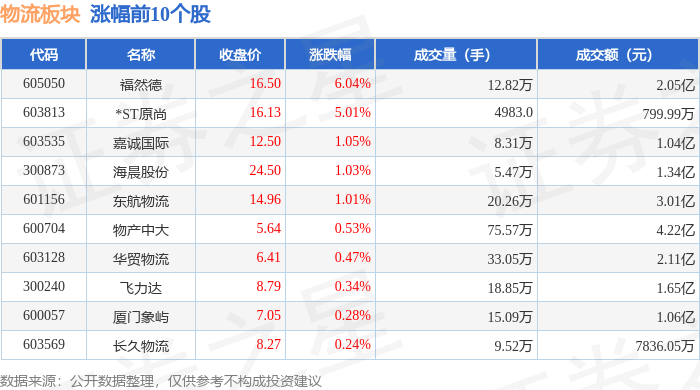
Market Overview - On August 22, the logistics sector declined by 0.49%, with Hengji Daxin leading the drop [1] - The Shanghai Composite Index closed at 3825.76, up 1.45%, while the Shenzhen Component Index closed at 12166.06, up 2.07% [1] Stock Performance - Notable gainers in the logistics sector included: - Furande (605050) with a closing price of 16.50, up 6.04% and a trading volume of 128,200 shares, totaling 205 million yuan [1] - ST Yuanshang (603813) closed at 16.13, up 5.01% with a trading volume of 4,983 shares, totaling approximately 800,000 yuan [1] - Major decliners included: - Hengji Daxin (002492) closed at 7.24, down 2.82% with a trading volume of 131,800 shares, totaling approximately 96.3 million yuan [2] - Huami Duhai (872351) closed at 29.92, down 2.54% with a trading volume of 26,700 shares, totaling approximately 80.1 million yuan [2] Capital Flow - The logistics sector experienced a net outflow of 317 million yuan from institutional investors, while retail investors saw a net inflow of 245 million yuan [2] - Notable capital flows included: - Donghang Logistics (601156) had a net inflow of 66.26 million yuan from institutional investors, but a net outflow of 46.13 million yuan from retail investors [3] - Furande (605050) saw a net inflow of 33.59 million yuan from institutional investors, with retail investors experiencing a net outflow of 12.39 million yuan [3]


国泰海通:7月快递单价降幅收窄 反内卷持续扩散
Zhi Tong Cai Jing· 2025-08-22 05:56
国泰海通主要观点如下: 7月价格降幅收窄,快递"反内卷"力度超预期,短期竞争压力趋缓,中长期继续保障良性竞争 7月快递件量同比+15.1%;顺丰深化落实激活经营,业务量同比+33.7%,增速持续领跑 1)全行业:2025年7月全国快递企业件量164.0亿件,同比+15.1%;2025年1-7月件量1120.5亿件,同比 +18.7%。小件化趋势持续、电商促销且退换货便捷,共同驱动2025年前7个月件量增速超过邮管局对 2025年全年件量增速超8%的预测。2)电商快递:圆通/韵达/申通2025年7月业务量分别同比 +20.8%/+7.6%/+11.9%;1-7月业务量分别同比+21.6%/+15.1%/+19.3%。3)直营快递:顺丰2025年7月业务 量同比+33.7%;1-7月业务量同比+26.9%,得益于落实激活经营策略,加大对前线业务的授权与激励,顺 丰件量增速3-7月连续领跑行业。 行业集中度持续集中,头部公司Q2市场份额环比提高 2022年初到2024年末,由于政策监管下价格竞争相对温和,份额向头部集中较缓慢。1)全行业:2025年 1-7月快递行业CR8为86.9,同比提升1.7,反映出2025年 ...

快递行业7月月报:“反内卷”逐步落地,期待8月行业价格修复-20250821
Guohai Securities· 2025-08-21 13:02
Investment Rating - The report maintains a "Recommended" rating for the logistics industry [1] Core Insights - In July 2025, the express delivery industry experienced a year-on-year business volume growth of 15.1%, outpacing the growth of physical online retail sales at 8.3% and social consumer retail sales at 3.7% [6][14] - The trend of small parcel delivery continues, driving rapid growth in express package volume [14] - The average revenue per ticket in the express delivery industry was 7.36 yuan in July 2025, reflecting a year-on-year decline of 5.33% and a month-on-month decline of 1.76% [21] - The report anticipates a price recovery in August 2025 due to the "anti-involution" trend in the industry [6] Industry Volume and Price - In July 2025, the year-on-year growth rates for express delivery business volume in first, second, and third-tier regions were +14.2%, +16.8%, and +28.0%, respectively [34] - The average revenue per ticket in first, second, and third-tier regions showed year-on-year declines of -4.7%, -7.2%, and -12.1%, respectively [34] Company Performance - In July 2025, the express delivery business volume growth rates for YTO Express, Yunda, Shentong, and SF Express were +20.81%, +7.56%, +11.90%, and +33.69%, respectively, with the industry average at 15.1% [43] - The year-on-year decline in average revenue per ticket for YTO Express, Yunda, Shentong, and SF Express was -7.14%, -3.54%, -1.50%, and -14.02%, respectively [44]