BYD(002594)

Search documents
【快讯】每日快讯(2026年2月13日)
乘联分会· 2026-02-13 08:47
Domestic News - The State Administration for Market Regulation released the "Compliance Guidelines for Pricing Behavior in the Automotive Industry," highlighting legal risks associated with misleading pricing practices [5] - The Ministry of Industry and Information Technology is soliciting public opinions on five mandatory national standards, including "Safety Requirements for Autonomous Driving Systems in Intelligent Connected Vehicles" [6] - The Ministry of Commerce announced that consumers purchasing new cars during the 9-day Spring Festival holiday can apply for vehicle trade-in subsidies [7] - Sichuan Province will provide subsidies up to 15,000 yuan for consumers who replace their vehicles with new energy or low-emission cars [8] - Shenzhen is launching a pilot program for "Vehicle-Road-Cloud Integration" in intelligent connected vehicles [9] - Xiaomi's charging network has over 1.7 million charging stations, marking a 66.7% year-on-year increase [10] - GAC Group has surpassed 2,000 self-operated charging stations, covering 211 cities nationwide [11] - Tesla has deepened localization in China by launching WeChat in-car features for its Model 3 and Model Y [12][13] International News - Canada plans to add 8,000 electric vehicle charging stations, investing over 84.4 million CAD to enhance its existing network of over 30,000 stations [14] - Tata Motors and Stellantis signed a memorandum of understanding to explore further collaboration in manufacturing and supply chain in India and overseas [15] - Ford plans to launch five new models priced under $40,000 in the U.S. by 2030, starting with an electric four-door pickup [16] - Toyota will introduce its first electric vehicle manufactured in the U.S. by the end of this year [17] Commercial Vehicles - FAW Jiefang's first product from its Indonesian KD factory has successfully rolled off the assembly line, marking a significant step in local manufacturing capabilities [18] - Beijing's 2026 Comprehensive Transportation Governance Action Plan aims to promote low-carbon transportation and increase the coverage of charging facilities for electric vehicles [19] - Qingling has signed a KD project agreement with local manufacturers in Africa, planning an initial production capacity of 20,000 units [20] - BYD is upgrading its Shark 6 pickup for the Australian market with a 2.0T plug-in hybrid system to enhance towing capacity [21]





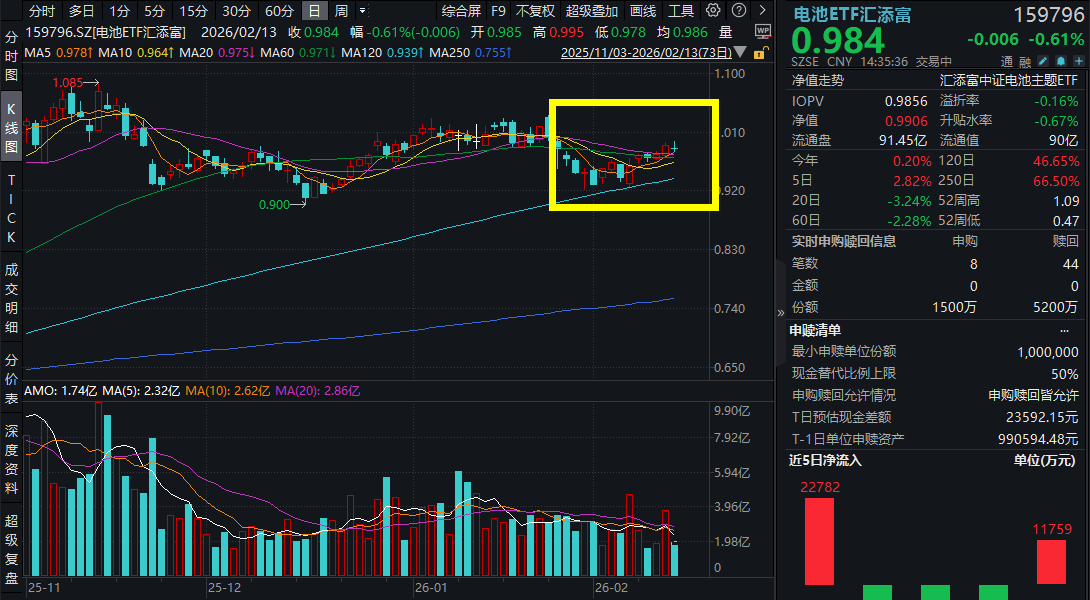
全球动力电池出货量高增42%,中企独占鳌头!电池ETF汇添富(159796)走十字星,昨日大举吸金超1亿元!需求端"淡季不淡",电池年后迎布局良机?
Sou Hu Cai Jing· 2026-02-13 07:05
Core Viewpoint - The A-share market experienced a volatile correction on February 13, with the Shanghai Composite Index falling over 1%, particularly affecting the battery sector, while the battery ETF Huatai-PineBridge (159796) saw a near 1% decline but attracted significant capital inflow, raising over 100 million yuan the previous day [1][3][5]. Group 1: Market Performance - The battery ETF Huatai-PineBridge (159796) showed active trading with a transaction volume of nearly 200 million yuan, indicating strong investor interest despite the market downturn [1]. - The component stocks of the battery ETF exhibited mixed performance, with Tianqi Lithium rising over 3% and several others, including Sunshine Power and Gree, declining over 3% [3][4]. Group 2: Industry Outlook - By 2025, global power battery shipments are projected to reach 1,495.1 GWh, marking a year-on-year growth of 42.2%, with a significant increase in the growth rate compared to previous forecasts [5]. - The overseas market for power batteries is expected to maintain high growth, with Chinese manufacturers increasing their market share, as evidenced by a 31.7% year-on-year increase in global power battery installation volume [6]. Group 3: Investment Opportunities - The battery sector is anticipated to benefit from a combination of strong demand and favorable export policies, creating a potential window for investment as production resumes post-holiday [7]. - The Huatai-PineBridge battery ETF is highlighted for its significant exposure to the energy storage segment, which is expected to benefit from surging overseas demand, with energy storage comprising 19% of its index [8][10].

绿色资产证券化 2025 年度运营报告与 2026 年度展望要点:绿色 ABS 产品发行规模下降,基础资产类型进一步扩充;清洁能源国央企与新能源汽车金融机构为核心发行主体;政策持续赋能绿色金融高质量发展
Zhong Cheng Xin Guo Ji· 2026-02-13 06:33
1. Report Industry Investment Rating - No information provided about the industry investment rating 2. Core Viewpoints of the Report - In 2025, the issuance scale of green ABS products declined, with the structure of underlying asset types adjusted. Green financial leasing ABS rose to the top in issuance scale. Green REITs, renewable energy price subsidy ABS, and new - energy vehicle loan ABS still dominated the issuance, while new underlying assets like held real estate and consumer finance loans were added [5][35]. - Multiple departments coordinated to deepen the financial supply - side reform, continuously improving the green finance standard system and basic institutions, and promoting the high - quality development of green finance. The green ABS market is moving towards higher - quality and diversified development [5][30][35]. 3. Summary by Relevant Catalogs 3.1 Issuance - In 2025, 136 green ABS products were issued in China, a 7.48% year - on - year decrease, with a total issuance scale of 185.326 billion yuan, a 16.59% year - on - year decline. Green enterprise ABS, green ABN, and green credit ABS accounted for 50.72%, 38.01%, and 11.27% respectively [5][6]. - By underlying asset types, green financial leasing ABS ranked first with an issuance scale of 58.484 billion yuan (31.56% of the total). Green REITs, renewable energy price subsidy ABS, and new - energy vehicle loan ABS decreased but remained major issuers. Held real estate and consumer finance loans expanded the types of green underlying assets [5][14]. - In 2025, 53 carbon - neutral ABS products were issued, with a scale of 70.393 billion yuan, a 32.02% year - on - year decline, accounting for 37.98% of green ABS [5]. 3.2 Issuance Interest Rate - The issuance spread of green ABS products showed a narrowing trend. In 2025, the average spreads of AAAsf - rated green credit ABS, ABN, and enterprise ABS products to the benchmark rate were 16BP, 46BP, and 64BP respectively. The spread of green credit ABS was significantly lower than other credit ABS, while the difference between green ABN/enterprise ABS and non - green ABS was small [5][26]. 3.3 Policy - In 2025, multiple departments issued policies to deepen the financial supply - side reform, improve the green finance standard system, and promote the development of green asset securitization. Key policies included those from the China Securities Regulatory Commission, the National Administration of Financial Regulation and the People's Bank of China, etc [30][31]. 3.4 Conclusion - In 2025, the green ABS market saw a decline in issuance scale and an adjustment of underlying asset types. With policy support, the market is moving towards high - quality and diversified development. Emerging fields such as green consumer credit, carbon sink revenue rights, and held real estate may become new growth drivers [35]. 3.5 Schedule - The schedule lists the detailed issuance information of green asset - backed securitization products in 2025, including green credit ABS, green ABN, and green enterprise ABS [37][38][39].

比亚迪王朝首款B级纯电SUV宋Ultra EV亮相:全新紫色涂装 配悬浮式车顶
Feng Huang Wang· 2026-02-13 05:33
Core Viewpoint - BYD has unveiled the official images of its first B-class pure electric SUV, the Song Ultra EV, featuring a new purple paint job and a design that blends Eastern aesthetics with contemporary design language [1] Group 1: Vehicle Specifications - The dimensions of the Song Ultra EV are 4850 mm in length, 1910 mm in width, and 1670 mm in height, with a wheelbase of 2840 mm [1] - Compared to the Song L DM, which measures 4780 mm in length, 1898 mm in width, and 1670 mm in height with a wheelbase of 2782 mm, the Song Ultra EV shows significant increases in length, width, and wheelbase, making it the largest model in the Song family [1] Group 2: Design Features - The exterior design of the Song Ultra EV continues to utilize BYD's classic "Dragon Face" aesthetic [1] - The front features a closed grille design that complements the continuous light strip, while the size of the air ducts on both sides of the lower bumper has been significantly increased to enhance aerodynamic performance [1]

观察|1月车市三把“王座”全部易主
Guang Zhou Ri Bao· 2026-02-13 03:15
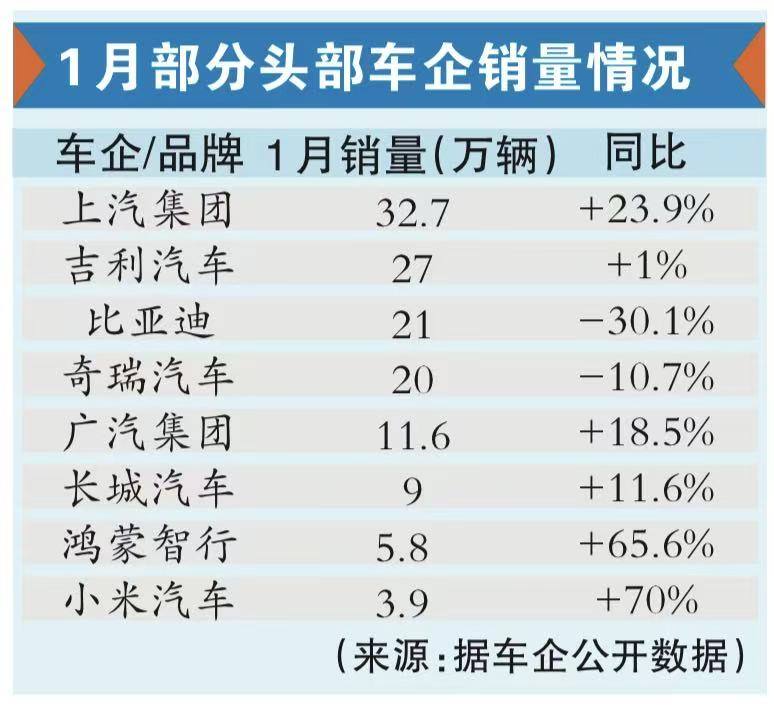
Core Insights - The January sales figures indicate a significant shift in the competitive landscape of the Chinese automotive market, with traditional giants like SAIC and Geely reclaiming leadership positions, while BYD's dominance is challenged [1][3][4] Group 1: Sales Performance - SAIC Group achieved sales of 327,000 vehicles in January, marking a year-on-year increase of 23.9% [2][4] - Geely Automotive sold 270,100 vehicles, a year-on-year growth of 1%, surpassing BYD to become the top-selling domestic brand [2][4] - BYD's sales fell to 210,000 vehicles, experiencing a significant year-on-year decline of 30.1% [2][4] - New energy vehicle sales for SAIC reached 85,000 units, growing by 39.7% [4] - The overall automotive production and sales in January were 2.45 million and 2.346 million units, respectively, with a slight year-on-year production increase of 0.01% [7] Group 2: New Players and Market Dynamics - The new energy vehicle segment saw a reshuffling, with Hongmeng Zhixing leading the new force with 57,915 units sold, a remarkable year-on-year increase of 65.6% [6] - Xiaomi Automotive followed closely with over 39,000 units sold, achieving a year-on-year growth of approximately 70% [6] - The previous leaders in the new force segment, such as Leap Motor, have seen a decline, with their sales dropping to 32,059 units [6] Group 3: International Market Growth - The overseas market is identified as a key growth area for automotive companies, with January exports reaching 681,000 vehicles, a year-on-year increase of 44.9% [7] - Exports of new energy vehicles doubled to 302,000 units, highlighting the importance of global expansion for competitive advantage [7]


比亚迪未放弃布局墨西哥,有意收购日产当地工厂
日经中文网· 2026-02-13 02:46
Core Viewpoint - BYD and Geely are among the final candidates to acquire Nissan's COMPAS factory in Mexico, following Nissan's decision to exit the Mexican market. This shift indicates BYD's strategy to leverage existing production bases rather than building new facilities in Mexico [1][5]. Group 1: Acquisition Intentions - BYD and Geely have expressed interest in acquiring Nissan's COMPAS factory, which is a joint venture with Mercedes-Benz, located in Aguascalientes, Mexico [1]. - The two Chinese automakers are competing with other large Chinese companies and Vietnamese EV manufacturers for the acquisition [1]. Group 2: Previous Plans and Changes - BYD had initially planned to establish a new factory in Mexico starting in 2023, with site selection nearing finalization by 2024 [3]. - The company had previously shown strong intentions to build a factory in Mexico, highlighted by a new car launch event in Mexico City in May 2024 [4]. Group 3: Government Influence and Market Dynamics - The Mexican government's sudden refusal to approve BYD's factory plans was influenced by the Trump administration's concerns over Chinese exports through Mexico, leading to a halt in the new factory project [5]. - The USMCA agreement provides certain advantages for automakers, allowing them to benefit from compliance even under Trump's tariff policies, although there remains a heightened vigilance regarding Chinese companies using Mexican production as a backdoor to the US market [7]. Group 4: Market Performance - Chinese automotive sales in Central and South America, particularly in Mexico, have been rapidly increasing, with BYD frequently sending large shipments of vehicles from China [7]. - The Mexican government has imposed tariffs of up to 50% on imports from countries without a free trade agreement, which could impact pricing strategies for competitive companies like BYD aiming to enter the US market [7].

中国车企打响第一枪!比亚迪正式起诉美国政府,要求退还关税
Sou Hu Cai Jing· 2026-02-13 02:34
Core Viewpoint - BYD has officially filed a lawsuit against the U.S. government, becoming the first Chinese automotive company to directly challenge U.S. tariff policies, which has sparked global discussion [1][3]. Group 1: Lawsuit Details - The lawsuit was initiated by four U.S. subsidiaries of BYD and was submitted to the U.S. International Trade Court on January 26, 2026 [3]. - BYD claims that the U.S. government's tariff policies, based on the International Emergency Economic Powers Act, lack legal foundation and constitute an overreach of authority [3]. - The company requests the court to declare the relevant tariff orders invalid, halt unreasonable measures, and demand full reimbursement of tariffs paid since April 2025, along with interest and litigation costs [3]. Group 2: Legal Basis and Industry Context - The legal basis used by the U.S. government is criticized as flawed, as the International Emergency Economic Powers Act does not authorize tariff imposition and does not even mention "tariffs" [3]. - Over 1,000 companies globally, including well-known firms like Toyota and Costco, have previously raised concerns about U.S. unilateral tariff measures, which they believe increase operational pressures and ultimately raise consumer costs in the U.S. [4]. - BYD's lawsuit represents a significant stance for the Chinese automotive industry on the global stage, marking a shift from passive adaptation to active defense of fair competition [5]. Group 3: Implications for Chinese Companies - The lawsuit signifies a transition for Chinese automotive brands from merely exporting products to engaging in rule-making and defending their rights [5]. - BYD's legal action could set a precedent for other Chinese companies facing trade barriers, potentially influencing the global automotive industry and international trade towards a more open and fair environment [5]. - The outcome of this lawsuit will not only impact BYD's overseas development but also serve as a reference for many Chinese enterprises in navigating trade barriers [5].
中国汽车:市场反馈及行业预期下调 -1 月季节性表现弱于往常,且物料成本通胀加剧-China Automobiles_ Marketing feedback & lowering estimates for the sector on weaker-than-usual Jan seasonality with BOM cost inflation
2026-02-13 02:18
Summary of Conference Call Notes on the Automotive Industry Industry Overview - **Industry**: Automotive, specifically focusing on electric vehicles (EVs) and new energy vehicles (NEVs) in China - **Current Market Sentiment**: Investor positioning in the automotive sector is underweight as of early 2026, with concerns about demand and cost inflation impacting outlooks [1][2] Key Points 1. Industry Volume Trajectory - **January 2026 Performance**: Domestic passenger vehicle retail volume decreased by 20% month-over-month (mom), compared to a 14% decrease in January 2024 [3] - **Market Expectations**: Anticipation of continued volume decline into February 2026, attributed to the Chinese New Year holiday and reduced stimulus effects [3] - **Future Outlook**: Expected recovery in consumer demand starting March 2026, coinciding with new product launches from BYD and the Beijing Auto Show [3] 2. Raw Material and Memory Cost Inflation - **Cost Increases**: Year-to-date increases in commodity prices (lithium, copper, aluminum) range from 27% to 85% year-over-year [4][18] - **Impact on BOM Costs**: Estimated average increase in Bill of Materials (BOM) costs for EVs is approximately Rmb4,000, leading to a gross margin decline of 2.0% and a net margin decline of 1.7% [4][11] - **OEM Negotiations**: OEMs are negotiating cost-sharing with suppliers, but are expected to absorb 100% of memory cost increases [4] 3. Potential Policy Stimulus - **Government Support Expectations**: Investors anticipate additional government support if demand remains weak, including subsidies for Level 3 vehicles and domestic chip usage [7] - **Economic Contribution**: Passenger vehicles accounted for about 5% of GDP in 2025, indicating the sector's significance to the economy [7] 4. Sensitivity Analysis on Costs - **Margin Concerns**: Rising raw material and memory costs are raising concerns about potential margin impacts for OEMs [8] - **Cost Pass-Through Assumptions**: Analysis assumes a 50/50 cost pass-through ratio for battery and metals, while memory costs are fully absorbed by OEMs [9][12] 5. Target Price Adjustments - **Price Target Reductions**: Target prices for covered OEMs and suppliers have been cut by up to 12% due to weaker demand and higher costs, with average estimates lowered by approximately 16% [2][24] - **Specific Company Adjustments**: - **BYD**: Target price reduced from Rmb144 to Rmb137 due to weaker delivery volumes and higher BOM costs [25] - **Li Auto**: Target price reduced from US$27 to US$24, reflecting lower sales and higher costs [25] - **XPeng**: Target price reduced from US$25 to US$22, driven by weaker sales and pricing pressures [25] - **NIO**: Target price reduced from US$7.0 to US$6.6, impacted by BOM cost inflation [25] 6. Long-term Projections - **Revenue and Net Income Changes**: Projections for revenue and net income have been adjusted downward for several companies, reflecting anticipated market conditions through 2030 [24][30] Additional Insights - **Investor Concerns**: There is a growing concern among investors regarding the sustainability of margins in light of rising costs and competitive pressures [8] - **Market Dynamics**: The automotive sector is facing significant challenges from both internal cost pressures and external market conditions, necessitating close monitoring of policy developments and consumer demand trends [7][8] This summary encapsulates the critical insights from the conference call, highlighting the automotive industry's current challenges and future outlook.


未知机构:国海汽车1月乘用车上险数解读及后续展望畅谈汽车第49期1-20260213
未知机构· 2026-02-13 02:05
国海汽车|1月乘用车上险数解读及后续展望 – 畅谈汽车第49期 1、1月乘用车市场结构与车企表现 ·2月乘用车销量预测分析:国内购车补贴政策于2026年1月1日实施,但因细则及渠道等方面较2025年1月有变化, 存在落地时间窗口或延迟,导致1月销量处于低位。 2月起各地政策加速落地,北京、上海2月上旬已启动,其他省市预计2月全面推进。 ·1月上险数据结构特征分析:1月国内乘用车上险和零售总量约155万辆,同环比均呈两位数下滑。 不同级别车型走势分化显著:2025年1月A00级小车销量约6万辆,2026年1月降至1.6万辆,同比下降超70%,主要 因新能源车购置税政策切换(2026年起加征5%购置税,2028年恢复至10%)导致2025年 国海汽车|1月乘用车上险数解读及后续展望 – 畅谈汽车第49期 1、1月乘用车市场结构与车企表现 ·1月上险数据结构特征分析:1月国内乘用车上险和零售总量约155万辆,同环比均呈两位数下滑。 不同级别车型走势分化显著:2025年1月A00级小车销量约6万辆,2026年1月降至1.6万辆,同比下降超70%,主要 因新能源车购置税政策切换(2026年起加征5%购置税,2028年恢 ...
“墨西哥官员想在跟美国谈妥前,暂缓中国投资”
Guan Cha Zhe Wang· 2026-02-13 02:03
Group 1 - The core issue is the impact of US tariffs on Mexico's automotive industry, leading to factory closures and job losses, while Chinese investments are seen as a potential solution [1][5] - Chinese automakers BYD and Geely are reportedly in the final bidding for the Nissan-Benz factory in Mexico, with VinFast also in the running, indicating a strategic move by Chinese companies to establish manufacturing bases in Mexico [1][2] - The Mexican government faces a dilemma between the need for job creation through Chinese investments and the risk of angering the US, which could jeopardize trade negotiations [1][7] Group 2 - Mexico's automotive industry has been significantly affected by US tariffs, with a reported loss of approximately 60,000 jobs due to the impact of tariffs since last year [5][6] - The Nissan-Benz factory in Aguascalientes, which has an annual capacity of 230,000 vehicles, is a key asset that could reshape the local industry landscape if acquired by Chinese firms [4][6] - The Mexican Congress has imposed tariffs of up to 50% on around 1,400 products from China, which has been criticized by Chinese officials as detrimental to bilateral trade relations [2][7] Group 3 - The market share of Chinese automakers in Mexico has grown from zero in 2020 to approximately 10% last year, with BYD and Geely both exceeding 4 million units in sales [2][5] - The Mexican automotive industry is heavily reliant on exports to the US, with projections indicating a decline in exports by nearly 3% in 2025 due to ongoing tariff pressures [5][6] - The Mexican government has been urged to reconsider its tariff policies, as they may lead to increased inflation on consumer goods and negatively impact local industries [7][8]