BYD(002594)

Search documents
比亚迪大涨超6%
第一财经· 2025-12-26 03:30
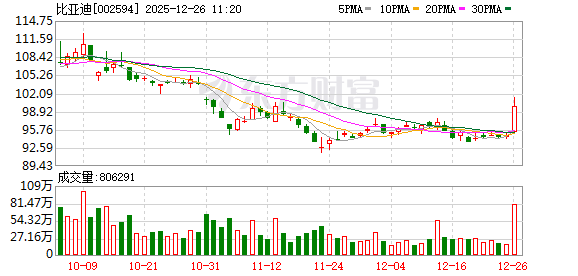
Group 1 - BYD's stock price increased by over 6% during trading on December 26, reaching 99.87 CNY per share, with over ten automotive stocks, including Great Wall Motors and SAIC Motor, also experiencing gains [1] - BYD's market capitalization is reported at 854.6 billion CNY, with a price-to-book ratio of 4.14 [2] - The article from the National Development and Reform Commission emphasizes the importance of regulating order and promoting innovation in the new energy vehicle, lithium battery, and photovoltaic industries, aiming to enhance industry concentration and create a globally leading technology hub during the 14th Five-Year Plan period [2]


比亚迪大涨超6%
Di Yi Cai Jing· 2025-12-26 03:20
Group 1 - BYD's stock price increased by over 6%, reaching 100.6 yuan per share as of the report [2] - The automotive sector showed strong performance, with over 10 automotive stocks, including Great Wall Motors, Seres, SAIC Motor, and Changan Automobile, experiencing gains [2] - The National Development and Reform Commission published an article emphasizing the importance of regulating order and promoting innovation in the "new three" industries, which include new energy vehicles, lithium batteries, and photovoltaics [2] Group 2 - The article highlights the need to address "involutionary" competition during the 14th Five-Year Plan period, aiming to maintain a fair competitive environment and increase industry concentration [2] - The goal is to establish a globally leading technological hub in these key industries [2]
这一板块,突然暴涨!
Zhong Guo Ji Jin Bao· 2025-12-26 02:58
Group 1: Market Overview - On December 26, the A-share market opened mixed, with the Shanghai Composite Index down 0.05%, the Shenzhen Component up 0.06%, and the ChiNext Index down 0.21%. By the time of reporting, the Shanghai Composite Index had turned positive, and the ChiNext Index was also expected to achieve an eight-day winning streak [1]. - Various sectors such as high send-out, Hainan Free Trade Port, photovoltaic glass, and lithium mining stocks were performing strongly, while sectors like computing power experienced a pullback [2]. Group 2: Lithium Mining Sector - The lithium mining index showed strong performance on December 26, with stocks like Tianhua New Energy, Yongxing Materials, Dazhong Mining, Guocheng Mining, and Jinyuan Co. all rising over 5% [3]. - Lithium carbonate futures prices broke through 130,000 yuan per ton, reaching a new high for the year on December 26 [4]. - Analysts noted that the cancellation of mining rights in Yichun and the delayed resumption of lithium mining by CATL have tightened supply. Despite facing short-term pullback pressures, the supply-demand dynamics are expected to support a medium-term price uptrend through 2026 [5]. Group 3: Automotive Sector - The automotive sector saw significant gains on December 26, with BYD rising over 5%, and other companies like Great Wall Motors, Jinlong Automotive, and Haima Automotive also showing notable increases. BYD's stock price exceeded 100 yuan, reaching a high of 101.45 yuan per share, marking a new high in over a month [6]. Group 4: Notable Stock Movements - Baida Qiancheng resumed trading on December 26, hitting a 20% limit up after being suspended since December 16, 2025, due to significant matters [7]. - Baida Qiancheng plans to acquire 100% of Xiamen Zhonglian Century Co., Ltd. through a combination of share issuance and cash payment, along with raising funds [8]. - Victory Energy achieved an 11-day limit up streak, with its stock price reaching 42.10 yuan per share, setting a new high. Other stocks like Jiamei Packaging and Tianji Co. also experienced consecutive limit up days [8].






电池龙头ETF(159767)近一年收益率达60%!新能源动力电池将迎来万亿级市场空间
Jin Rong Jie· 2025-12-26 02:54
Group 1 - The core viewpoint of the articles highlights the strong performance of the photovoltaic equipment and new energy battery sectors, with significant gains in related stocks such as BYD and Tianhua New Energy, reflecting a robust market for new energy vehicles and batteries [1] - The Xinyin Guozheng New Energy Vehicle Battery ETF (159767) has achieved a one-year return of 59.33%, indicating strong investor interest and market confidence in the sector [1] - The fund manager emphasizes the substantial market potential for power batteries, projected to reach trillions, driven by increasing penetration of new energy vehicles, clear policy support, accelerated technological iterations, and enhanced global competitiveness of Chinese companies [1] Group 2 - The battery leader ETF (159767) closely tracks the Guozheng New Energy Vehicle Battery Index, which reflects the market performance of listed companies in the new energy vehicle battery industry in the A-share market [2] - The ETF consists of 30 constituent stocks, with the top ten holdings including CATL, BYD, and Ganfeng Lithium, showcasing a diversified investment in leading companies within the sector [2] - The current management and custody fees for the battery leader ETF are 0.60% per year, which is lower than the industry average, making it suitable for both retail and professional investors [2]


汽车早报|深蓝汽车完成61.22亿元C轮融资 丰田11月全球销量和产量均下滑
Xin Lang Cai Jing· 2025-12-26 00:40
Group 1 - Deep Blue Automotive announced the completion of its Series C financing, raising a total of 6.122 billion yuan from Chang'an Automobile, Chongqing Yufu Holdings Group, and China Merchants Bank Financial Asset Investment [1] - ZhiMi Automotive achieved its first full-cost profitability in December, marking a significant milestone in its five-year history, with quarterly sales showing continuous month-on-month growth and exceeding 10,000 units for four consecutive months [1] - BYD has published a patent for a vehicle collision avoidance control method, which aims to improve the success rate of collision avoidance by controlling the vehicle's wheels through its motors instead of steering [1] Group 2 - Jinbei Automotive signed a memorandum of understanding with E-Works to establish R&D centers in both China and Germany, focusing on electric chassis and related components [3] - The newly established Chuanglian Investment (Tianjin) Partnership has a total investment of 50.4 million yuan, with partners including Geely Investment and others, aimed at engaging in investment activities [4] - Hon Hai Advanced announced the launch of its first electric vehicle, "BRIA," with three different models priced between 899,000 and 1,149,000 New Taiwan dollars, featuring LFP batteries and a maximum range of 516 kilometers [5] Group 3 - Toyota reported a decline in global sales and production for November 2025, with total sales of 965,919 vehicles, a year-on-year decrease of 1.9%, and production of 934,001 vehicles, down 3.4% year-on-year [6] - Toyota temporarily halted production of the new RAV4 model for final quality confirmation, with plans to resume production shortly after the halt [7]


陆家嘴财经早餐2025年12月26日星期五
Wind万得· 2025-12-26 00:31
1. 外汇市场迎来标志性时刻。12月25日,离岸人民币对美元盘中升破"7"整数关口,为15个月来首次,最高触及6.9985。 与此同时,在岸人民币对美元逼 近"7"关口,最高触及7.0053,创15个月新高。展望明年,业内普遍预计人民币汇率有望继续升值,但不会出现单边走势。 2. LOF集体狂欢后资金炒作退潮。 在前一日经历20余只LOF批量涨停后,12月25日,国泰商品LOF、黄金主题LOF、国投瑞盈LOF、国投白银LOF、中信 保诚商品LOF全部跌停,嘉实黄金LOF、黄金LOF均跌超9%。多家基金公司宣布旗下LOF限购升级,黄金LOF申购限额由5000元下调至10元。国投白银 LOF 12月26日开市起停牌1小时,12月29日起A类份额限购金额由500元降至100元,C类份额暂停申购。 3 ."年终奖"话题引发热议。京东发布2025年终奖公告,京东集团92%的员工拿满甚至拿到超额年终奖,年终奖总投入同比增幅超过70%,预计将创下行业 今年最大涨幅。 其中京东采销今年将实现平均25薪,上不封顶。近期巨头涨薪消息不断,网传比亚迪已对技术研发人员实施涨薪,调薪幅度多数在1000 元左右,字节跳动、宁德时代涨薪消 ...

技术研发“大军”集体涨薪?比亚迪:属实
Nan Fang Du Shi Bao· 2025-12-25 23:15
比亚迪研发人员达12万人 12月22日,有消息称"比亚迪技术研发人员涨薪"。对此,比亚迪方面回应称,"情况属实"。但对于"大 部分涨薪500-1000元、少部分涨薪2000-3000元"的传闻,比亚迪方面未予以置评。 超30%分布于海外研发中心 网传消息称,不同于年初的全员普调,本次调薪精准锚定研发部门,基础薪资涨幅区间为500-1000元, 而承担关键技术突破任务的骨干人员涨幅可达2000-3000元。其中,电池材料、自动驾驶算法、电驱系 统三大领域的工程师成为重点激励对象,部分项目组平均调薪幅度超过20%。 作为支撑涨薪的人才基础,比亚迪已构建起规模庞大的研发团队矩阵,整体研发人员规模达12万人,超 30%分布于海外研发中心。这一庞大的人才队伍支撑起企业密集的技术产出,2024年比亚迪全球专利申 请量同比增长35%。 累计研发投入超2200亿元 业绩方面,比亚迪2025年三季报显示,今年前三季度,比亚迪实现营业收入5662.7亿元,同比增长约 13%;归母净利润为233.3亿元,同比下降7.55%。值得注意的是,2025年前三季度,比亚迪研发投入达 437.5亿元,同比增长31%,累计研发投入超2200亿 ...
长沙领跑!前11月湖南“新三样”出口增长81.5%
Chang Sha Wan Bao· 2025-12-25 14:50
Core Insights - Hunan Province's exports of electric vehicles, lithium-ion batteries, and photovoltaic products reached 17.34 billion yuan in the first 11 months of 2025, marking an 81.5% year-on-year increase [1] - The leading city, Changsha, accounted for 14.67 billion yuan of these exports, growing by 86.7% and representing 84.6% of the province's total [2] - Private enterprises, particularly BYD and Anker Electronics, played a significant role, with private sector exports of these products totaling 16.63 billion yuan, an 88% increase, making up 95.9% of the total [1] Export Performance - Electric vehicle exports reached 10.7 billion yuan, a growth of 105.3% [1] - Lithium-ion battery exports were 6.08 billion yuan, increasing by 61% [1] - Photovoltaic product exports totaled 560 million yuan [1] Regional Highlights - Changsha continues to lead the province, while Xiangxi and Shaoyang emerged as notable performers with export values of 620 million yuan and 290 million yuan, respectively, showing increases of 590% and 1430% [2] - ASEAN remains the largest trading partner, with exports to the region amounting to 5.14 billion yuan, a staggering growth of 467.9% [2] Market Structure and Strategy - The export market structure for Hunan's "new three items" is diversifying, with Indonesia, Mexico, and the United States being the top three export destinations [2] - Recommendations include promoting a "diversification + local overseas" strategy, focusing on emerging markets in Africa, the Middle East, and Southeast Asia [3] - Emphasis on "green manufacturing + unified standard certification" to address carbon tariff barriers and support the development of low-carbon technologies [3]

欧媒:中国都上桌了,500年来第一次,欧洲却连牌桌都挤不进?
Sou Hu Cai Jing· 2025-12-25 12:48
Group 1: European Defense Industry Challenges - The European defense industry faces significant challenges, including a massive production capacity gap, particularly in ammunition, which fails to meet Ukraine's needs [3] - Disagreements among EU member states complicate cross-border collaboration in defense, as each country has its own military industrial system and interests [3] - Europe's reliance on U.S. defense spending, which accounts for 30% of U.S. defense expenditures, has left Europe vulnerable, especially as U.S. focus shifts to other regions [3] Group 2: Economic and Industrial Decline - European industries are experiencing hollowing out, with traditional sectors losing competitiveness, particularly in technology and manufacturing [6] - Germany's industrial output is projected to decline by 2% in 2025, marking the fourth consecutive year of decline, indicating a structural recession [9] - The automotive sector is under pressure, with companies like BYD significantly increasing their market share in Europe, while local manufacturers struggle with battery supply and regulatory changes [5][12] Group 3: Regulatory and Policy Issues - The EU's complex regulatory environment has hindered the swift transition to electric vehicles, with frequent changes in environmental standards causing confusion among manufacturers [11] - The EU's attempts to establish a digital single market and enhance local digital enterprise competitiveness are ongoing, but challenges remain in breaking down national barriers [14] - The EU's legislative efforts, such as the Digital Services Act and Digital Markets Act, aim to counteract U.S. tech dominance, but the effectiveness is limited by existing technological dependencies [13][14] Group 4: Technological Strengths and Collaborations - Europe maintains strengths in certain technological areas, such as wind power and high-end manufacturing, with a significant share of global medical patents [12] - Collaborations between European automakers and Chinese battery manufacturers are emerging, creating a synergistic model that combines European vehicle technology with Chinese battery solutions [12] - The EU's regulatory frameworks in digital governance and environmental standards are seen as leading globally, despite the challenges faced by local industries [13]
价格合规为汽车业反内卷再加码
Xin Lang Cai Jing· 2025-12-25 12:40
Core Viewpoint - The release of the "Automobile Industry Price Behavior Compliance Guidelines" aims to regulate pricing behaviors in the automotive industry, addressing the ongoing "involution" competition and providing a foundation for healthy market development by 2026 [2][18]. Group 1: Industry Response and Impact - Major automotive companies such as BYD, Xpeng Motors, and BAIC Group have responded positively to the guidelines, committing to eliminate price fraud and unfair competition [2][18]. - The guidelines are expected to alleviate the long-standing issue of price inversion faced by dealers, which has led to significant financial losses, with 52.6% of dealers reporting losses in the first half of 2023 [3][19]. - The guidelines explicitly prohibit selling below cost, which is seen as a protective measure for dealers and is welcomed by the majority of them [4][20]. Group 2: Pricing and Rebate Issues - The guidelines address the complex rebate structures that often burden dealers, requiring manufacturers to clarify rebate policies and respect dealers' pricing autonomy [8][24]. - A survey indicated that while half of the brands have reduced rebate payment periods to within one month, some still exceed 60 days, creating operational pressure for dealers [8][24]. - The guidelines aim to promote transparency in pricing and rebate practices, shifting the market focus from price wars to value competition [5][21]. Group 3: Regulatory Framework and Compliance - The guidelines mandate that third-party platforms involved in automotive sales must adhere to pricing regulations, ensuring consumer rights and fair trading practices [9][25]. - A multi-dimensional compliance framework is proposed, including clear pricing rules, promotional conduct, and service charges to enhance transparency in the automotive sales process [10][26]. - The guidelines encourage the establishment of internal compliance mechanisms within automotive companies to prevent pricing violations and enhance brand integrity [10][26]. Group 4: Future Outlook and Challenges - The guidelines are seen as a significant step towards curbing irrational competition in the automotive market, with expectations for improved profitability across the industry [12][28]. - However, industry experts emphasize the need for detailed implementation rules to ensure effective execution, particularly regarding cost accounting standards [13][29]. - The successful implementation of the guidelines will require collaboration among manufacturers, dealers, and regulatory bodies to foster a healthy competitive environment [15][31].