
Muyuan Foods (002714)

Search documents
牧原股份:11月商品猪销售收入93.9亿元
Mei Ri Jing Ji Xin Wen· 2025-12-05 08:54
每经AI快讯,12月5日,牧原股份(002714.SZ)公告,2025年11月份,公司销售商品猪660.2万头,同比变 动11.80%(其中向全资子公司牧原肉食品有限公司及其子公司合计销售商品猪299.1万头);商品猪销 售均价11.56元/公斤,同比变动-28.73%;商品猪销售收入93.90亿元,同比变动-20.43%。 (文章来源:每日经济新闻) ...


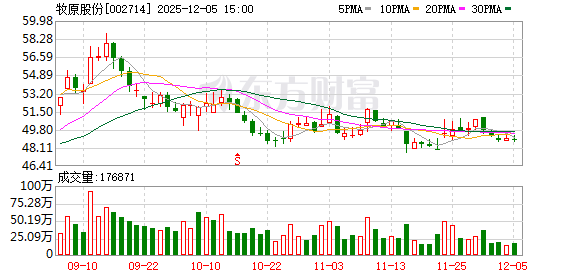
牧原股份(002714.SZ):11月商品猪销售收入93.90亿元 同比下降20.43%
智通财经网· 2025-12-05 08:53
智通财经APP讯,牧原股份(002714.SZ)发布公告,2025年11月份,公司销售商品猪660.2万头,同比变 动11.80%(其中向全资子公司牧原肉食品有限公司及其子公司合计销售商品猪299.1万头);商品猪销售均 价11.56元/公斤,同比变动-28.73%;商品猪销售收入93.90亿元,同比变动-20.43%。 ...
牧原股份:11月商品猪销售收入93.9亿元 同比下降20.43%
Zheng Quan Shi Bao Wang· 2025-12-05 08:48
人民财讯12月5日电,牧原股份(002714)12月5日公告,2025年11月份,公司销售商品猪660.2万头, 同比增长11.8%;商品猪销售均价11.56元/公斤,同比下降28.73%;商品猪销售收入93.9亿元,同比下降 20.43%。 ...
牧原股份(002714) - 2025年11月份销售简报
2025-12-05 08:45
| 证券代码:002714 | 证券简称:牧原股份 | 公告编号:2025-107 | | --- | --- | --- | | 债券代码:127045 | 债券简称:牧原转债 | | 牧原食品股份有限公司 2025 年 11 月份销售简报 二、风险提示 (一)生猪市场价格的大幅波动(下降或上升),都可能会对公司的经营业 绩产生重大影响。如果未来生猪市场价格出现大幅下滑,仍然可能造成公司的业 绩下滑。敬请广大投资者审慎决策,注意投资风险。 (二)生猪市场价格变动的风险是整个生猪生产行业的系统风险,对任何一 家生猪生产者来讲都是客观存在的、不可控制的外部风险。 (三)动物疫病是畜牧行业发展中面临的主要风险,可能会对公司的经营业 绩产生重大影响。敬请广大投资者审慎决策,注意投资风险。 本公司及董事会全体成员保证信息披露内容的真实、准确、完整,没有虚假 记载、误导性陈述或重大遗漏。 一、2025 年 11 月份销售情况简报 2025 年 11 月份,公司销售商品猪 660.2 万头,同比变动 11.80%(其中向全 资子公司牧原肉食品有限公司及其子公司合计销售商品猪 299.1 万头);商品猪 销售均价 11.5 ...
飞天茅台电商价低至1399元?消费ETF(159928)跌近1%弱势四连阴!机构评12月消费:市场风格继续有利!
Xin Lang Cai Jing· 2025-12-04 07:04
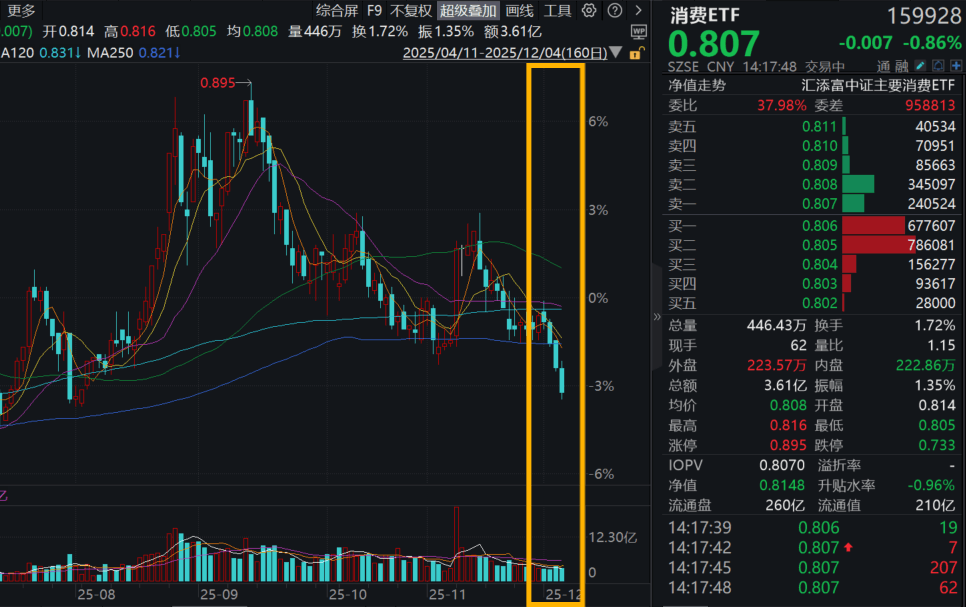
Group 1: Market Performance - The consumer sector continues to experience a pullback, with the Consumer ETF (159928) declining nearly 1% for the fourth consecutive day, with a trading volume exceeding 450 million yuan [1] - The Consumer ETF (159928) has accumulated over 420 million yuan in inflows over the past 20 days, and as of December 3, its latest scale exceeds 21.1 billion yuan, leading its peers significantly [1] - The Hong Kong Stock Connect Consumer 50 ETF (159268) also fell nearly 1%, with a trading volume exceeding 24 million yuan, and it received a net subscription of 2 million shares during the day, accumulating over 67 million yuan in inflows over the past 20 days [3] Group 2: Valuation and Investment Strategy - As of December 3, the TTM price-to-earnings ratio of the Consumer ETF (159928) is 19.74, which is at the 3.99% percentile over the past 10 years, indicating a higher valuation attractiveness [5] - Market style is expected to favor low valuations as the year-end approaches, with seasonal patterns suggesting a shift in investor allocation strategies [5] - High dividend and stable performance stocks are recommended for long-term attention in the context of insufficient growth and declining interest rates [7] Group 3: Alcohol Industry Insights - The white liquor sector is currently in a deep adjustment phase, with the demand and pricing strategies of leading brands like Moutai remaining uncertain [8] - Moutai's pricing strategy includes maintaining high-quality development and focusing on market-oriented marketing transformations, with an emphasis on digital and green transitions [8] - The white liquor sector is expected to see a recovery in demand, particularly with the upcoming long holiday period, which may support valuation recovery [8][9]





东兴证券晨报-20251203
Dongxing Securities· 2025-12-03 10:46
Core Insights - The report highlights the ongoing development of China-Honduras relations, emphasizing the benefits brought to the Honduran people through cooperation in various sectors, including agriculture and trade [2] - The report notes a significant decline in the import of complete automobiles in China, with a 30% year-on-year decrease in the first ten months of 2025 [2] - The report discusses the successful launch of the Zhuque-3 reusable rocket, although it faced challenges during the recovery phase [5] Economic News - The Ministry of Foreign Affairs reports on the strengthening of China-Honduras relations, with notable achievements in agricultural cooperation and trade agreements [2] - The China Automobile Industry Association indicates a decrease in automobile imports, with a total of 404,000 vehicles imported in the first ten months of 2025, a 30% decline year-on-year [2] - The Ministry of Commerce states that the trade-in program for consumer goods has generated over 2.5 trillion yuan in sales, benefiting over 360 million people [2] - The report mentions the launch of the Zhuque-3 rocket, which is designed for low-cost, high-frequency, and reusable space missions, although the recovery test was unsuccessful [5] Company Insights - Beibu Gulf Port reported a cargo throughput of 29.4854 million tons in November 2025, a year-on-year increase of 0.29%, with a cumulative throughput of 329 million tons for the year, up 10.19% [6] - Lingyi Technology has completed the assembly of over 5,000 humanoid robots, collaborating with more than 20 domestic companies and making progress with North American clients [6] - InnoLight Technology has formed a strategic partnership with ON Semiconductor to accelerate the application of GaN technology in various sectors, potentially generating hundreds of millions in sales [6] - Jianyou Co., Ltd. received FDA approval for its propofol injection, expanding its product offerings in the U.S. market [6] - ST Zhang's subsidiary plans to collaborate on the operation and improvement of the Dayong Ancient City project, with a registered capital of 180 million yuan [6]





湖南出台11项举措提振扩大消费,海南印发生育补贴!消费ETF(159928)三连跌迎来低位布局机会?昨日大举吸金超1亿元!
Sou Hu Cai Jing· 2025-12-03 06:26
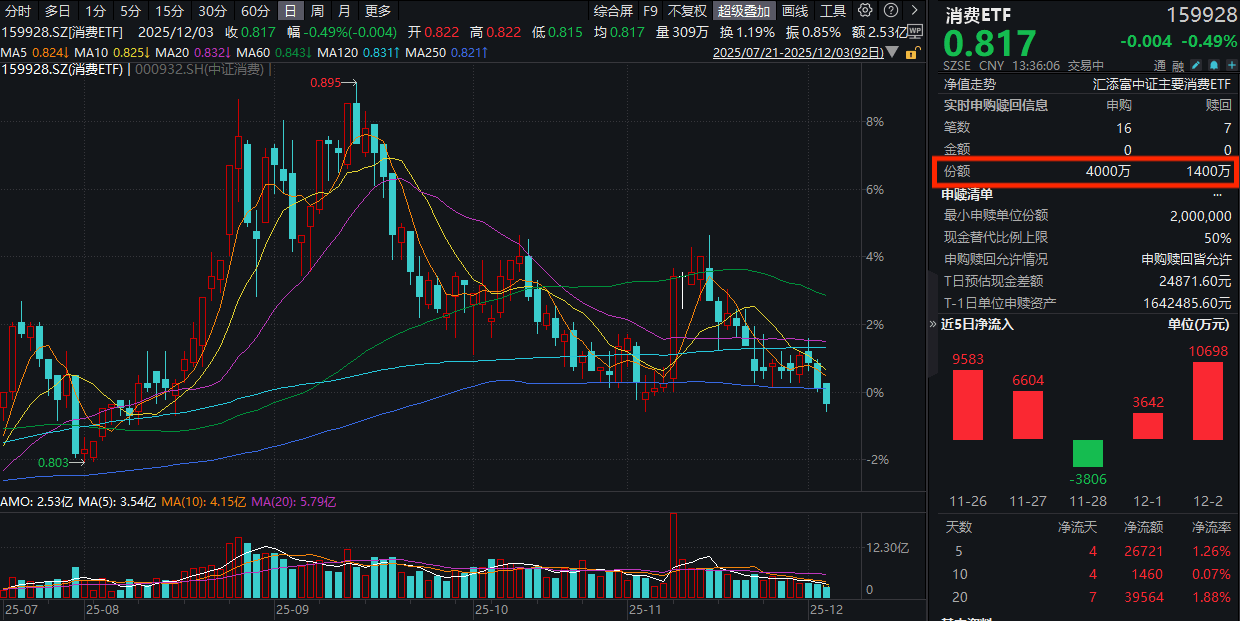
Group 1: Market Performance - The consumer sector experienced a decline, with the Consumer ETF (159928) dropping by 0.49%, marking its third consecutive day of decline, and a trading volume exceeding 250 million yuan [1] - The Consumer ETF (159928) saw a net subscription of 26 million units during the day, with a net inflow of 107 million yuan yesterday, accumulating over 390 million yuan in the past 20 days [1] - As of December 2, the latest scale of the Consumer ETF (159928) exceeded 21.3 billion yuan, leading its peers significantly [1] Group 2: Policy and Support Measures - Hunan province introduced 11 measures to boost consumption, emphasizing increased financial support for key consumption areas such as trade circulation and life services [3] - Hainan province issued a child-rearing subsidy plan, providing annual subsidies of 3,600 yuan per child for eligible families starting from January 1, 2025 [3] Group 3: Valuation and Investment Outlook - The Consumer ETF (159928) has a TTM price-to-earnings ratio of 19.89, which is at the 4.41% percentile over the past decade, indicating a high valuation attractiveness [5] - Seasonal trends suggest that Q4 often sees shifts in investment styles, with December being a period where low valuation stocks may gain favor [5] Group 4: Future Consumption Trends - According to Jiangyin International, consumer spending is expected to see a slight recovery in 2025, with moderate growth continuing into 2026, driven by structural changes in consumer demand [7] - The consumer confidence index is gradually improving but remains below the threshold, indicating cautious consumer sentiment [7] Group 5: Food and Beverage Sector Insights - Huachuang Securities anticipates that traditional leading companies in the food and beverage sector will improve their market share, while new industry trends are emerging [8] - The food and beverage industry is expected to stabilize after a period of supply-demand imbalance, with a focus on traditional products like beer and dairy [9] - The industry is witnessing a shift towards new demands and business models, with opportunities in functional foods and health products [9]
畜牧ETF(159867)红盘向上,后续产能有望持续去化
Xin Lang Cai Jing· 2025-12-03 06:06
Group 1 - The average price of live pigs in China is 11.63 yuan/kg as of November 29, showing a decline of 1.11% compared to the previous weekend, with the industry facing a loss of 111 yuan per head for nine consecutive weeks [1] - The price of weaned piglets at 7 kg is 209 yuan per head, with an average loss of approximately 81 yuan per head for exported piglets this week [1] - The average slaughter weight this week is 129.22 kg, with a slight increase of 0.41 kg week-on-week, while the average slaughter weight for smallholders is at a high of 145.17 kg [1] Group 2 - The demand side shows an increase in daily slaughter volume by 3.39% week-on-week, driven by northern slaughterhouses responding to low pig prices and the onset of seasonal consumption in southern markets [1] - There are sporadic outbreaks of pig diseases in certain regions due to cooler weather, with the proportion of pigs under 90 kg in total slaughter increasing to 4.83%, up by 0.34% from last week [1] - The agricultural team emphasizes the importance of monitoring the pig sector's capacity reduction due to production cuts, losses in farming, and disease interference, suggesting that capacity may continue to decrease [1] Group 3 - As of December 3, 2025, the CSI Livestock Breeding Index shows significant gains for several stocks, including Luoniushan up by 9.98% and Yike Foods up by 3.36% [2] - The Livestock ETF closely tracks the CSI Livestock Breeding Index, which includes companies involved in feed, veterinary drugs, and livestock farming [2] - The top ten weighted stocks in the CSI Livestock Breeding Index account for 65.6% of the index, with major companies like Muyuan Foods and Wens Foodstuffs leading the list [2]




生猪:周期价值、成长并行 - 深耕价值沃野,布局周期新机
2025-12-03 02:12
Summary of Conference Call on Livestock Industry Industry Overview - The livestock industry, particularly the pork sector, is facing structural challenges with a projected supply gap for fresh meat in 2023-2024, making leading companies like YouRan Agriculture attractive for investment due to their market position and low valuations [1][2][4] - The swine sector is transitioning from cyclical growth to cyclical value, with a notable increase in piglet prices in Q1 2025 leading to a stock price rebound, followed by a market slowdown and a drop in pork prices below cost levels [1][6] Key Companies and Recommendations - **Pork Sector**: - **Mu Yuan Co., Ltd.**: Recommended for its value foundation, cyclical momentum, and growth potential [1][3][4] - **De Kang Agriculture**: Noted for its first-tier breeding level and third-tier valuation, considered a strategic recommendation [1][3] - **Wens Foodstuff Group**: Favored for its stability [1][3] - **Feed Sector**: - **Hai Da Group**: Achieved steady growth through dual domestic and international market drivers [1][3] - **Broiler Chicken Sector**: - **Li Hua Co., Ltd.**: Excelled in cost control [1][5] - **Sheng Nong Development**: Enhanced market competitiveness through its full industry chain advantages [1][5] Market Dynamics and Future Outlook - The pork industry is in a critical phase of capacity reduction, with policies and market forces enhancing expectations for a cyclical reversal. Leading companies like Mu Yuan maintain profitability and reduce debt while increasing dividends [4][6] - For 2026, the industry is expected to see: - Insufficient proactive capacity reduction but significant slowdown in capacity growth - Clear cost differentiation between large enterprises and small to medium-sized farms - Re-evaluation of valuations and investment value, with policies aimed at controlling production capacity becoming more stringent [6][7] Investment Strategy - The core strategy for the agricultural sector in 2026 focuses on selecting individual stocks for stable returns while waiting for broader market gains. The meat cattle sector is highlighted for its potential [2] - Specific investment recommendations include: - **Mu Yuan Co., Ltd.**: Identified as a top pick due to its excellent quality, significant market potential (valued over 300 billion), innovative technology, and strong sustainable profitability [7] - Other companies with value potential include Wens Foodstuff and De Kang Agriculture, with De Kang noted for its quality-price advantage during valuation recovery phases [7] Additional Insights - The overall livestock market is experiencing significant changes, with a nationwide reduction in production already underway and winter demand expected to support marginal demand increases [6] - The low valuations and high capital influx into the pork sector highlight its investment value [6]
5.85亿元资金今日流入农林牧渔股
Zheng Quan Shi Bao Wang· 2025-12-02 09:03
Market Overview - The Shanghai Composite Index fell by 0.42% on December 2, with seven industries experiencing gains, led by the oil and petrochemical sector with a rise of 0.71% and light industry manufacturing at 0.55% [1] - The media and non-ferrous metals sectors saw the largest declines, with drops of 1.75% and 1.36%, respectively [1] - The agricultural, forestry, animal husbandry, and fishery sector decreased by 0.34% [1] Capital Flow Analysis - The main capital outflow from the two markets totaled 46.499 billion yuan, with seven industries seeing net inflows [1] - The light industry manufacturing sector had the highest net inflow of 679 million yuan, while the agricultural, forestry, animal husbandry, and fishery sector had a net inflow of 585 million yuan despite its decline [1] Agricultural, Forestry, Animal Husbandry, and Fishery Sector - The sector experienced a decline of 0.34%, with 105 stocks in total; 47 stocks rose, including 2 that hit the daily limit, while 57 stocks fell [2] - Notable inflows included Pingtan Development with a net inflow of 758 million yuan, followed by Luoniushan and Shennong Seed with inflows of 130 million yuan and 89.381 million yuan, respectively [2] - Major outflows were seen in Muyuan Foods, Zhengbang Technology, and COFCO Sugar, with net outflows of 1.02 billion yuan, 730.564 million yuan, and 455.241 million yuan, respectively [2][4] Top Stocks by Capital Inflow - Pingtan Development: +10.03% with a turnover rate of 16.30% and a capital flow of 757.98 million yuan [2] - Luoniushan: +10.04% with a turnover rate of 10.12% and a capital flow of 130.15 million yuan [2] - Shennong Seed: +5.66% with a turnover rate of 29.61% and a capital flow of 89.381 million yuan [2] Top Stocks by Capital Outflow - Muyuan Foods: -1.15% with a turnover rate of 0.46% and a capital flow of -1.021573 billion yuan [4] - Zhengbang Technology: -3.12% with a turnover rate of 3.28% and a capital flow of -730.564 million yuan [4] - COFCO Sugar: -2.25% with a turnover rate of 1.03% and a capital flow of -455.241 million yuan [4]


