
BANK OF QINGDAO(002948)

Search documents
银行股配置重构系列四:为何本轮重点推荐优质城商行?
Changjiang Securities· 2025-05-26 15:36
Investment Rating - The report maintains a "Positive" investment rating for the banking sector, particularly favoring high-quality city commercial banks [11]. Core Insights - In the current macroeconomic environment, government leverage expansion is the clearest direction for bank operations, with state-owned banks and city commercial banks focusing on government-related business as a core strategy for balance sheet expansion [2][7]. - Leading city commercial banks are accelerating their market share acquisition, with their performance growth consistently outpacing the banking industry, driven primarily by relatively high-speed balance sheet expansion [6][10]. - The asset quality of city commercial banks, primarily engaged in government-related business, is currently the most stable, with expectations for a decline in the net generation rate of non-performing loans this year [2][9]. Summary by Sections Macroeconomic Environment - The current macroeconomic environment favors government-related business, with city commercial banks focusing on local government, urban construction, and local state-owned enterprises [7]. - The demand for government-led financing continues to expand in key economic regions, such as the Chengdu-Chongqing area and Shandong province, despite concerns about export pressures in the Yangtze River Delta [7][8]. Competitive Landscape - The competitive dynamics between state-owned banks and leading city commercial banks are evolving, with state-owned banks experiencing a significant increase in credit market share due to macro policy guidance [8]. - Regulatory measures are being implemented to protect the net interest margins of state-owned banks, indirectly slowing their loan issuance and creating a more favorable competitive environment for city commercial banks [8][9]. Asset Quality and Loan Performance - City commercial banks have maintained low non-performing loan rates due to their focus on government-related loans, which have seen reduced risk following recent debt restructuring efforts [9]. - The tightening of risk control and loan issuance in retail banking is expected to lead to a slight decrease in the net generation rate of non-performing loans this year [9]. Investment Outlook - The report is optimistic about city commercial banks becoming the core focus for institutional investors in the banking sector, with expectations for their valuations to rise above 1x PB [10]. - Specific banks, such as Hangzhou Bank, are anticipated to lead in valuation increases due to their regional economic strength, asset quality, and performance growth [10].




银行业周度追踪2025年第20周:新一轮存款降息缓释净息差压力-20250526
Changjiang Securities· 2025-05-26 15:36
Investment Rating - The investment rating for the banking industry is "Positive" and maintained [10] Core Insights - The Yangtze Bank Index increased by 0.6% this week, outperforming the CSI 300 Index by 0.8% and the ChiNext Index by 1.5%. The market's focus on bank stocks has notably increased due to the logic of active fund allocation [2][6] - Following a 10 basis point (BP) reduction in the Loan Prime Rate (LPR) in May, major banks initiated a new round of deposit rate cuts. The interest rate for demand deposits decreased by 5 BP to 0.05%, while the rates for one-year, three-year, and five-year fixed deposits were reduced by 15 BP, 25 BP, and 25 BP respectively, with the one-year fixed deposit rate falling below 1.0% to 0.95% [7][26] - The recent deposit rate cuts are expected to effectively offset the impact of the LPR reduction, leading to a narrowing of the decline in net interest margins (NIM) in the future [8][30] Summary by Sections Market Performance - The Yangtze Bank Index's performance this week shows a cumulative increase of 0.6%, with significant contributions from city commercial banks like Qingdao Bank, which reported a revenue growth rate that exceeded expectations [6][17] - The average dividend yield for the five major state-owned banks in A-shares is 4.49%, with a 277 BP spread over the 10-year government bond yield, while the H-shares yield is even higher at 5.75% [19][24] Deposit Rate Cuts - The recent round of deposit rate cuts is the seventh since 2022, aimed at alleviating the pressure on banks' net interest margins. The current NIM for state-owned banks has reached a new low of 1.33% [7][28] - The report anticipates that the deposit rates will continue to have downward space, but due to the significant cuts already made, no further reductions are expected before the end of 2025 [26][30] Impact on Net Interest Margin - The deposit rate cuts are expected to provide a positive contribution to the banks' NIM, with estimates suggesting an average positive impact of 5 BP from the recent rate adjustments [30][31] - The banks with a higher proportion of fixed deposits and lower mortgage ratios are expected to benefit more from the recent rate cuts [31] Convertible Bonds and Valuation Opportunities - There is a growing market interest in convertible bonds issued by banks, particularly those like Hangzhou Bank, which are expected to see valuation recovery as they exceed forced redemption prices [34][35] - Other banks such as Nanjing Bank and Qilu Bank are also highlighted for their potential valuation recovery as they approach their respective conversion prices [34]
青岛银行发布2025年第一季度碳减排贷款信息披露
Jin Tou Wang· 2025-05-26 06:03
2025年5月23日,青岛银行(002948)发布公告称,根据中国人民银行相关规定,青岛银行股份有限公 司(以下简称青岛银行)在碳减排支持工具的支持下,向符合条件的碳减排项目发放碳减排贷款,并根 据要求向公众披露本机构获得碳减排支持工具支持的碳减排项目数量、碳减排贷款金额和加权平均利 率、碳减排贷款带动的年度碳减排量。以下信息不存在虚假记载、重大遗漏或误导性陈述。 2025年第一季度,青岛银行在碳减排支持工具支持下,合计向5个项目发放碳减排贷款5934.7727万元, 贷款加权平均利率3.64%,带动的年度碳减排量为12878.65吨二氧化碳当量,其中碳减排效应最为显著 的项目为威海恒兴能源有限公司临港区22.5MW分布式光伏发电项目。本年度,青岛银行累计向5个项 目发放碳减排贷款5934.7727万元,贷款加权平均利率3.64%,带动的年度碳减排量为12878.65吨二氧化 碳当量。获得碳减排支持工具支持以来,青岛银行累计向8个项目发放碳减排贷款57850.9527万元,贷 款加权平均利率3.68%,带动的年度碳减排量为155652.68吨二氧化碳当量。 本信息披露的碳减排贷款将专项用于清洁能源、节能环保和 ...
存银行,还不如买银行股?
第一财经· 2025-05-26 01:26
Core Viewpoint - The decline in domestic deposit rates has diminished the attractiveness of traditional savings, leading to a "substitution effect" where bank stocks are favored over deposits, resulting in strong performance in the banking sector [1][3][10]. Summary by Sections Deposit Rate Decline - Since 2025, domestic deposit rates have been continuously decreasing, with the one-year fixed deposit rate falling below 1%, marking a historical low [3]. - The diminishing returns from traditional savings have reignited discussions around the benefits of investing in bank stocks instead of saving [3]. Dividend Yield Comparison - As of May 23, 2025, among 42 A-share listed banks, 31 banks have a dividend yield exceeding 4%, with some banks like Ping An Bank and Minsheng Bank surpassing 8% [3]. - The significant yield difference has prompted a "substitution effect," where investors see greater returns from bank stocks compared to deposits [3]. Strong Performance of Bank Stocks - The banking sector has shown robust performance, with a year-to-date increase of 7.66%, outperforming the Shanghai and Shenzhen 300 Index, which has declined by 1.34% [3][4]. - Investors, including insurance funds and public funds, have increased their holdings in bank stocks significantly [4][5]. Insurance and Public Fund Involvement - Insurance funds have been the primary players in increasing bank stock holdings, with a 27.2% holding ratio as of Q1 2025, up 4.3 percentage points from the end of 2023 [5]. - Public funds have also increased their allocation to bank stocks, with the proportion rising from 1.2% to 2.5% by the end of Q1 2025 [5]. Sector Performance Disparity - There is a noticeable divergence in performance within the banking sector, with regional banks like Qingdao Bank and Chongqing Rural Commercial Bank showing strong gains, while some larger banks have underperformed [7]. - As of Q1 2025, state-owned banks experienced a 1.5% decline in revenue, while city commercial banks saw a 3% increase [8]. Asset Quality and Non-Performing Loans - The non-performing loan generation rate for large banks has increased, while it has decreased for joint-stock and rural commercial banks [9]. - Regional banks, benefiting from local economic support, maintain lower non-performing loan ratios compared to national banks [9]. Future Outlook - Analysts believe that high dividend strategies will continue to drive bank stock prices in the short term, while net interest margins and asset quality will be critical for long-term performance [11][12]. - The banking sector is facing challenges from asymmetric interest rate cuts, which may pressure net interest margins but could also lower funding costs in the long run [12].





本周聚焦:多家银行下调存款挂牌利率
GOLDEN SUN SECURITIES· 2025-05-25 06:18
Investment Rating - The report indicates a positive outlook for the banking sector, suggesting that certain stocks may have alpha potential due to policy catalysts and a cyclical recovery [4]. Core Insights - Multiple banks have lowered their deposit rates, with the one-year and five-year Loan Prime Rate (LPR) reduced by 10 basis points on May 20, 2025. This trend reflects a broader market-driven decline in deposit costs [1][2]. - The average deposit cost rate for China Merchants Bank decreased significantly by 25 basis points to 1.29% in Q1 2025, indicating a trend of improving deposit costs across the sector [1]. - The report highlights that banks like Chongqing Bank, Minsheng Bank, and CITIC Bank have substantial room for further deposit cost reductions, suggesting a favorable environment for banks to optimize their funding costs [2]. Summary by Sections Section 1: Focus of the Week - Several banks have adjusted their deposit rates downward, with over half of listed banks participating in this trend by May 24, 2025 [1]. - The report notes that the average deposit cost rate for China Merchants Bank has shown improvement since Q2 2024, aligning with previous forecasts of enhanced cost reduction in liabilities [1]. Section 2: Sector Perspective - The banking sector is expected to benefit from expansionary policies aimed at stabilizing the economy, with specific banks like Ningbo Bank, Postal Savings Bank, and China Merchants Bank highlighted as potential investment opportunities [4]. - The report emphasizes that the cyclical recovery may take time, but the ongoing interest rate cuts could sustain the dividend strategy for banks like Shanghai Bank and Jiangsu Bank [4]. Section 3: Key Data Tracking - The report tracks various financial metrics, including the issuance of interbank certificates and the average rates for different types of bank notes, indicating a dynamic market environment [9][8]. - It also notes the increase in the proportion of deposits with a remaining maturity of less than one year, which rose by 3 percentage points to 37.4% by the end of 2024, suggesting a trend towards concentrated deposit maturities [2][16].



资金情绪谨慎A股市场结构性行情持续
Zhong Guo Zheng Quan Bao· 2025-05-22 21:02
● 本报记者 吴玉华 行业板块方面,5月22日,申万一级行业中有6个行业出现主力资金净流入,其中传媒、国防军工、轻工 制造行业主力资金净流入金额居前,分别为13.87亿元、9.43亿元、5.83亿元。在出现主力资金净流出的 25个行业中,汽车、计算机、机械设备行业主力资金净流出金额居前,分别为37.77亿元、29.16亿元、 26.32亿元。 5月22日,A股市场震荡调整,银行板块逆势走强,上海银行、浦发银行等多只银行股创历史新高,结 构性行情持续。三大指数均下跌,创业板指跌近1%,整个A股市场超4400只股票下跌。市场成交缩 量,成交额为1.14万亿元。资金面上,Wind数据显示,22日沪深两市主力资金净流出超252亿元,资金 情绪谨慎。 分析人士认为,结合宽松的货币政策以及中长期资金流入资本市场,A股下行风险相对可控。短期来 看,市场下有支撑,但向上仍需消化外部不确定性因素带来的担忧,建议积极把握市场结构性机会。 缩量调整 5月22日,A股市场缩量调整,题材板块多数下跌。截至当天收盘,上证指数、深证成指、创业板指、 科创50指数、北证50指数分别下跌0.22%、0.72%、0.96%、0.48%、6.15 ...



高位股资金博弈加剧 银行股拉升稳大盘
Shang Hai Zheng Quan Bao· 2025-05-22 18:56
Group 1: Market Overview - A-share market showed increased structural differentiation on May 22, with high-position thematic stocks retreating and the North China 50 Index dropping over 6% [2] - The Shanghai Composite Index closed down 0.22% at 3380.19 points, while the Shenzhen Component Index fell 0.72% to 10219.62 points, and the ChiNext Index decreased by 0.96% to 2045.57 points [2] Group 2: Bank Sector Performance - Bank stocks rose against the market trend, with several banks like Pudong Development Bank, Jiangsu Bank, and Chengdu Bank reaching historical highs, while others like Qingdao Bank and CITIC Bank increased by over 2% [3] - Major state-owned banks and several others lowered RMB deposit rates on May 20, which is expected to positively impact net interest margins and allow banks to increase government bond allocations to support the real economy [3][4] - The valuation recovery logic driven by bank stock dividends is expected to continue, with limited downward pressure on net interest margins and stable performance anticipated [3] Group 3: High-Position Stock Dynamics - High-position stocks have become a market focus amid fluctuations, with stocks like Nanjing Port experiencing significant volatility, including a 7.21% increase after a drop [4] - Over 80 stocks have doubled in price this year, primarily in sectors like restructuring, price increases, robotics, AI, and new consumption, although many of these are small-cap stocks with poor performance [4][5] Group 4: Valuation Concerns - Some doubling stocks, such as Zhongyida, have been flagged for high valuations despite significant price increases, with a cumulative rise of 252.61% while the company remains in a loss position [5] - The market is expected to continue a volatile trend with low trading volumes, and structural opportunities may arise in sectors like export industry chains, domestic demand expansion, high dividend yields, and mergers and acquisitions [5]
突然大跌超6%!发生了什么?
证券时报· 2025-05-22 08:30
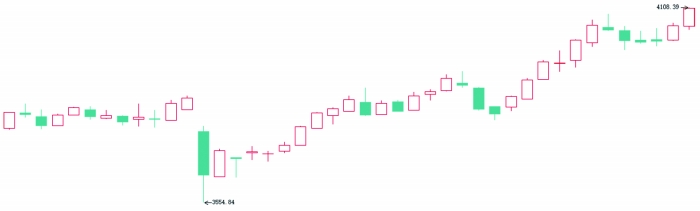
Market Overview - The Shanghai Composite Index experienced a narrow range of fluctuations, while the ChiNext Index saw a decline of over 1%. The North Star 50 Index, which had just reached a new high, fell sharply by over 6% [2][6] - The closing figures showed the Shanghai Composite Index down by 0.22% at 3380.19 points, the Shenzhen Component Index down by 0.72% at 10219.62 points, and the ChiNext Index down by 0.96% at 2045.57 points. The North Star 50 Index closed down 6.15% [2] Sector Performance - Consumer sectors such as tourism, catering, and food and beverage collectively declined, while the banking sector rose against the trend, with notable gains from CITIC Bank and Qingdao Bank, both up over 3% [2][9] - The military industry sector showed strength, with stocks like Guoke Tiancai and Sichuan Chuangxin hitting the daily limit [2] - The AI application concept remained active, with stocks like Kunlun Wanwei and Huibo Yuntong also hitting the daily limit. The innovative drug concept continued to attract attention, with Sanofi Health achieving four consecutive limits [2] North Star A-Shares - The North Star A-Shares saw significant declines, with stocks like Ningxin New Materials dropping over 15% and others like Jinfeng Biological and Lingge Technology falling by more than 14% [4][5] - The North Star 50 Index had previously broken through the 1500-point mark on the 21st but faced a sharp drop of over 6% in the afternoon of the current trading day [6] Banking Sector Insights - The banking sector showed resilience, with several banks reaching new highs. The overall net interest margin for banks is expected to remain stable, with limited downward pressure throughout the year [11] - Institutional insights suggest that the valuation repair logic driven by dividend value is likely to continue, with banks being attractive due to their stable fundamentals and low valuations [11] - The impact of regulatory changes, such as new public fund regulations, is expected to drive increased allocation to bank stocks, enhancing their appeal to long-term funds [11] Nanjing Port Activity - Nanjing Port experienced significant volatility, opening with a limit down but later rebounding to hit a limit up, closing with a gain of 7.2% and a total transaction volume exceeding 1.65 billion yuan [13][15] - The stock had previously shown similar volatility, achieving six limit-ups in the past seven trading days, although the company issued a risk warning regarding its stock price surge [15]


超4400只个股飘绿,银行股逆市走强!北证50跌超6%
21世纪经济报道· 2025-05-22 08:17
Market Overview - The market experienced a day of volatility on May 22, with the ChiNext Index leading the decline, and the North Exchange 50 Index dropping over 6% [1][8] - The Shanghai Composite Index fell by 0.22%, the Shenzhen Component Index by 0.72%, and the ChiNext Index by 0.96% [1][2] Sector Performance - Bank stocks showed resilience, with several banks, including China Citic Bank, reaching new historical highs [4][11] - Conversely, new consumption concept stocks faced significant declines, with companies like Kexin Co. dropping over 10% [4] - The total trading volume in the Shanghai and Shenzhen markets was 1.1 trillion yuan, a decrease of 70.8 billion yuan from the previous trading day [4] Individual Stock Highlights - Ningde Times had a trading volume of over 7.4 billion yuan, leading the market, followed by BYD and Kunlun Wanwei [4][5] - Jinbo Biological, a leading stock on the North Exchange, saw its price drop over 17% during the day, attributed to profit-taking by investors after a significant price increase [10] ETF Performance - The S&P 500 ETF led the gains with an increase of 4.51%, while gaming ETFs also saw positive movements [6][7] Investment Sentiment - The market's adjustment was influenced by external factors, including a poor auction result for the 20-year U.S. Treasury bonds, which heightened global risk aversion [8] - There are indications of overcrowding in micro-cap stocks, with trading volumes surpassing previous highs, suggesting potential selling pressure [8] Banking Sector Insights - The banking sector is experiencing a positive trend, with analysts suggesting that the recent financial policies and structural tools could lead to a performance turnaround for banks [16]





【盘中播报】沪指跌0.06% 美容护理行业跌幅最大
Zheng Quan Shi Bao Wang· 2025-05-22 06:23
Market Overview - The Shanghai Composite Index decreased by 0.06% as of 13:58, with a trading volume of 769.43 million shares and a turnover of 905.99 billion yuan, representing a 7.18% decrease compared to the previous trading day [1]. Industry Performance - The banking sector showed the highest increase with a rise of 0.64%, followed by the defense and military industry at 0.40%, and media at 0.24% [1]. - The largest declines were seen in the beauty and personal care sector, which fell by 3.43%, followed by basic chemicals at 1.37%, and social services at 1.35% [2]. Detailed Industry Data - **Banking**: Increased by 0.64%, with a turnover of 195.55 billion yuan, up 6.37% from the previous day. Leading stock: Qingdao Bank, up 3.48% [1]. - **Defense and Military**: Increased by 0.40%, with a turnover of 442.61 billion yuan, up 28.21%. Leading stock: Guoke Tiancai, up 20.00% [1]. - **Media**: Increased by 0.24%, with a turnover of 274.71 billion yuan, up 26.78%. Leading stock: Kunlun Wanwei, up 19.14% [1]. - **Beauty and Personal Care**: Decreased by 3.43%, with a turnover of 111.40 billion yuan, up 12.49%. Leading stock: Jinbo Biological, down 14.98% [2]. - **Basic Chemicals**: Decreased by 1.37%, with a turnover of 558.32 billion yuan, down 15.99%. Leading stock: Ningxin New Materials, down 15.04% [2]. - **Social Services**: Decreased by 1.35%, with a turnover of 73.33 billion yuan, up 3.98%. Leading stock: Guoyi Bidding, down 5.94% [2].