
VGT(300476)

Search documents
如何一键布局创业板核心资产?创业板50ETF(159949)单日成交近13亿 流动性居市场前列
Xin Lang Cai Jing· 2026-01-22 08:29
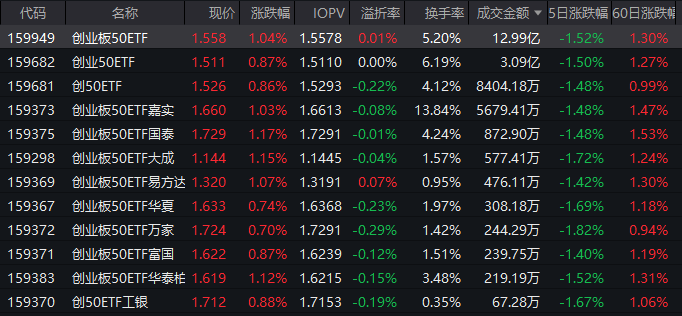
Market Performance - On January 22, the A-share market experienced a morning surge followed by a pullback, with the three major indices closing in the green, and the ChiNext Index rising nearly 1% [1][6] - The ChiNext 50 ETF (159949) increased by 1.04%, closing at 1.558 yuan, with a turnover rate of 5.20% and a transaction volume of 1.299 billion yuan, ranking first among similar ETFs [1][6] Liquidity and Trading Data - As of January 22, the ChiNext 50 ETF (159949) recorded a cumulative transaction amount of 38.006 billion yuan over the last 20 trading days, with an average daily transaction amount of 1.900 billion yuan; since the beginning of the year, the cumulative transaction amount over 14 trading days was 27.332 billion yuan, with an average daily transaction amount of 1.952 billion yuan [2][7] - The circulating scale of the ChiNext 50 ETF was 24.900 billion yuan as of January 21, 2026 [2][7] Fund Holdings and Performance - The latest quarterly report indicates that the top ten holdings of the ChiNext 50 ETF (159949) showed mixed performance, including stocks like CATL, Zhongji Xuchuang, and Mindray Medical [3][8] - The fund manager noted that the fourth quarter saw a return to structural market trends, with significant divergence in the ChiNext, particularly in sectors like AI and new energy [10] Investment Outlook - The ChiNext 50 ETF is viewed as a convenient tool for long-term investors interested in China's technology growth sector, with a three-year return of 35.16%, outperforming its benchmark and ranking 526th among 1,633 similar products [5][11] - Recommendations for investors include adopting a dollar-cost averaging strategy or phased investment to smooth out short-term volatility while closely monitoring the performance of constituent stocks and relevant policy developments [5][11]






AI引爆需求,PCB行业迎来业绩兑现期
Huan Qiu Wang· 2026-01-22 05:44
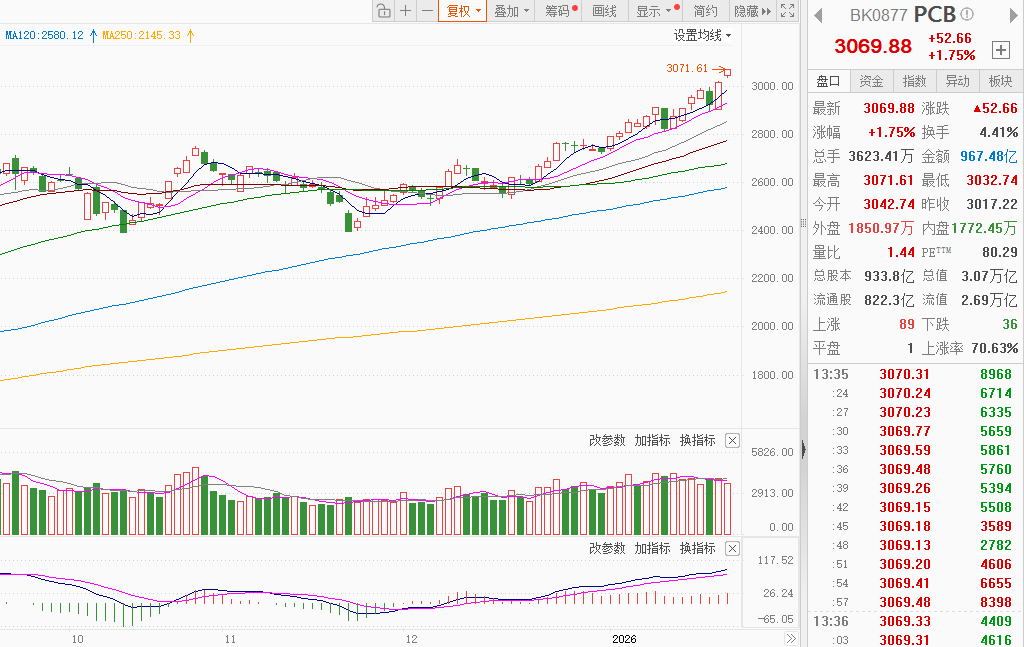
Core Viewpoint - The PCB sector in A-shares is experiencing a strong upward trend driven by the explosive growth of AI applications, with significant performance improvements expected in the industry [1][3]. Group 1: Industry Performance - As of January 21, 2026, the PCB sector index has seen a cumulative increase of over 8% since the beginning of the year, with a daily rise of 3.77% on January 21 [1][4]. - The demand for high-end circuit boards, particularly HDI and high-layer boards, is being driven by the rapid penetration of AI servers and smart driving technologies [3]. - The global PCB market is projected to grow by approximately 5.8% in 2024 and 6.8% in 2025, reaching an estimated value of about $94.661 billion by 2029, with a compound annual growth rate of around 5.2% [3]. Group 2: Financial Performance - As of January 20, 2026, PCB concept stocks have seen a net financing inflow of 1.674 billion yuan, with nine stocks, including Xingsen Technology and Yongda Photonics, having net purchases exceeding 100 million yuan [4]. - Among nearly 50 PCB stocks in A-shares, 37 companies reported year-on-year profit growth or reduced losses in the first three quarters of 2025, indicating a strong recovery in the industry [4]. - Jin'an Guoji expects a net profit of 280 million to 360 million yuan for 2025, representing a year-on-year increase of 655.53% to 871.40%, driven by improved market conditions and optimized product structure [5]. Group 3: Company Developments - Shenghong Technology anticipates a net profit of 4.16 billion to 4.56 billion yuan for 2025, reflecting a year-on-year growth of 260.35% to 295%, supported by large-scale production in AI computing and data center sectors [5]. - Shenzhen South Circuit achieved a net profit of 2.326 billion yuan in the first three quarters of 2025, setting a record for annual net profit since its listing, and is actively expanding production capacity [6]. - The entire PCB supply chain is benefiting, with Inno Laser reporting nearly 90 million yuan in orders for PCB forming equipment since 2025, indicating a prosperous industry landscape [6].

主力资金流入前20:天孚通信流入7.48亿元、中际旭创流入6.77亿元
Jin Rong Jie· 2026-01-22 03:45
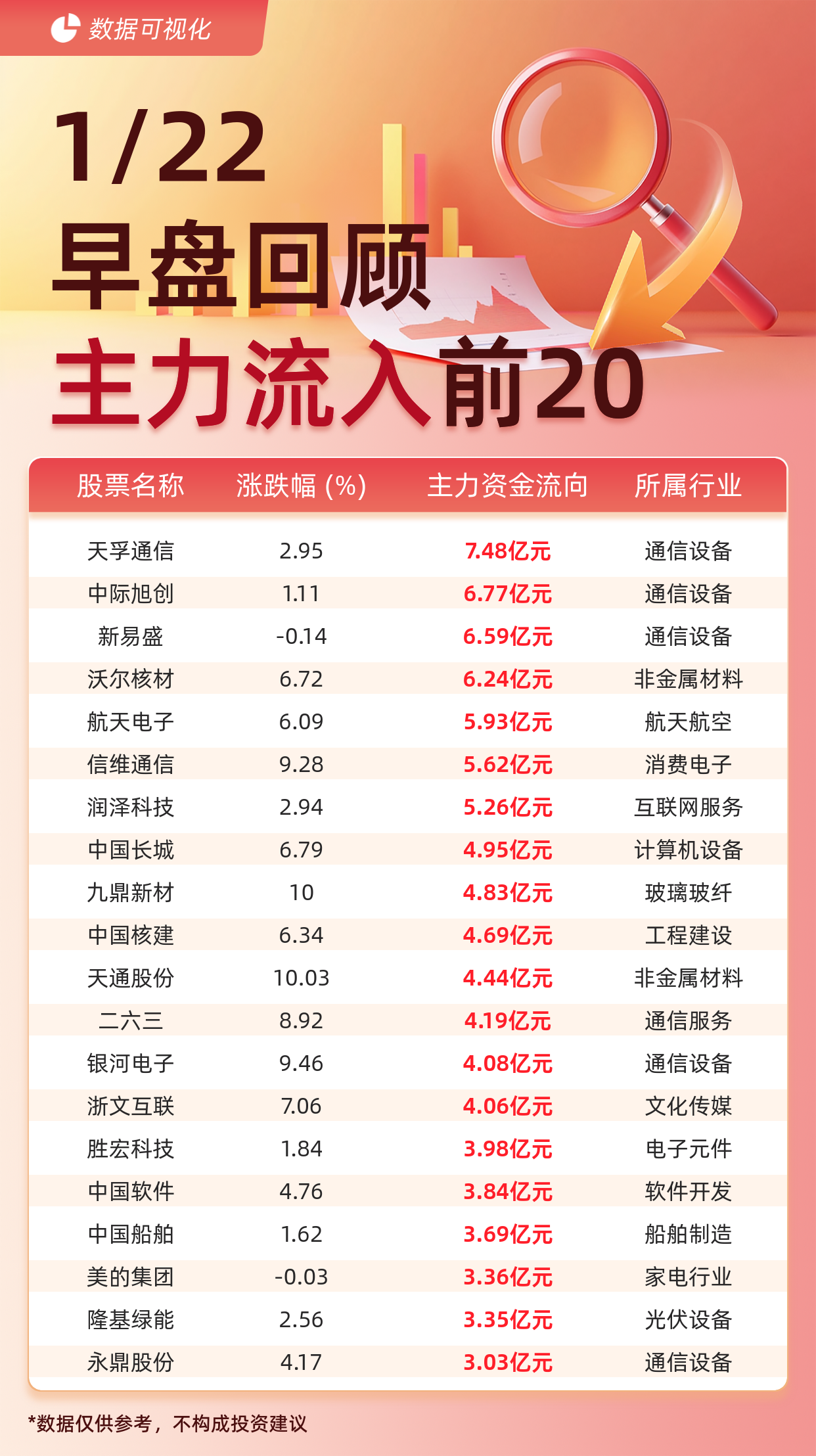
Group 1 - The top 20 stocks with significant capital inflow include Tianfu Communication (748 million), Zhongji Xuchuang (677 million), and Xinyi Sheng (659 million) [1] - The sectors represented among the top inflow stocks include communication equipment, non-metal materials, aerospace, and software development [2][3] - Notable stock performances include Tianfu Communication with a 2.95% increase, Zhongji Xuchuang with a 1.11% increase, and Walden Materials with a 6.72% increase [2][3] Group 2 - The highest capital inflow was observed in Tianfu Communication with 748 million, followed by Zhongji Xuchuang with 677 million and Xinyi Sheng with 659 million [1] - Other significant stocks with capital inflow include Aerospace Electronics (593 million), Xinwei Communication (562 million), and Runze Technology (526 million) [1][2] - The stock with the highest percentage increase is Tiantong Co., Ltd. with a 10.03% rise, followed by Jiu Ding New Materials with a 10% increase [3]


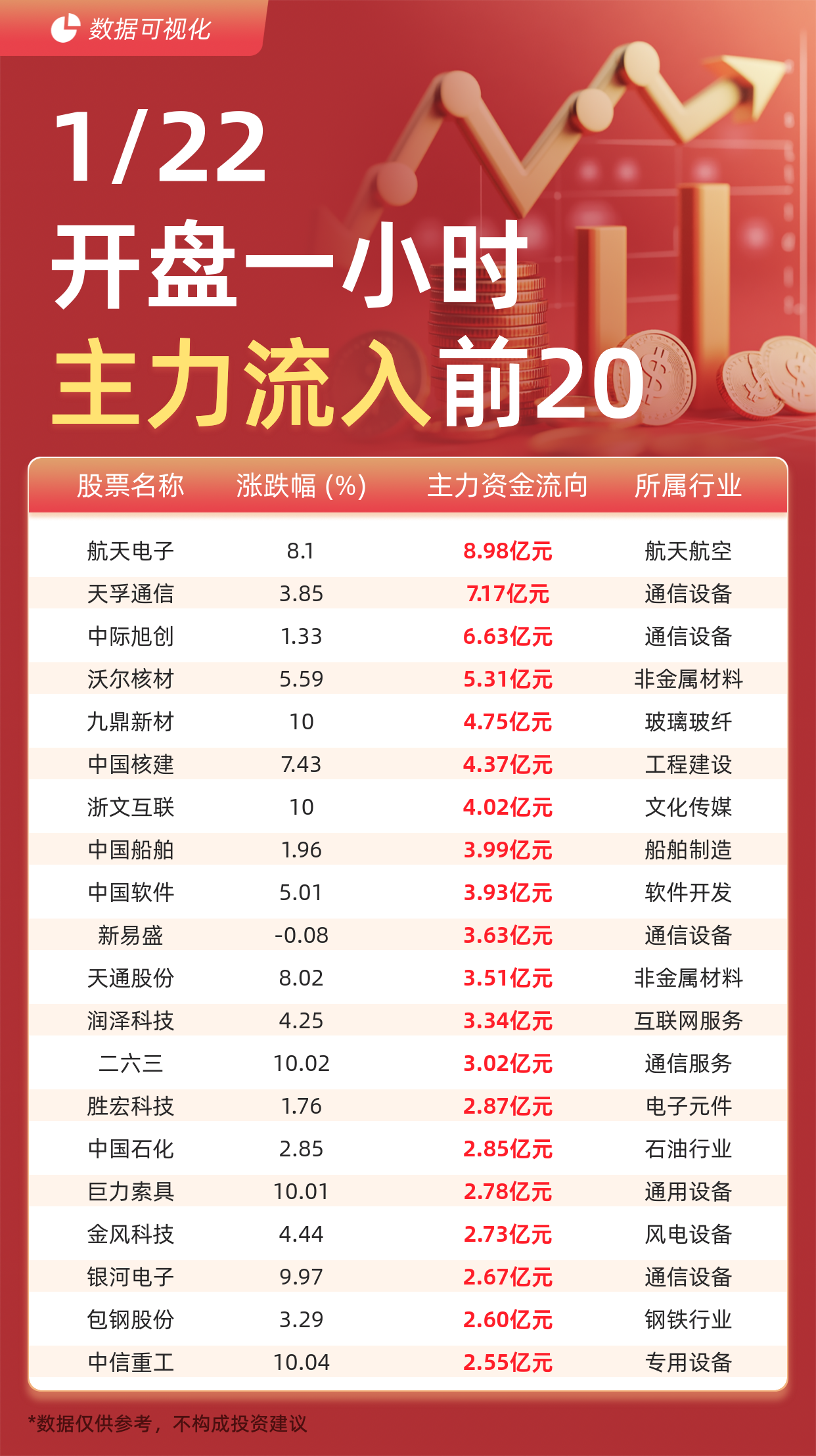
主力资金流入前20:航天电子流入8.98亿元、天孚通信流入7.17亿元
Jin Rong Jie· 2026-01-22 02:43
Group 1 - The top 20 stocks with significant capital inflow include Aerospace Electronics (8.98 billion), Tianfu Communication (7.17 billion), and Zhongji Xuchuang (6.63 billion) [1] - Aerospace Electronics experienced a price increase of 8.1%, while Tianfu Communication and Zhongji Xuchuang saw increases of 3.85% and 1.33% respectively [2] - Other notable stocks with substantial capital inflow include Woer Nuclear Materials (5.31 billion), Jiuding New Materials (4.75 billion), and China Nuclear Engineering (4.37 billion) [1][2] Group 2 - Jiuding New Materials had a significant price increase of 10%, while Zhejiang Wenlian and China Shipbuilding also saw increases of 10% and 1.96% respectively [2][3] - The energy sector is represented by China Petroleum with a capital inflow of 2.85 billion and a price increase of 2.85% [3] - Companies like Jushi Group and Goldwind Technology also showed strong performance with capital inflows of 2.78 billion and 2.73 billion, and price increases of 10.01% and 4.44% respectively [3]


高盛:AI正在引爆PCB大周期
Hua Er Jie Jian Wen· 2026-01-21 13:08
Core Insights - Goldman Sachs indicates that the construction of artificial intelligence infrastructure is driving the PCB (Printed Circuit Board) and CCL (Copper Clad Laminate) industries into a super cycle, fueled by the continuous upgrade of AI server specifications [1] - The report predicts that the global AI server PCB market will grow by 113% year-on-year by 2026 and continue to grow by 117% in 2027, while the AI server CCL market is expected to see even more remarkable growth, with increases of 142% and 222% in 2026 and 2027, respectively [1][3] Group 1: Dual Drivers - The core logic of the Goldman Sachs report is based on two major trends: speed upgrades leading to increased value and scale effects expanding the total addressable market (TAM) [2] - The demand for high-speed connection technologies such as 800G and 1.6T is driven by the significant increase in computing density per rack of AI servers, which directly enhances the dollar value of PCBs and CCLs [2] Group 2: Market Forecast - According to Goldman Sachs' model, the global AI server PCB market is expected to grow from approximately $3.1 billion in 2024 to $27.1 billion in 2027 [3] - The CCL market is projected to surge from $1.5 billion in 2024 to $18.7 billion in 2027, with growth rates for CCL in 2026 and 2027 (142% and 222%) surpassing those of optical modules and AI training servers [3] Group 3: Investment Perspective - Goldman Sachs counters concerns about market growth slowing and increased competition, arguing that rapid technological migration leads customers to rely on technology leaders for product quality and timely delivery [4] - The development and production of the latest generation of AI servers require significant R&D investment and capital expenditure, effectively limiting the number of new entrants and creating a more favorable competitive environment for leading companies [4]


解密主力资金出逃股 连续5日净流出544股



Zheng Quan Shi Bao Wang· 2026-01-21 09:24
Core Viewpoint - As of January 21, a total of 544 stocks in the Shanghai and Shenzhen markets have experienced net outflows of main funds for five consecutive days or more, indicating a significant trend of capital withdrawal from these stocks [1]. Group 1: Stocks with Longest Net Outflow - Qinan Co., Ltd. has the longest net outflow period, with main funds withdrawing for 21 consecutive days [1]. - Kain Technology follows with a net outflow for 18 consecutive days [1]. Group 2: Stocks with Largest Total Net Outflow - Shenghong Technology has the highest total net outflow amounting to 9.277 billion yuan over 11 days [1]. - Aerospace Development ranks second with a total net outflow of 6.928 billion yuan over 10 days [1]. Group 3: Stocks with Highest Net Outflow Proportion - *ST Yanshi has the highest proportion of net outflow relative to trading volume, with a 30% drop in the last 7 days [1]. - Other notable stocks with significant net outflow proportions include China Satellite and China Satcom, with respective proportions of 6.59% and 8.40% [1]. Group 4: Performance of Affected Stocks - Shenghong Technology has seen a cumulative decline of 14.99% during the net outflow period [1]. - Aerospace Development has experienced a cumulative drop of 29.48% [1]. - China Satellite and China Satcom have also faced declines of 17.90% and 26.81%, respectively [1].
“顶流”调仓!傅鹏博、李晓星,加仓这些股票
Zhong Guo Zheng Quan Bao· 2026-01-21 08:51
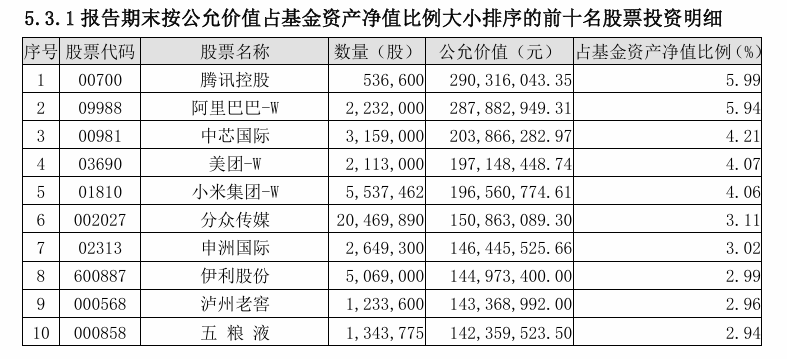
Group 1: Fund Manager Insights - Fund manager Fu Pengbo reduced holdings in companies with weak fundamentals and increased investments in data center liquid cooling, storage, and computing-related companies [1][2] - Fu noted that the annual reports of listed companies for 2025 will be pre-disclosed by the end of January 2026, with high-growth sectors like AI, non-ferrous metals, and lithium battery materials expected to show significant growth [1][3] - Li Xiaoxing increased positions in Hong Kong internet and consumer stocks while reducing holdings in some Hong Kong financial stocks, believing that overall opportunities in the equity market for 2026 outweigh risks [1][4] Group 2: Fund Performance and Adjustments - Fu's fund saw minor changes in its top ten holdings, with Maiwei Co. replacing China Mobile, and increased positions in Han's Laser while reducing stakes in companies like Ningde Times and Tencent [2][3] - Li's fund reported a stock position of 88.55% at the end of Q4 2025, a decrease of 4.54 percentage points from Q3 2025, with new entries in the top ten holdings including Tencent, Alibaba, and Meituan [4][5] Group 3: Market Outlook - Fu and Zhu believe that the stock market's activity is increasing, with a "spring excitement" arriving early, and expect high growth in sectors like AI and semiconductor manufacturing [3][6] - Li highlighted that AI remains the main line of global technological innovation, with significant capital expenditure growth in the AI sector, and domestic internet companies expected to maintain stable growth [6][7] - The consumer sector's performance needs dynamic observation, with many quality consumer stocks showing favorable dividend yields [6][7] Group 4: Sector-Specific Insights - The pharmaceutical sector experienced fluctuations in Q4 2025 due to previously high market expectations and capital flowing to other popular sectors, but long-term prospects for domestic innovative drugs remain positive [7] - The CRO and CDMO segments are showing clear signs of recovery in domestic and international demand, indicating an industry turning point [7]






AI产业链系列报告一:26年算力景气度持续上行,关注互联、液冷、供电板块
Guoxin Securities· 2026-01-21 05:24
Investment Rating - The report maintains an "Outperform" rating for the AI industry [1] Core Insights - The capital expenditure (Capex) guidance from major overseas companies is optimistic, with a continuous upward trend in computing power expected through 2026. The total Capex for Microsoft, Google, Amazon, and Meta is projected to reach $406.5 billion in 2025 and $596.4 billion in 2026, representing year-on-year growth of 46% and 47% respectively [3][5][22] - The demand for AI-related infrastructure is driving significant upgrades in interconnects, cooling, and power supply sectors, indicating a long-term growth cycle distinct from previous technology cycles [3][4] Summary by Sections 1. Overseas Major Companies' Capex Guidance - Major companies like Microsoft, Google, Amazon, and Meta are expected to increase their Capex significantly, with projections of $186.4 billion, $139.5 billion, $162.5 billion, and $108 billion respectively for 2026 [6][7][14][18][21] - The overall Capex for these four companies is expected to account for 62% of the global AI-related Capex, which is projected to reach $960 billion by 2026 [22][23] 2. Interconnect Sector: Optical Modules and PCBs - The interconnect sector is experiencing a fundamental shift in demand due to AI server cluster construction, leading to simultaneous upgrades in computing boards, switches, and optical modules, which will increase both demand and pricing [3][4] - The deployment of 800G technology is expected to accelerate, with 1.6T technology entering the introduction phase [3] 3. Cooling Sector: Liquid Cooling Demand - The power density of AI GPU racks is projected to rise from 130 kW in 2024 to over 1 MW by 2029, making liquid cooling technology essential [3][4] 4. Power Supply Sector: AIDC Power Distribution Evolution - The evolution of AIDC power distribution methods is crucial, with a focus on HVDC and SST technologies to enhance system efficiency and reduce energy losses [3][4] 5. Investment Recommendations - The report suggests focusing on specific companies within various sectors: - Computing power: Haiguang Information - Interconnects - Optical modules: LightSpeed Technology, Huagong Technology - Interconnects - PCBs: Shenghong Technology, Shennan Circuits, and others - Cooling: Invec - Power supply: Magpow [3][4]




睿远基金旗下产品最新重仓股曝光:傅鹏博加仓寒武纪,赵枫买回美的
Sou Hu Cai Jing· 2026-01-21 03:57
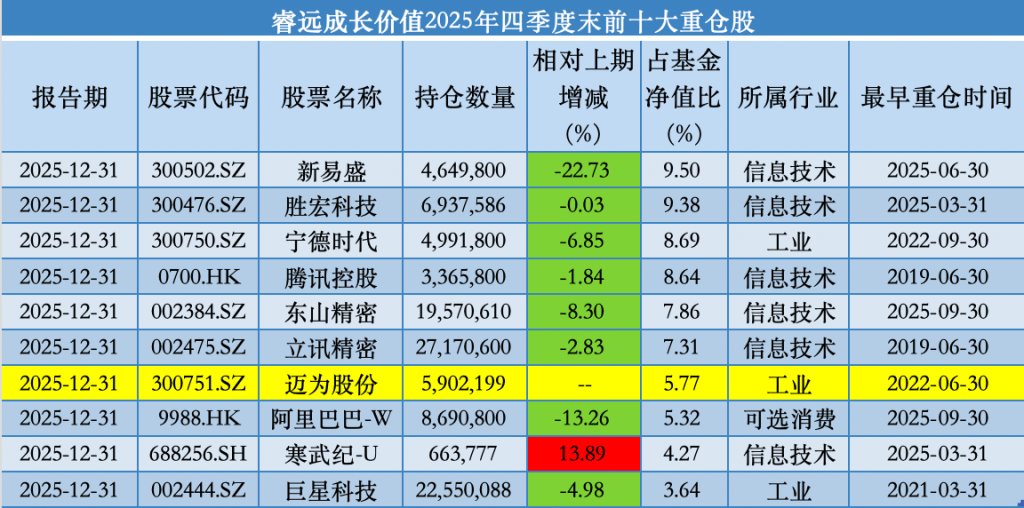
Core Viewpoint - The report highlights significant changes in the investment strategies of Ruiyuan Fund's star fund managers, with notable adjustments in stock holdings and performance metrics for the fourth quarter of 2025. Group 1: Fund Performance and Adjustments - Ruiyuan Growth Value Mixed Fund experienced a net redemption of 136.2 million shares, marking the second-highest redemption in its history, with total net assets decreasing from 23.629 billion yuan to 21.087 billion yuan [3][4] - The fund's stock allocation increased slightly from 89.93% to 90.48%, while the proportion of Hong Kong stocks in the fund's net value decreased from 27.92% to 20.14% [3][4] - Ruiyuan Balanced Value Three-Year Holding Fund's stock allocation reached a three-year high of 90.66%, with a slight increase in the proportion of Hong Kong stocks to 41.99% [10] Group 2: Stock Holdings and Changes - The top ten holdings of Ruiyuan Growth Value Mixed Fund included New Yisheng, Shenghong Technology, and Ningde Times, with New Yisheng seeing a 22.73% reduction in holdings [4][5] - Ruiyuan Balanced Value Three-Year Holding Fund saw significant changes, with the re-entry of Midea Group into the top ten holdings and reductions in holdings of companies like Lixun Precision and China Ping An [10][12] - The fund managers noted a shift in focus towards sectors like photovoltaic and semiconductor high-end equipment manufacturing, while reducing exposure to companies with weak fundamentals [6][10] Group 3: Future Outlook and Strategy - The fund managers expressed optimism about the market, anticipating that the return on equity assets will remain attractive compared to other asset classes, with potential returns exceeding 10% for leading companies [11][13] - They plan to focus on companies with strong fundamentals and competitive advantages, particularly those expanding overseas, as this is expected to drive future growth [13][14] - The report indicates a structural market environment with limited risks of significant downturns, while opportunities for excess returns remain [8][13]





中国 PCB 行业 - 规格升级、单位增长与产能扩张驱动加速;首次覆盖胜宏科技、深南电路、生益科技并给予买入评级-China PCB_ Acceleration mode with spec upgrades, unit growth, and capacity expansion; Initiate Victory Giant, WUS, Shengyi Tech at Buy
2026-01-21 02:58
Summary of Conference Call on China PCB Industry Industry Overview - The conference call focused on the PCB (Printed Circuit Board) and CCL (Copper Clad Laminate) industry in China, particularly in relation to AI infrastructure and its growth potential [1][2]. Key Trends and Insights - **Higher Speed and Capacity Expansion**: The demand for higher speed connections (800G / 1.6T) in AI servers is driving an increase in PCB and CCL dollar content. This is coupled with a significant ramp-up in AI server production, leading to overall growth in the Total Addressable Market (TAM) for PCBs and CCLs [1][2]. - **Revenue Growth**: Revenue growth for companies like Victory Giant, WUS, and Shengyi Tech is projected to increase from an average of +2% in 2022 to +58% YoY in 9M25, driven by the AI infrastructure cycle [2]. - **Future Projections**: The expected Compound Annual Growth Rate (CAGR) for net income (NI) for Victory Giant, WUS, and Shengyi Tech from 2026 to 2028 is forecasted at 57%, 47%, and 50% respectively, with operating profit margins (OPM) expanding to 33%, 26%, and 20% by 2028 [2]. Competitive Landscape - **Market Dynamics**: There is a debate among investors regarding the maturity of the AI infrastructure market, which could lead to slower growth and increased competition. However, the report argues that ongoing specification upgrades and the transition from copper cables to PCBs in AI servers will mitigate competitive intensity [3]. - **Customer Base Expansion**: The shift from GPU AI server clients to ASIC AI server clients is expected to increase, supported by local customer growth and strong commitments from Chinese suppliers to R&D and capacity expansion [2][3]. Financial Highlights - **Valuation and Price Targets**: - Victory Giant is initiated with a Buy rating and a target price (TP) of Rmb550, reflecting a 26.3x 2027E PE ratio and an expected +57% NI YoY growth on average in 2027-28E [36]. - WUS and Shengyi Tech are also rated Buy with target prices of Rmb127 and Rmb111 respectively, indicating strong growth potential [8]. - **Risks**: Key downside risks include slower-than-expected AI server ramp-up, increased competition, and delays in new capacity expansion [8]. Operational Efficiency - **R&D and Automation**: The companies are heavily investing in R&D and automation, which is expected to enhance yield rates, operational efficiency, and fast delivery times [37][40]. - **Financial Metrics**: The report anticipates a gross margin increase from 36% in 2025E to 42% in 2030E, driven by a product mix upgrade towards AI server PCBs [41]. Conclusion - The China PCB and CCL industry is poised for significant growth driven by the AI infrastructure boom, with key players like Victory Giant, WUS, and Shengyi Tech expected to benefit from rising demand, specification upgrades, and operational efficiencies. The overall sentiment is positive, with strong revenue and profit growth projections despite potential competitive challenges.
