
EOPTOLINK(300502)

Search documents
新易盛股价连续3天下跌累计跌幅8.61%,汇丰晋信基金旗下1只基金持15.23万股,浮亏损失467.77万元
Xin Lang Cai Jing· 2025-11-11 07:19
Core Viewpoint - New Yisheng's stock price has been declining for three consecutive days, with a total drop of 8.61% during this period, indicating potential concerns among investors regarding the company's performance and market conditions [1][2]. Group 1: Company Overview - Chengdu New Yisheng Communication Technology Co., Ltd. was established on April 15, 2008, and went public on March 3, 2016 [1]. - The company specializes in the research, development, production, and sales of optical modules, with 98.86% of its main business revenue coming from products above 25G [1]. Group 2: Stock Performance - As of the latest report, New Yisheng's stock price is 326.00 CNY per share, with a trading volume of 12.583 billion CNY and a turnover rate of 4.25%, resulting in a total market capitalization of 324.035 billion CNY [1]. - The stock has experienced a decline of 2.98% on November 11, contributing to a cumulative loss over the past three days [1]. Group 3: Fund Holdings - HSBC Jintrust Fund has a significant holding in New Yisheng, with its "HSBC Jintrust Technology Pioneer Stock" fund reducing its stake by 10,080 shares in the third quarter, now holding 152,300 shares, which represents 9.62% of the fund's net value [2]. - The fund has incurred a floating loss of approximately 1.5232 million CNY today and a total floating loss of 4.6777 million CNY during the three-day decline [2]. Group 4: Fund Performance - The "HSBC Jintrust Technology Pioneer Stock" fund was established on July 27, 2011, with a current size of 579 million CNY and has achieved a year-to-date return of 75.48%, ranking 105 out of 4,216 in its category [2]. - Over the past year, the fund has returned 59.99%, ranking 123 out of 3,922, and since inception, it has delivered a return of 230.92% [2].

新易盛股价连续3天下跌累计跌幅8.61%,东方基金旗下1只基金持8680股,浮亏损失26.66万元
Xin Lang Cai Jing· 2025-11-11 07:18
Core Points - New Yisheng's stock price has declined by 2.98% to 326.00 CNY per share, with a total market capitalization of 3240.35 billion CNY, marking a cumulative drop of 8.61% over the past three days [1] - The company specializes in the research, production, and sales of optical modules, with 98.86% of its main business revenue coming from products above 25G [1] Group 1 - New Yisheng's stock has experienced a trading volume of 125.83 billion CNY and a turnover rate of 4.25% [1] - The company was established on April 15, 2008, and went public on March 3, 2016 [1] - The revenue breakdown indicates that products below 25G contribute only 0.87%, while other products account for 0.26% [1] Group 2 - One of the top ten holdings in the fund is New Yisheng, with the Dongfang New Strategy Flexible Allocation Mixed A fund holding 8,680 shares, representing 1.22% of the fund's net value [2] - The fund has incurred a floating loss of approximately 8.68 thousand CNY today and a total of 26.66 thousand CNY over the three-day decline [2] - The fund manager, Wang Fangling, has been in charge for 3 years and 313 days, with the fund's total asset size at 3.87 billion CNY [2]
华夏创成长ETF(159967)投资价值分析:动量+成长双因子驱动,把握趋势行情进攻属性
金融街证券· 2025-11-11 07:18
Report Industry Investment Rating No relevant content provided. Core Viewpoints of the Report - In a unilateral rising market, the momentum factor can amplify returns by concentrating on strong-performing stocks, resulting in significant excess returns. When combined with the growth factor, it can capture trends while adding a fundamental safety net to the investment portfolio, making it suitable for medium-risk preference investors. The "growth + momentum" dual-factor investment logic is systematically implemented in the ChiNext Momentum Growth Index and its linked product, the Huaxia ChiNext Growth ETF [1][11]. Summary According to the Directory Product Fund - Huaxia ChiNext Growth ETF (159967) - **Investment Attributes and Returns**: The Huaxia ChiNext Growth ETF closely tracks the ChiNext Momentum Growth Index, serving as a passive investment tool for high-growth and strong-momentum portfolios on the ChiNext board. Since its establishment in June 2019, it has achieved a cumulative return of 113.97%, significantly outperforming broad-based indices such as the CSI 300. In the rising market since May 2025, it has shown outstanding performance with a six-month return of 46.51%, demonstrating its offensive nature in a bull market. However, it has high volatility, with a three-year return of 1.10% significantly trailing the CSI 300's 22.70% [2][11][14]. - **Fund Manager and Fund Company**: The fund is managed by Rong Ying, who manages 21 funds with a total scale of approximately 138.292 billion yuan. As of October 22, 2025, the Huaxia ChiNext Growth ETF has a scale of 30.39 billion yuan. Huaxia Fund, the fund manager, has a total public fund management scale of 2041.571 billion yuan as of October 22, 2025, with 114 ETFs worth 896.351 billion yuan and 13 money market funds worth 774.607 billion yuan, consolidating its leading position in public offering index investment [15][19]. Tracking Index - ChiNext Momentum Growth Index (399296.SZ) - **Index Composition and Calculation**: The index is compiled by Guozheng Index Company, selecting 50 listed company securities with good growth ability and obvious momentum effects from the ChiNext board. It uses a Paasche weighting method with a single stock weight cap of 15% and adjusts samples and weights quarterly. The sample selection involves screening stocks based on liquidity and then using growth and momentum factors to calculate scores and determine the final 50 stocks [20][21][27]. - **Performance and Returns**: Since its release in 2019, the index has achieved a cumulative return of 157.46%, significantly higher than mainstream broad-based indices. In 2020, it had a return of 97.14%, showing high growth elasticity. In the period from May 1 to October 22, 2025, it had a cumulative return of 40.24%, also outperforming major broad-based indices [4][31][35]. - **Weighted Stocks and Industry Distribution**: The top ten component stocks account for 76.63% of the total weight, with high concentration in the technology growth sector. The top four industries (communications, power equipment, electronics, and non-bank finance) account for nearly 80% of the total weight, highlighting the index's focus on the technology growth sector [3][37][52]. - **Valuation and Earnings**: As of October 22, 2025, the index's PE TTM is 40.83 times, slightly lower than the historical median of 44.73 times, indicating a reasonable valuation. From 2019 to 2024, the index's component stocks showed strong growth in revenue and net profit, and it is expected to maintain double-digit growth from 2025 to 2026 [61][64]. - **Sources of High Growth and Excess Returns**: The index's high growth elasticity and excess returns stem from its precise sample screening, factor tilt weighting, high-growth and high-elasticity asset characteristics, and regular dynamic adjustments [71]. Sample Space - ChiNext Composite Index - **Market Value and Industry Structure**: The index shows a pattern where small-cap stocks dominate in number and large-cap stocks dominate in weight. The industry structure has been evolving towards power equipment, electronics, and communications, with the power equipment industry's weight increasing from 13.89% in 2020 to 23.46% in 2025, and the communications industry's weight rising from 2.90% to 9.69% [76][78]. - **Growth and Profitability**: The index has shown strong growth momentum in revenue, with its growth rate consistently higher than that of major market indices from 2020 to 2024. Its average net profit growth rate from 2020 to 2024 was 11.73%, significantly higher than that of mainstream broad-based indices. The average ROE in the past five years was 6.86%, indicating relatively good profitability [79][81][83]. - **Industry Focus and New Productivity Layout**: The index's industry structure focuses on technology growth, with a low financial sector weight and high weights in emerging technology fields such as communications and computers, reflecting the trend of new productivity development and industrial upgrading [88].


新易盛日内成交额超100亿元
Mei Ri Jing Ji Xin Wen· 2025-11-11 05:47
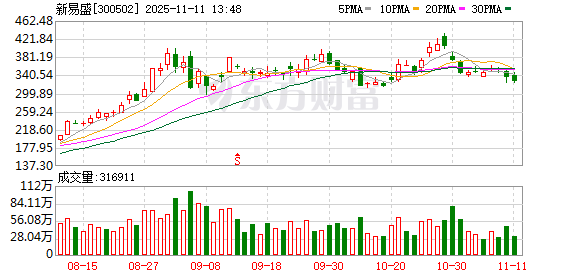
Group 1 - The core point of the article is that New Yi Sheng's intraday trading volume exceeded 10 billion yuan, but the stock price has decreased by 2.68% [2]

创业板人工智能概念股走低,相关ETF跌约3%
Sou Hu Cai Jing· 2025-11-11 05:44
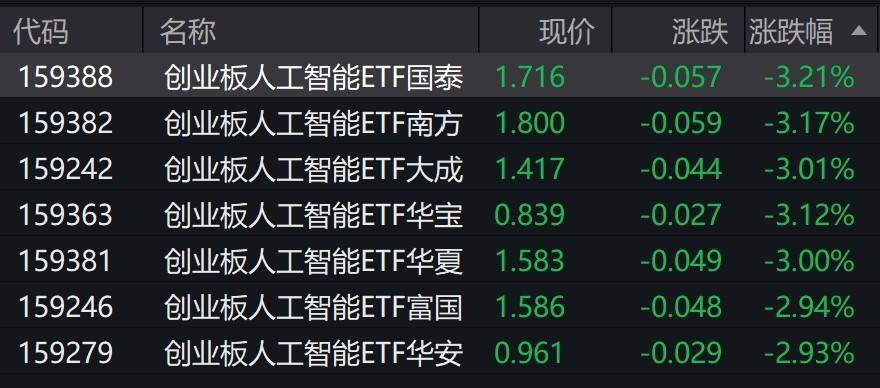
Group 1 - The core viewpoint indicates a decline in the AI concept stocks on the ChiNext board, with Tianfu Communication dropping over 8%, Zhongji Xuchuang falling over 4%, and Xinyi Sheng decreasing over 3% [1] - The ChiNext AI-related ETFs experienced a decline of approximately 3% [1] - Specific ETF performance includes: Guotai ETF down 3.21% to 1.716, Nanfang ETF down 3.17% to 1.800, and Dacheng ETF down 3.01% to 1.417 [2] Group 2 - Analysts suggest that the AI application ecosystem is becoming increasingly complete, with rapid penetration of large model technology in vertical fields such as finance, healthcare, and education, exceeding market expectations [2] - With increased policy support and accelerated domestic computing power construction, leading companies in the AI industry chain are expected to continue benefiting [2]


新易盛成交额达100亿元,现跌2.98%。
Xin Lang Cai Jing· 2025-11-11 05:29
Group 1 - The company achieved a transaction volume of 10 billion yuan [1] - The stock price has decreased by 2.98% [1]
A股午评:创业板指跌0.74%,光伏板块逆势上扬
2 1 Shi Ji Jing Ji Bao Dao· 2025-11-11 04:00
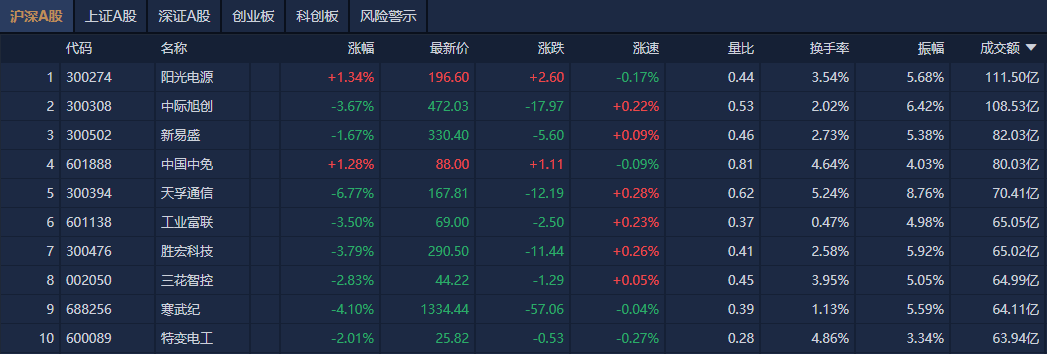
Market Overview - The market experienced fluctuations in the early session, with the three major indices opening high but closing lower, particularly the ChiNext index which fell over 1% [1] - By the end of the morning session, the Shanghai Composite Index decreased by 0.38%, the Shenzhen Component Index fell by 0.52%, and the ChiNext Index dropped by 0.74% [1] Sector Performance - The photovoltaic sector saw a collective surge, with stocks like GCL-Poly Energy and Trina Solar hitting the daily limit [1] - The lithium battery sector strengthened again, with Yongtai Technology achieving two limit-ups in three days [1] - The superhard materials sector experienced rapid gains, with Sifangda and Huanghe Whirlwind both reaching the daily limit [1] - The food and beverage sector showed localized activity, with Sanyuan Foods achieving two consecutive limit-ups [1] Declines - The coal sector faced significant declines, with Antai Group experiencing a sharp drop [2] Trading Volume - The total trading volume in the Shanghai and Shenzhen markets reached 1.26 trillion yuan, a decrease of 184.6 billion yuan compared to the previous trading day [3] Individual Stock Highlights - Sunshine Power led in trading volume with over 11.1 billion yuan, followed by Zhongji Xuchuang, Xinyisheng, and China Duty Free [4]


两部门分类引导新能源消纳,创业50ETF(159682)盘中涨近1%,亿纬锂能等储能股走高
2 1 Shi Ji Jing Ji Bao Dao· 2025-11-11 02:20
Group 1 - The Chuangye 50 ETF (159682) experienced a mid-session increase of 0.82% with a trading volume exceeding 57 million yuan, driven by gains in component stocks such as Jiangbolong, Sungrow Power Supply, Jinlang Technology, Yiwei Lithium Energy, and CATL [1] - On November 10, the Chuangye 50 ETF recorded a decline but attracted 99.05 million yuan in capital inflow, indicating strong investor interest despite market fluctuations [1] - The ETF tracks the Chuangye 50 Index, which includes sectors such as manufacturing, information transmission, software, and technology services, with key weighted stocks including CATL, Dongfang Wealth, and others [1] Group 2 - Dongwu Securities forecasts a gradual introduction of domestic capacity compensation electricity prices and continuous growth in overseas emerging markets, predicting a 40%-50% increase in global energy storage installations next year and a compound growth rate of 30%-50% over the next three years [2] - The company maintains a positive outlook on large-scale energy storage, integrated storage solutions, and leading energy storage battery manufacturers [2] Group 3 - The National Development and Reform Commission and the National Energy Administration released guidelines to promote the consumption and regulation of new energy, focusing on large-scale development and high-quality consumption, with the aim of building a new power system compatible with high proportions of new energy [1] - Experts emphasize the importance of guiding various types of new energy development and enhancing the adaptability of the new power system, which will be crucial for large state-owned enterprises in the power generation, grid, and equipment manufacturing sectors [1]




科技3Q25总结:关注AI算力链及运营商
HTSC· 2025-11-11 01:55
Investment Rating - The report maintains an "Overweight" rating for the communication sector and communication equipment manufacturing [6]. Core Insights - The communication industry showed a steady growth in 3Q25, with total revenue and net profit attributable to shareholders increasing by 5.2% and 12.3% year-on-year, respectively [9]. - The growth is driven by the AI computing demand, particularly benefiting the optical communication and copper connection sectors, while telecom operators are expected to maintain stable growth [9][20]. - The report highlights the potential for high growth in net profit for the optical communication sector due to increased investments in AI computing capabilities [9][20]. Summary by Sections Telecom Operators - The three major telecom operators reported a revenue and net profit growth of 1.1% and 2.1% year-on-year, respectively, with net profit growth outpacing revenue growth [2][20]. - Traditional business revenue growth has slowed, but emerging AI applications are expected to drive growth in cloud computing and data center services [2][20]. - The operators' return on equity (ROE) continues to improve due to reduced capital expenditures and enhanced operational efficiency [2][25]. Optical Communication - The optical module and optical device sectors experienced significant growth, with total revenue and net profit increasing by 51% and 123% year-on-year, respectively [3][33]. - Key players like Zhongji Xuchuang benefited from sustained demand for 800G optical modules and the ramp-up of 1.6T products [3][33]. - Future demand for optical devices is expected to recover as the market for 800G and 1.6T optical modules expands [3][33]. Copper Connection - The copper connection sector saw a revenue and net profit increase of 26% and 72% year-on-year, respectively [4][63]. - Companies like Huafeng Technology are expected to benefit from the release of domestic super node projects, despite some short-term fluctuations in profit due to client pricing adjustments [4][63]. - The sector's growth is supported by the introduction of new AI-related products and the anticipated demand from super node deployments [4][63]. IDC (Internet Data Center) - The IDC sector reported a revenue decline of 1.6% but a net profit increase of 236% year-on-year, driven by successful public REITs projects [37]. - AI demand is expected to enhance the industry's growth prospects, although short-term challenges remain due to AI chip supply constraints [37][42]. - The report anticipates that as domestic AI chip production increases, the supply issues will gradually resolve, leading to improved performance in the IDC sector [37][42]. General Trends - The overall communication industry is benefiting from AI computing investments, with various segments such as optical modules, copper connections, and IDC showing promising growth trajectories [9][20][37]. - The report emphasizes the importance of adapting to the evolving landscape driven by AI and cloud computing, which is reshaping demand across the communication sector [9][20].




488股获融资买入超亿元,阳光电源获买入29.04亿元居首
Di Yi Cai Jing· 2025-11-11 01:16
Group 1 - On November 10, 2023, a total of 3,741 A-shares received financing funds for purchase, with 488 stocks having purchase amounts exceeding 100 million yuan [1] - The top three stocks by financing purchase amount were Yangguang Electric Power, Zhongji Xuchuang, and Xinyisheng, with amounts of 2.904 billion yuan, 2.436 billion yuan, and 2.413 billion yuan respectively [1] - Three stocks had financing purchase amounts accounting for over 30% of the total transaction amount, with Shisheng Intelligent, Ruilian New Materials, and Haocen Software leading at 39.87%, 37.79%, and 32.22% respectively [1] Group 2 - There were 46 stocks with net financing purchases exceeding 100 million yuan, with the top three being Tianfu Communication, Cambridge Technology, and China West Electric, which had net purchases of 440 million yuan, 424 million yuan, and 409 million yuan respectively [1]

