EOPTOLINK(300502)

Search documents
科技行业周报(第四十五周):通信3Q持仓高增,AI算力获加仓-20251110
HTSC· 2025-11-10 11:58
Investment Rating - The communication industry is rated as "Overweight" [10] - The communication equipment manufacturing sector is also rated as "Overweight" [10] Core Insights - The communication sector saw a significant increase in holdings, with the top ten funds holding 7.26% of the communication sector, up 3.58 percentage points from the previous quarter, marking the highest quarterly holding ratio since 2019 [2][3] - The sector's overweight ratio increased to 3.36%, up 2.90 percentage points from the previous quarter [3][14] - Key areas of investment include optical modules, liquid cooling, optical chips, and optical fiber cables, while operators, data centers, and Beidou systems saw reduced holdings [3][14] - The TTM price-to-earnings ratio for the communication sector as of November 7, 2025, is 43.62x, which is at the 69.3% historical percentile since early 2011 [3][14] Summary by Sections Market Performance - The communication index rose by 0.92% last week, while the Shanghai Composite Index increased by 1.08% and the Shenzhen Component Index by 0.19% [2][13] Fund Holdings - In Q3 2025, public funds increased their holdings in the communication sector, with significant increases in companies like Zhongji Xuchuang, Xinyi Sheng, Tianfu Communication, Yingweike, and Yuanjie Technology, with total market value increases of 82.43 billion, 78.93 billion, 9.29 billion, 4.06 billion, and 3.79 billion respectively [3][25] - The top five companies by increase in holdings during Q3 2025 saw stock price increases of 176.8%, 188.0%, 110.8%, 169.2%, and 120.3% respectively [25][26] Key Companies and Recommendations - Recommended companies include Xinyi Sheng, Zhongxing Communication, Ruijie Network, China Mobile, China Telecom, China Unicom, and Hengtong Optoelectronics, all rated as "Buy" [10][58] - The report highlights the potential for AI computing chain investments, particularly in optical modules and related technologies [2][3] Valuation and Future Outlook - The report anticipates continued growth in the AI computing sector, with companies like Xinyi Sheng expected to benefit significantly from the demand for high-speed products [59][62] - Adjustments to profit forecasts for companies like Zhongxing Communication and Ruijie Network reflect a cautious outlook due to market conditions, but long-term growth potential remains [59][62]





主力资金丨尾盘10股获资金爆买!
Zheng Quan Shi Bao Wang· 2025-11-10 11:06
Core Insights - The main point of the articles is the analysis of capital flow in various industries, highlighting the sectors that experienced significant inflows and outflows of funds on November 10, 2023. Group 1: Industry Performance - A total of 23 industries saw an increase, with the beauty care and food & beverage sectors leading with gains exceeding 3% [1] - Among the 8 declining industries, the power equipment sector had the largest drop at 1.09% [1] - The food & beverage and retail sectors received the highest net inflows, each exceeding 1.1 billion [1] Group 2: Capital Inflows - Ten industries experienced net inflows, with food & beverage and retail sectors leading with inflows over 1.1 billion each [1] - The real estate sector saw a net inflow of 700 million, while light industry manufacturing and pharmaceutical sectors each had inflows exceeding 400 million [1] Group 3: Capital Outflows - The power equipment sector had the highest net outflow, amounting to 6.88 billion [2] - Other sectors with significant outflows included electronics, mechanical equipment, automotive, and computer industries, each exceeding 2 billion [2] Group 4: Individual Stock Performance - Notable stocks with significant net inflows included Cambridge Technology with 758 million, marking the highest inflow since June 12, 2023 [4] - Wuliangye, a leading liquor company, saw a net inflow of 652 million, emphasizing its commitment to shareholder returns with a projected cash dividend rate of 70% for 2024 [4] - Other companies with notable inflows included BYD, Fushikong, and China Duty Free, among others [5] Group 5: End-of-Day Capital Flow - At the end of the trading day, there was a net inflow of 1.165 billion across the markets, with the ChiNext board contributing 928 million [10] - Individual stocks with significant end-of-day inflows included Tianfu Communication with 316 million [11]





“新三样”股价涨幅不俗,三季报业绩表现突出
Di Yi Cai Jing· 2025-11-10 10:04
Core Insights - The "New Three Samples" sectors, including electric power equipment, communication, and new energy, have shown significant stock price performance and robust financial results in 2023, reflecting a profound transformation in the Chinese economy [1][2][4]. Electric Power Equipment Sector - The electric power equipment industry in the Shenzhen market achieved a total revenue of 1.32 trillion yuan, a year-on-year increase of 10%, and a net profit of 946.09 billion yuan, up 29.53% [2]. - The average stock price increase for electric power equipment companies was nearly 51%, with 90% of companies experiencing positive growth, and 26 companies seeing their stock prices more than double [4][5]. Communication Sector - The communication sector reported a total revenue of 292.38 billion yuan, a year-on-year growth of 14.34%, and a net profit of 308.09 billion yuan, up 36.65% [2]. - Key players like NewEase (300502.SZ) and Guangxun Technology (002281.SZ) demonstrated substantial growth, with NewEase's revenue increasing by 221.70% and net profit by 284.37% [6][7]. New Energy Sector - The new energy sector generated a total revenue of 1.06 trillion yuan, reflecting a year-on-year increase of 10.56%, and a net profit of 787.05 billion yuan, up 31.87% [3]. - Notable growth was observed in specific segments, with battery, photovoltaic equipment, and wind power equipment net profits increasing by 30.60%, 16.89%, and 82.56% respectively [3]. Leading Companies - Leading companies in the electric power equipment sector, such as Siyuan Electric (002028.SZ), reported a revenue of 138.27 billion yuan, up 32.86%, and a net profit of 21.91 billion yuan, up 46.94% [5]. - In the new energy sector, CATL (300750.SZ) achieved a revenue of 283.07 billion yuan, a 9.28% increase, and a net profit of 490.34 billion yuan, up 36.20% [6][7].


数据复盘丨免税、磷化工等概念走强 88股获主力资金净流入超1亿元
Zheng Quan Shi Bao Wang· 2025-11-10 09:57
Market Overview - The Shanghai Composite Index closed at 4018.60 points, up 0.53%, with a trading volume of 960.6 billion yuan [1] - The Shenzhen Component Index closed at 13427.61 points, up 0.18%, with a trading volume of 1213.865 billion yuan [1] - The ChiNext Index closed at 3178.83 points, down 0.92%, with a trading volume of 523.234 billion yuan [1] - The total trading volume of both markets reached 2174.465 billion yuan, an increase of 175.398 billion yuan compared to the previous trading day [1] Sector Performance - Strong sectors included beauty care, food and beverage, retail, agriculture, precious metals, oil and petrochemicals, insurance, and textiles [2] - Active concepts included duty-free, phosphorus chemicals, diamond cultivation, dairy, community group buying, liquor, nano-silver, organic silicon, and prepared dishes [2] - Weak sectors included electric equipment, machinery, electronics, communications, automotive, and steel [2] Stock Performance - A total of 3249 stocks rose, while 1812 stocks fell, with 98 stocks remaining flat and 8 stocks suspended [2] - 92 stocks hit the daily limit up, while 15 stocks hit the daily limit down [2] Fund Flow - The net outflow of main funds in the Shanghai and Shenzhen markets was 25.429 billion yuan, with the ChiNext experiencing a net outflow of 14.756 billion yuan [5] - The food and beverage sector saw the highest net inflow of main funds, amounting to 1.563 billion yuan [5] - The electric equipment sector had the largest net outflow, totaling 6.88 billion yuan [5] Individual Stock Highlights - 2106 stocks experienced net inflows, with 88 stocks receiving over 1 billion yuan in net inflows [8] - Cambridge Technology had the highest net inflow of 758 million yuan, followed by Wuliangye and BYD [9] - 3052 stocks faced net outflows, with 128 stocks seeing over 1 billion yuan in net outflows [11] - The stock with the highest net outflow was Xinyi Sheng, with an outflow of 1.816 billion yuan [12] Institutional Activity - Institutions had a net buy of 10 stocks, with Wanrun Technology leading at approximately 131.24 million yuan [14] - The total net sell by institutions was about 697 million yuan, with Xinquan shares experiencing the highest net sell of approximately 333.3 million yuan [14]


创业板前三季度营收净利均两位数增长,创业50ETF(159682)盘中交投活跃、成交额超2亿元,机构:看好科技成长景气主线
2 1 Shi Ji Jing Ji Bao Dao· 2025-11-10 05:12
Core Viewpoint - The ChiNext 50 ETF (159682) has experienced a decline of over 2% as of the morning close on November 10, with a trading volume exceeding 200 million yuan, indicating significant market activity [1] Group 1: ETF Performance - The ChiNext 50 ETF tracks the ChiNext 50 Index, with industry allocations including manufacturing, information transmission, software, and technology services [1] - Key weighted stocks in the index include CATL, Dongfang Wealth, Xinyisheng, Zhongji Xuchuang, Shenghong Technology, Huichuan Technology, Sunshine Power, and Tianfu Communication [1] - The ETF also includes off-market connecting funds: Connect A (017949) and Connect C (017950) [1] Group 2: Earnings Reports - As of October 31, 2023, 1,388 companies listed on the ChiNext have reported a total revenue of 3.25 trillion yuan for the first three quarters, reflecting a year-on-year growth of 10.69% [1] - The net profit for these companies reached 244.66 billion yuan, with a year-on-year increase of 18.69%, indicating an acceleration in growth compared to the first half of the year [1] Group 3: Market Outlook - According to Industrial Securities, positive factors from the quarterly reports are expected to catalyze a favorable outlook for the technology growth sector [1] - The market's risk appetite is anticipated to rise as the most significant overseas disturbances may be subsiding, coinciding with a phase of positive catalysts from domestic quarterly report validations [1] - Expectations of a potential interest rate cut by the Federal Reserve may further strengthen this trend [1]





三大指数集体回调,沪深300ETF博时(515130)盘中成交额已超1000万元
Sou Hu Cai Jing· 2025-11-10 03:28
Core Viewpoint - The A-share market is experiencing volatility, but overall corporate earnings are in a recovery phase, with a positive medium-term outlook supported by stable economic and policy expectations [2][3]. Market Performance - As of November 10, 2025, the CSI 300 Index decreased by 0.24%, with notable stock movements including China Duty Free leading with a 10.00% increase and Sanhua Intelligent Control dropping by 7.02% [2]. - The CSI 300 ETF by Bosera fell by 0.33%, with a recent price of 1.52 yuan, while it saw a cumulative increase of 0.73% over the past week as of November 7 [2]. Investment Strategy - Analysts suggest focusing on sectors with independent growth logic and improving return on equity (ROE), rather than avoiding AI narratives entirely [3]. - The current market style is expected to be more balanced compared to the third quarter, with recommendations to invest in technology growth and high-end manufacturing sectors, as well as cyclical sectors benefiting from domestic demand recovery [3]. Sector Analysis - The TMT sector, along with materials and chemicals, is significantly influenced by AI narratives, with these sectors comprising over 60% of institutional holdings [3]. - The top ten weighted stocks in the CSI 300 Index as of October 31, 2025, include Ningde Times and Kweichow Moutai, accounting for 21.76% of the index [4].



光模块CPO概念早盘重挫,科创创业50ETF(159783)跌近2.5%,新易盛领跌
Mei Ri Jing Ji Xin Wen· 2025-11-10 03:03
Core Viewpoint - The A-share market showed mixed performance with the ChiNext index experiencing a decline of over 1.5%, while sectors such as beauty care, retail, and food and beverage saw gains. The report highlights the ongoing volatility in the market and emphasizes the investment opportunities within the computing power industry chain, particularly in AI-related sectors [1]. Market Performance - On November 10, the three major A-share indices exhibited varied movements, with the ChiNext index dropping more than 1.5% [1]. - The communication and electronics sectors led the decline, while beauty care, retail, and food and beverage sectors were among the top gainers [1]. - The mainstream ETF, Kexin Chuangye 50 ETF (159783), fell nearly 2.5%, with significant declines in holdings such as Xinyisheng, Shenghong Technology, and others [1]. Industry Insights - Tianfeng Securities maintains a positive outlook on the investment opportunities within the core targets of the computing power industry chain, citing high demand for AI-related services reflected in overseas company earnings reports [1]. - The report indicates that the domestic computing power sector is expected to grow, driven by continued investments from major companies like Alibaba and ByteDance in AI [1]. - The overall sentiment suggests that 2025 may mark a pivotal year for domestic AI infrastructure competition and application development [1]. Investment Recommendations - Continuous monitoring of AI industry dynamics and investment opportunities related to AI applications is advised, as both China and the U.S. are making significant advancements in AI technologies [1].
光模块CPO蓄力回调,创业板人工智能ETF华夏、5G通信ETF获得资金密集加仓
Mei Ri Jing Ji Xin Wen· 2025-11-10 02:57
Core Viewpoint - A-shares experienced a volatile trading session with major indices opening high but subsequently retreating, while sectors like lithium batteries and AI computing saw increased activity, indicating a potential spring market rally driven by growth-oriented technology sectors [1] Market Performance - Major A-share indices opened high but faced a pullback, with sectors such as lithium batteries and AI computing showing activity, while previously strong sectors like optical modules and robotics led the decline [1] - Notable stocks such as New Yisheng, Industrial Fulian, and Jingwang Electronics fell over 3% [1] - The 5G Communication ETF (515050) dropped nearly 3%, and the ChiNext AI ETF (159381) fell over 2% [1] Fund Flows - The AI computing sector has seen a consolidation phase, with significant capital inflows; in the last 10 trading days, the 5G Communication ETF (515050) attracted a net subscription of 450 million yuan, while the ChiNext AI ETF (159381) accumulated 250 million yuan [1] Future Outlook - Institutions are optimistic about the upcoming spring market, particularly for high-growth technology sectors [1] - Dongwu Securities predicts that the spring market will primarily focus on growth-oriented industrial trends, particularly those represented by AI [1] - The global technology industry is expected to experience a trend-driven growth, supported by China's unique advantages such as a large user base and manufacturing capabilities, which will facilitate deeper participation in global tech transformations [1] - The long-term logic of industrial development remains unchanged, with core global industry segments expected to build momentum for future growth after recent adjustments [1]



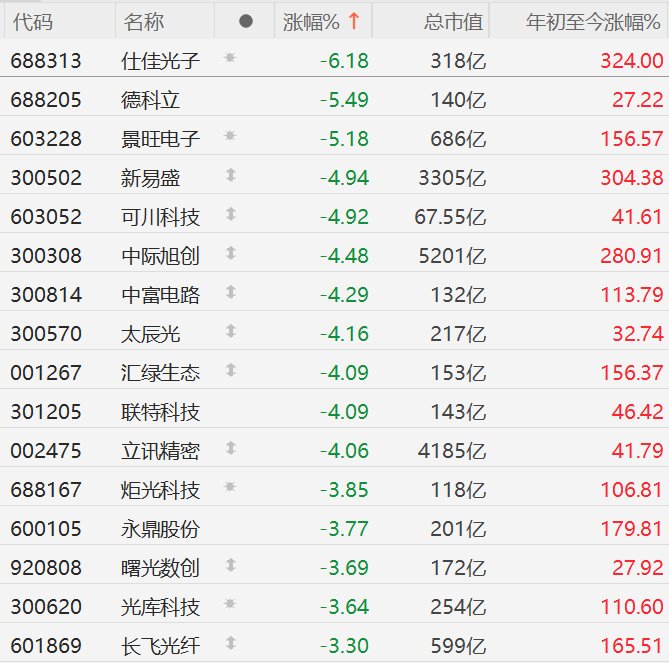
CPO概念股集体下跌,仕佳光子跌超6%
Mei Ri Jing Ji Xin Wen· 2025-11-10 02:32
Group 1 - CPO concept stocks experienced a collective decline on November 10, with significant drops observed across various companies [1] - Shijia Photon fell over 6%, while Dekeli and Jingwang Electronics dropped more than 5% [1] - New Yisheng, Kechuan Technology, Zhongji Xuchuang, Zhongfu Circuit, Taicheng Light, Huilv Ecology, and Liante Technology all saw declines exceeding 4% [1]


A股CPO概念股集体下跌,新易盛跌超4%
Ge Long Hui A P P· 2025-11-10 02:29
Group 1 - The CPO concept stocks in the A-share market experienced a collective decline, with notable drops in several companies [1] - Shijia Photon fell over 6%, while Dekeli and Jingwang Electronics dropped over 5% [1] - Other companies such as Xinyi Sheng, Kecuan Technology, Zhongji Xuchuang, and others also saw declines exceeding 4% [1] Group 2 - Specific stock performance includes: - Shijia Photon (688313) down 6.18% with a market cap of 31.8 billion and a year-to-date increase of 324% [2] - Dekeli (688205) down 5.49% with a market cap of 14 billion and a year-to-date increase of 27.22% [2] - Jingwang Electronics (603228) down 5.18% with a market cap of 68.6 billion and a year-to-date increase of 156.57% [2] - Xinyi Sheng (300502) down 4.94% with a market cap of 330.5 billion and a year-to-date increase of 304.38% [2] - Kecuan Technology (603052) down 4.92% with a market cap of 6.755 billion and a year-to-date increase of 41.61% [2] - Zhongji Xuchuang (300308) down 4.48% with a market cap of 520.1 billion and a year-to-date increase of 280.91% [2]