EOPTOLINK(300502)

Search documents
新易盛股价跌5.08%,达诚基金旗下1只基金重仓,持有6720股浮亏损失11.93万元
Xin Lang Cai Jing· 2025-11-10 02:23
Core Insights - New Yisheng experienced a decline of 5.08% on November 10, with a stock price of 332.03 CNY per share and a total market capitalization of 3300.29 billion CNY [1] Company Overview - Chengdu New Yisheng Communication Technology Co., Ltd. was established on April 15, 2008, and went public on March 3, 2016. The company specializes in the research, development, production, and sales of optical modules [1] - The revenue composition of the company's main business includes 98.86% from above 25G, 0.87% from below 25G, and 0.26% from other sources, with no revenue from PON [1] Fund Holdings - Dachen Fund has one fund heavily invested in New Yisheng, specifically the Dachen Value Pioneer Flexible Allocation A (011030), which reduced its holdings by 6,100 shares in the third quarter, now holding 6,720 shares, representing 7.23% of the fund's net value [2] - The fund has incurred an estimated floating loss of approximately 119,300 CNY today [2] Fund Performance - Dachen Value Pioneer Flexible Allocation A (011030) was established on May 19, 2021, with a current scale of 17.3476 million CNY. Year-to-date, it has achieved a return of 34.5%, ranking 2469 out of 8219 in its category, and a one-year return of 31.59%, ranking 2010 out of 8125 [2] - Since its inception, the fund has experienced a loss of 16.14% [2] Fund Management - The fund is managed by Wu Haoyang and Chen Ran. Wu has been in the position for 1 year and 61 days, with a total asset scale of 165 million CNY, achieving a best return of 43.06% and a worst return of 14.94% during his tenure [3] - Chen has been managing the fund for 323 days, with a total asset scale of 335 million CNY, achieving a best return of 41.61% and a worst return of 3.37% during his tenure [3]

【20+演讲探索】高速光互连、OCS、光模块热管理、空心光纤、光接口等技术
傅里叶的猫· 2025-11-09 11:57
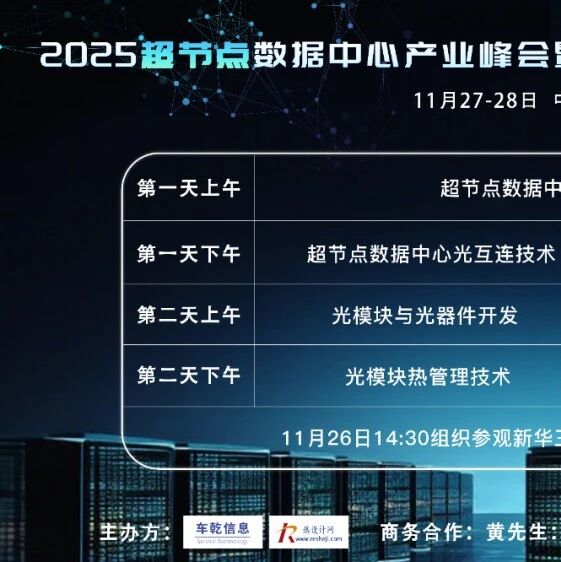
Core Insights - The "2025 Super Node Data Center Industry Summit and High-Density Data Center Developer Forum" will be held from November 26-28 in Hangzhou, Zhejiang, focusing on topics such as super node data center architecture design, interconnection technology, optical module packaging trends, liquid cooling technology, and high thermal conductivity materials [2] - The forum is expected to attract over 500 industry experts and 40+ speakers from major companies including Nvidia, Huawei, Alibaba Cloud, and China Mobile [2] Group 1: Forum Overview - The event will feature one main conference and two specialized sessions for in-depth discussions [2] - Key topics include innovations in AI chip interconnection protocols and the evolution of super node optical interconnection [3][4] Group 2: Technical Presentations - Presentations will cover high-speed optical interconnection systems for AI clusters and the opportunities and challenges of hollow-core optical fibers in data centers [4][5] - Discussions will also focus on thermal management materials for optical modules and the application of graphene in thermal management [4][5] Group 3: Schedule Highlights - The first day will include keynotes on super node data centers and liquid cooling acceleration plans by Intel [9][10] - The second day will address optical module development and thermal management technologies [11][12] Group 4: Participation and Sponsorship - Various participation formats are available, including theme reports and sponsorship opportunities [16][19] - Registration for the event is priced at 2500 per participant [16]




深市多行业新动能引领高质量发展 2025年前三季度业绩亮眼
Zheng Quan Ri Bao Wang· 2025-11-09 11:44
Core Viewpoint - The Shenzhen Stock Exchange (SZSE) listed companies reported significant growth in revenue and net profit in the first three quarters of 2025, indicating a robust performance and high-quality development in China's capital market, contributing positively to macroeconomic stability [1] Group 1: Power Equipment Industry - The power equipment sector achieved a total revenue of 1.32 trillion yuan, a year-on-year increase of 10%, and a net profit of 946.09 billion yuan, up 29.53% [2] - Companies in this sector are heavily investing in research and development, with a focus on technological innovation to drive growth [2][3] - For instance, Siyi Electric achieved a revenue of 13.83 billion yuan, growing by 32.86%, and a net profit of 2.19 billion yuan, increasing by 46.94% [2] Group 2: Communication Industry - The communication sector reported a total revenue of 292.38 billion yuan, a year-on-year increase of 14.34%, and a net profit of 30.81 billion yuan, up 36.65% [4] - Companies like NewEase achieved a revenue of 16.51 billion yuan, growing by 221.70%, and a net profit of 6.32 billion yuan, increasing by 284.37% [4][5] - The growth is attributed to breakthroughs in core technologies that help overcome industry barriers [5] Group 3: New Energy Sector - The new energy sector generated a total revenue of 1.06 trillion yuan, a year-on-year increase of 10.56% [6] - The net profit growth in sub-sectors includes battery (30.60%), photovoltaic equipment (16.89%), and wind power equipment (82.56%) [7] - CATL reported a revenue of 283.07 billion yuan, growing by 9.28%, and a net profit of 49.03 billion yuan, increasing by 36.20% [7][8] Group 4: Consumer Sector - The consumer sector, particularly the home appliance industry, saw a revenue increase of 5.17% and a net profit growth of 9.14% in the first three quarters [9] - Midea Group achieved a total revenue of 364.72 billion yuan, growing by 13.85%, and a net profit of 37.88 billion yuan, increasing by 19.51% [9][10] - Companies are focusing on technological innovation and brand enhancement to capture market opportunities [9]



硅光:开启光子新纪元
GOLDEN SUN SECURITIES· 2025-11-09 06:53
Investment Rating - The report maintains an "Overweight" rating for the silicon photonics sector, highlighting the potential for significant growth in this technology [7]. Core Insights - Silicon photonics technology is not merely an upgrade in manufacturing processes but represents a comprehensive transformation of the optical module industry, affecting manufacturing methods, cost structures, performance, and overall industry value logic [22][23]. - The demand for AI computing continues to rise, leading to a generational leap in optical module rates towards 1.6T, which further emphasizes the importance of silicon photonics [22]. Summary by Sections Investment Focus - The investment focus is shifting from backend packaging to frontend chip design and wafer manufacturing, with four key areas of interest: fabless silicon chip design companies, silicon modulation chip manufacturers, supporting chips/devices, and semiconductor equipment for silicon photonics [23][24][25]. Market Dynamics - The shortage of EML chips, which rely heavily on III-V compound semiconductor materials, creates a development window for silicon photonics as a mainstream alternative [26]. - Silicon photonics technology is expected to capture a growing market share, projected to rise from 30% in 2025 to 60% by 2030 [22][26]. Performance and Cost Advantages - Silicon photonics offers significant advantages in terms of cost, performance, and production capacity, with a critical point reached where it establishes superiority over traditional solutions [27]. - The technology allows for the integration of multiple optical components on a single chip, leading to reduced transmission losses and higher bandwidth density [27][9]. Industry Outlook - The overall market for optical modules remains robust, with leading companies like Coherent and Lumentum reporting better-than-expected financial results, driven by increased demand from AI data centers [28]. - The report recommends continued investment in the computing sector, particularly in leading optical module companies and related components, as they are well-positioned to benefit from the ongoing expansion of AI computing infrastructure [28][11].


光模块龙头盈利超预期呈现AI强劲需求,人工智能AIETF(515070)盘中震荡攀升
Mei Ri Jing Ji Xin Wen· 2025-11-07 05:33
Group 1 - A-shares opened lower but turned positive, with sectors like power grid equipment, photovoltaic equipment, and batteries leading the gains [1] - The AI ETF (515070) saw its intraday decline narrow to 0.89%, with holdings such as Amlogic, Xichuang Data, and others rebounding [1] - Coherent, a leader in optical modules, reported Q1 revenue of $1.58 billion, a 17% year-over-year increase, exceeding market expectations [1] - Coherent's non-GAAP EPS was $1.16, surpassing the expected $1.05, marking four consecutive quarters of better-than-expected earnings [1] - The growth in Coherent's performance is driven by strong demand in AI data centers and communications, with CPO and LPO technologies becoming key for next-gen data center architectures [1] Group 2 - Galaxy Securities noted that the evolution of AI data center architecture is driving demand for high-end optical modules, indicating strong long-term growth potential in the industry [1] - The shift towards high-speed, low-power AI data center architectures is pushing the optical module industry to upgrade from 800G to 1.6T and above [1] - The maturity of new technology paths like CPO and LPO is expected to enhance industry barriers, allowing leading companies to capture larger market shares [1] Group 3 - The AI ETF (515070) tracks the CS AI Theme Index (930713), selecting stocks that provide technology, basic resources, and applications for AI [2] - The top ten weighted stocks in the ETF include leading domestic tech companies such as Zhongji Xuchuang, New Yisheng, and others [2] - Related products include the AI ETF (515070), the ChiNext AI ETF (159381), and the Sci-Tech AI ETF (589010) [2]


光模块(CPO)指数盘中走弱,东山精密领跌
Mei Ri Jing Ji Xin Wen· 2025-11-07 02:03
Group 1 - The optical module (CPO) index experienced a decline of 2% during intraday trading on November 7 [1] - Most constituent stocks of the index fell, with Dongshan Precision leading the decline at 4.23% [1] - Other notable declines included Yuanjie Technology at 3.39%, Liante Technology at 3.37%, Shijia Photon at 2.70%, and Xinyi Sheng at 2.60% [1]



新易盛-风险收益更新
2025-11-07 01:28
Summary of Eoptolink Technology Inc Ltd Conference Call Company Overview - **Company**: Eoptolink Technology Inc Ltd (300502.SZ) - **Industry**: Greater China Technology Hardware - **Current Stock Price**: Rmb346.76 (as of November 3, 2025) - **Price Target**: Rmb255.00 - **Stock Rating**: Underweight Key Financial Metrics - **Earnings Growth**: - 2Q25: 338% YoY - 3Q25: 205% YoY - **Earnings Estimates**: - 2025: EPS lowered by 3.5% to Rmb9.72 - 2026: EPS estimate remains at Rmb18.77 - 2027: EPS estimate remains at Rmb25.43 - **Revenue Estimates**: - 2025: Rmb27,165.7 million (Morgan Stanley estimate) - 2025 Net Income: Rmb10,352.5 million Core Insights - **Earnings Deceleration**: The significant drop in earnings growth from 338% in 2Q25 to 205% in 3Q25 indicates a trend of deceleration that is expected to continue into future quarters [3][13][18] - **Market Position**: Eoptolink has gained significant market share and achieved substantial earnings growth in 2Q25, but the growth rate is anticipated to slow down, potentially leading to a de-rating of the stock [13][18] - **Valuation Concerns**: The stock is currently trading at a forward P/E of 20x, which is above the +1 standard deviation level, suggesting limited upside potential given the current consensus already positions Eoptolink as a leading player in the market [14] Investment Drivers - **AI Demand Surge**: Anticipated increased demand for AI technologies is expected to significantly alter the demand landscape in 2025-26 [13] - **Transceiver Demand**: Stronger demand for 800G and 1.6T transceivers is projected to be a key catalyst for Eoptolink's growth in 2025 [17][18] - **Global Revenue Exposure**: The company has a diverse revenue exposure with significant contributions from North America and Mainland China [22][23] Risks to Price Target / Rating - **Competition**: Intense competition from silicon photonics players could impact market share, margins, and average selling prices (ASPs) [20] - **Order Demand**: Weaker-than-expected demand for 800G and 1.6T products could further pressure the company's performance [25] - **Geopolitical Tensions**: Slower-than-expected share gains in the datacom market due to geopolitical issues could pose additional risks [25] Additional Insights - **Historical Performance**: The stock has shown significant volatility, with a 52-week range of Rmb433.33 to Rmb46.89, indicating potential for both gains and losses [5] - **Long-term Growth Rate**: A long-term growth rate of 3.5% is applied in the valuation model, reflecting a conservative outlook [9] This summary encapsulates the key points from the conference call regarding Eoptolink Technology Inc Ltd, highlighting the company's financial performance, market position, investment drivers, and associated risks.
沪指重返4000点 算力硬件板块反弹
Shang Hai Zheng Quan Bao· 2025-11-06 18:46
Market Overview - A-shares experienced a rally with the Shanghai Composite Index surpassing 4000 points, closing at 4007.76, up 0.97% [2] - The Shenzhen Component Index rose 1.73% to 13452.42, while the ChiNext Index increased by 1.84% to 3224.62 [2] - Total trading volume in the Shanghai and Shenzhen markets reached 20,759 billion, an increase of 1,816 billion from the previous trading day [2] Sector Performance - The computing hardware sector led the gains, with stocks like Dongshan Precision and Huigreen Ecology hitting the daily limit, and Cambrian Technologies rising over 9% [3] - The power equipment sector continued its strong performance, with companies like Huasheng Lithium and Moen Electric also hitting the daily limit [5] Computing Hardware Sector - The computing hardware stocks saw a resurgence, particularly in storage chips and optical modules [3] - Longguang Huaxin achieved a 20% limit-up, while Demingli, Dongshan Precision, and Huigreen Ecology also reached the limit [3] - SK Hynix announced successful negotiations with NVIDIA for the supply of the next-generation high-bandwidth memory (HBM4), with prices expected to be over 50% higher than the previous generation [3] - A report from Datong Securities highlighted explosive growth in data storage demand driven by the rapid evolution and widespread application of AI technology, predicting continued price increases in storage through Q4 2025 [3] Power Equipment Sector - The power equipment sector showed strong momentum, with significant gains in areas such as electricity, ultra-high voltage, and flexible direct current transmission [5] - InfoLink reported an 85.7% year-on-year increase in global energy storage system shipments expected in the first half of 2025 [5] - The International Energy Agency forecasts that by 2030, global data center electricity demand will approach 1 trillion megawatt-hours, with AI-related consumption accounting for nearly half of new electricity demand in the U.S. [5] Market Outlook - The market is expected to remain active, focusing on investments related to the "14th Five-Year Plan" [6] - With the completion of Q3 reports, the market will shift its focus to next year's earnings expectations and industry trends, leading to a more thematic trading phase [6] - Long-term structural volatility is anticipated, with recommendations to consider low-volatility assets as a basic allocation while monitoring potential adjustments in the technology sector for better cost-effectiveness [6][7]



创业板公司2025年三季度业绩出炉!超七成公司实现盈利
Zheng Quan Ri Bao Wang· 2025-11-06 11:07
Core Insights - The overall performance of companies listed on the ChiNext board shows significant growth in both revenue and net profit, with the electronic communication industry experiencing rapid growth and traditional industries recovering profitability [1][2]. Group 1: Financial Performance - As of October 31, 2025, 1,388 ChiNext companies reported a total revenue of 3.25 trillion yuan, an increase of 10.69% year-on-year, and a net profit of 244.66 billion yuan, up 18.69% year-on-year [2]. - In Q3 2025, ChiNext companies achieved a total revenue of 1.18 trillion yuan, reflecting a quarter-on-quarter growth of 7.13%, and a net profit of 93.26 billion yuan, with a quarter-on-quarter increase of 18.32% [2]. - Over 70% of the companies reported profits, and more than 50% experienced profit growth, indicating a robust financial performance across the board [2]. Group 2: Sector Performance - The ChiNext board outperformed other domestic market sectors in terms of revenue and profit growth during the first three quarters of 2025 [3]. - Large-cap companies on the ChiNext board showed significant revenue and profit growth, with the top 100 companies generating 1.54 trillion yuan in revenue, a 17.72% increase, and 170.84 billion yuan in net profit, a 26.78% increase [4]. - The electronic and communication sectors saw substantial growth, with the electronic industry reporting a 21.65% year-on-year revenue increase and a 36.29% net profit increase [7][8]. Group 3: Investment and R&D - Long-term asset investment by ChiNext companies reached 273.77 billion yuan, a 9.46% increase year-on-year, indicating strong investment intentions [5]. - R&D expenditures totaled 147.35 billion yuan, reflecting a 6.20% year-on-year increase, with many companies significantly increasing their R&D intensity [6]. Group 4: Industry Recovery - Various industries, including power equipment, machinery, and traditional sectors, have shown signs of recovery, with the power equipment sector experiencing a 12.90% revenue increase and a 28.61% net profit increase [7][9]. - The construction materials industry saw a remarkable 719.94% increase in net profit, driven by demand from major infrastructure projects [9].